Ethanol Blending vs Sugar Prices: India's Food-Fuel Policy Trilemma
As duty-free sugar imports return after nine years, India navigates the delicate trade-off between E20 ethanol targets, mill liquidity, and food price inflation.
Sep, 2026
•8 min read
Overview
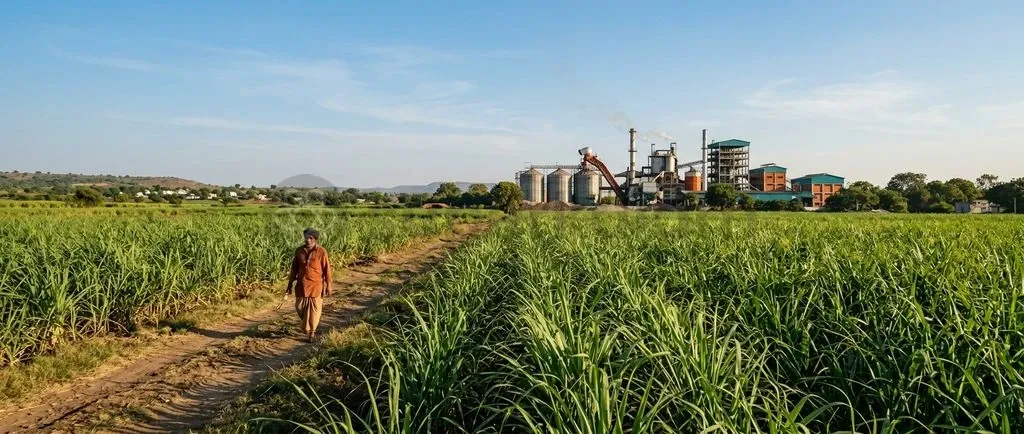
India's retail sugar price pressures in 2026 stem primarily from climate-induced cane output contractions in key peninsular states and tightening carryover stocks. They do not originate from the Ethanol Blended Petrol Programme, which has decoupled fuel targets from sugar by shifting two-thirds of distillery demand to grain-based feedstocks.
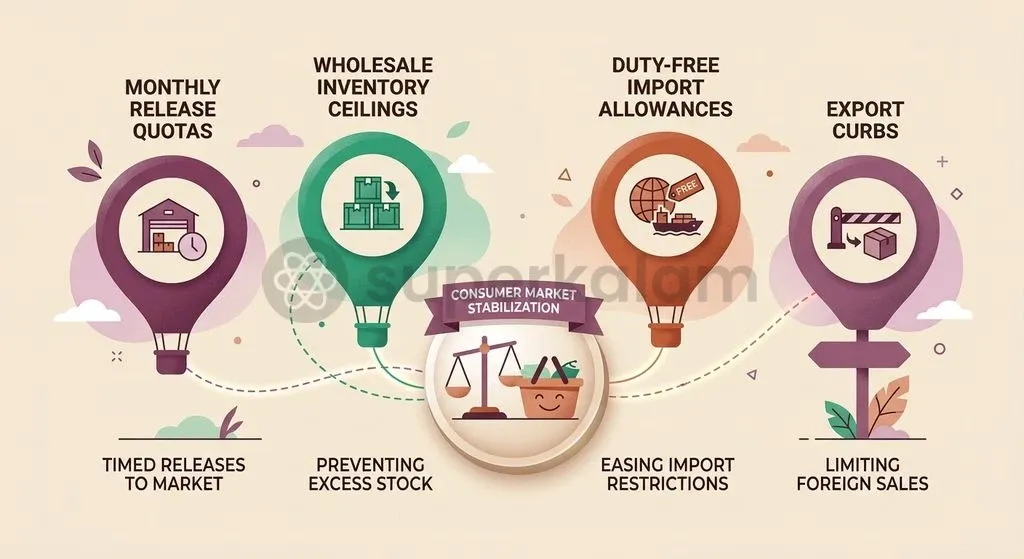
As of August 2026, the central government has deployed targeted market interventions—including zero-duty raw sugar import quotas and strict wholesale stockholding limits—to stabilise domestic consumer inflation ahead of peak festive demand. Meanwhile, dynamic administrative controls under the Sugar (Control) Order continue to calibrate diversion limits, ensuring essential food security while preserving liquidity for rural sugarcane growers.
Why in the News: The August 2026 Sugar Measures and Inflation Fears
The central government deployed three coordinated interventions in August 2026 to contain retail prices and secure festive supplies:
- Zero-Duty Import Allowance: The Directorate General of Foreign Trade authorised a duty-free import quota of 10 lakh metric tonnes of raw sugar under tariff code 1701 in August 2026. This intervention marks India's first zero-duty sugar import allowance since the 2016–17 season, designed to curb potential price spikes in the domestic market ahead of peak festive consumption.
- Wholesale Stock Limits: The Department of Food and Public Distribution imposed strict stockholding limits on wholesale sugar dealers, capping inventories at 400 metric tonnes through November 30, 2026, under the Essential Commodities Act, 1955.
- Export Controls: Commercial sugar exports have remained under the 'Restricted' regulatory category since June 2022 to insulate domestic consumer price index baskets against agro-climatic deficits.
Discuss with Superkalam
Which sugarcane processing route diverts secondary molasses while causing a 1.5 to 2.0 percentage point reduction in sugar recovery?
Ask NowHow Does India's Sugar-to-Ethanol Diversion Work?
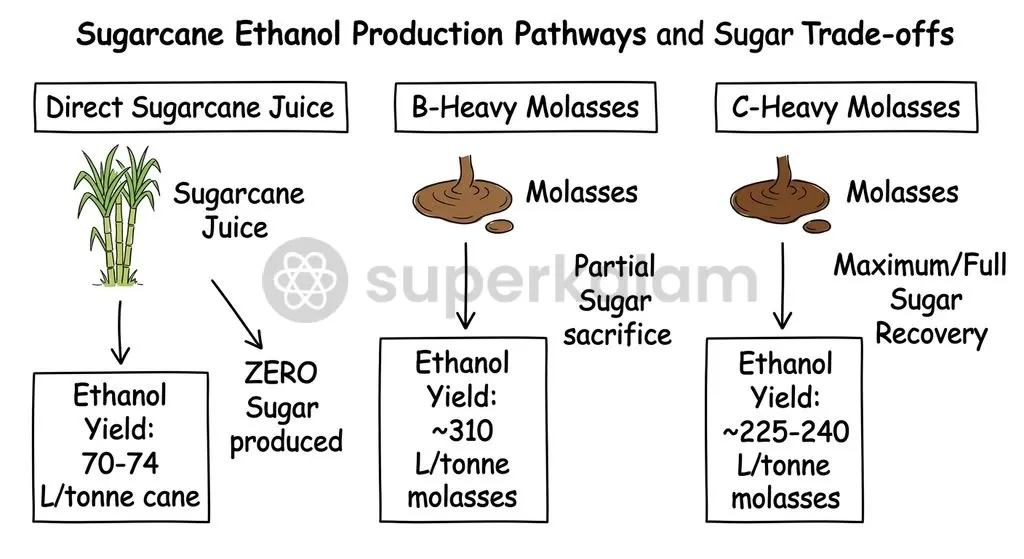
The National Sugar Institute classifies sugarcane-based ethanol production into three primary pathways depending on the stage of processing and sugar extraction. The processing route chosen by distilleries directly determines how much crystal white sugar is sacrificed to produce biofuel.
- 100% Cane Juice / Syrup Diversion: Direct conversion routes all fermentable sugars straight into bioethanol, yielding approximately 70–74 litres per tonne of cane while producing zero crystal white sugar.
- B-Heavy Molasses Route: Intermediate diversion extracts first-stage sugar crystals but diverts secondary molasses, reducing sugar recovery rates by 1.5 to 2.0 percentage points while yielding about 310 litres of ethanol per tonne of molasses.
- C-Heavy Molasses Route: The conventional route processes the final, exhausted by-product after three successive crystallisation stages, yielding 225–240 litres of ethanol per tonne with zero sacrifice of crystal white sugar.
| Feedstock Pathway | Impact on White Sugar Output | Average Ethanol Yield | Strategic Regulatory Role |
|---|---|---|---|
| Direct Sugarcane Juice / Syrup | 100% sacrifice (no crystal sugar produced) | 70–74 litres per tonne cane | First pathway curtailed during domestic supply shocks |
| B-Heavy Molasses | Partial sacrifice (reduces recovery by 1.5–2.0%) | ~310 litres per tonne molasses | Main flexible lever for balancing mill cashflow |
| C-Heavy Molasses | 0% sacrifice (fully exhausted by-product) | 225–240 litres per tonne molasses | Baseline continuous feedstock for non-food distillation |
Discuss with Superkalam
How does prompt procurement payments from Oil Marketing Companies for ethanol help resolve the historical challenge of cane price arrears for farmers?
Ask NowIs Ethanol Truly Behind Rising Sugar Prices? What the Data Shows
Official data from the Ministry of Consumer Affairs, Food & Public Distribution indicates that domestic sugar diversion to ethanol fell from approximately 12% in 2022–23 to around 9% during the 2025–26 season. This downward trend demonstrates that ethanol blending is not absorbing an expanding share of domestic sugarcane.
| Feedstock Category | Share of Total Volume | Absolute Volume |
|---|---|---|
| Grain-Based Feedstocks | 68% | 551.43 crore litres |
| Sugarcane-Based Feedstocks | 32% | 259.24 crore litres |
| Total Ethanol Supplied to OMCs (Nov 2025 – Jul 2026) | 100% | 810.67 crore litres |
Furthermore, the Ethanol Blended Petrol Programme has significantly shifted towards grain-based feedstocks to insulate food markets. Out of 810.67 crore litres of ethanol supplied to Oil Marketing Companies between November 2025 and July 2026, grain feedstocks contributed 68% of total volume, whereas sugarcane sources accounted for only 32%. The administrative mechanism has deliberately buffered crystal sugar supplies from energy sector demand.
Beyond Biofuels: Climate Shocks, Cane Cycles, and Export Controls
Domestic sugar balance sheets face pressure from cyclical climate headwinds rather than industrial biofuel diversion:
- Production Contraction: Gross Indian sugarcane production before ethanol diversion for the 2025–26 season contracted to an estimated 296–306 lakh metric tonnes due to uneven monsoon distribution and pest infestations across Maharashtra and Karnataka, down from initial projections of 343 lakh tonnes, according to output assessments by the Department of Food and Public Distribution (as reported by Press Trust of India on 21 August 2026).
- Buffer Stock Depletion: Opening sugar buffer stocks for the season commencing October 1, 2026, are projected at 32–42 lakh metric tonnes, tightening domestic balance sheets compared to the 47 lakh metric tonnes recorded in October 2025, per trade balance sheets from the Directorate of Sugar & Vegetable Oils (as reported on 21 August 2026).
- Statutory Cane Pricing: Sugarcane pricing itself is governed by a dual statutory framework: the central Fair and Remunerative Price (FRP) under the Sugarcane (Control) Order, 1966, alongside State Advised Prices (SAP) enforced by states such as Uttar Pradesh and Punjab.
Discuss with Superkalam
Weigh the trade-offs between implementing administrative export bans versus allowing market-driven flex-fuel adjustments during domestic supply deficits.
Ask NowThe Policy Trilemma: Balancing Food Prices, Green Fuel, and Farm Income
The Cabinet Committee on Economic Affairs approved the sugarcane Fair and Remunerative Price at ₹365 per quintal for the 2026–27 season at a basic recovery rate of 10.25%. This benchmark provides a 100.5% return over production costs (A2+FL of ₹182 per quintal), anchoring rural farm incomes across major agrarian belts.
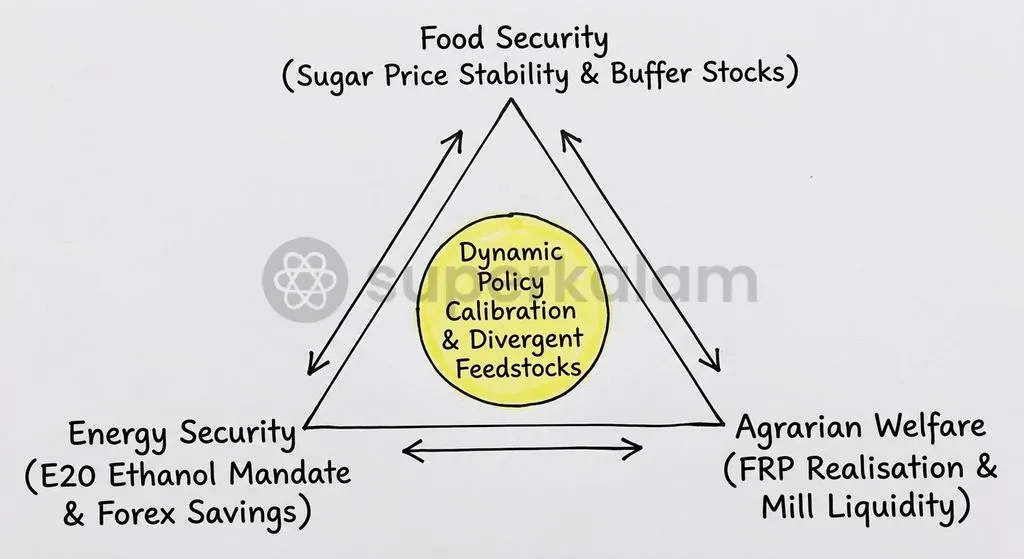
Managing this structural balance involves three competing operational priorities:
- Sustaining Cane Grower Liquidity: Prompt payments from Oil Marketing Companies for ethanol have transformed mill liquidity, enabling the clearance of 99.5% of cane arrears for the 2024–25 sugar season as of April 2026.
- Achieving Decarbonisation Targets: The Ethanol Blended Petrol Programme achieved the national E20 target during 2025–26—five years ahead of the timeline originally set under the National Policy on Biofuels 2018. Between 2014–15 and May 2026, the programme generated over ₹1.90 lakh crore in foreign exchange savings, substituted 310 lakh metric tonnes of imported crude, and avoided 930 lakh metric tonnes of carbon emissions. Total domestic distillation capacity reached 2,000 crore litres in 2026, up from 421 crore litres in 2014.
- Calibrating Domestic Food Protection: When balance sheets tighten, the government intervenes decisively. During 2023–24, it capped sugar diversion at 17 lakh tonnes and prohibited direct juice diversion for industrial spirits to protect domestic food availability.
Discuss with Superkalam
Propose a rule-based regulatory framework that could automatically adjust ethanol diversion limits based on carryover sugar stock thresholds.
Ask NowGlobal Perspectives: What India Can Learn from Brazil's Flex-Fuel Model
Brazil manages its biofuel ecosystem through an industrial flex-mill architecture that dynamically toggles daily cane processing between sugar and hydrous ethanol. Brazilian processing mills alter production splits between 45% and 55% sugar versus ethanol in response to real-time international commodity pricing and domestic pump parity.
| Dimension | Brazil's Market-Driven Model | India's Administered Policy Framework |
|---|---|---|
| Operational Mechanism | Market-linked daily flex between sugar and hydrous ethanol | Administered feedstock allocations and mill-wise monthly quotas |
| Pricing Structure | Free-market pump pricing and international arbitrage | Government-determined FRP/SAP and fixed OMC procurement tariffs |
| Vehicle Fleet Integration | High penetration of 100% hydrous ethanol Flex-Fuel Vehicles (FFVs) | Standardised nationwide blending mandate in commercial petrol |
| Supply Stabilization | Rapid automated swing capacity absorbing global price shocks | Administrative export bans, stock limits, and import tariff waivers |
Way Forward: Creating a Responsive, Shock-Proof Sugar and Ethanol Policy
The Ministry of Petroleum and Natural Gas must continue decoupling national blending targets from annual sugarcane production volatility. Broadening the feedstock basket through grain and second-generation agricultural residues ensures energy security goals do not compromise food price stability.
- Predictable Rule-Based Trigger Mechanisms: Establish objective balance-sheet thresholds under the Sugar (Control) Order to automatically adjust juice diversion caps whenever projected carryover stocks drop below three months of domestic consumption.
- Expanding Multi-Feedstock Distillation Infrastructure: Support grain-based distilleries with dual-feed technology to process damaged food grains and surplus maize without relying on table-grade cereals.
- Modernising Strategic Buffer Stocking: Deploy market-neutral buffer stock purchases through central agencies when crushing peaks to prevent mill distress, releasing stocks counter-cyclically during pre-festival demand surges.
- Accelerating Dedicated Flex-Fuel Engines: Incentivise the adoption of Flex-Fuel Vehicles capable of running on higher biofuel blends, mirroring international benchmarks to absorb cyclical agrarian surpluses.
Key Takeaways
- Import and Inventory Interventions: The Directorate General of Foreign Trade opened a zero-duty import quota of 10 lakh metric tonnes of raw sugar in August 2026, alongside wholesale stockholding limits of 400 metric tonnes to stabilise domestic retail prices.
- Declining Sugar Share in Ethanol: Sugarcane diversion to ethanol dropped to approximately 9% in 2025–26, with grain-based feedstocks providing 68% of total OMC ethanol supplies between November 2025 and July 2026.
- Agricultural Drivers of Inflation: Domestic supply tightness in 2026 stems primarily from weather-related yield contractions in Maharashtra and Karnataka, where gross output fell to an estimated 296–306 lakh metric tonnes [LIKELY — per DFPD Output Assessment (as reported on 21 August 2026)].
- Liquidity and Energy Milestones: The Ethanol Blended Petrol Programme cleared 99.5% of sugarcane dues for the 2024–25 season as of April 2026, while achieving the E20 blending mandate five years ahead of the 2030 target.
Mains Question
"India's Ethanol Blended Petrol Programme has achieved notable decarbonisation and foreign exchange savings, yet it faces the complex challenge of balancing rural farm incomes with domestic food price stability." In light of this statement, critically analyse the food-fuel-remuneration trilemma facing India's sugar and ethanol policy. (15 Marks)
Evaluate NowMains Question
Compare the administered sugar and biofuel regulatory framework in India with the market-driven flex-fuel architecture of Brazil. Elucidate how structural flexibility can buffer domestic markets from agro-climatic shocks. (10 Marks)
Evaluate NowPractice MCQs
QUESTION 1
With reference to sugarcane-based ethanol production pathways in India, consider the following statements:
- Direct diversion of 100% sugarcane juice yields zero crystal white sugar.
- The B-Heavy molasses route reduces sugar recovery rates by 1.5 to 2.0 percentage points.
- Distillation from C-Heavy molasses requires a 100% sacrifice of crystal white sugar. Which of the statements given above are correct?
QUESTION 2
Consider the following statements regarding the regulatory measures deployed in the Indian sugar sector:
- The Fair and Remunerative Price (FRP) of sugarcane is governed under the Sugarcane (Control) Order, 1966.
- Stockholding limits on wholesale sugar dealers can be imposed under the Essential Commodities Act, 1955.
- Raw sugar imports under tariff code 1701 have historically remained entirely free of customs duties without regulatory quotas. Which of the statements given above is/are correct?
QUESTION 3
With reference to the Ethanol Blended Petrol (EBP) Programme in India, consider the following statements:
- In the supply period between November 2025 and July 2026, grain-based feedstocks contributed a larger volume of ethanol than sugarcane-based feedstocks.
- Total domestic ethanol distillation capacity expanded to over 2,000 crore litres in 2026.
- The national E20 blending target was achieved during 2025–26, ahead of the timeline originally set under the National Policy on Biofuels 2018. Which of the statements given above are correct?
QUESTION 4
Which of the following best describes the structural mechanism of Brazil's flex-fuel sugarcane model compared to India's regulatory framework?
QUESTION 5
Consider the following statements regarding domestic sugar dynamics:
- The share of domestic sugar diverted to ethanol increased continuously between 2022–23 and 2025–26.
- Sugarcane pricing in India involves both central Fair and Remunerative Prices (FRP) and State Advised Prices (SAP) enforced by certain states. Which of the statements given above is/are correct?