EPFO Wage Ceiling Raised to ₹25,000: What It Means for 51 Lakh Workers
The EPFO wage ceiling rises from ₹15,000 to ₹25,000, expanding EPF and EPS coverage to 51 lakh more workers while reshaping take-home pay and employer costs.
Sep, 2026
•9 min read
From 17 September 2026, the EPFO wage ceiling rises from ₹15,000 to ₹25,000 a month. This brings about 51 lakh formal workers earning in that band under compulsory EPF and EPS coverage. They gain higher retirement and pension contributions, though monthly take-home pay may fall and employers' payroll costs may rise.
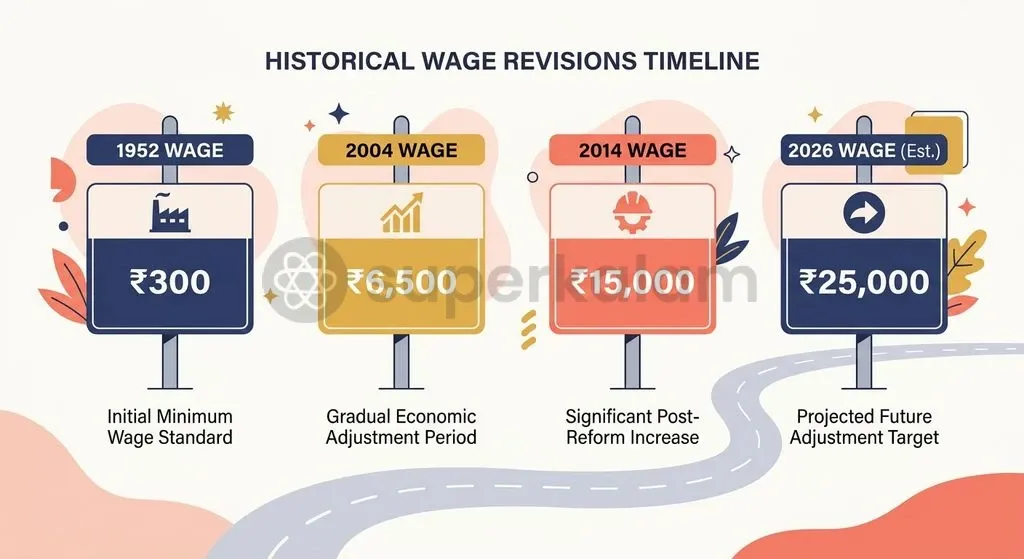
Background: Evolution of the EPFO Wage Threshold
The Employees' Provident Funds and Miscellaneous Provisions Act, 1952 established statutory social security thresholds to protect industrial wage earners from post-retirement destitution. Periodic upward revisions reflect broader economic expansion, cost-of-living adjustments, and currency depreciation.
Historical revisions demonstrate how the statutory boundary has evolved over seven decades:
- 1 November 1952: The statutory wage ceiling was inaugurated at ₹300 per month at the inception of the scheme.
- 2004 to 2014: The threshold remained static at ₹6,500 per month for an entire decade, causing substantial exclusion of formal workers due to wage inflation.
- 1 September 2014: The Central Government enhanced the statutory wage ceiling from ₹6,500 to ₹15,000 per month, accompanied by reforms to minimum pension guarantees.
- 17 September 2026: The threshold was elevated to ₹25,000 per month, restoring parity with actual entry-level wages across organised industrial sectors.
Discuss with Superkalam
Recall the historical statutory wage ceilings under the EPFO from 1952 to 2026.
Ask NowUnderstanding the Three Pillars: EPF, EPS, and EDLI Explained
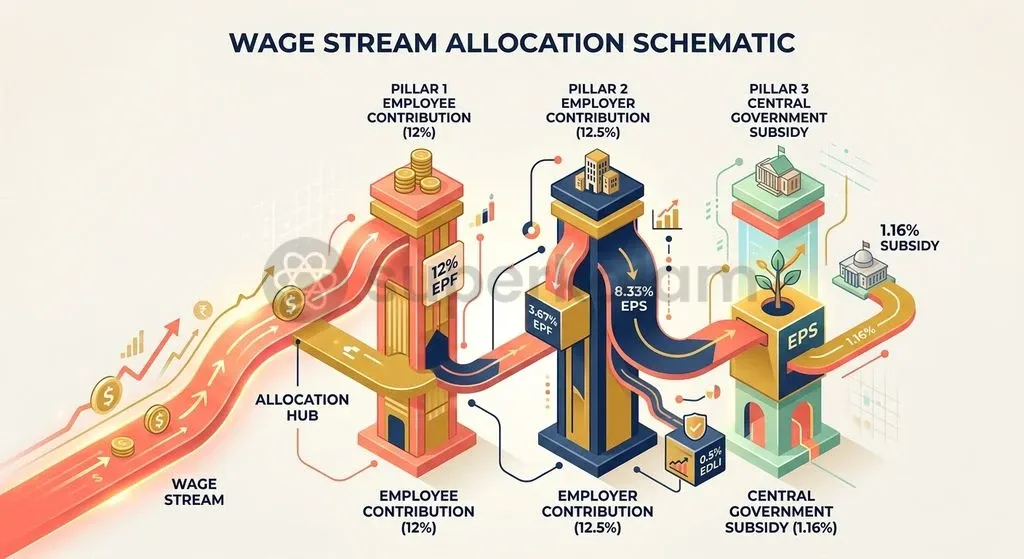
The Employees' Provident Fund Organisation administers three distinct social security programmes under the statutory framework of the 1952 Act. These tripartite mechanisms combine employee deductions, employer contributions, and Central Government budgetary subsidies.
| Scheme Name | Governing Statute | Contribution Ratio | Core Objective |
|---|---|---|---|
| Employees' Provident Fund (EPF) | Employees' Provident Funds Scheme, 1952 | Employee: 12%; Employer: 3.67% | Accumulates a defined-contribution corpus with compound interest for retirement or severance. |
| Employees' Pension Scheme (EPS) | Employees' Pension Scheme, 1995 | Employer: 8.33%; Union Govt: 1.16% | Provides a defined-benefit monthly pension upon superannuation or disability. |
| Employees' Deposit Linked Insurance (EDLI) | EDLI Scheme, 1976 | Employer: 0.50%; Employee: 0% | Delivers statutory life insurance coverage to nominees if a member dies during active service. |
Deductions apply to an employee's basic wage, dearness allowance, and retaining allowance. The employee's entire 12% contribution is credited directly into their personal EPF account.
The employer matches this with a 12% contribution, but the sum is divided between social insurance pillars. Exactly 3.67% flows to EPF, while 8.33% is diverted to EPS up to the statutory wage ceiling, supplemented by a 0.50% allocation for EDLI coverage.
What the Revision from ₹15,000 to ₹25,000 Means in Practice
Raising the EPFO statutory wage threshold expands the mandatory contribution base, directly increasing monthly deposits for formal staff earning between ₹15,000 and ₹25,000. Establishments employing 20 or more individuals must now compulsorily enrol all staff within this pay band.
The operational shift changes statutory monthly flows across two key mechanisms:
- Higher Pension Divergence: Under the previous ₹15,000 cap, the employer's 8.33% allocation to EPS was capped at ₹1,250 per month. Under the ₹25,000 ceiling, this statutory diversion reaches ₹2,080 per month.
- Higher Provident Fund Additions: The remaining balance of the employer's statutory 12% liability stays within the employee's interest-bearing provident fund account.
Consequently, an employee earning ₹25,000 receives larger absolute additions to both retirement savings and pension entitlements each month.
Discuss with Superkalam
Explain the structural difference between the defined-contribution mechanism of EPF and the defined-benefit mechanism of EPS.
Ask NowBenefits for Workers: Enhanced Retirement Corpus and Life Cover
Employees covered under the enhanced ₹25,000 EPFO ceiling accumulate substantially higher terminal retirement savings and qualify for enhanced monthly defined pensions. The adjustment protects purchasing power against secular inflation.
Under Paragraph 12 of the Employees' Pension Scheme, 1995, monthly superannuation pension is calculated using a defined-benefit formula:
$$\text{Monthly Pension} = \frac{\text{Pensionable Salary} \times \text{Pensionable Service}}{70}$$
Key worker benefits arising from this statutory revision include:
- Enhanced Pension Calculation: Because the statutory ceiling caps baseline pensionable salary, raising the cap from ₹15,000 to ₹25,000 lifts the statutory ceiling on prospective monthly pension calculations.
- Judicial Clarity on Higher Pension: In EPFO v. Sunil Kumar (2022 INSC 1164), the Supreme Court upheld the 2014 amendment capping statutory pensionable salary while permitting eligible employees to opt for pension on higher wages, striking down an additional 1.16% employee contribution requirement. The ₹25,000 ceiling provides a higher baseline without requiring complex joint options.
- Expanded Life Insurance Cover: Accompanying EDLI life insurance coverage automatically expands for newly covered employees, giving families of wage earners direct financial protection against breadwinner mortality during active employment.
The Trade-Offs: Reduced Take-Home Pay and Higher Employer Costs
Mandatory EPFO contributions alter employee cash flows and employer payroll expenses, generating structural frictions between take-home pay and compliance. The policy reform introduces distinct microeconomic trade-offs for both parties.
For workers earning between ₹15,000 and ₹25,000 under a fixed Cost-to-Company (CTC) structure, mandatory deductions cause an immediate reduction in take-home pay. A worker earning ₹25,000 experiences a mandatory monthly employee deduction of ₹3,000 (12%), alongside corresponding employer-side deductions from their overall CTC package, reducing immediate disposable household liquidity.
- Mandatory Employee Deduction: The 12% deduction to EPF lowers immediate net take-home pay.
- Statutory Employer Contribution: The 12% matching contribution across EPF/EPS alongside EDLI increases overall wage overhead.
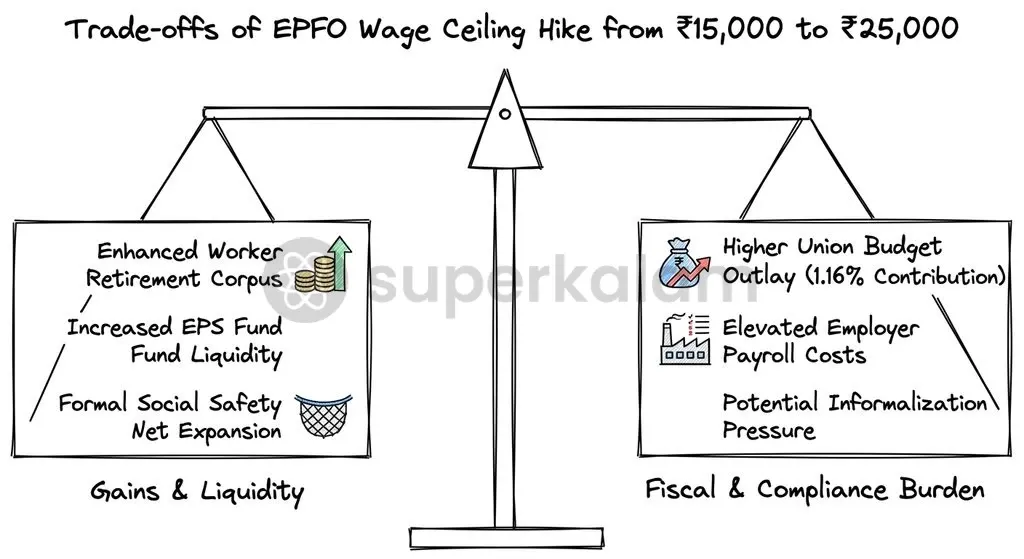
For Micro, Small, and Medium Enterprises (MSMEs) with 20 or more staff, the threshold hike raises statutory compliance costs. Employers must contribute up to ₹3,250 per covered worker monthly across EPF, EPS, EDLI, and administrative charges.
This cost expansion creates a notable informalisation-risk trade-off. To avoid the statutory overhead of crossing the 20-employee threshold, small firms may intentionally suppress visible headcount or misclassify permanent workers as third-party contract labour. Such avoidance strategies risk undermining the very formalisation objectives the wage ceiling increase seeks to advance.
Discuss with Superkalam
Calculate how the take-home pay of an employee with a fixed CTC earning ₹25,000 per month changes following the mandatory 12% EPF deduction.
Ask NowFiscal Implications for the Central Government and Pension Funds
The Central Government provides budgetary support to the Employees' Pension Scheme through a statutory 1.16% wage subsidy up to the notified ceiling. This fiscal commitment expands alongside the wage threshold.
Key fiscal dynamics of the enhancement include:
- Budgetary Outgo: The annual budgetary outgo for this pension subsidy rises to approximately ₹11,339 crore under the ₹25,000 threshold, compared to the prior annual allocation of around ₹10,250 crore.
- Five-Year Union Commitment: The revised ceiling results in a projected five-year fiscal outlay of ₹56,696 crore from the Union Budget.
- Liquidity vs. Actuarial Deficits: Reports by the Comptroller and Auditor General of India lows provide immediate liquidity to meet near-term pension disbursements.
Discuss with Superkalam
Analyse the potential unintended consequences of increased payroll compliance costs on employment practices among MSMEs employing near 20 workers.
Ask NowKey Takeaways
- Cabinet Approval and Threshold: The Union Cabinet enhanced the mandatory EPFO wage ceiling from ₹15,000 to ₹25,000 per month, effective 17 September 2026.
- Expanded Coverage: The revision brings more than 51 lakh additional formal sector workers earning between ₹15,000 and ₹25,000 into compulsory statutory social security.
- Contribution Mechanics: Employees contribute 12% to EPF, while the employer's 12% is split into 3.67% for EPF, 8.33% for EPS (capped at ₹2,080 per month), and 0.5% for EDLI.
- Union Budget Outlay: The Central Government provides a 1.16% wage subsidy to EPS, requiring an estimated annual outgo of ₹11,339 crore and a 5-year outlay of ₹56,696 crore.
- Informalisation Risk: Higher employer compliance expenses (up to ₹3,250 per worker) and lower take-home pay under CTC packages could incentivise micro-enterprises to bypass coverage through contract labour.
- Statutory Alignment: The reform bridges existing EPFO operations with the broader architecture of the Code on Social Security, 2020.
Mains Question
The enhancement of the EPFO wage ceiling from ₹15,000 to ₹25,000 strengthens long-term retirement security, but it simultaneously introduces operational and financial trade-offs for workers and MSMEs. Critically examine. (15 Marks)
Evaluate NowMains Question
'Periodic revisions of statutory wage thresholds under the Employees' Provident Funds and Miscellaneous Provisions Act, 1952 are essential to prevent the exclusion of industrial wage earners from social security nets.' Elucidate. (10 Marks)
Evaluate NowPractice MCQs
QUESTION 1
With reference to the statutory framework governing the Employees' Provident Fund Organisation (EPFO), consider the following statements: 1. The employee's mandatory 12% contribution is credited entirely into the personal Employees' Provident Fund (EPF) account. 2. Under the tripartite contribution structure, the employer's entire 12% contribution is credited to the Employees' Pension Scheme (EPS). 3. The Employees' Deposit Linked Insurance (EDLI) Scheme requires an employer contribution but zero financial contribution from the employee. Which of the statements given above is/are correct?
QUESTION 2
Consider the following statements regarding the evolution of the mandatory wage ceiling under the Employees' Provident Funds and Miscellaneous Provisions Act, 1952: 1. At its inception on 1 November 1952, the statutory wage ceiling was inaugurated at ₹300 per month. 2. The statutory wage ceiling remained unchanged at ₹6,500 per month from 2004 until its enhancement in September 2014. 3. The revision effective September 17, 2026, enhanced the mandatory wage ceiling from ₹15,000 to ₹25,000 per month. Which of the statements given above are correct?
QUESTION 3
With reference to the revision of the EPFO wage ceiling from ₹15,000 to ₹25,000, consider the following statements: 1. The statutory cap on the employer's 8.33% allocation diverted to the Employees' Pension Scheme (EPS) increases from ₹1,250 to ₹2,080 per month. 2. In EPFO v. Sunil Kumar (2022), the Supreme Court struck down the requirement of an additional 1.16% employee contribution for higher pensions. 3. Establishments employing 10 or more workers are compulsorily mandated to enroll employees earning up to ₹25,000. Which of the statements given above is/are correct?
QUESTION 4
Under Paragraph 12 of the Employees' Pension Scheme (EPS), 1995, which of the following formulas is used to calculate the monthly superannuation pension?
QUESTION 5
Which of the following describes the nature of social security benefits provided under the Employees' Provident Fund (EPF) and the Employees' Pension Scheme (EPS) respectively?