Environmental Performance Index: India's Ranking vs Climate Reality
Evaluating the methodological clash between global environmental rankings and India's verified achievements in renewable capacity and emissions reduction.
Aug, 2026
•9 min read

Overview
A sharp divergence separates global environmental ranking methodologies from India's verified climate outcomes. Global metrics often penalise industrialising nations through unvalidated emission projections. In contrast, domestic decarbonisation programmes have met major renewable energy milestones years ahead of international schedules.
In the 2026 Environmental Performance Index published by Yale University and Columbia University, India received a ranking of 176th out of 177 assessed nations. However, the Ministry of Environment, Forest and Climate Change has formally challenged this assessment. The Ministry presented verified milestones, including achieving 50% non-fossil electric power installed capacity and reducing the emissions intensity of Gross Domestic Product by 37.38%.
This gap highlights the need for equitable sustainability metrics. Global assessments must fairly account for per-capita resource consumption, historical emissions responsibility, and local socio-economic realities.
Why Global Environmental Indices Are in the Spotlight
The Environmental Performance Index has sparked widespread debate over how international assessment frameworks evaluate developing economies undergoing rapid industrial transitions. As of August 2026, the contrast between international rankings and domestic decarbonisation data has intensified discussions across multilateral policy platforms.
In the 2026 Environmental Performance Index, India was placed 176th among 177 evaluated countries with an overall score of 22.46, ranking ahead of only Laos, according to the Yale Center for Environmental Law & Policy and Columbia University's Center for International Earth Science Information Network.
The Ministry of Environment, Forest and Climate Change formally rejected the findings, arguing that the methodology applies flawed extrapolation models that ignore actual ground-level progress.
Key reasons why these rankings draw intense institutional scrutiny include:
- Distorted Sovereign Perceptions: Low composite scores influence global credit ratings and multilateral development assessments.
- Impact on Sustainable Capital: Global green funds and ESG investors frequently rely on top-line index scores to screen emerging markets.
- Methodological Omissions: Broad index models fail to capture targeted domestic energy transition trajectories and local socio-economic priorities.
Discuss with Superkalam
Which primary policy objectives and indicator count form the core architecture of the Environmental Performance Index?
Ask NowUnderstanding the Environmental Performance Index: Structure and Metrics
The Environmental Performance Index is a biennial global evaluation produced by researchers at Yale University and Columbia University in collaboration with the World Economic Forum.
The assessment framework measures national environmental sustainability by evaluating 47 distinct performance indicators across 12 issue categories. These categories are grouped under three primary policy objectives:
- Environmental Health: Measures public health protection from environmental hazards such as ambient air quality, unsafe sanitation, and heavy metal exposure.
- Ecosystem Vitality: Assesses natural resource management, including biodiversity conservation, forest cover retention, marine habitats, and agricultural practices.
- Climate Change: Evaluates national greenhouse gas emission trajectories, projected carbon neutrality pathways, and renewable energy adoption rates.
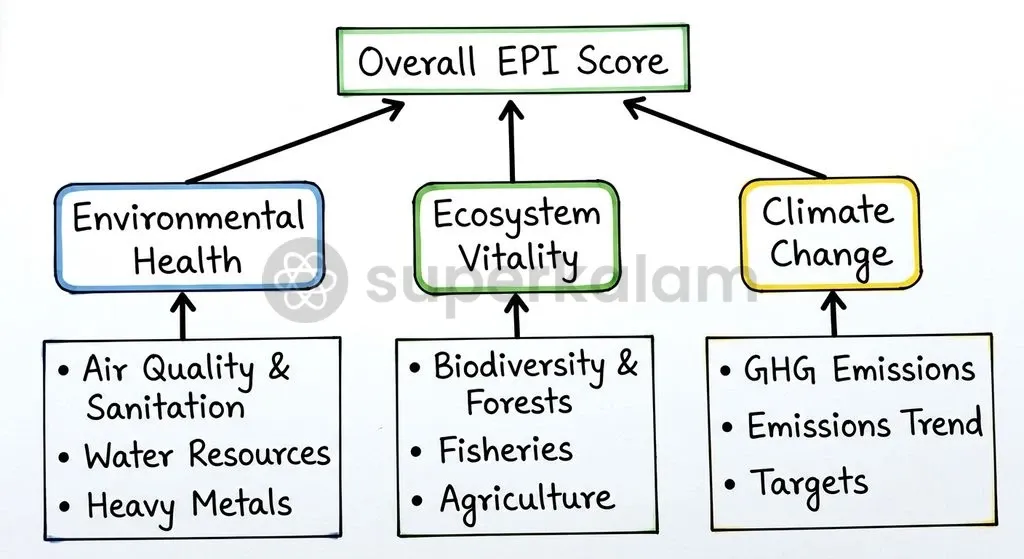
The index standardises raw data into scores ranging from 0 to 100, comparing national outcomes against established international policy targets. However, the aggregation method combines disparate ecological indicators using pre-determined weight distributions, which often obscure local ecological contexts and baseline constraints in developing countries.
India's Ground Progress: Renewable Capacity, NDCs, and Energy Transition
India has recorded measurable progress across domestic decarbonisation indicators, surpassing several key Nationally Determined Contribution targets well ahead of established statutory schedules.
The nation achieved 50% non-fossil capacity in its cumulative electric power installed base in June 2025, fulfilling its updated Paris Agreement pledge five years ahead of the 2030 target.
Progress across other core climate commitments includes:
- Emissions Intensity Reduction: India reduced the emissions intensity of its Gross Domestic Product by 37.38% by 2022 relative to 2005 levels, progressing steadily toward the updated 45% reduction commitment for 2030.
- Carbon Sink Creation: The country added an aggregate 2.44 billion tonnes of carbon dioxide equivalent in carbon sinks between 2005 and 2022 through nationwide afforestation and agroforestry initiatives, closing in on the 2030 target of 2.5 to 3.0 billion tonnes.
- Enhanced 2035 Pledges: The Union Cabinet approved expanded NDC targets for 2035, raising the emissions intensity reduction target to 47%, setting a 60% non-fossil electric capacity target, and increasing the carbon sink target to 3.5 to 4.0 billion tonnes of carbon dioxide equivalent.
- Demand-Side Climate Action: India incorporated the Lifestyle for Environment initiative, known as Mission LiFE, into its formal UNFCCC submissions to promote sustainable consumption patterns worldwide.
Discuss with Superkalam
How does territorial emission accounting create an unfair bias against industrialising manufacturing economies compared to consumption-based metrics?
Ask NowComparing the Two Views: Global Methodology vs Domestic Reality
The Ministry of Environment, Forest and Climate Change identified fundamental methodological contradictions when contrasting global index parameters with ground-level climate actions.
| Evaluation Dimension | Global EPI Framework (Yale / Columbia) | India's Ground Reality & Policy Position |
|---|---|---|
| Emission Baseline Accounting | Evaluates territorial production-based emissions, omitting international trade flows. | Points out that developed nations outsource polluting manufacturing to developing economies. |
| Future Projections | Employs a 10-year linear extrapolation of past emissions to estimate 2050 trajectories. | Rejects linear extrapolation for ignoring rapid non-fossil additions, expanding carbon sinks, and enhanced energy efficiency. |
| Per-Capita Metric Weight | Allocates approximately 1% weight to equity-based per-capita greenhouse gas emissions. | Emphasises that domestic per-capita emissions stand at roughly one-third the global average. |
| Data Verification Methods | Relies heavily on satellite-derived modeling such as the Copernicus atmospheric dataset. | Highlights that global satellite models exhibit high data uncertainty in regions lacking dense ground-based calibration networks. |
| Resource Efficiency Metrics | Excludes measures for circular economy adoption and per-capita waste generation. | Champions demand-side conservation through Mission LiFE initiatives and domestic circular resource frameworks. |
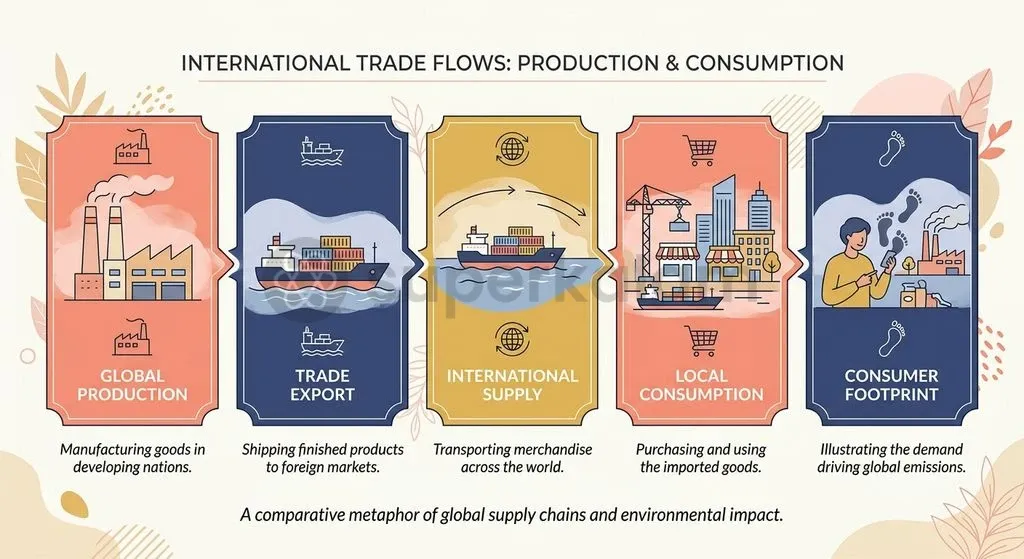
Key Structural Flaws: Per Capita Equity and Historical Responsibility
Global environmental indices systematically overlook equity by favouring territorial production metrics over consumption-based emission accounting.
The Ministry of Environment, Forest and Climate Change highlighted that the index assigns a 14% heavy weight to unvalidated future emission projections while allocating only around 1% weight to per-capita greenhouse gas emissions.
Methodological deficiencies cited by technical agencies include:
- Linear Extrapolation Bias: Projecting 2050 emissions through a simple ten-year historical trend misrepresents developing economies that are actively deploying capital into renewable energy grids and transit electrification.
- Neglect of Carbon Leakage: Territorial accounting penalises manufacturing nations while ignoring the high consumption footprints of post-industrial economies that import energy-intensive commodities.
- Data Quality Gaps: Atmospheric models derived from satellite readings, such as Copernicus, often fail to account for local meteorological conditions without extensive ground-level calibration.
- Omission of Lifestyle Indicators: Key conservation indicators, including per-capita municipal solid waste generation, water utilisation efficiency, and agro-ecological food systems, are omitted from the index scoring matrix.
Discuss with Superkalam
Examine how low composite scores in global environmental indices might adversely impact a developing country's access to international green finance and sovereign credit ratings.
Ask NowThe Governance Dilemma: Balancing Economic Growth with Sustainability
Indian environmental jurisprudence integrates developmental imperatives with constitutional mandates to protect natural ecosystems.
The Constitution of India embeds environmental protection through distinct provisions across its structural framework:
- Directive Principles of State Policy: Article 48A, introduced by the 42nd Constitutional Amendment Act of 1976, directs the State to protect and improve the environment and safeguard the nation's forests and wildlife.
- Fundamental Duties: Article 51A(g) imposes a moral duty upon every citizen to protect and improve the natural environment, encompassing forests, lakes, rivers, and wildlife.
- Judicial Interpretation of Article 21: The Supreme Court expanded the fundamental Right to Life in Subhash Kumar v. State of Bihar (1991) to include the right to a pollution-free environment, holding that life encompasses the enjoyment of wholesome air and water.
India executes its sustainability policies through the National Action Plan on Climate Change, which coordinates eight National Missions targeting solar energy, enhanced energy efficiency, sustainable habitat, water preservation, and sustainable agriculture.
Ethical Dimensions: Climate Justice, CBDR-RC, and Global Equity
The principle of Common But Differentiated Responsibilities and Respective Capabilities forms the ethical cornerstone of international climate negotiations.
Codified under Article 3(1) of the UNFCCC and reinforced in Article 2(2) of the Paris Agreement, the principle requires developed nations to shoulder greater historical responsibility for cumulative greenhouse gas emissions while supporting developing nations through climate finance and technology transfers.
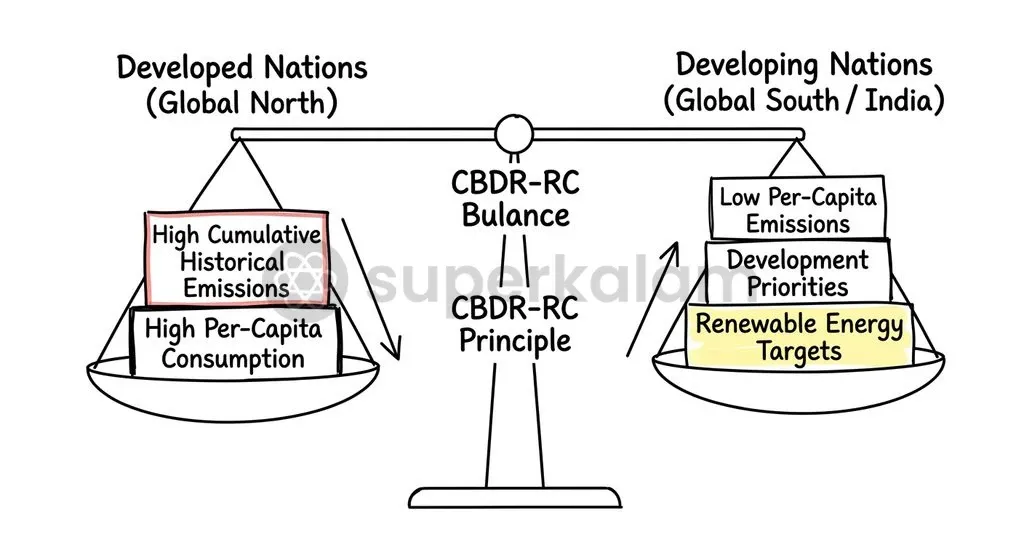
India's carbon emissions per capita stand at approximately one-third of the global average, demonstrating that domestic energy consumption remains focused on meeting baseline socio-economic needs rather than luxury emissions.
Core ethical pillars governing this international framework include:
- Historical Carbon Space: Industrialised economies consumed the vast majority of the global carbon budget during their developmental phases.
- Right to Development: Emerging economies require sufficient policy space to eradicate poverty, build resilient infrastructure, and ensure basic energy access.
- Inter-Generational Equity: Evaluating countries without adjusting for historical emissions compromises inter-generational climate justice and unfairly penalises the global South.
Discuss with Superkalam
Propose three structural reforms that international index creators should incorporate to align environmental performance scoring with the principle of Common But Differentiated Responsibilities (CBDR-RC).
Ask NowWay Forward: Reforming Global Metrics and Bolstering Domestic Action
Policy analysts emphasise that developing nations must build robust, transparent environmental measurement systems to present an accurate assessment of sustainability progress.
Key strategic priorities include:
- Developing Indigenous Indices: Indian statistical and environmental institutions could operationalise a dedicated National Environmental Performance Index to deliver evidence-based environmental benchmarking suited to developing economies, as proposed by domestic policy analysts [per NITI Aayog / Planning Commission State Environmental Performance Framework Records (as reported, 2013)].
- Expanding Ground-Level Monitoring: Expanding continuous ambient air quality and water monitoring stations under the National Clean Air Programme will generate reliable empirical datasets, reducing reliance on coarse global satellite modelling.
- Advocating Multilateral Accounting Reforms: India should continue to utilise platforms like the UNFCCC and the G20 to campaign for consumption-based carbon accounting, full operationalisation of climate finance commitments, and frictionless clean technology transfers.
- Scaling Demand-Side Climate Interventions: Expanding Mission LiFE from an educational campaign into measurable public policy frameworks will institutionalise resource efficiency, circular economy principles, and low-carbon lifestyles.
Key Takeaways
- The Environmental Performance Index 2026 ranked India 176th out of 177 nations, drawing formal rejection from the Ministry of Environment, Forest and Climate Change over methodological and data inconsistencies.
- India achieved 50% non-fossil power capacity in June 2025, five years ahead of its 2030 Nationally Determined Contribution target, while reducing GDP emissions intensity by 37.38% against 2005 levels by 2022.
- The Union Cabinet has approved enhanced 2035 targets, committing to a 47% emissions intensity cut and 60% cumulative non-fossil electric capacity.
- The EPI framework assigns a heavy 14% weight to unvalidated future emission projections while allocating only around 1% weight to equity-focused per-capita emissions metrics.
- Constitutional provisions under Article 48A (DPSP) and Article 51A(g) (Fundamental Duties), alongside the judicial expansion of Article 21, establish the legal architecture for domestic environmental governance.
- Climate justice and the principle of Common But Differentiated Responsibilities demand accounting for historical emissions and acknowledging that India's per-capita emissions remain at one-third the global average.
Mains Question
"Global environmental indices often penalise industrialising nations through territorial accounting and unvalidated projection models while discounting per-capita equity." In the light of the 2026 Environmental Performance Index, critically analyse the methodological limitations of global sustainability rankings. (15 Marks)
Evaluate NowMains Question
Highlighting India's achievements under its Nationally Determined Contributions (NDCs), elucidate the constitutional and policy mechanisms guiding India's domestic climate transition. (10 Marks)
Evaluate NowPractice MCQs
QUESTION 1
With reference to the Environmental Performance Index (EPI), consider the following statements:
- It is a biennial report published by Yale University and Columbia University in collaboration with the World Economic Forum.
- The index framework evaluates national environmental sustainability across 47 performance indicators grouped under three primary policy objectives.
- In the 2026 Index, equity-based per-capita greenhouse gas emissions were allocated a weight exceeding 10% in the scoring framework.
Which of the statements given above is/are correct?
QUESTION 2
Consider the following statements regarding India's climate commitments and Nationally Determined Contributions (NDCs):
- India achieved 50% non-fossil electric power installed capacity in June 2025, fulfilling its target five years ahead of schedule.
- India reduced the emissions intensity of its GDP by 37.38% by 2022 compared to 2005 levels.
- The Union Cabinet's expanded NDC targets for 2035 include setting a 60% non-fossil electric capacity target and raising the emissions intensity reduction target to 47%.
Which of the statements given above are correct?
QUESTION 3
With reference to the constitutional and judicial framework for environmental protection in India, consider the following statements:
- Article 48A was inserted into the Directive Principles of State Policy by the 42nd Constitutional Amendment Act of 1976.
- Article 51A(g) places a fundamental duty upon citizens to protect and improve the natural environment.
- In Subhash Kumar v. State of Bihar (1991), the Supreme Court held that the right to live includes the right to the enjoyment of pollution-free water and air under Article 21.
Which of the statements given above are correct?
QUESTION 4
The Ministry of Environment, Forest and Climate Change (MoEFCC) has challenged the methodology of the Environmental Performance Index primarily on which of the following grounds?
- Heavy reliance on 10-year linear extrapolation of past emissions to project 2050 pathways.
- Using production-based territorial emission accounting that neglects carbon leakage and consumption footprints.
- Data quality uncertainties associated with satellite-derived models lacking ground-level calibration.
Select the correct answer using the code given below:
QUESTION 5
Under India's updated climate targets and international submissions, the 'Mission LiFE' initiative is primarily aimed at: