Enemy Property Act: Wartime Powers and Citizen Property Rights
How retroactive amendments to wartime property laws stripped citizen inheritance rights, pitting sovereign expropriation against constitutional protections.
Oct, 2026
•13 min read

Overview
Statutory vesting under the Enemy Property Act, 1968 began as a provisional wartime conservatorship to manage assets of hostile foreign nationals. Over decades, retroactive amendments turned this system into a permanent state expropriation regime. It now extinguishes the inheritance rights of bona fide Indian citizens while liquidating private holdings for budgetary capital receipts.
Parliament enacted this framework after the 1962 Sino-Indian War and the 1965 Indo-Pakistani War, placing thousands of holdings under the Custodian of Enemy Property for India. A landmark 2005 Supreme Court ruling affirmed that Indian heirs retain lawful succession. However, Parliament passed the Enemy Property (Amendment and Validation) Act, 2017, nullifying judicial rulings with retroactive effect from 1968 and barring succession.
Today, the institutional focus has moved from diplomatic trusteeship to public asset monetisation. This transformation raises fundamental constitutional questions regarding property rights and procedural fairness.
Why Enemy Property Is Back in the Spotlight
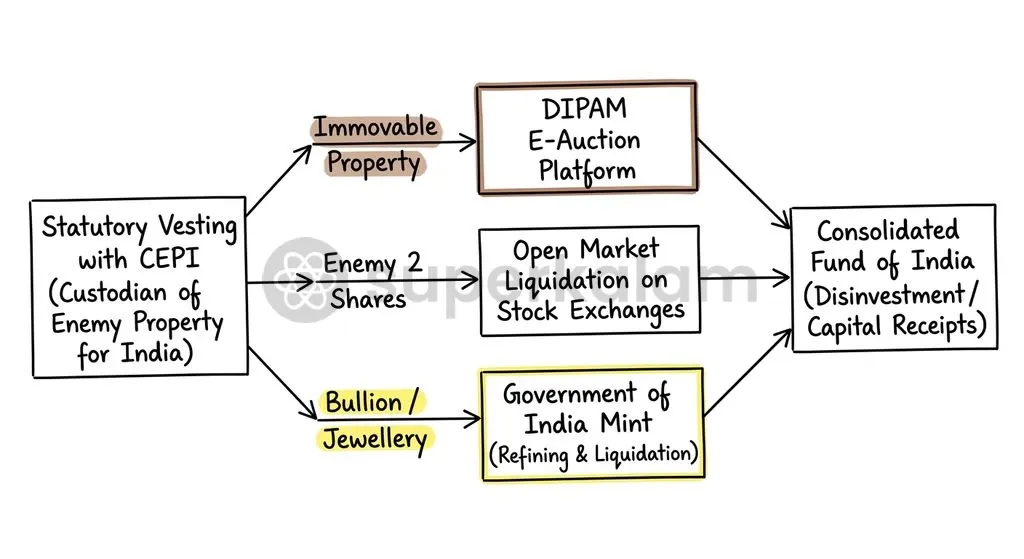
The Ministry of Home Affairs has accelerated the financial liquidation of enemy assets across India to augment non-tax capital receipts for the Union government. Under this initiative, the Custodian of Enemy Property for India realised over ₹3,400 crore primarily through the disposal of financial instruments, according to official disclosures by the Ministry of Home Affairs.
This balance-sheet push spans multiple asset classes:
- Corporate Equities: Sale of 7.52 crore shares across 152 corporate entities yielded ₹2,708.9 crore.
- Precious Metals: Bullion liquidation of gold and silver executed directly through the India Government Mint.
- Real Estate Inventory: Ongoing identification of marketable urban land parcels and commercial estates across northern and eastern states.
A separate legal dimension emerged on 22 February 2024. Ruling on municipal taxation in Lucknow Nagar Nigam v. Kohli Brothers Colour Lab Pvt. Ltd., the Supreme Court held that enemy properties managed by the Custodian do not qualify as "Union property" under Article 285(1) of the Constitution. Statutory vesting transfers administrative trusteeship rather than sovereign ownership. Consequently, these holdings remain liable to local municipal taxes.
Public attention has also intensified over state-level administrative realignments. As reported by The Hindu and The Economic Times in October 2026, the Union government initiated steps to designate the West Bengal state administration as custodian for approximately 4,000 enemy establishments. This decentralisation aims to direct dormant rental yields and asset revenues straight into provincial infrastructure projects.
Discuss with Superkalam
Recall the emergency regulation and wartime conflict that first created administrative custody over foreign assets in India.
Ask NowHow Wartime Defense Rules Created the Custodian
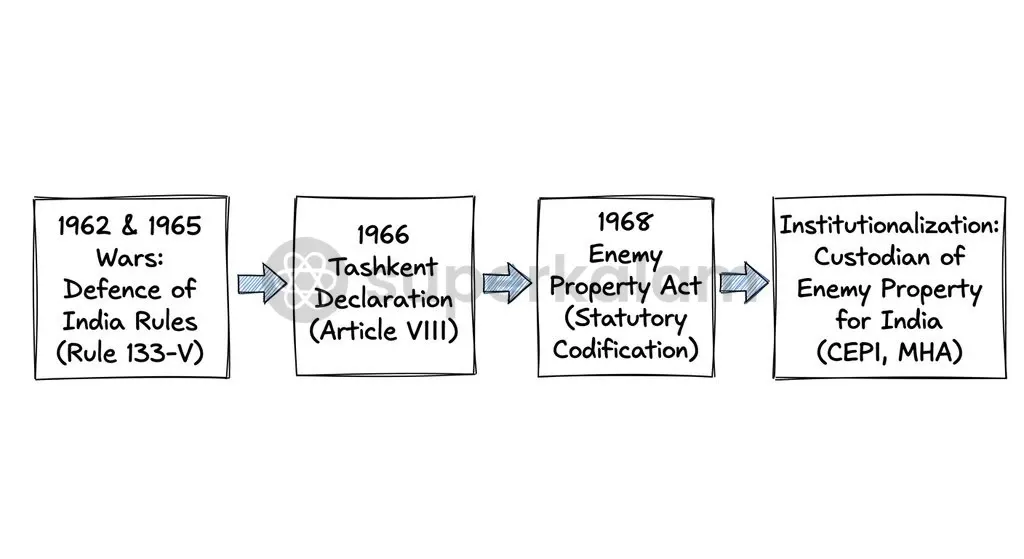
The Defence of India Rules, 1962 introduced the emergency statutory apparatus that first sequestered foreign-held commercial and residential assets within Indian territory. Following the outbreak of the 1962 Sino-Indian War and subsequent armed hostilities with Pakistan in 1965, the central government invoked Rule 133-V of these emergency regulations, as documented in Union of India v. Raja Mohammed Amir Mohammad Khan. This rule empowered the central executive to take possession of commercial holdings, agricultural tracts, and personal belongings owned by nationals of adversarial states.
Diplomatic engagement briefly pointed toward property restitution. On 10 January 1966, Prime Minister Lal Bahadur Shastri and President Ayub Khan signed the Tashkent Declaration following United Nations mediation. Article VIII of the Tashkent Declaration explicitly bound both nations to discuss the return of properties and assets seized during the 1965 war. That bilateral pathway collapsed when Pakistan unilaterally sold off Indian-owned properties across its territory in 1971.
- Hostilities (1962 & 1965): Armed conflicts trigger emergency asset sequestration under wartime executive orders.
- Rule 133-V Vesting: Emergency regulations transfer administrative possession of foreign-owned assets to central authorities.
- Tashkent Article VIII (1966): Bilateral agreement establishes formal commitment to negotiate property restitution.
- Statutory Custody (1968): Expiration of emergency powers compels Parliament to formalise unbroken statutory custody.
Faced with the expiration of wartime emergency powers, Parliament passed the Enemy Property Act, 1968 (Act No. 34 of 1968) on 20 August 1968. The legislation operated with retrospective force from 10 July 1968, ensuring administrative continuity over assets previously seized under emergency defence rules.
Section 3 of the statute constituted the Custodian of Enemy Property for India as a permanent statutory authority. Administratively housed under the Freedom Fighters and Rehabilitation Division of the Ministry of Home Affairs, the Custodian manages, preserves, and oversees these contested holdings.
Who Holds Enemy Assets: Chinese and Pakistani Properties in India
The Custodian of Enemy Property for India maintains regulatory oversight over 12,611 enemy property establishments spread across 20 States and 3 Union Territories. Parliamentary submissions by the Ministry of Home Affairs confirm that 12,485 of these establishments trace their lineage to Pakistani nationals who migrated during Partition or the conflicts of 1965 and 1971. Chinese citizens account for the remaining 126 establishments, originating from migrations during the 1962 border war.
Geographical distribution reflects historical migration pathways. Uttar Pradesh holds the single largest regional concentration, accounting for over 6,000 properties, followed by West Bengal with over 4,000 establishments.
Chinese-origin properties display a distinct geographic clustering. Meghalaya accommodates the highest concentration with 57 properties, reflecting commercial settlements established in the eastern frontier before the 1962 conflict.
| Analytical Dimension | Pakistan-Origin Enemy Properties | China-Origin Enemy Properties |
|---|---|---|
| Total Registered Units | 12,485 establishments | 126 establishments |
| Primary Statutory Origin | 1965 and 1971 Indo-Pak Wars | 1962 Sino-Indian War |
| Leading State Jurisdiction | Uttar Pradesh (>6,000 properties) | Meghalaya (57 properties) |
| Secondary Concentration | West Bengal (>4,000 properties) | West Bengal and Eastern border states |
| Asset Diversity | Residential estates, agricultural land, corporate equities | Commercial estates, tea plantation assets, urban realty |
| Statutory Regulator | Custodian of Enemy Property for India (CEPI) | Custodian of Enemy Property for India (CEPI) |
Physical verification and estate management present persistent bureaucratic hurdles for the Ministry of Home Affairs. Many parcels remain entangled in unauthorised urban encroachments, long-running tenancy disputes, and complex local title fraud. The disparity between sprawling real estate inventories and modern commercial usability has driven recent policy efforts toward wholesale asset liquidation.
Discuss with Superkalam
Explain the difference between statutory administrative trusteeship and sovereign ownership as clarified in the Lucknow Nagar Nigam (2024) ruling.
Ask NowThe Mahmudabad Case: When the Court Sided with Indian Heirs
The Supreme Court of India delivered a landmark property-rights ruling on 21 October 2005 in Union of India v. Raja Mohammed Amir Mohammad Khan. The dispute centred on expansive royal estates across Uttar Pradesh, including Butler Palace in Lucknow and administrative estates in Sitapur and Nainital. The original titleholder, the Raja of Mahmudabad, left India for Pakistan in 1957, while his wife and son chose to remain permanently in India as citizens.
Following the elder Raja's death in London in 1973, his son, Raja Mohammad Amir Mohammad Khan, initiated legal proceedings to secure his ancestral succession. The Union government claimed that the properties had permanently vested in the Custodian under the Enemy Property Act, 1968. A two-judge bench of the Supreme Court rejected the state's contention, ruling that statutory vesting creates an administrative trusteeship rather than an absolute sovereign title.
The apex court established two enduring legal principles in its 2005 verdict:
- Limited Custodial Title: Vesting under the 1968 Act grants the Custodian managerial control to prevent asset flight during wartime, not beneficial ownership.
- Inviolability of Citizen Rights: An Indian citizen cannot be branded an enemy or stripped of their statutory inheritance simply because their forebear acquired foreign citizenship.
Because the legal heir was a born Indian citizen exercising constitutional rights, the Supreme Court ordered the Union government to release the Mahmudabad estates from statutory custody. This judgment placed an affirmative constitutional check on state power, holding that national security laws cannot arbitrarily disinherit loyal domestic citizens.

The 2017 Amendment: Retrospective Closure of Succession Rights
Parliament enacted the Enemy Property (Amendment and Validation) Act, 2017 to nullify the judicial rationale articulated in the Mahmudabad ruling. Promulgated after five successive presidential ordinances, the 2017 statute applied sweeping amendments retroactively to 10 July 1968. The legislation amended Sections 2(b) and 2(c), expanding statutory definitions of "enemy" and "enemy subject" to encompass legal heirs and successors, irrespective of their Indian citizenship.
The statutory overhaul inserted several restrictive provisions into the primary 1968 Act:
- Nullification of Succession: Section 6 was amended to declare any transfer of enemy property by an enemy subject or their successors void ab initio, expressly extinguishing the operation of all personal laws of succession.
- Perpetual Vesting: The statute mandated that enemy status attaches indelibly to the property itself, preventing title from reverting to legal heirs even upon the death of the original foreign owner.
- Power of Liquidation: Section 8A authorised the Custodian to sell, transfer, or monetise enemy assets with prior central approval, overriding any contradictory court decree.
- Jurisdictional Exclusion: Section 18B barred civil courts from entertaining any suit or legal proceeding concerning enemy properties or administrative decisions taken by the Custodian.
Through these structural revisions, the legislature eliminated the legal distinction between an enemy national and an Indian successor. By applying these standards retroactively across five decades, Parliament effectively voided settled probate orders and restored thousands of disputed estates back to the Custodian's direct control.
Discuss with Superkalam
How might a municipal corporation apply the 2024 Supreme Court verdict to resolve long-pending local tax arrears on Custodian-held properties?
Ask NowThe Constitutional Friction: Article 300A Versus Sovereign Eminent Domain
The Enemy Property (Amendment and Validation) Act, 2017 creates sharp tension with Article 300A and Article 14 of the Constitution of India. Although the Forty-fourth Constitutional Amendment Act of 1978 removed property from Part III, Article 300A ensures that no person shall be deprived of their property save by authority of law. A constitutional statute authorising deprivation must remain procedurally fair, non-arbitrary, and tied to a legitimate public purpose, as highlighted by legal analyses from PRS Legislative Research.
Article 14 equality guarantees are directly implicated by the amended statutory definitions. By treating Indian citizens whose ancestors migrated to Pakistan or China differently from other Indian heirs, the statute establishes an invidious historical classification. Denying citizens their ancestral succession solely on account of a forebear's wartime movement penalises individuals for circumstances beyond their personal conduct, raising doubts under the test of reasonable classification.
| Constitutional Principle | Statutory Manifestation under 2017 Act | Constitutional Vulnerability |
|---|---|---|
| Article 300A Protection | Retrospective vesting extinguishes accrued succession rights | Deprivation without fair compensation or procedural safeguards |
| Article 14 Equality | Indian heirs classified by ancestral migration history | Creation of unequal citizen classes based on forebear conduct |
| Separation of Powers | Section 18B bars civil court jurisdiction over Custodian actions | Precludes judicial remedies against administrative overreach |
The doctrine of separation of powers faces structural strain under the 2017 framework. While Parliament can alter the basis of a judicial ruling prospectively, retroactive nullification paired with a Section 18B jurisdictional bar turns custodial care into permanent state expropriation.
This statutory reach remains contested. In Lucknow Nagar Nigam (2024), the Supreme Court reiterated that statutory vesting creates a regulatory trusteeship rather than unencumbered state ownership, confirming that constitutional property questions around these assets remain active.
Discuss with Superkalam
Compare the 2005 Mahmudabad judgment with the 2017 Amendment to identify how the executive and legislature countered judicial limits on disinheriting domestic heirs.
Ask NowFrom Wartime Bargaining Chip to Budgetary Monetisation
The strategic utility of enemy property has shifted from diplomatic bargaining leverage to domestic fiscal management. During the drafting of the Enemy Property Act, 1968, properties were preserved to maintain reciprocity and encourage bilateral restitution talks under the Tashkent Declaration. When Pakistan liquidated Indian assets in 1971, that diplomatic balance evaporated, leaving Indian holdings frozen in administrative limbo for several decades.
The Union Cabinet transformed this custodial regime on 28 February 2019 by approving an institutional monetisation mechanism. This executive resolution empowered the Department of Investment and Public Asset Management (DIPAM) to sell enemy shares and real estate portfolios under Section 8A. Financial proceeds do not sit in custodial escrow; they flow straight into the Consolidated Fund of India as disinvestment capital receipts.
| Policy Phase | Diplomatic Conservatorship (1968–2016) | Fiscal Liquidation Regime (2017–Present) |
|---|---|---|
| Core Objective | Asset preservation for post-conflict diplomatic talks | Budgetary non-tax revenue and capital generation |
| Statutory Character | Reversible administrative trusteeship | Irreversible commercial liquidation via state power |
| Operational Agency | CEPI under Ministry of Home Affairs oversight | Joint coordination between CEPI and DIPAM |
| Citizen Succession | Recognized under Supreme Court precedent (Mahmudabad) | Barred retroactively by statutory amendment |
| Financial Yield | Minimal, restricted to agricultural and urban rents | Over ₹3,400 crore realised from shares and bullion |
This policy shift transforms public authority over private holdings. What began as a wartime conservatorship to prevent hostile capital transfers has evolved into state revenue generation. By privatising these properties through public auctions, the state permanently extinguishes both the original owner's title and the potential succession claims of domestic heirs.
Way Forward: Reconciling National Security with Citizen Succession Rights
Reconciling sovereign security powers with constitutional property protections requires targeted legislative and administrative reforms. While the state possesses an unquestioned mandate to protect its territory and domestic economy from foreign adversaries during active hostilities, extended peace-time statutes must adhere to fundamental fairness. Indefinite deprivation of citizen property without compensation strains the core principles of administrative justice.
Three policy interventions would restore institutional balance to the enemy property regime:
- Specialised Claims Adjudication: Parliament should amend Section 18B to establish an independent appellate tribunal headed by retired judicial officers. This mechanism would provide a dedicated forum to evaluate bona fide Indian citizenship claims, replacing total civil court exclusion with fair procedural review.
- Targeted Compensation Standards: Where immovable assets are monetised through DIPAM auctions, the central government should establish an escrow compensation framework. If heirs demonstrate verified Indian citizenship and lawful succession, a designated share of proceeds should be disbursed as compensation under Article 300A standards.
- Auditing and Verification: The Ministry of Home Affairs must complete geographic surveys and digitise titles across all 12,611 properties. Resolving urban encroachment through transparent municipal partnerships prevents illegal land grabbing while preserving public accountability.
Ethical governance requires the state to respect the rule of law even when dealing with contentious historical legacies. Upholding the rights of Indian citizens irrespective of ancestral nationality reinforces democratic trust without compromising territorial security.
Discuss with Superkalam
Propose a balanced administrative mechanism that allows the state to monetise long-abandoned enemy assets while offering fair recourse to bona fide Indian heirs.
Ask NowKey Takeaways
- The Enemy Property Act, 1968 was enacted on 20 August 1968, with retrospective effect from 10 July 1968, formalising the custody of assets seized under Rule 133-V of the Defence of India Rules, 1962.
- The Custodian of Enemy Property for India oversees 12,611 properties across 20 States and 3 Union Territories, comprising 12,485 Pakistani-origin holdings and 126 Chinese-origin establishments.
- In the 2005 Raja of Mahmudabad judgment, the Supreme Court ruled that statutory vesting confers managerial custody rather than absolute sovereign ownership, protecting the inheritance rights of bona fide Indian heirs.
- The Enemy Property (Amendment and Validation) Act, 2017 retrospectively amended Sections 2, 6, and 8A, extinguishing citizen succession rights, ousting civil court jurisdiction under Section 18B, and authorising commercial sales.
- The Supreme Court held in Lucknow Nagar Nigam (2024) that enemy properties are not "Union property" under Article 285(1), confirming the Custodian acts as a statutory trustee rather than an absolute owner.
- Through the Department of Investment and Public Asset Management, the Union government has converted wartime custodianship into a budgetary monetisation channel, raising over ₹3,400 crore from financial assets.
Mains Question
'Statutory vesting under the Enemy Property Act, 1968 was conceived as a provisional wartime conservatorship, but legislative interventions have altered it into an instrument of permanent expropriation.' Examine the constitutional and legal implications of the Enemy Property (Amendment and Validation) Act, 2017. (10 Marks)
Evaluate NowMains Question
'The shift in managing enemy property assets from diplomatic trusteeship to aggressive budgetary monetisation presents significant administrative, federal, and constitutional dilemmas.' Critically analyse. (15 Marks)
Evaluate NowPractice MCQs
QUESTION 1
With reference to the Enemy Property Act, 1968 and its subsequent amendments, consider the following statements:
- The original vesting of assets under the Act followed emergency powers exercised under Rule 133-V of the Defence of India Rules, 1962.
- The Custodian of Enemy Property for India is an administrative authority functioning under the Ministry of External Affairs.
- The 2017 Amendment expanded the definition of 'enemy' to include legal heirs and successors, irrespective of whether they are Indian citizens. Which of the statements given above are correct?
QUESTION 2
Consider the following statements regarding the legal status of enemy properties in India:
- In 'Lucknow Nagar Nigam v. Kohli Brothers Colour Lab Pvt. Ltd.' (2024), the Supreme Court ruled that enemy properties qualify as 'Union property' under Article 285(1) and are exempt from local municipal taxation.
- In the 2005 'Mahmudabad' ruling, the Supreme Court held that statutory vesting under the 1968 Act grants administrative trusteeship rather than sovereign title to the Custodian.
- The Enemy Property (Amendment and Validation) Act, 2017 applied retrospective changes with effect from 10 July 1968. Which of the statements given above is/are correct?
QUESTION 3
Consider the following statements regarding the distribution and composition of enemy properties registered with the Custodian of Enemy Property for India:
- Establishments tracing their lineage to Pakistani nationals outnumber those tracing their lineage to Chinese nationals.
- Uttar Pradesh accounts for the single largest regional concentration of Pakistan-origin enemy properties.
- Meghalaya holds the highest concentration of China-origin enemy properties among Indian states. Which of the statements given above is/are correct?
QUESTION 4
In the context of modern monetization of enemy properties, through which of the following avenues has the Custodian of Enemy Property for India directly liquidated bullion (gold and silver)?
QUESTION 5
Consider the following statements regarding international and domestic legal frameworks governing wartime property seizures:
- Article VIII of the Tashkent Declaration (1966) contained an explicit bilateral commitment between India and Pakistan to discuss the return of properties seized during the 1965 war.
- Bilateral restitution under the Tashkent Declaration collapsed after Pakistan unilaterally disposed of Indian-owned properties in 1971. Which of the statements given above is/are correct?