Elephant Corridors in India: Bottlenecks, Legal Safeguards, and AI Solutions
As linear infrastructure fractures 150 elephant corridors, bridging statutory gaps and deploying AI early-warning systems are vital for peaceful co-existence.
Sep, 2026
•11 min read
Overview
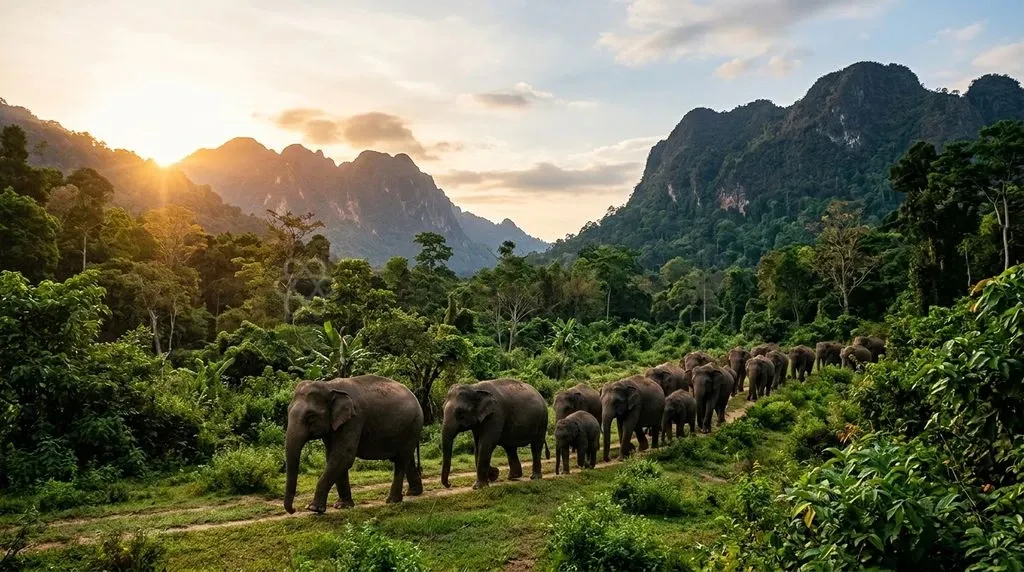
An elephant corridor is a narrow linear strip of land facilitating wild Asian elephant movement between fragmented forest habitats. It maintains seasonal migratory pathways, supports demographic viability, and prevents genetic isolation across India's estimated population of 22,446 wild elephants.
As linear infrastructure, commercial cultivation, and mining encroach upon historical passages, habitat fragmentation intensifies human-elephant conflict. According to the Ministry of Environment, Forest and Climate Change, securing these contiguous landscapes requires bridging a core statutory gap in national wildlife legislation. It also demands deploying early-warning technological safeguards and institutionalising equitable community co-existence models.
Why India's Elephant Corridors Are Under Increasing Pressure
As of August 2026, the Ministry of Environment, Forest and Climate Change has documented 150 elephant corridors across 15 range states. This inventory reflects severe ecological fragmentation caused by rapid developmental growth.
India's wild Asian elephant (Elephas maximus) population faces mounting survival pressures as contiguous forests shrink into isolated habitat patches. Preserving core protected areas fails if ecological connectivity between them is permanently severed.
Key structural factors defining India's corridor network include:
- Broad Cross-Border Reach: The national network encompasses 19 inter-state corridors and six transboundary international corridors connecting India with Nepal, according to a PIB press release on World Elephant Day 2026.
- Extensive Spatial Requirements: Elephants require expansive home ranges for foraging and water. Migratory blockages force herds directly into agricultural zones and human habitations.
- Escalating Conflict: Spatial compression drives severe crop destruction, property loss, and recurring casualties.
Securing these passages requires moving beyond reactive mitigation toward legally entrenched landscape management. Unplanned developmental projects continue to compromise herd mobility and genetic health, making corridor protection an urgent environmental priority.
What Is an Elephant Corridor and Why Does Connectivity Matter?
The Ministry of Environment, Forest and Climate Change defines an elephant corridor as a linear habitat pathway facilitating animal movement between larger viable forest patches. These biological conduits sustain regular home-range movements and seasonal migrations between foraging grounds. They also maintain vital gene flow among otherwise isolated breeding populations, per the MoEFCC Report on Elephant Corridors of India 2023.
Ecological connectivity is indispensable for megaherbivore resilience. When developmental barriers sever traditional migratory routes, small herds suffer from inbreeding depression, reduced reproductive fitness, and local extinction risks. Maintaining contiguous pathways ensures demographic exchange, prevents overgrazing within restricted pockets, and preserves broader landscape biodiversity.
Aspirants often confuse administrative landscape designations with structural movement corridors. The table below delineates the functional and legal differences between an Elephant Corridor and an Elephant Reserve:
| Feature | Elephant Corridor | Elephant Reserve |
|---|---|---|
| Primary Definition | Narrow linear strip facilitating movement between viable habitat patches | Large administrative landscape encompassing protected areas, forests, and human-use zones |
| Functional Purpose | Seasonal migration and genetic exchange between distinct populations | Long-term regional habitat protection and comprehensive landscape management |
| Average Spatial Scale | Localised linear parcels (often less than a few square kilometres) | Expansive conservation territories covering thousands of square kilometres |
| Administrative Framework | Ground-validated and monitored by the Project Elephant Division | Formally notified administrative units managed under Project Elephant guidelines |
| Current National Footprint | 150 ground-validated corridors across 15 range states | 33 notified reserves spanning 80,777 sq km across 14 range states |
Discuss with Superkalam
How many elephant corridors and notified elephant reserves are currently documented across India according to official reports?
Ask NowMapping India's Elephant Landscape: A Region-Wise Assessment
Regional distribution of elephant corridors reveals severe geographic asymmetry across India, with the East-Central landscape hosting the largest concentration of vulnerable pathways. The latest field documentation by the Ministry of Environment, Forest and Climate Change recorded 150 ground-validated corridors across 15 range states, marking a 40% increase in documented corridors compared to 2010 baselines.
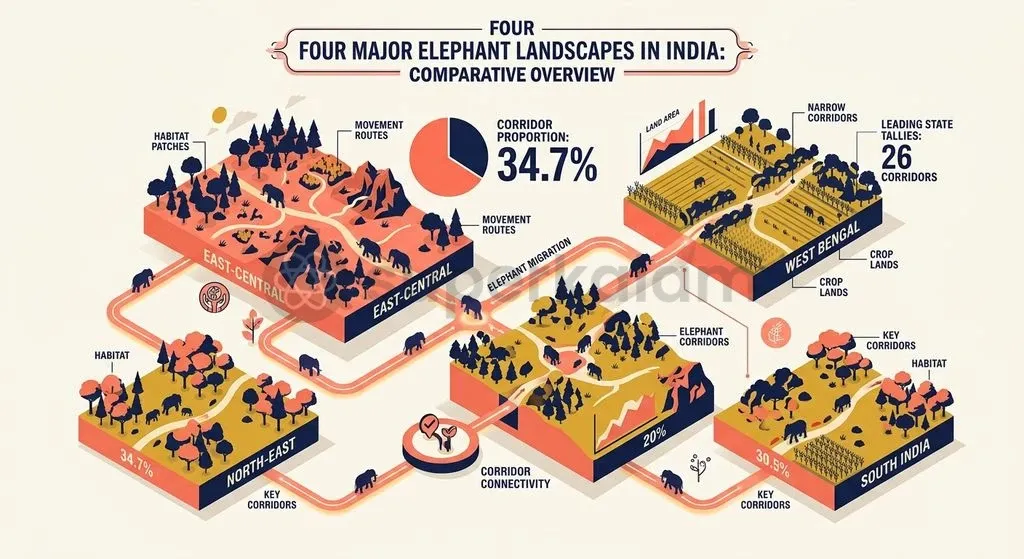
According to official releases from the Ministry of Environment, Forest and Climate Change and PIB, India's elephant distribution spans four primary geographical landscapes:
- East-Central Landscape (West Bengal, Odisha, Jharkhand, Chhattisgarh): This region contains the highest number of elephant corridors at 52, representing 34.7% of the national total. West Bengal leads all individual states with 26 corridors, accounting for over 17% of all corridors nationwide. High human population density, extensive open-cast coal mining, and agricultural encroachment make this landscape the country's most volatile conflict zone.
- Southern Western Ghats (Karnataka, Kerala, Tamil Nadu): Harbouring dense elephant populations, this landscape relies on critical montane passes to link protected areas. The Sigur Plateau corridor is a vital ecological link connecting the Western Ghats (Mudumalai and Bandipur Tiger Reserves) with the Eastern Ghats (BRT Tiger Reserve and Biligirirangana hills), enabling essential genetic exchange across metapopulations.
- Northeast Landscape (Assam, Meghalaya, Arunachal Pradesh, Nagaland): Characterised by dense foothill forests and international border passages, this zone contains numerous transboundary routes into Bhutan and Bangladesh. Flood plain dynamics along the Brahmaputra basin drive seasonal movements between high-altitude reserves and low-lying foraging grounds.
- North-Western Terai (Uttarakhand, Uttar Pradesh): Encompassing the Shivalik foothills and Terai grasslands, this region facilitates longitudinal movements between Rajaji and Corbett National Parks. Key passages, such as the Chilla-Motichur corridor, maintain essential connectivity across heavily developed river valleys and transport arteries.
Key Bottlenecks: How Linear Infrastructure and Encroachment Fracture Habitats
Linear infrastructure projects documented by the Wildlife Institute of India constitute the primary physical barrier severing traditional elephant migratory paths across range landscapes. Rapid infrastructure expansion without dedicated passage provisions transforms continuous migratory corridors into fatal obstacle courses.
According to the Wildlife Institute of India's Linear Infrastructure Mitigation Guidelines, major physical bottlenecks fall into five distinct structural categories:
- Railway Networks: Unfenced railway tracks cutting through dense forest corridors cause repeated collision casualties when herds traverse tracks during nocturnal foraging.
- Highways and Expressways: Unmitigated multi-lane highways introduce high-speed vehicular traffic and wide, impassable asphalt barriers that deter herd crossings or cause vehicular collisions.
- High-Voltage Transmission Lines: Sagging electrical power cables passing through reserve forests and private plantation fringes create acute electrocution hazards for tall megaherbivores.
- Irrigation Canals: Deep, steep-sided concrete canals constructed through migratory pathways trap young calves and adult elephants, causing fatal drownings or permanently severing herd routes.
- Commercial Encroachment and Mining: Open-cast mining operations, commercial resorts, and monoculture cash-crop plantations physically obstruct bottleneck passes, forcing herds into densely populated village settlements.
Discuss with Superkalam
Why is structural and biological connectivity between fragmented forest patches vital for the long-term genetic health of Asian elephants?
Ask NowHuman-Elephant Conflict Hotspots: Drivers, Casualties, and Economic Loss
East-Central India remains the epicentre of human-elephant conflict, generating severe socio-economic distress and accounting for over 60 percent of nationwide human casualties. The MoEFCC Project Elephant Division Annual Compendium reports that fragmented landscapes across West Bengal, Odisha, Jharkhand, and Chhattisgarh record over 60% of annual human fatalities caused by elephants in India.
The conflict dynamic operates through three interconnected pressures:
- Crop Depredation: The destruction of natural foraging pathways forces hungry elephant herds into standing agricultural crops such as paddy and sugarcane.
- Livelihood Shocks and Retaliation: Smallholder farmers face devastating financial losses, triggering retaliatory measures including illegal electric wire fencing, poison baits, and physical clashes.
- Ex-Gratia Relief Relief Framework: Under Project Elephant guidelines, the Central Government provides ₹10 lakh ex-gratia relief for loss of human life or permanent incapacitation, ₹2 lakh for grievous injury, and up to ₹25,000 for minor injuries caused by wild animals.
While financial compensation mitigates immediate livelihood shocks, it does not resolve the persistent loss of spatial connectivity.
Legal and Institutional Safeguards: Project Elephant to Landmark Judicial Rulings
The statutory and judicial mechanisms governing elephant corridors span three key dimensions:
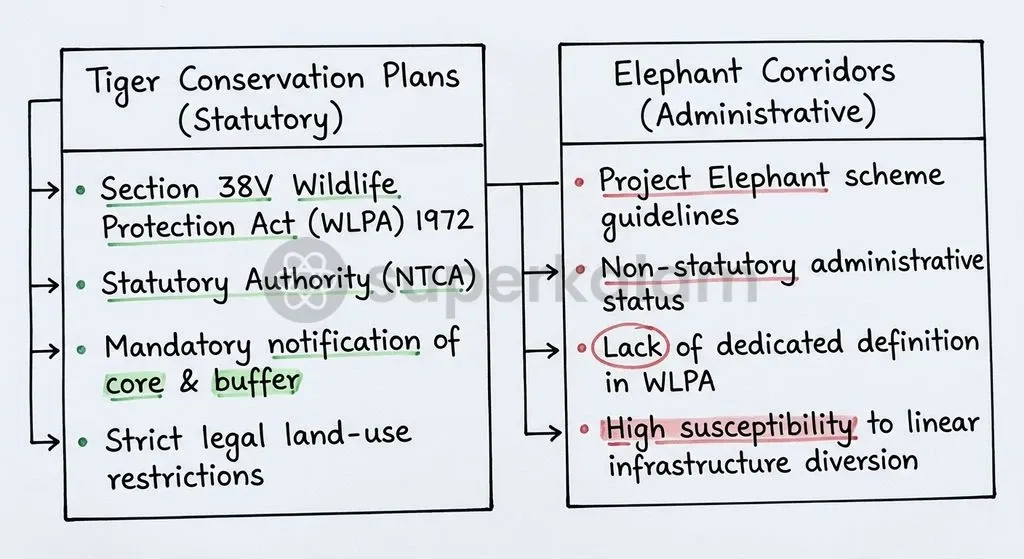
- Statutory Void in the WPA: The Wildlife (Protection) Act, 1972 contains a significant gap by omitting a formal legal definition or dedicated protection framework for elephant corridors. While tiger corridors receive explicit statutory recognition and mandatory protection under Section 38V via Tiger Conservation Plans, elephant corridors remain legally unclassified under the Act.
- Executive Administrative Framework: Project Elephant was launched by the Central Government in 1992 as a centrally sponsored scheme to provide financial and technical support to state wildlife divisions. It focuses on protecting wild elephants, safeguarding habitats, addressing conflict, and improving captive welfare. However, administrative corridor guidelines lack the binding statutory weight of parliamentary legislation, leaving lands vulnerable to commercial acquisition.
- Judicial Precedent and Enforcement: The Indian higher judiciary has stepped in to establish binding environmental jurisprudence. In Hospitality Association of Mudumalai v. In Defence of Environment and Animals (2020 INSC 597), the Supreme Court of India upheld the Tamil Nadu Government's notification of the Sigur Plateau elephant corridor.
In that ruling, the Court firmly applied the Precautionary Principle and the Public Trust Doctrine. It ordered the immediate closure and demolition of unauthorised commercial resorts operating within the corridor to guarantee the right of passage for wildlife.
Discuss with Superkalam
If you were designing a highway expansion through the Chilla-Motichur or Sigur Plateau corridor, what specific linear infrastructure mitigation measures would you incorporate?
Ask NowSmart Interventions: From AI-Powered Rail Warnings to Eco-Bridges and Bio-Fencing
Indian Railways and wildlife authorities have deployed targeted technological innovations to mitigate unnatural elephant mortality along high-risk infrastructure bottlenecks. Modern conservation practice blends automated sensor networks, non-lethal bio-deterrents, and structural engineering to restore functional connectivity.
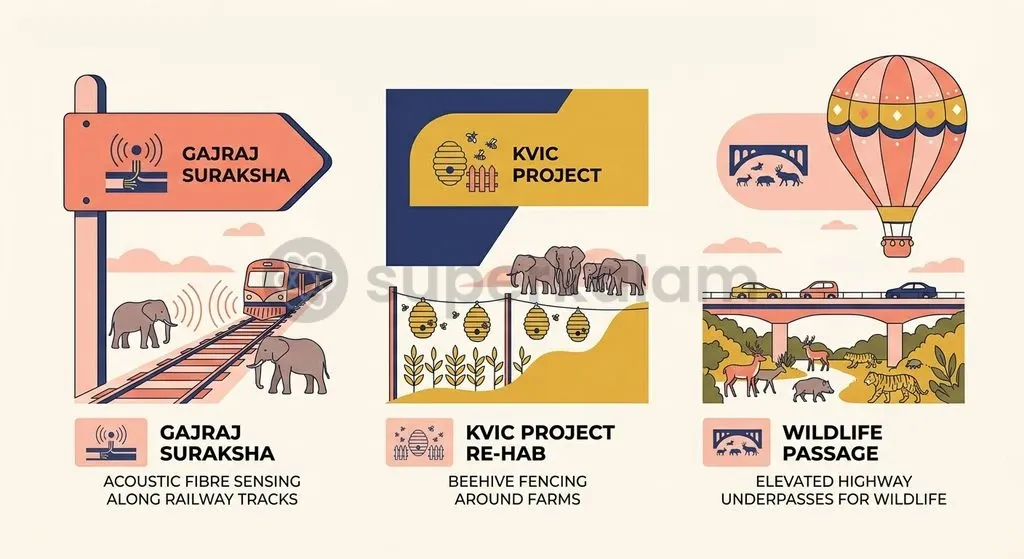
Field-tested smart mitigation mechanisms currently deployed across India include:
- Gajraj Suraksha AI Detection System: Indian Railways introduced 'Gajraj Suraksha', an indigenous AI-based Intrusion Detection System (IDS) that uses Distributed Acoustic Sensing on optical fibre cables along railway tracks. The system detects elephant ground vibrations within 200 metres of tracks and sends automated real-time alerts directly to station masters and locomotive pilots. Following the deployment of AI detection, speed limits, and mitigation measures, nationwide elephant deaths from train collisions dropped by 54% between 2013 and 2024, falling from 26 deaths to 12.
- Project RE-HAB (Reducing Elephant-Human Attacks using Bees): Launched by the Khadi and Village Industries Commission under the National Honey Mission, this initiative installs string-connected bee boxes along corridor boundaries. Elephants avoid honeybee swarms, turning these low-cost bio-fences into humane deterrents that simultaneously generate rural apiculture income.
- Structural Eco-Ducts and Underpasses: Dedicated engineering interventions, such as elevated highway underpasses constructed along National Highway 74 in the Chilla-Motichur corridor within the Rajaji National Park landscape, have successfully restored functional animal passage across heavy transport arteries.
- Community Early-Warning Grids: Village-level 'Gaja Sathis' (Elephant Companions) and Quick Response Teams use radio-collaring telemetry, automated SMS alerts, and local communication networks to track herd movements and prevent accidental confrontations.
Discuss with Superkalam
Why does the East-Central landscape account for over 60% of human casualties despite the Southern Western Ghats harbouring dense elephant populations?
Ask NowWay Forward: Securing Contiguous Landscapes and Community Co-Existence
Securing long-term elephant conservation requires embedding statutory protection for corridors within national law while strengthening community-based co-existence mechanisms. Because elephant home ranges span administrative and political boundaries, isolated protected areas cannot ensure the survival of the species without interconnected landscapes.
Policy priorities must focus on four structural pillars:
- Statutory Amendment of Wildlife Legislation: Parliament should amend the Wildlife (Protection) Act, 1972 to introduce a formal statutory definition for elephant corridors, mirroring the protection afforded to tiger corridors under Section 38V. This statutory grounding would require mandatory ecological impact assessments before diverting corridor lands for commercial or infrastructure projects.
- Mandatory Linear Infrastructure Guidelines: Road, rail, and canal planners must integrate the Wildlife Institute of India's eco-duct and underpass designs during the initial project planning stage, preventing costly post-construction retrofitting.
- Inter-State Landscape Task Forces: Given that 19 critical corridors cross state borders, regional coordination committees should harmonise forestry operations, anti-poaching patrols, and real-time monitoring grids between neighbouring state departments.
- Ethical and Community-Led Conservation: Upholding environmental justice under GS4 ethical paradigms requires fair and prompt disbursement of ex-gratia compensation to forest-fringe farmers. Treating local communities as conservation partners through programmes like the Gaja Sathi initiative fosters durable co-existence and reduces retaliatory hostility.
Key Takeaways
- Corridor Definition and Scale: An elephant corridor is a linear strip of land facilitating wild elephant movement between viable habitat patches; the MoEFCC has ground-validated 150 corridors across 15 range states.
- Regional Hotspots: The East-Central region (Odisha, Jharkhand, Chhattisgarh, West Bengal) holds 52 corridors and accounts for over 60% of nationwide human fatalities caused by human-elephant conflict.
- Statutory Gap: Unlike tiger corridors protected under Section 38V of the Wildlife (Protection) Act, 1972, elephant corridors lack a dedicated statutory definition and binding legislative protection.
- Judicial Precedent: In Hospitality Association of Mudumalai (2020 INSC 597), the Supreme Court affirmed the ecological primacy of the Sigur Plateau corridor, mandating the closure of commercial resorts to protect animal movement.
- Technological Mitigation: The Gajraj Suraksha AI system organises Distributed Acoustic Sensing on optical fibre cables to alert train drivers within 200 metres, helping reduce train-collision mortalities by 54% between 2013 and 2024.
Mains Question
"While tiger corridors receive explicit protection under Section 38V of the Wildlife (Protection) Act, 1972, elephant corridors remain confined to administrative guidelines without binding statutory status." Critically examine the ecological and administrative ramifications of this statutory void on landscape-level wildlife conservation in India. (15 Marks)
Evaluate NowMains Question
In the context of escalating human-elephant interface in the East-Central landscape, evaluate the structural bottlenecks fracturing elephant corridors and assess the adequacy of existing mitigation frameworks. (10 Marks)
Evaluate NowPractice MCQs
QUESTION 1
Consider the following statements regarding the legal and institutional framework governing wildlife corridors in India:
- Tiger corridors receive explicit statutory recognition and mandatory protection under Section 38V of the Wildlife (Protection) Act, 1972.
- Elephant corridors are explicitly defined and accorded statutory protection under a dedicated chapter of the Wildlife (Protection) Act, 1972.
- Project Elephant was launched in 1992 as a centrally sponsored scheme to provide financial and technical support to range states. Which of the statements given above are correct?
QUESTION 2
With reference to the geographical distribution of elephant corridors in India, consider the following statements:
- The East-Central landscape accounts for more than one-third of the total documented elephant corridors in the country.
- West Bengal contains the highest number of elephant corridors among all individual range states.
- The Sigur Plateau corridor serves as a vital ecological link connecting the Western Ghats with the Eastern Ghats. Which of the statements given above are correct?
QUESTION 3
Consider the following statements regarding the comparative features of Elephant Reserves and Elephant Corridors:
- An Elephant Reserve is a large administrative landscape managed under Project Elephant guidelines, whereas an Elephant Corridor is a narrow linear strip facilitating movement between habitat patches.
- There are currently 150 formally notified Elephant Reserves spanning over 80,000 sq km across India.
- The Chilla-Motichur corridor maintains ecological connectivity between Rajaji and Corbett National Parks. Which of the statements given above is/are correct?
QUESTION 4
Consider the following statements regarding the socio-economic dimensions of human-elephant conflict and corridor management:
- The East-Central landscape accounts for over 60% of annual human fatalities caused by elephants in India.
- Under Project Elephant norms, the central ex-gratia relief for loss of human life or permanent incapacitation caused by wild animals is ₹10 lakh. Which of the statements given above is/are correct?
QUESTION 5
Which of the following physical bottlenecks have been documented as structural barriers fragmenting elephant migratory pathways?
- Steep-sided concrete irrigation canals
- High-voltage sagging transmission lines
- Unfenced railway tracks cutting through forest corridors
- Open-cast mining and commercial plantation encroachments Select the correct answer using the code given below: