Edible Oil Import Duty Cut 2026: Palm, Soybean and Sunflower Rates
From 24 September 2026, crude sunflower oil has nil basic customs duty; crude palm and soybean oil have 5% BCD. See revised rates and impacts.
Sep, 2026
•9 min read
Overview
India reduced import duties on edible oils in September 2026 to contain retail food inflation. This step exposed a recurring structural conflict between protecting domestic oilseed farmers and ensuring affordable prices for consumers.
The Ministry of Finance lowered the Basic Customs Duty on crude and refined palm, soybean, and sunflower oils through Notification No. 31/2026-Customs. Because India imports nearly 60% of its edible oil requirements at an annual cost reaching up to ₹1.61 lakh crore, international price spikes feed directly into domestic consumer inflation. Slashing tariffs right before domestic harvest cycles depresses local farm-gate prices below government support benchmarks. Balancing this trilemma requires combining long-term productivity programmes like the National Mission on Edible Oils with predictable, counter-cyclical tariff bands.
Why in the News: Recent Changes to Edible Oil Import Tariffs
The Department of Revenue under the Ministry of Finance notified substantial reductions in Basic Customs Duty across crude and refined edible oils through Notification No. 31/2026-Customs. As of September 2026, the policy intervention aims to moderate escalating cooking oil prices across domestic retail markets.
International vegetable oil quotations surged sharply, prompting the central government to adjust border duties. The tariff adjustments recalibrate rates on Crude Palm Oil, Crude Soybean Oil, and Crude Sunflower Seed Oil, alongside their refined variants.
While the revision offers immediate household relief, it lands during the Kharif crop marketing window. This timing creates friction between retail price stabilisation and farm income protection.
Understanding India's Edible Oil Import Basket and Consumption Patterns
India remains the world's largest importer of edible vegetable oils. It sources 56% to 60% of its annual domestic demand of 25 to 26 million tonnes from international markets.
According to trade data from the Solvent Extractors' Association of India (SEA) and the Directorate General of Commercial Intelligence and Statistics (DGCIS), this import dependence generates a foreign exchange outflow between ₹1.31 lakh crore and ₹1.61 lakh crore ($16 billion to $18.3 billion) each year.
Domestic consumption has outpaced national production due to rising incomes, population growth, and dietary shifts. A policy brief by NITI Aayog notes that annual per capita edible oil consumption in India has climbed to 19 to 23.5 kg per year, significantly higher than the Indian Council of Medical Research (ICMR) dietary guideline of 12 kg per year.
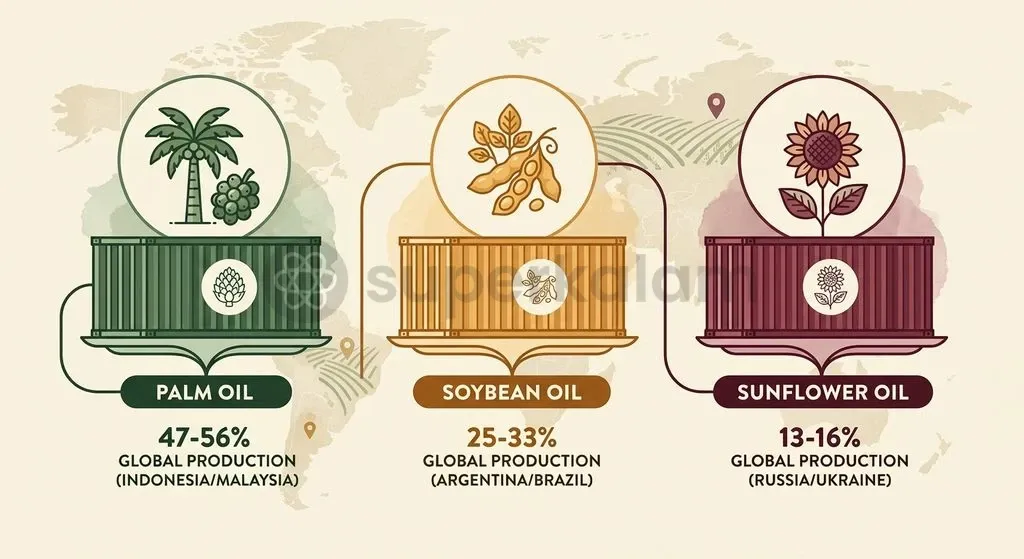
The imported vegetable oil basket consists of three primary commodities sourced from specific global geographies:
| Vegetable Oil Type | Share of Total Imports | Primary Sourcing Countries | Key Characteristics & Domestic Uses |
|---|---|---|---|
| Palm Oil (CPO & RBD Palmolein) | 47% to 56% | Indonesia, Malaysia | Dominates commercial food processing, hotels, restaurants, and blending; lowest cost |
| Soybean Oil (Crude Degummed) | 25% to 33% | Argentina, Brazil | Major household direct consumption oil in central, western, and northern India |
| Sunflower Oil (Crude) | 13% to 16% | Russia, Ukraine | High domestic consumer preference in southern and western urban retail markets |
Discuss with Superkalam
Recall the three primary edible oils imported by India and the top exporting countries for each.
Ask NowBasic Customs Duty and Tariff Structure: What Changed and How It Works
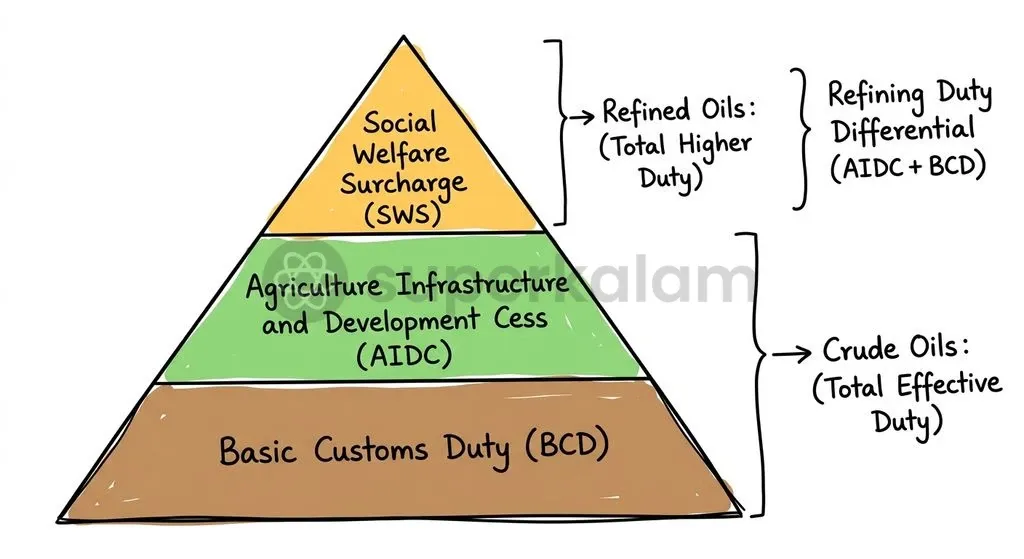
The total effective border duty on imported edible oils comprises three distinct fiscal components administered under the Customs Tariff framework. According to the Central Board of Indirect Taxes and Customs (CBIC), the cumulative tariff combines the Basic Customs Duty (BCD), the Agriculture Infrastructure and Development Cess (AIDC), and the Social Welfare Surcharge (SWS).
Notification No. 31/2026-Customs introduced targeted reductions to both crude and refined tariff slabs to alter landed import parity prices:
- Crude Sunflower Seed Oil: Basic Customs Duty reduced from 10% to Nil (0%).
- Crude Palm Oil (CPO): Basic Customs Duty reduced from 10% to 5%.
- Crude Soybean Oil: Basic Customs Duty reduced from 10% to 5%.
- Refined Sunflower Oil: Basic Customs Duty reduced from 32.5% to 22.5%.
- Refined Palm Oil and Refined Soybean Oil: Basic Customs Duty reduced from 32.5% to 27.5%.
The Department of Food and Public Distribution maintains an intentional duty differential between crude and refined oils to preserve domestic processing operations. Setting higher import duties on refined oils ensures that domestic solvent extractors and refiners import crude feedstock to process locally. This supports industrial capacity utilisation and restricts finished packaged imports.
The Inflation Dilemma: Why the Government Slashed Import Duties
The central government slashed import tariffs primarily to insulate domestic consumers from hardening global edible oil prices and restrain Consumer Price Index (CPI) food inflation. According to press releases from the Department of Consumer Affairs, cooking oils carry a notable weight in the retail food inflation basket, leaving kitchen budgets vulnerable to external supply shocks.
Key transmission factors and global pressures driving the tariff cuts include:
- Surging benchmark indices: The Food and Agriculture Organization (FAO) reported that its FAO Vegetable Oil Price Index climbed consecutively to reach 196.9 points in August 2026, driven by firmer international palm and soybean oil quotations.
- Imported inflation transmission: Because India imports over half of its cooking oil, rising global quotations pass directly into domestic retail prices unless buffered by border duty cuts.
- Targeted fiscal cushion: Fiscal authorities deploy tariff cuts as shock absorbers to lower landed costs at Indian ports, preventing cooking oil inflation from spilling into broader household metrics.
Discuss with Superkalam
Explain why maintaining an intentional tariff wedge between crude and refined edible oils is crucial for domestic agro-processing industries.
Ask NowBalancing the Domestic Ecosystem: Impact on Oilseed Farmers vs Domestic Refiners
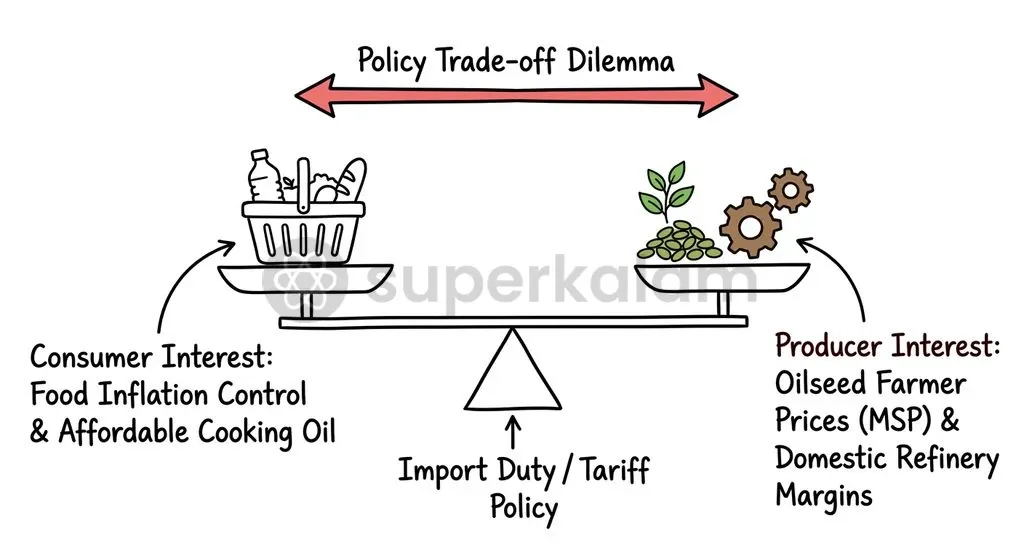
Import tariff cuts create a sharp policy trade-off between consumer price stability, oilseed farm viability, and the domestic refining industry. Reports from the Commission for Agricultural Costs and Prices (CACP) highlight that tariff cuts during the Kharif harvesting window can cause domestic mandi prices of oilseeds like soybean and groundnut to drop below their designated Minimum Support Price (MSP).
When cheap imported crude oils flood domestic ports, wholesale crushers and solvent extraction plants reduce procurement of local oilseeds. This dynamic leaves domestic cultivators vulnerable to post-harvest price distress.
To mitigate these market crashes, the Ministry of Agriculture and Farmers Welfare uses operational mechanisms under the Pradhan Mantri Annadata Aay Sanraksan Abhiyan (PM-AASHA):
- Price Support Scheme (PSS): Deployed by central nodal agencies like NAFED for direct physical procurement of oilseeds.
- Price Deficiency Payment Scheme (PDPS): Compensates registered farmers directly for the gap between mandi prices and MSP without physical stock procurement.
Domestic vegetable oil refiners also face operational strains from narrowed duty spreads. A compressed duty differential encourages imports of processed oils, lowering crushing capacity utilisation and reducing the local availability of oil meal used in animal feed.
National Mission on Edible Oils – Oil Palm (NMEO-OP) and Long-Term Self-Reliance
The central government established dedicated national missions to expand domestic cultivation and reduce long-term import vulnerability. The Union Cabinet approved the National Mission on Edible Oils – Oil Palm (NMEO-OP) to scale up domestic oil production significantly.
Key operational parameters and institutional targets under the national edible oil strategy include:
- Targeted capital outlay: A total financial outlay of ₹11,040 crore (comprising a Central share of ₹8,844 crore and a State share of ₹2,196 crore), targeting 6.5 lakh additional hectares under oil palm cultivation.
- Yield advantages: ICAR-Indian Institute of Oil Palm Research (IIOPR) assessments indicate oil palm yields approximately five times more edible oil per hectare than conventional oilseed crops such as mustard, soybean, and groundnut.
- Production concentration: Andhra Pradesh and Telangana account for approximately 98% of total domestic crude palm oil production.
- Statutory price insulation: The mission operationalised a statutory Viability Price (VP) benchmarked against the 5-year annual average price of Crude Palm Oil, adjusted by the Wholesale Price Index (WPI) and multiplied by 14.3%, with the Centre providing direct viability gap funding when market rates drop.
- Expanded oilseed mission: Approved on October 3, 2024, the National Mission on Edible Oils – Oilseeds (NMEO-OS) runs across a 7-year window from 2024-25 to 2030-31 to expand high-yielding seed hubs and domestic crushing efficiency.
Discuss with Superkalam
Analyze the transmission channel through which a spike in the FAO Vegetable Oil Price Index affects India's domestic Consumer Price Index (CPI).
Ask NowGlobal Precedents: How Other Major Importers Balance Food Security and Farm Incomes
Major agricultural importing economies use structural tariff mechanisms and strategic grain reserves to balance consumer access with domestic agricultural viability. The European Union and China combine variable border adjustments with targeted input subsidies and national processing reserves to stabilise domestic markets.
Leading global economies handle this market exposure through structured state mechanisms:
- China's Strategic Buffers: Relies on dynamic state reserve purchases and state-owned processing giants to buffer volatility, buying domestic oilseeds during slumps and releasing refined reserves during retail surges.
- Southeast Asian Sliding Levies: Applies sliding export and import levies pegged to international benchmark prices, insulating domestic value chains from unhedged price cycles.
- Targeted Non-Tariff Support: Implements dedicated public processing infrastructure and price deficiency guarantees rather than relying solely on ad-hoc border duty changes.
The Way Forward: Bridging the Production Gap Without Crushing Farm Realisation
Addressing India's edible oil trilemma requires transitioning from reactive border tariff adjustments to a structured, rule-based trade framework. Policy papers from NITI Aayog and the Solvent Extractors' Association of India suggest adopting a dynamic counter-cyclical tariff framework with predictable duty bands tied to global commodity price triggers, rather than relying on unannounced ad-hoc duty cuts.
Policy priorities to build sustainable domestic self-reliance include:
- Predictable Tariff Corridors: Establish clear duty bands that adjust automatically when international prices cross defined thresholds, giving farmers and refiners a predictable price environment.
- Strengthening Price Deficiency Payments: Expand the operational scale of the Price Deficiency Payment Scheme (PDPS) under PM-AASHA, ensuring farmers receive direct bank transfers when market prices drop below MSP during harvest periods.
- Accelerating NMEO-OS Implementation: Establish dedicated oilseed seed hubs to raise breeder and foundation seed replacement rates across mustard, soybean, and groundnut growing belts.
- Expanding Non-Traditional Oil Sources: Increase recovery from secondary sources, including rice bran oil extraction and cottonseed oil processing, to add domestic supply without requiring extra arable land.
- Promoting Sustainable Water Management: Implement micro-irrigation systems alongside the expansion of NMEO-OP in southern and north-eastern states to balance oil palm cultivation with regional ecological limits.
Discuss with Superkalam
Propose an alternative, dynamic tariff policy mechanism that protects domestic farmers during harvest windows without triggering retail inflation during lean seasons.
Ask NowKey Takeaways
- The Ministry of Finance reduced Basic Customs Duty on crude sunflower oil to 0%, and crude palm and soybean oils to 5% under Notification No. 31/2026-Customs to curb retail inflation.
- India imports 56% to 60% of its annual edible oil consumption of 25 to 26 million tonnes, creating an annual import bill between ₹1.31 lakh crore and ₹1.61 lakh crore.
- Palm oil forms the largest share of imports (47% to 56%) from Indonesia and Malaysia, followed by soybean oil (25% to 33%) from South America and sunflower oil (13% to 16%) from the Black Sea region.
- The National Mission on Edible Oils – Oil Palm (NMEO-OP) operates with an outlay of ₹11,040 crore and uses a Viability Price formula to insulate growers from international price swings.
- Long-term stability requires shifting to a dynamic counter-cyclical tariff framework combined with targeted price support via PM-AASHA and expanded seed hubs under NMEO-OS.
Mains Question
"Reductions in edible oil import tariffs to temper retail food inflation often conflict directly with farm-gate price realisation during domestic harvest windows." In this context, critically examine the policy dilemma faced by India in balancing consumer price stability with agricultural income protection. (15 Marks)
Evaluate NowMains Question
The National Mission on Edible Oils – Oil Palm (NMEO-OP) seeks to reduce India's import bill and enhance vegetable oil security. Evaluate the structural potential and geographical concentration of oil palm cultivation in India. (10 Marks)
Evaluate NowPractice MCQs
QUESTION 1
With reference to the National Mission on Edible Oils – Oil Palm (NMEO-OP), consider the following statements:
- Oil palm produces nearly five times more edible oil per hectare compared to conventional oilseed crops.
- Andhra Pradesh and Telangana together account for over 95% of India's total domestic crude palm oil production.
- The statutory Viability Price mechanism is benchmarked against the Wholesale Price Index adjusted price of Crude Palm Oil multiplied by a factor of 14.3%.
Which of the statements given above are correct?
QUESTION 2
Consider the following statements regarding India's edible oil consumption and import profile:
- India imports nearly 56% to 60% of its annual domestic edible oil requirements.
- Per capita edible oil consumption in India is lower than the dietary guidelines recommended by the Indian Council of Medical Research (ICMR).
- Palm oil constitutes the largest share of India's imported edible vegetable oil basket.
Which of the statements given above is/are correct?
QUESTION 3
Regarding the tariff structure and recent border duty revisions notified under Notification No. 31/2026-Customs, consider the following statements:
- The Basic Customs Duty (BCD) on Crude Sunflower Seed Oil was reduced to Nil (0%).
- The BCD on Crude Palm Oil and Crude Soybean Oil was lowered to 5%.
- A higher duty is maintained on refined edible oils compared to crude oils to support domestic refining capacity utilisation.
Which of the statements given above are correct?
QUESTION 4
Which of the following schemes operates under the Pradhan Mantri Annadata Aay Sanraksan Abhiyan (PM-AASHA) to directly compensate registered farmers for the difference between mandi prices and the Minimum Support Price without requiring physical stock procurement?
QUESTION 5
Consider the following pairs regarding major edible oil types imported by India and their primary source geographies:
- Crude Palm Oil : Indonesia and Malaysia
- Crude Soybean Oil : Argentina and Brazil
- Crude Sunflower Oil : Russia and Ukraine
How many of the pairs given above are correctly matched?