e-Cinepramaan Leak: Cybersecurity Failures in Digital Governance
When state portals mandate sensitive submissions without secure architecture, digital governance breaches constitutional trust and basic fiduciary obligations.
Oct, 2026
•10 min read

Overview
The reported security breach on the Central Board of Film Certification's e-Cinepramaan portal exposes structural deficiencies in public IT procurement. Digital platforms streamline regulatory administration across agencies. Yet public authorities frequently decouple statutory data intake from engineering safeguards.
Without continuous defensive architecture, portals compelling the upload of creative works, contracts, and identity records become systemic single points of failure. Resolving this exposure demands moving beyond static point-in-time certifications. Public systems require automated security pipelines, enforceable vendor accountability, and fiduciary data handling under the Digital Personal Data Protection Act, 2023.
Why the CBFC e-Cinepramaan Breach Matters
The Central Board of Film Certification (CBFC) faced scrutiny after confidential application files appeared openly online. According to an investigation reported by The Hindu in October 2026, confidential data from applications covering over 500 film titles submitted between December 2025 and August 2026 was inadvertently exposed. As of October 2026, this incident demonstrates the stark gap between mandated digitisation and digital security safeguards within central regulatory authorities.
The episode highlights two conflicting realities:
- Statutory Coercion: Public authorities compel creators to submit proprietary creative assets, personal identification, and commercial trade secrets.
- Fiduciary Neglect: Operating without defensive engineering violates the affirmative fiduciary duty that public data custodians owe to citizens.
Regulatory digitisation without security-by-design turns administrative workflows into severe state-sponsored data risks.
Following public reports of the leak, the office of the CBFC Chairperson stated that initial internal examinations found no trace of certification records being breached via unauthorised intrusion, while confirming that a formal comprehensive security audit was launched per The Hindu Report: Official Statement of CBFC Chairperson Office.
Discuss with Superkalam
Which central ministry launched the e-Cinepramaan portal in 2017, and which specific statute provides its statutory mandate?
Ask NowInside e-Cinepramaan: How India Digitised Film Certification
The Ministry of Information and Broadcasting launched the e-Cinepramaan portal on 27 March 2017 to eliminate administrative corruption and introduce transparency into film certification per a PIB Press Release. The portal replaced physical paperwork, letting producers file applications, remit fees, upload documents, and track certification status online.
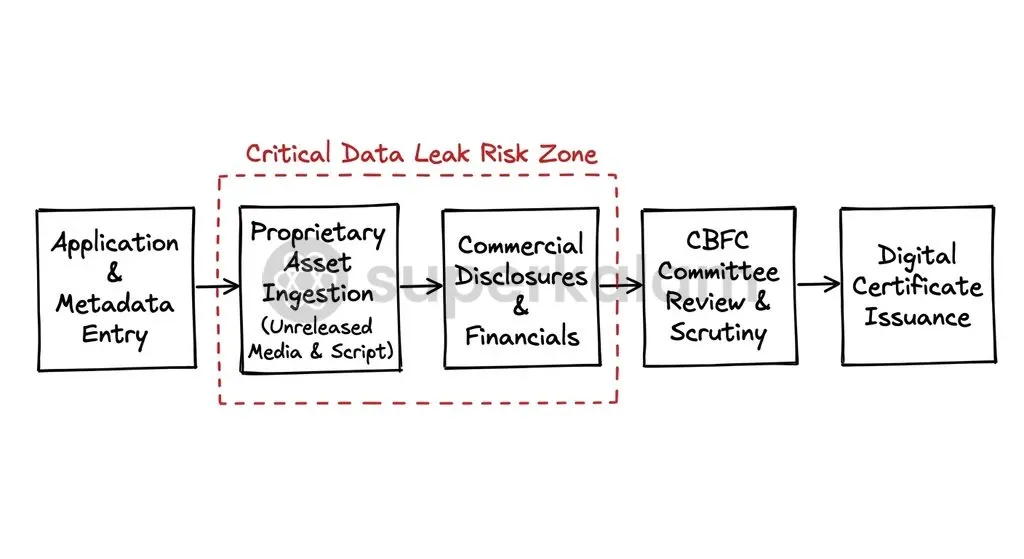
Operating under the statutory authority of the Cinematograph Act, 1952, the platform is the mandatory administrative bridge between filmmakers and the certification board. The submission workflow operates through defined statutory and technical stages:
- Application Lodgment: The applicant producer creates a digital dossier on the portal, providing detailed corporate details, personal identifications, and production metadata.
- Creative Material Ingestion: The applicant uploads unreleased shooting scripts, dialogue sheets, English translations, and complete shot-by-shot lyric sheets.
- Commercial Disclosures: Distribution contracts, chain-of-title documentation, and regional rights agreements are submitted to verify intellectual property ownership.
- Scrutiny and Board Review: CBFC examining committees access the ingested assets to recommend clearance, issue modification directions, or specify cuts.
- Certification Issuance: Following cuts and affidavit submissions, the board generates digital certificates.
In November 2025, the CBFC expanded this platform by deploying a Multilingual Module per a PIB Mumbai Press Release. This module allowed production houses to pursue pan-India multilingual certifications across regional languages through a single unified submission. Consequently, it concentrated high-value cinematic assets within a single database ecosystem.
The Anatomy of the Leak: What Broke and What Data Was Exposed
The data exposure on e-Cinepramaan compromised extensive proprietary assets and sensitive documentation. According to reportage by The Hindu Explained in October 2026, the exposed records included complete shooting scripts, shot-by-shot regional translations, censor cut directives, and confidential commercial film distribution contracts detailing unredacted licensing fees.
The exposure resulted from fundamental endpoint security misconfigurations and broken access controls. Stored attachments lacked zero-trust identity verification, leaving private application endpoints exposed to unauthenticated public requests.
| Parameter | Statutory Public Data | Exposed Confidential Assets |
|---|---|---|
| Legal Basis | Section 5A(2), Cinematograph Act, 1952 | Confidential submissions under administrative rules |
| Data Nature | Final certification category and excised cut summaries | Full unreleased scripts, dialogue sheets, and shooting drafts |
| Commercial Sensitivity | Low (post-release regulatory transparency) | High (confidential licensing rights and distributor fee schedules) |
| Intellectual Property | Public record notification in the Official Gazette | Original proprietary works under Section 14 of the Copyright Act, 1957 |
| System Visibility | Explicitly intended for open public inspection | Mandated for restricted internal scrutiny by appointed panels |
The breach highlights an operational failure to separate statutory transparency outputs from administrative inputs. While the law mandates public release of final certification orders, the portal infrastructure failed to isolate sensitive pre-certification filings.
Discuss with Superkalam
How does the concept of 'compliance theatre' explain why a public portal holding a 'Safe to Host' certification can remain exposed to basic cyber vulnerabilities?
Ask NowBeyond the Glitch: Vendor Procurement and the Trap of Compliance Theatre
The operational breakdown at e-Cinepramaan stems from systemic defects in public technology procurement. Central and state departments routinely outsource the design, development, and maintenance of public portals to external vendors through the Government e-Marketplace (GeM) and departmental tenders.
Under Rule 149 and Rule 150 of the General Financial Rules (GFR), 2017, the default procurement standard remains the lowest evaluated cost bid (L1) for standard services. Vendors selected under L1 often cut costs by deploying generic software templates, bypassing security engineers, and omitting continuous defensive testing.
Procurement guidelines permit alternate frameworks, but administrative practice often ignores them:
- Lowest-Cost (L1) Selection: Default mechanism under GFR Rules 149 and 150, which disincentivises custom secure engineering in favour of generic code templates.
- Quality and Cost Based Selection (QCBS): Permitted under GFR Rule 192 for complex IT systems to balance technical competence against price (ratios like 80:20 or 70:30), but frequently avoided due to administrative inertia and audit concerns per the Manual for Procurement of Consultancy & Other Services.
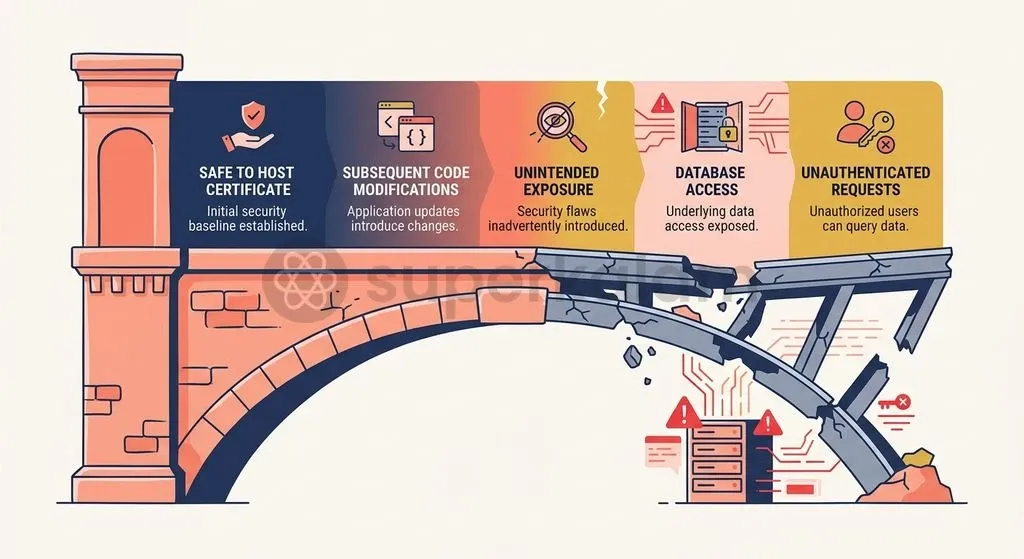
This procurement pattern fosters compliance theatre, where departments treat security as an administrative sign-off rather than an active engineering posture. Public agencies lean heavily on the 'Safe to Host' certification issued by auditing firms empanelled by the Indian Computer Emergency Response Team (CERT-In).
Yet CERT-In's own guidelines specify that a 'Safe to Host' certificate is merely a point-in-time assessment that becomes formally invalid the moment underlying code, configuration files, or database dependencies are altered. When platforms like e-Cinepramaan push new modules, such as the November 2025 multilingual feature, without triggering automated re-auditing pipelines, the system enters an uninspected operational state while retaining paper compliance.
The Wider Fallout: Piracy Risks, Privacy Laws, and State Fiduciary Duty
Regulatory data exposure carries steep economic and legal risks. Under the Copyright Act, 1957, original literary and dramatic works receive automatic protection from the moment of creation, granting authors exclusive rights over public communication and commercial adaptation per Section 13 and Section 14.
When complete shooting scripts and detailed cut orders are exposed before theatrical release, producers face severe risks:
- Premature plot leaks that destroy promotional value and box-office returns.
- Intellectual property infringement and unauthorised script adaptations across overseas markets.
- Loss of commercial bargaining leverage caused by the public disclosure of distribution advances and minimum guarantee terms.
Beyond commercial copyright, the breach implicates the statutory architecture of the Digital Personal Data Protection (DPDP) Act, 2023. Under the Act, any government department processing personal identifiers is a Data Fiduciary.
Section 8(5) of the DPDP Act mandates that every Data Fiduciary must implement reasonable security safeguards to prevent personal data breaches. Section 8(6) obligates the entity to notify both the Data Protection Board of India and affected individuals upon discovering a breach, while Item 1 of the Schedule prescribes penalties up to ₹250 crore for systemic failure to maintain security safeguards.
This administrative duty was established by the Supreme Court in Justice K.S. Puttaswamy (Retd.) v. Union of India (2017). A nine-judge Constitution Bench held that informational privacy and data protection are fundamental rights under Article 21 of the Constitution. The ruling established that the state owes an affirmative fiduciary obligation to safeguard citizen data collected under statutory mandate.
As the Law Commission of India noted in administrative fiduciary analyses, a public authority compelling disclosures under legal penalties holds a much higher institutional standard of care than a private enterprise entering into voluntary commercial contracts. A failure to protect citizen data is not merely a technical glitch—it represents an administrative breach of constitutional trust.
Discuss with Superkalam
Why does statutory data intake by a regulatory authority entail a significantly higher fiduciary standard of care than data gathered via voluntary commercial contracts?
Ask NowSecuring India's Public Portals: Concrete Lessons from the e-Cinepramaan Failure
Remediating public web vulnerabilities requires replacing periodic compliance checks with automated code analysis and enforceable vendor contracts. The e-Cinepramaan failure demonstrates that application defence cannot function as an afterthought.
The Ministry of Electronics and Information Technology (MeitY) and CERT-In have established mandatory incident reporting timelines. CERT-In's statutory directions issued under Section 70B(6) of the Information Technology Act, 2000 require all public and private entities to report security incidents within six hours of detection. Covered entities must also maintain system architecture and infrastructure logs within Indian jurisdiction for a rolling period of 180 days to facilitate forensic auditing.
To translate these requirements into systemic resilience, public IT governance must adopt three institutional reforms:
1. Mandatory DevSecOps and Continuous Testing
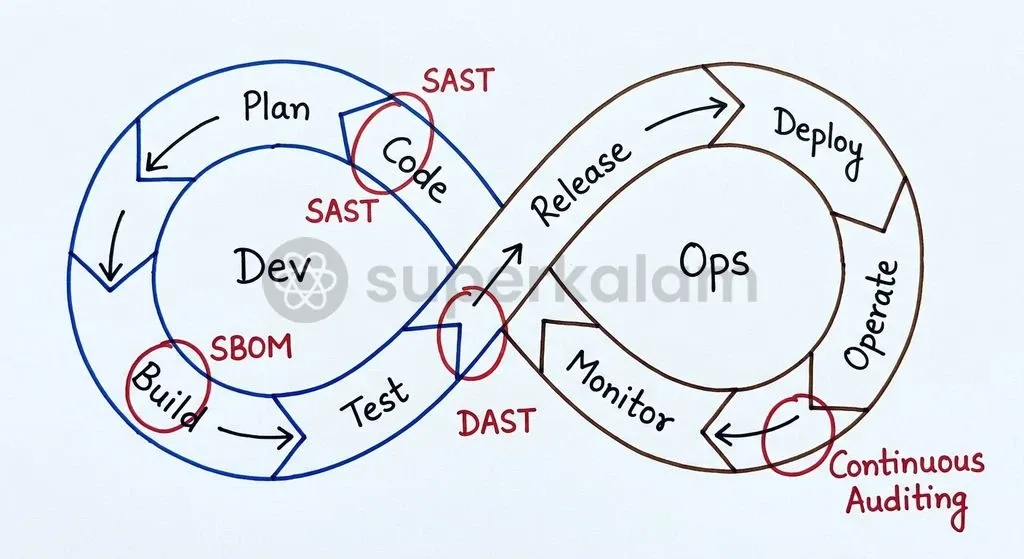
Public sector software pipelines must abandon the illusion of annual audit certifiability. Procurement contracts must mandate automated DevSecOps pipelines that integrate security testing directly into development workflows per CERT-In Technical Guidelines on SBOM and Application Security.
- Static Application Security Testing (SAST): Automated tools scanning source code repositories on every commit to flag hardcoded credentials, misconfigurations, and syntax flaws.
- Dynamic Application Security Testing (DAST): Continuous, automated probing of running web applications to detect accessible endpoints, database injection risks, and broken access controls.
- Software Bill of Materials (SBOM): Maintaining real-time inventories of all third-party libraries, open-source packages, and framework dependencies to rapidly patch discovered vulnerabilities.
2. Contractual Liability and Reformed IT Procurement
Departments must end their default reliance on lowest-cost L1 bidding for software systems managing sensitive regulatory records. Portals handling high-value proprietary assets should be procured exclusively through the Quality and Cost Based Selection (QCBS) framework under Rule 192 of the GFR, 2017, placing primary weighting on vendor cybersecurity capabilities and engineering standards.
Vendor contracts must also include enforceable financial penalty clauses tied to Service Level Agreements (SLAs) for security maintenance. Contracts should define strict timelines for patch remediation, assign shared liability for regulatory penalties incurred under the DPDP Act, and mandate regular third-party penetration testing.
3. Open Vulnerability Disclosure and Bug Bounties
Government departments must move past reflexively denying security breaches. MeitY has operationalised an institutional Vulnerability Disclosure Programme (VDP) managed by the National Critical Information Infrastructure Protection Centre (NCIIPC) and CERT-In per NCIIPC Guidelines for Responsible Vulnerability Disclosure.
Regulators such as the CBFC should actively use these mechanisms by inviting ethical security researchers to identify and responsibly disclose system flaws. Replacing institutional secrecy with systematic vulnerability coordination allows platforms to uncover and fix exposure points before malicious actors exploit them.
Discuss with Superkalam
Between default L1 bidding and Quality and Cost Based Selection (QCBS) under GFR Rule 192, evaluate which approach best balances fiscal discipline with public cybersecurity.
Ask NowKey Takeaways
- The Core Incident: An investigation reported in October 2026 revealed that the CBFC's e-Cinepramaan portal exposed confidential application materials, including unreleased shooting scripts and commercial distribution agreements, for over 500 films submitted between December 2025 and August 2026.
- Procurement Failures: The incident illustrates the danger of lowest-cost L1 vendor selection under GFR Rule 149 and Rule 150, which often leads contractors to sacrifice defensive security-by-design principles to preserve profit margins.
- The Limit of Point-in-Time Audits: The static 'Safe to Host' certificate issued by CERT-In empanelled auditors becomes invalid as soon as new code or modules are deployed, creating a dangerous compliance theatre if not backed by continuous automated monitoring.
- Statutory Liabilities: Unauthorised data exposures on state-run portals violate the fiduciary duties anchored in Article 21 under the Puttaswamy (2017) judgment and trigger liabilities under Section 8(5) and Section 8(6) of the Digital Personal Data Protection Act, 2023.
- Regulatory Reporting Windows: CERT-In directions issued under Section 70B(6) of the Information Technology Act, 2000 mandate that covered government bodies report cyber incidents within six hours and maintain ICT infrastructure logs for 180 days.
- The Way Forward: Securing public digital infrastructure requires shifting from annual checklist audits to automated DevSecOps pipelines (incorporating SAST, DAST, and SBOM tracking), adopting QCBS procurement under GFR Rule 192, and running active vulnerability disclosure programmes.
Mains Question
"The administrative reliance on lowest-cost (L1) procurement under the General Financial Rules (GFR), 2017, combined with periodic 'Safe to Host' certifications, creates a trap of compliance theatre in digital governance." Critically analyse with reference to recent security breaches in public regulatory platforms. (10 Marks)
Evaluate NowMains Question
"When public authorities compel citizens and businesses to disclose proprietary assets and personal data under statutory mandate, failure to provide defensive engineering constitutes an administrative breach of constitutional trust." In light of the Justice K.S. Puttaswamy (2017) judgment and the Digital Personal Data Protection Act, 2023, elucidate the scope of the State's affirmative fiduciary duty as a data custodian. (15 Marks)
Evaluate NowPractice MCQs
QUESTION 1
Consider the following statements regarding the regulatory framework for data protection and public technology procurement in India:
- Under the Digital Personal Data Protection Act, 2023, a Data Fiduciary is statutorily mandated to notify both the Data Protection Board of India and affected individuals in the event of a personal data breach.
- The General Financial Rules (GFR), 2017 permit the Quality and Cost Based Selection (QCBS) method under Rule 192 for procurement of complex IT systems.
- A 'Safe to Host' certification issued by CERT-In empanelled auditors remains legally valid even after subsequent code modifications and database dependency updates. Which of the statements given above is/are correct?
QUESTION 2
With reference to the statutory certification of films and the e-Cinepramaan platform, consider the following statements:
- The e-Cinepramaan portal operates under the statutory authority of the Cinematograph Act, 1952.
- Section 5A(2) of the Cinematograph Act, 1952 mandates the publication of unreleased shooting scripts and commercial distribution contracts in the Official Gazette.
- The Multilingual Module deployed on e-Cinepramaan allows producers to seek pan-India certifications across regional languages via a single unified submission. Which of the statements given above are correct?
QUESTION 3
Consider the following statements regarding public IT procurement mechanisms under the General Financial Rules (GFR), 2017:
- Rule 149 and Rule 150 establish the lowest evaluated cost bid (L1) as the default selection standard for standard public services.
- Quality and Cost Based Selection (QCBS) strictly prohibits evaluating technical competence at a weight higher than price. Which of the statements given above is/are correct?
QUESTION 4
Under Item 1 of the Schedule to the Digital Personal Data Protection (DPDP) Act, 2023, what is the maximum statutory financial penalty prescribed for a Data Fiduciary that fails to implement reasonable security safeguards to prevent a personal data breach?
QUESTION 5
Consider the following statements in the context of administrative fiduciary duties and intellectual property rights in India:
- In Justice K.S. Puttaswamy (Retd.) v. Union of India (2017), the Supreme Court ruled that informational privacy and data protection are fundamental rights under Article 21.
- Under the Copyright Act, 1957, original literary and dramatic works receive automatic legal protection from the moment of creation. Which of the statements given above is/are correct?