DRT3b Enzyme and the Central Dogma: UPSC Explained
DRT3b makes repetitive DNA without a nucleic acid template. See how bacterial defence works and why this does not overturn the central dogma.
Oct, 2026
•7 min read
Overview
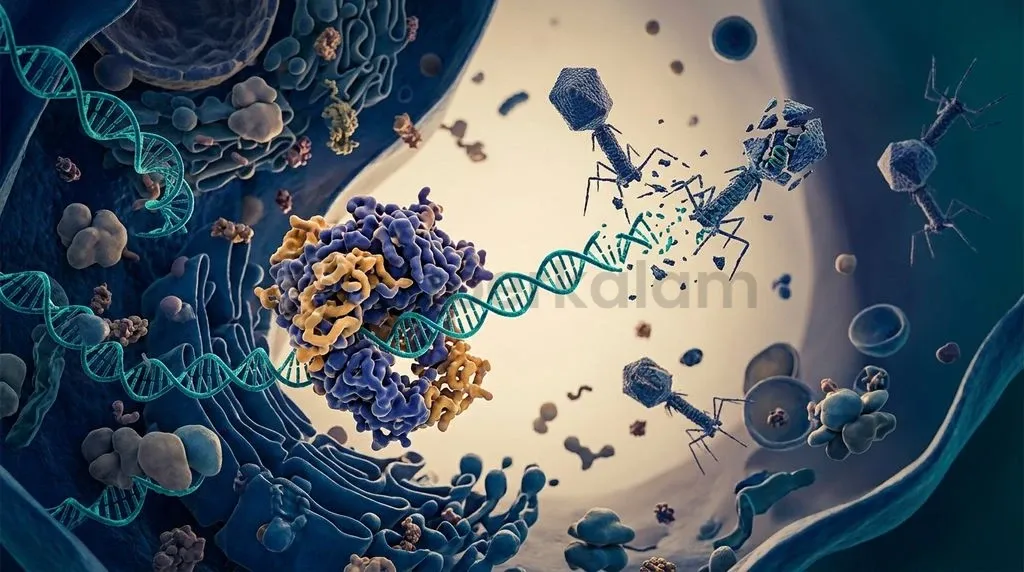
The discovery of the bacterial DRT3b enzyme by Stanford University researchers demonstrates that specific proteins can synthesise alternating dinucleotide DNA without a nucleic acid template. This establishes a novel biochemical mechanism for enzymatic DNA synthesis, while leaving Francis Crick's Central Dogma of molecular biology completely intact. According to a landmark study published in Science, the Escherichia coli defence system couples the templated reverse transcriptase Drt3a with the template-free enzyme Drt3b to manufacture viral-blocking repetitive DNA strands.
Initial commentary suggested this non-templated activity challenged foundational biological rules. However, Drt3b merely enforces a fixed structural pattern rather than reverse-translating complex polypeptide sequences back into genetic information. As of April 2026, this biochemical mechanism deepens our understanding of microbial immunity and unlocks sustainable pathways for enzymatic DNA data storage and therapeutic nucleotide manufacturing.
Why in the News: The Discovery of the DRT3b Enzyme
The discovery of the DRT3b enzyme emerged in April 2026 when Stanford University researchers identified an unprecedented antiphage defence mechanism in Escherichia coli. A research team led by Alex Gao and Deng et al. resolved the structural architecture of the bacterial defence-associated reverse transcriptase 3 (DRT3) system, as reported in Science (Deng et al., 'Protein-templated synthesis of dinucleotide repeat DNA by an antiphage reverse transcriptase', DOI: 10.1126/science.aed1656).
The complex is a specialised ribonucleoprotein machine that halts bacteriophage infection by generating repetitive DNA without relying on host genomic templates. Bacterial immune systems deploy diverse enzymatic weapons to neutralise viral invaders. Key structural dimensions of the discovery include:
- Complex Architecture: It assembles into a D3-symmetric 6:6:6 complex containing six Drt3a subunits, six Drt3b subunits, and a non-coding RNA (ncRNA) scaffold.
- Novel Synthesis Mode: The Drt3b subunit polymerises DNA without reading an RNA or DNA guide.
- Theoretical Debate: The mechanism prompted initial inquiries into whether the enzyme breached classical rules of genetic information flow.
What Is the Central Dogma of Molecular Biology?
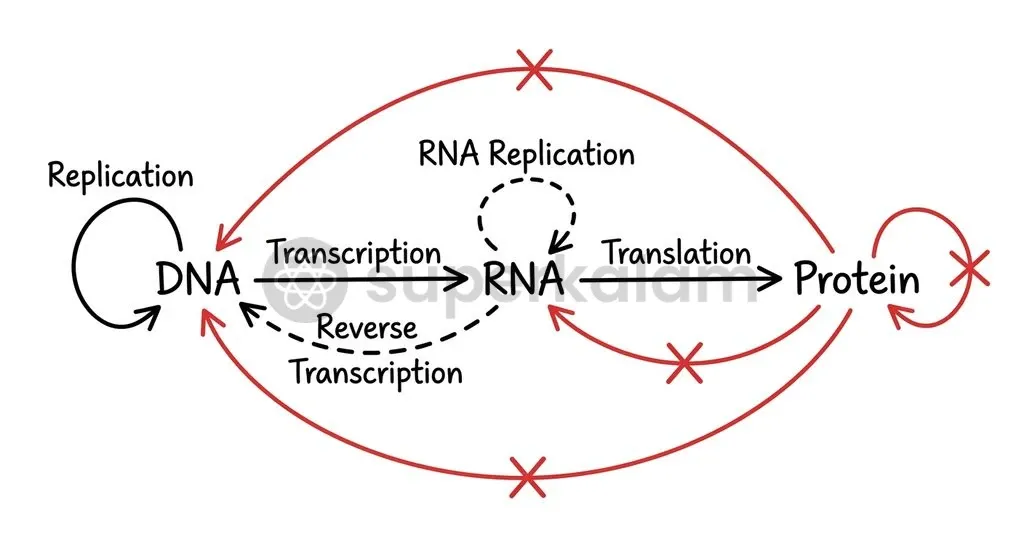
Francis Crick formulated the Central Dogma in 1958 to define how genetic sequence information flows between nucleic acids and functional proteins. As clarified by Francis Crick in Nature (Crick, F., 'Central Dogma of Molecular Biology', Nature 227, 561–563), the dogma states that once detailed residue-by-residue sequence information reaches a protein, it cannot flow back into nucleic acids or other proteins. The framework categorises sequence transfers into three distinct classes:
- General Transfers: Common cellular pathways including DNA-to-DNA replication, DNA-to-RNA transcription, and RNA-to-protein translation.
- Special Transfers: Context-specific pathways comprising RNA-to-RNA replication, RNA-to-DNA reverse transcription, and direct DNA-to-protein translation.
- Forbidden Transfers: Information flows that do not occur in nature, specifically protein-to-protein, protein-to-RNA, and protein-to-DNA sequence transfer.
Biological discoveries over subsequent decades expanded the dogma's nuances without breaking its core rule. In 1970, Howard Temin and David Baltimore discovered reverse transcriptase in retroviruses, proving RNA could serve as a template for DNA synthesis. Later in 1982, Stanley Prusiner characterised prions, which transfer conformational structural states between proteins without altering or reverse-translating primary amino acid sequences.
Discuss with Superkalam
What are the structural components that make up the D3-symmetric complex of the bacterial DRT3 defence system?
Ask NowHow DRT3b Synthesises DNA Without a Template
The DRT3 system operates through a coordinated dual-enzyme mechanism inside Escherichia coli to produce antiphage double-stranded DNA polymers. The synthesis proceeds through distinct catalytic steps:
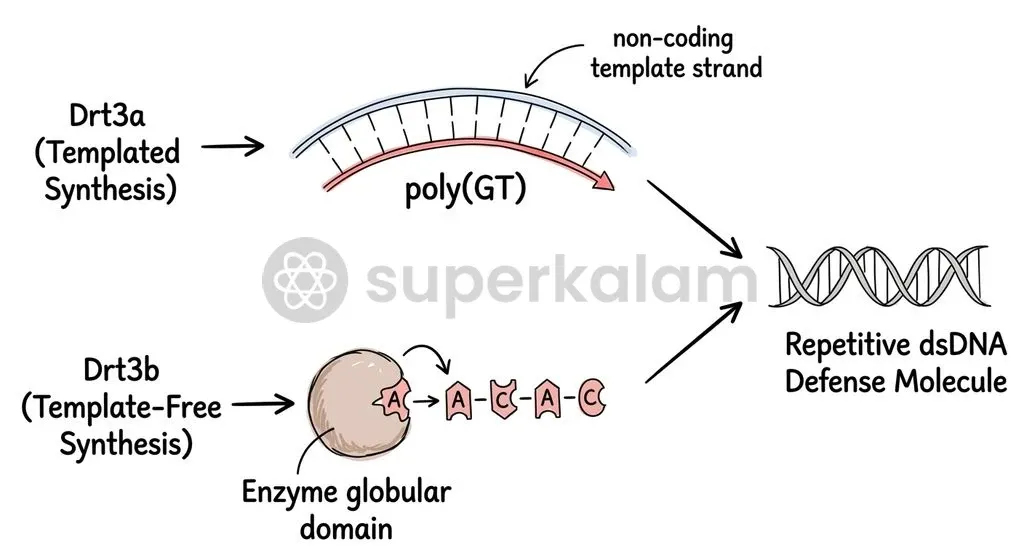
- Templated Reverse Transcription: The Drt3a subunit synthesises a single-stranded poly(GT) DNA strand by reading a conserved ACACAC template motif situated on the ncRNA scaffold.
- Template-Free Strand Synthesis: The Drt3b subunit synthesises a complementary poly(AC) DNA strand without any nucleic acid template, utilising specific amino acid residues within its active site to enforce strict adenine-cytidine dinucleotide alternation.
- Duplex Assembly and Antiphage Arrest: The single-stranded poly(GT) and poly(AC) products pair spontaneously inside the host bacterium to form repetitive double-stranded DNA, inducing bacterial dormancy or abortive infection to halt viral replication.
Discuss with Superkalam
How does the dual-enzyme mechanism of Drt3a and Drt3b work together to halt bacteriophage replication in E. coli?
Ask NowComparison: Standard DNA Polymerase vs DRT3b Mechanism
Standard DNA polymerases require a complementary nucleic acid template strand, whereas the DRT3b enzyme utilises steric active-site constraints to govern nucleotide addition. The following table contrasts standard polymerisation mechanisms with template-independent enzymes:
| Feature / Mechanism | Standard DNA Polymerase | Terminal Deoxynucleotidyl Transferase (TdT) | Viral Reverse Transcriptase | DRT3b Subunit |
|---|---|---|---|---|
| Primary Template | DNA template strand | None (template-independent) | RNA template strand | None (template-free) |
| Primer Requirement | Requires RNA or DNA primer | Requires free 3'-OH end | Requires primer (tRNA/DNA) | Primer-independent extension |
| Nucleotide Selectivity | Watson-Crick base pairing | Random dNTP incorporation | Watson-Crick base pairing | Steric active-site pocket |
| Sequence Output | High-fidelity complement | Uncontrolled homopolymer tails | Complementary cDNA | Strict poly(AC) repeats |
| Biological Role | Genome replication & repair | V(D)J immune diversification | Viral genome replication | Antiphage bacterial defence |
Why Template-Free Synthesis Does Not Overturn Francis Crick's Dogma
Francis Crick defined the Central Dogma as a prohibition against reverse-translating arbitrary amino acid sequences back into genetic code, a rule DRT3b does not violate. According to scientific analysis in Frontiers in Microbiology / The Hindu Science Analysis, Drt3b does not read a polypeptide's variable sequence to encode corresponding codons into DNA. Instead, Drt3b is a structural biocatalyst whose active site physically accommodates only alternating adenine and cytidine triphosphates.
Biochemists have long recognized non-templated DNA polymerisation in other natural systems:
- Precedent in Vertebrate Immunity: As detailed in NCERT Class XII Biology (Chapter: Biotechnology - Principles and Processes), Terminal Deoxynucleotidyl Transferase (TdT) randomly adds deoxynucleotides to the 3'-ends of DNA molecules during immunological gene rearrangement without consulting a template.
- Absence of Reverse-Translation: Drt3b generates a fixed, invariant dinucleotide repeat rather than translating protein sequence data into genetic sequences.
- Intact Directional Boundary: Because no complex sequence information travels backwards from protein to nucleic acid, the directional information boundary established by Francis Crick remains unbreached.
Discuss with Superkalam
How could engineered non-templated reverse transcriptases be applied inside human cells to treat viral infections or immune disorders?
Ask NowPotential Applications in Biotechnology, Data Storage, and Medicine
Enzymatic DNA Synthesis technologies powered by novel polymerases like DRT3b offer sustainable alternatives to conventional chemical phosphoramidite synthesis methods. Chemical DNA synthesis requires toxic reagents and produces hazardous organic waste, creating significant environmental burdens.
Enzymatic approaches provide several transformative advantages across industry and medicine:
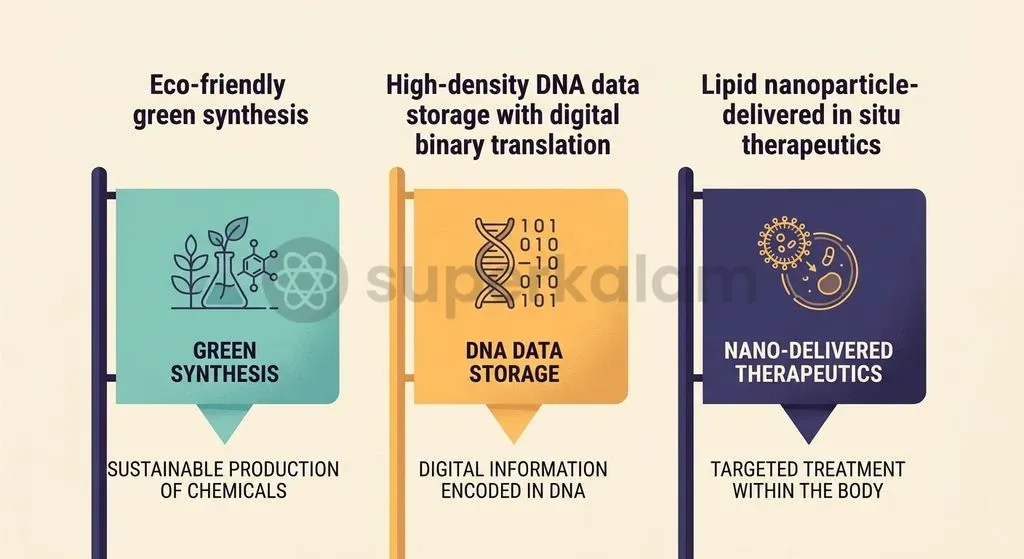
- Eco-Friendly Biomanufacturing: Enzymatic DNA Synthesis (EDS) operates in benign aqueous buffers, eliminating hazardous organic solvents and reducing industrial chemical waste.
- High-Density DNA Data Storage: Synthetic enzymatic platforms achieve superior write densities required to archive petabytes of digital data per gram of DNA.
- Targeted In Situ Therapeutics: Engineered non-templated reverse transcriptases can be packaged into lipid nanoparticle-delivered mRNA vectors to synthesise custom DNA decoys, CpG immunostimulants, and aptamers directly within diseased cells.
Way Forward: The Expanding Frontier of Synthetic Biology
India's biotechnology sector must integrate emerging enzymatic DNA synthesis discoveries to bolster national biomanufacturing capabilities and precision medicine infrastructure. Modernising nucleotide synthesis platforms is critical to reducing import dependencies on toxic phosphoramidite reagents while advancing biosecurity and data storage solutions.
Key strategic priorities include:
- Harnessing Biocatalytic Platforms: Investing in domestic enzyme engineering pipelines to adapt template-free polymerases for high-throughput gene assembly.
- Establishing Biosafety Frameworks: Formulating clear regulatory guidelines for synthetic repeat DNA constructs to ensure biosafety while encouraging research in antiphage defence mechanisms.
- Fostering Translational Diagnostics: Integrating non-templated enzymatic tools into point-of-care molecular diagnostic devices for rapid pathogen identification.
Discuss with Superkalam
Compare the nucleotide incorporation mechanisms and sequence outputs of DRT3b, Terminal Deoxynucleotidyl Transferase (TdT), and standard DNA polymerases.
Ask NowKey Takeaways
- The DRT3 system from Escherichia coli contains Drt3a (which copies an ncRNA scaffold) and Drt3b (which synthesises poly(AC) DNA without a nucleic acid template).
- Francis Crick's Central Dogma prohibits the reverse-translation of protein sequences into nucleic acids; it does not ban template-free enzymatic nucleotide polymerisation.
- Drt3b relies on active-site amino acid constraints to enforce alternating nucleotide addition, functioning as a repetitive catalyst rather than an information translator.
- Template-independent synthesis is well-documented in classical biochemistry, exemplified by Terminal Deoxynucleotidyl Transferase (TdT) in vertebrate immune diversification.
- Enzymatic DNA synthesis provides eco-friendly manufacturing pathways for digital DNA storage, therapeutic nucleotide vectors, and precision synthetic biology tools.
Mains Question
"The discovery of template-independent enzymatic synthesis in bacterial defence systems expands our understanding of biochemical catalysis without breaching the directional boundaries of Francis Crick's Central Dogma." Elucidate. (10 Marks)
Evaluate NowMains Question
Enzymatic DNA Synthesis (EDS) is emerging as a sustainable alternative to conventional chemical phosphoramidite methods. In this context, examine the technological potential of template-free biocatalysts and outline the strategic imperatives for developing domestic synthetic biology infrastructure. (15 Marks)
Evaluate NowPractice MCQs
QUESTION 1
With reference to the bacterial Defence-Associated Reverse Transcriptase 3 (DRT3) system discovered in Escherichia coli, consider the following statements:
- It functions as a D3-symmetric 6:6:6 complex comprising Drt3a, Drt3b, and a non-coding RNA (ncRNA) scaffold.
- The Drt3a subunit synthesises a single-stranded poly(GT) DNA strand by reading an ACACAC motif on the ncRNA scaffold.
- The Drt3b subunit synthesises a poly(AC) DNA strand without reading a nucleic acid template.
Which of the statements given above are correct?
QUESTION 2
Regarding the Central Dogma of molecular biology formulated by Francis Crick and related biological mechanisms, consider the following statements:
- The Central Dogma strictly prohibits the flow of sequence information from proteins back into nucleic acids or other proteins.
- The template-free activity of the DRT3b enzyme overturns the Central Dogma by reverse-translating polypeptide sequences into DNA.
- Terminal Deoxynucleotidyl Transferase (TdT) is an example of a template-independent DNA polymerase operating in vertebrate immune systems.
Which of the statements given above is/are correct?
QUESTION 3
Consider the following statements comparing DRT3b with other DNA polymerisation mechanisms:
- Standard DNA polymerases require both a nucleic acid template strand and an RNA or DNA primer to initiate synthesis.
- Terminal Deoxynucleotidyl Transferase (TdT) synthesises strict dinucleotide repeats through steric active-site constraints.
- Unlike standard DNA polymerases, the DRT3b subunit is capable of primer-independent extension.
Which of the statements given above is/are correct?
QUESTION 4
Consider the following statements regarding the applications and environmental benefits of Enzymatic DNA Synthesis (EDS):
- EDS operates in benign aqueous buffers, eliminating the hazardous organic solvents typical of chemical phosphoramidite synthesis.
- Enzymatic synthesis platforms enable high-density digital data storage with superior write densities per gram of DNA.
- Engineered non-templated reverse transcriptases can be delivered via lipid nanoparticles to synthesise therapeutic DNA decoys directly inside diseased cells.
Which of the statements given above are correct?
QUESTION 5
In the context of bacterial immunity, how does the Escherichia coli DRT3 ribonucleoprotein machine execute antiphage defence?