DRDO AIP Submarine System: Closing India's Undersea Gap
As submarine fleet deficits widen amid Project-75I delays, DRDO's fuel-cell AIP offers an indigenous bridge to sustain stealth in the Indian Ocean.
Oct, 2026
•9 min read
Overview
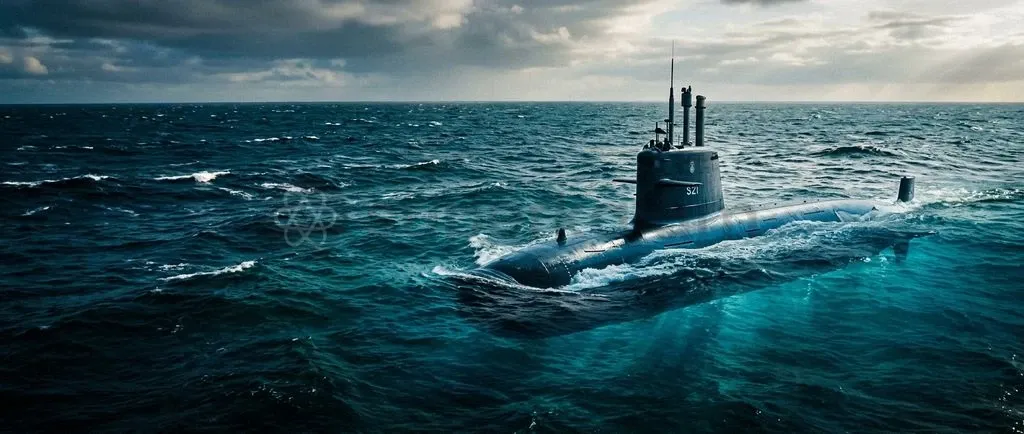
The Defence Research and Development Organisation's Naval Materials Research Laboratory has developed an indigenous Air Independent Propulsion system. It utilises a phosphoric acid fuel cell to generate hydrogen on board. This extends the submerged endurance of conventional submarines without the explosive hazards of compressed gas storage.
Replacing atmospheric snorkelling with electrochemical power generation cuts indiscretion rates to near zero. This fills a significant undersea operational gap in the Indian Ocean. While Project-75I faces delays and complex retrofits remain, this indigenous system marks a decisive stepping stone toward self-reliance in naval deterrence.
Why in the News? The Push for Indigenous Submarine Propulsion
The Defence Research and Development Organisation marked a major milestone on 24 October 2026 by inaugurating advanced integration trials in Hazira, Gujarat. According to the Press Information Bureau, Setting to Work Phase-2 (STW-2) activity for the indigenous Air Independent Propulsion (AIP) Energy Module commenced at Larsen & Toubro's AM Naik Heavy Engineering Complex.
As of October 2026, the Indian Navy is moving to install this technology directly into its operational fleet. The key steps driving this transition include:
- Land-Based Validation: DRDO proved the Naval Materials Research Laboratory (NMRL) prototype in Mumbai across continuous endurance and maximum power modes.
- Industrial Integration Pact: The Ministry of Defence signed a ₹1,990 crore contract with Mazagon Dock Shipbuilders Limited (MDL) on 30 December 2024 to build and install the AIP plug.
- Operational Concealment: Conventional diesel-electric submarines require non-nuclear auxiliary power to remain hidden beneath surface tracks.
Developing a domestic AIP system shields India's undersea deterrent from modern airborne radar and maritime surveillance.
India's Undersea Deficit: The Lagging Force Levels and Project-75I Bottlenecks
The Indian Navy operates well below the force levels set by national security planners. In July 1999, the Cabinet Committee on Security (CCS) approved a 30-year submarine building plan. It mandated 24 conventional attack submarines by 2030 across Project-75 and Project-75I, followed by the indigenous Project-76.
As of October 2026, the Indian Navy operates just 16 conventional diesel-electric attack submarines, missing the 24-boat target envisioned for 2030. The active conventional fleet comprises:
- Six Kalvari-class (French Scorpène design) submarines;
- Four Shishumar-class (German HDW Type 209) submarines;
- Six Sindhughosh-class (Russian Kilo-class Type 877EKM) submarines.
Project-75 delivered six Kalvari-class boats from Mazagon Dock Shipbuilders Limited, but Project-75I ran into technical and procedural roadblocks. Mandating sea-proven fuel-cell AIP systems narrowed foreign competition and slowed vendor negotiations. This multi-year delay creates a sharp capability gap while regional navies step up patrols across the northern Indian Ocean.
Discuss with Superkalam
Recall the operational target set by the Cabinet Committee on Security in 1999 for conventional submarines by 2030, and compare it with the active fleet size as of October 2026.
Ask NowHow Air Independent Propulsion Works: Breaking the Snorkeling Vulnerability
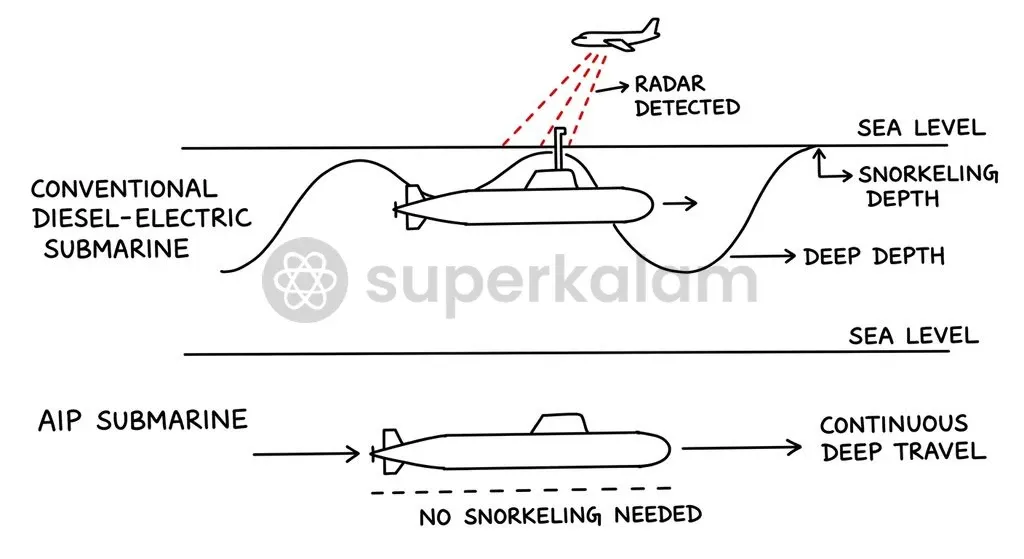
Conventional diesel-electric submarines (SSKs) must surface or snorkel regularly to recharge their batteries using diesel generators. This intake process requires running noisy engines at periscope depth through a raised mast. That operating routine makes the boat vulnerable to detection.
Technical assessments show conventional submarines face an indiscretion rate of 10% to 30%, forcing them to snorkel every 24 to 72 hours. Snorkelling creates thermal plumes, reflects radar off the exposed mast, and generates acoustic noise picked up by maritime patrol aircraft.
| Submarine Configuration | Operational Profile | Tactical Vulnerability |
|---|---|---|
| Conventional SSK | Surfaced / Snorkelling (10–30% of patrol) | Exposed to radar and ASW sensors |
| AIP Integration | Submerged patrol (Up to 21 continuous days) | Acoustically silent and hidden |
NMRL's fuel-cell module reduces the submarine's indiscretion rate to near zero. Generating electricity electrochemically extends submerged patrol runs from 3 to 4 days up to 14 to 21 days at speeds of 4 to 6 knots. Consequently, submarines can loiter undetected in strategic waters without raising masts.
Inside DRDO-NMRL's Fuel Cell: The Sodium Borohydride Mechanism Explained
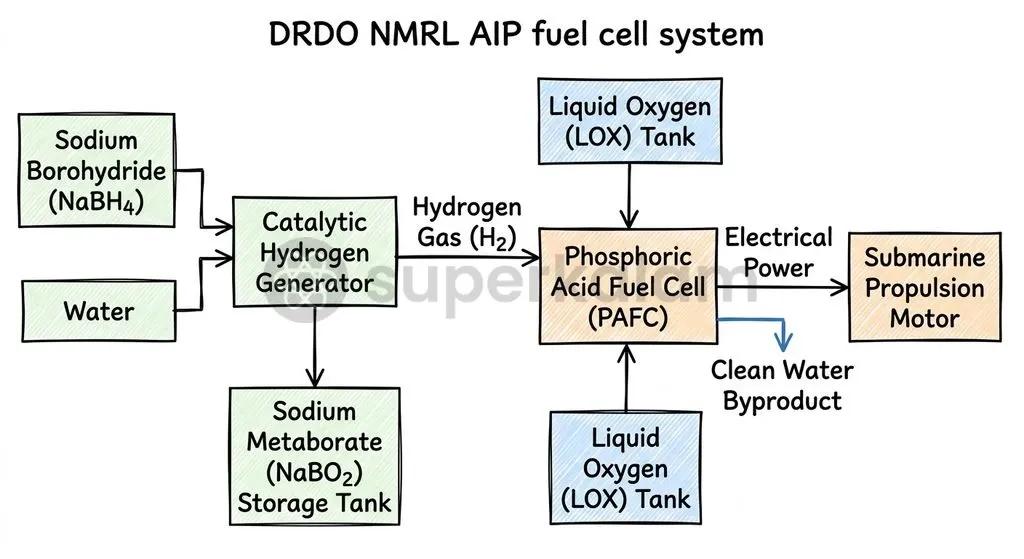
NMRL chose a fuel cell layout that eliminates the hazard of storing compressed gas inside a submarine hull. The power plant is a 270 kW Phosphoric Acid Fuel Cell (PAFC) that uses concentrated phosphoric acid in a silicon carbide (SiC) matrix as its electrolyte. It combines hydrogen with pure liquid oxygen to produce direct-current electricity.
Instead of carrying compressed or cryogenic gas, the system generates hydrogen on demand via the catalytic hydrolysis of Sodium Borohydride ($\text{NaBH}_4$):
$$\text{NaBH}_4 + 2\text{H}_2\text{O} \xrightarrow{\text{catalyst}} \text{NaBO}_2 + 4\text{H}_2 + \text{Heat}$$
This on-demand extraction avoids the explosive hazards of keeping high-pressure hydrogen inside an enclosed pressure hull. However, the chemical design introduces distinct engineering trade-offs:
- Volumetric Deadweight: Carrying aqueous Sodium Borohydride brings a volumetric and weight penalty compared to elemental hydrogen gas.
- Thermal Management: Strong heat from catalytic hydrolysis requires constant cooling loops to prevent thermal runaway.
- Effluent Handling: The reaction leaves Sodium Metaborate ($\text{NaBO}_2$), which cannot be discharged overboard without leaving detectable acoustic or chemical trails.
- Holding Tanks: The spent solution must be retained in dedicated internal holding tanks, requiring trim adjustments as fuel mass converts.
A key advantage of NMRL's PAFC is its operating range. Running at 150°C to 200°C, phosphoric acid cells resist trace impurities and carbon monoxide that would foul low-temperature platinum catalysts.
Discuss with Superkalam
Explain how the catalytic hydrolysis of Sodium Borohydride removes the primary safety hazard associated with conventional fuel-cell submarines.
Ask NowAIP Technology Face-Off: NMRL's Fuel Cell vs Stirling, MESMA, and German PEM
Navies deploy different AIP designs that balance fuel efficiency against underwater radiated noise. These systems rely either on thermal-cycle combustion engines or electrochemical fuel cells.
Sweden's Saab Kockums developed the Stirling engine, a closed-cycle setup burning pure liquid oxygen and low-sulphur diesel fuel. It drives reciprocating pistons to run a generator. The engine is proven, but moving parts generate vibration, and exhaust gases must be forced into the sea.
France built the MESMA (Module d'Energie Sous-Marine Autonome) system, which is a miniature closed-cycle steam turbine burning ethanol and liquid oxygen. MESMA delivers a lower efficiency of 20% to 25% and produces thermal signatures that complicate stealth.
Germany's ThyssenKrupp Marine Systems uses low-temperature Proton Exchange Membrane (PEM) cells. PEM modules run silently at high efficiency, but store hydrogen externally in heavy metal-hydride cylinders.
| Parameter | DRDO-NMRL AIP (India) | Stirling Engine (Sweden) | MESMA Turbine (France) | Siemens PEM Fuel Cell (Germany) |
|---|---|---|---|---|
| Operating Principle | Phosphoric Acid Fuel Cell (PAFC) | Closed-cycle external combustion | Closed-cycle steam turbine | Proton Exchange Membrane (PEM) |
| Fuel / Oxidiser | On-board $\text{NaBH}_4$ hydrolysis / Liquid Oxygen | Diesel fuel / Liquid Oxygen | Ethanol combustion / Liquid Oxygen | External metal hydride $\text{H}_2$ / Liquid Oxygen |
| Operating Temperature | 150°C to 200°C | High combustion thermal cycle | High steam thermal cycle | ~80°C |
| Conversion Efficiency | Moderate to High (~40–45%) | Moderate (~30–35%) | Low (~20–25%) | High (~50–60%) |
| Acoustic Signature | Extremely Low (no moving parts) | Moderate (reciprocating machinery) | Noticeable (turbines and pumps) | Extremely Low (no moving parts) |
| Exhaust / Byproducts | Aqueous $\text{NaBO}_2$ stored internally | $\text{CO}_2$ exhaust pumped overboard | Exhaust gas dissolved overboard | Pure water ($\text{H}_2\text{O}$) |
| Primary Drawback | Volumetric penalty of storage tanks | Moving parts cause acoustic noise | Low efficiency and heat signature | Heavy external hydride storage |
These trade-offs explain why DRDO chose fuel cells. Eliminating combustion and mechanical pistons gives the platform the acoustic silence needed to elude sub-surface tracking.
Discuss with Superkalam
If a conventional submarine with an indiscretion rate of 25% is deployed in a radar-monitored choke point, apply the article's data to illustrate how an AIP upgrade alters its detection profile.
Ask NowRetrofit Roadblock: Integrating NMRL AIP into the Kalvari-Class Fleet
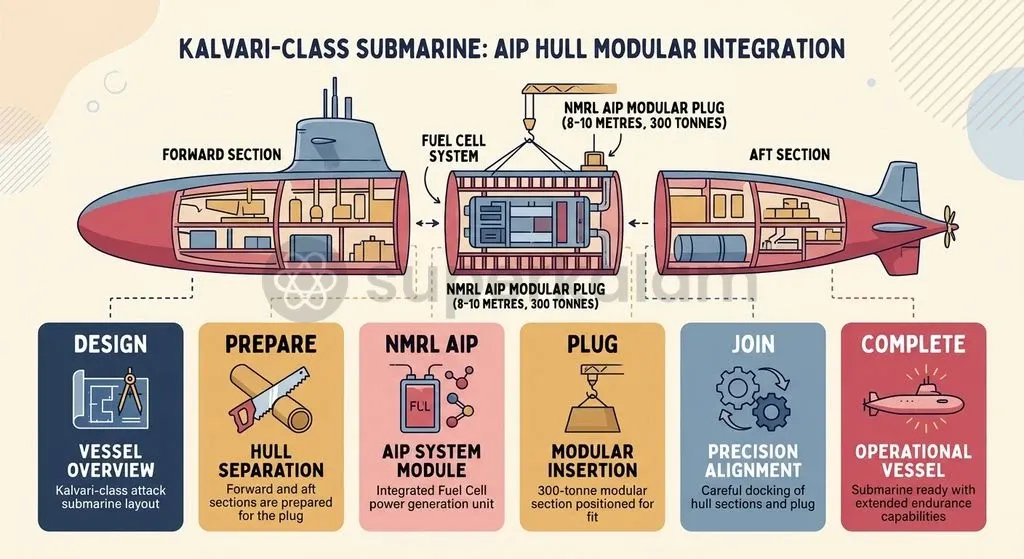
Mazagon Dock Shipbuilders Limited faces rigorous fabrication demands in retrofitting Scorpène-class hulls. Fitting an operational submarine with an AIP plug requires a major structural modification called jumboisation. Technicians must slice the hull open midships and insert a modular section measuring roughly 8 to 10 metres in length and weighing 300 tonnes.
Key Stages of the Jumboisation Sequence:
- Pressure Hull Sectioning: Engineers cut the high-tensile pressure hull midships between accommodation and machinery compartments.
- Module Insertion: Shipbuilders align and insert the 300-tonne modular AIP plug.
- Hull Re-integration: Technicians reweld the hull to form a single, lengthened submarine body.
Technical documentation highlights several complex engineering hurdles:
- High-Tensile Metallurgy: Cutting and welding the 80 HLES high-yield stress alloy requires strict thermal controls to prevent micro-fissures under deep-sea pressure.
- Hydrodynamic and Centre-of-Gravity Shifts: A longer hull changes displacement, pitch, and drag, demanding updates to the Submarine Tactical Integrated Combat System.
- Cryogenic Safety: Routing high-pressure liquid oxygen lines across compartments requires vacuum insulation and isolation valves to manage fire hazards.
On 23 January 2023, NMRL and Naval Group France signed an agreement to complete detailed design and certify structural safety. The first installation will occur during the Major Refit and Life Certification (MRLC) of the lead Kalvari submarine in early 2027. Completing this work on schedule will test domestic shipyard throughput.
Strategic Imperative: Maritime Deterrence in the Indian Ocean and the Way Forward
The Indian Maritime Security Strategy prioritises layered undersea deterrence to protect commercial sea lanes across the Indian Ocean. Operational doctrine divides missions by submarine type. Silent, AIP-fitted conventional submarines (SSKs) excel at choke-point ambushes across the Malacca, Sunda, and Lombok straits. Meanwhile, nuclear-powered attack submarines (SSNs) handle sustained, high-speed open-ocean patrols.
To sustain fleet numbers while indigenous AIP matures, the Defence Acquisition Council approved Acceptance of Necessity on 13 July 2023 for three additional Scorpène submarines built with factory-fitted AIP plugs. Concurrently, the Cabinet Committee on Security approved the construction of two nuclear attack submarines under Project 77 on 9 October 2024 at an estimated cost of ₹40,000 crore at the Ship Building Centre in Visakhapatnam.
Indian naval planners must focus on three operational priorities:
- Accelerate Industrial Production: MDL and domestic partners must streamline plug fabrication so MRLC refits stay within scheduled dockyard cycles.
- Secure Chemical Supply Chains: Naval commands must guarantee steady supplies of high-purity Sodium Borohydride and liquid oxygen at operating bases.
- Scale Project-76 Design Work: Technical insights from the 270 kW PAFC system should guide higher-output fuel cells for the future, fully indigenous Project-76 line.
Deploying the NMRL fuel cell strengthens domestic naval design. While refits pose manufacturing challenges, domestic AIP technology ensures India's conventional fleet can hold regional choke points silently and reliably.
Discuss with Superkalam
Analyse the trade-offs between mechanical AIP systems (like Stirling and MESMA) and electrochemical systems (like NMRL PAFC and Siemens PEM) in terms of efficiency and acoustic stealth.
Ask NowKey Takeaways
- The Naval Materials Research Laboratory developed a 270 kW Phosphoric Acid Fuel Cell AIP system, generating hydrogen on demand to eliminate hazardous gas storage.
- Hydrogen is produced by the catalytic hydrolysis of Sodium Borohydride ($\text{NaBH}_4$), with spent sodium metaborate ($\text{NaBO}_2$) stored internally.
- Adding the AIP module cuts a submarine's indiscretion rate to near zero, expanding submerged endurance from 3 to 4 days up to 14 to 21 days.
- As of October 2026, the Indian Navy operates 16 conventional submarines, remaining short of the 24-submarine target set for 2030 by the 1999 CCS plan.
- Fleet expansion relies on a twin approach: retrofitting Kalvari-class hulls during early 2027 refits while initiating nuclear attack submarine builds under Project 77.
Mains Question
"Replacing atmospheric snorkelling with electrochemical power generation cuts indiscretion rates to near zero, filling an operational gap in undersea deterrence." In light of this statement, examine the technical trade-offs of the DRDO-NMRL Phosphoric Acid Fuel Cell (PAFC) and its significance for the Indian Navy's conventional submarine fleet. (10 Marks)
Evaluate NowMains Question
The 1999 Cabinet Committee on Security (CCS) 30-year submarine building plan mandated a force level of 24 conventional attack submarines by 2030, yet force levels remain constrained at 16 boats. Critically analyse the technological and industrial challenges involved in bridging India's undersea deficit through indigenous AIP integration and retrofitting. (15 Marks)
Evaluate NowPractice MCQs
QUESTION 1
With reference to the Air Independent Propulsion (AIP) system developed by DRDO's Naval Materials Research Laboratory (NMRL), consider the following statements:
- It utilises a Phosphoric Acid Fuel Cell (PAFC) operating at elevated temperatures between 150°C and 200°C.
- Hydrogen for electrochemical power generation is stored externally in high-pressure cryogenic cylinders within the hull.
- The chemical reaction produces aqueous Sodium Metaborate (NaBO2), which is stored internally rather than discharged overboard.
Which of the statements given above are correct?
QUESTION 2
Consider the following statements regarding the operational characteristics of conventional submarines (SSKs) versus AIP-equipped submarines:
- Conventional diesel-electric submarines exhibit an indiscretion rate of 10% to 30% due to periodic snorkelling requirements.
- Integration of the NMRL fuel cell system cuts the indiscretion rate to near zero.
- AIP systems allow conventional submarines to remain submerged continuously for up to 14 to 21 days at low patrol speeds.
Which of the statements given above is/are correct?
QUESTION 3
With reference to different submarine Air Independent Propulsion (AIP) technologies, consider the following pairs:
- MESMA : Closed-cycle steam turbine burning ethanol and liquid oxygen
- Stirling Engine : Closed-cycle external combustion with moving reciprocating pistons
- Siemens PEM : High-temperature fuel cell generating hydrogen from sodium borohydride
Which of the pairs given above is/are correctly matched?
QUESTION 4
Regarding the structural retrofitting of the indigenous AIP system into the Indian Navy's Kalvari-class fleet, what does the engineering process known as 'jumboisation' entail?
QUESTION 5
Consider the following statements regarding India's submarine force levels and strategic planning:
- The 1999 Cabinet Committee on Security (CCS) 30-year plan envisioned 24 conventional attack submarines by 2030.
- As of October 2026, the active conventional fleet stands at 16 submarines.
- The current conventional fleet includes Kalvari-class, Shishumar-class, and Sindhughosh-class submarines.
Which of the statements given above are correct?