DPDP Act in Hospitals: Why Clinical Consent Falls Short
Hospitals can no longer treat surgical consent as a digital privacy waiver under the DPDP Act without risking statutory penalties of up to ₹250 crore.
Oct, 2026
•11 min read

Overview
The Digital Personal Data Protection Act, 2023 establishes that obtaining clinical consent for surgical or medical treatment under National Medical Commission guidelines no longer gives healthcare providers lawful authority to collect, digitise, or share a patient's personal health data. Under the statute, hospitals operate as statutory Data Fiduciaries bound by strict purpose limitation, mandatory itemised notices, and verifiable security safeguards. While Section 7 carves out narrow legitimate-use exemptions for acute life-threatening emergencies, treating medical consent as an all-inclusive privacy waiver violates informational self-determination under Article 21. As of March 2025, healthcare administrators face statutory financial penalties of up to ₹250 crore for data security lapses, requiring hospitals to fundamentally decouple bedside clinical care from digital personal data compliance.
Why Patient Data Privacy in Hospitals Is in the Spotlight
The Supreme Court of India recognised health data as an intimate zone of personal privacy requiring constitutional protection under Article 21 in the landmark Puttaswamy judgment. Writing for the nine-judge bench, the Court affirmed that informational privacy forms an intrinsic facet of human dignity and personal liberty. Because health records expose vulnerable physiological, genetic, and psychological details, mishandling medical records inflicts severe dignitary and social harm.
Modern hospitals no longer function as isolated physical clinics. Digital workflows like electronic health records, automated insurance verification, telemedicine portals, and diagnostics routinely digitise sensitive patient information across connected networks. This technological shift has outpaced traditional administrative practices, leaving large troves of patient records exposed on institutional servers.
The Digital Personal Data Protection Act, 2023 transforms this constitutional doctrine into a binding regulatory regime. Under Section 2(i) of the statute, hospitals qualify as Data Fiduciaries because they determine the purpose and means of processing personal health data. Blanket admission forms that bundle medical treatment with commercial data sharing no longer satisfy legal standards, exposing healthcare administrators to direct regulatory scrutiny.
Clinical Consent vs Data Consent: What Sets Them Apart
Indian medical jurisprudence draws a strict boundary between physical clinical consent under common law and digital data consent under the Digital Personal Data Protection Act, 2023. For decades, hospital admission protocols relied on a single signature to cover diagnosis, surgical risk, physical handling, and administrative record-keeping. The new statutory framework renders this unified approach legally invalid.
Clinical consent originates in medical ethics and tort law. In Samira Kohli v. Dr. Prabha Manchanda (2008), the Supreme Court established that a doctor must secure informed consent before initiating physical procedures, ensuring the patient understands the nature, risks, and alternatives of the intervention. Regulated by the National Medical Commission, this doctrine shields physicians against allegations of assault, battery, or negligence, but it confers no legal authority to digitise, store, or profile patient information.
+-------------------------------------------------------------------------+
|                    THE DUAL CONSENT ARCHITECTURE                        |
|                                                                         |
|  +--------------------------------+  +-------------------------------+  |
|  |     CLINICAL CONSENT           |  |     DATA CONSENT              |  |
|  |  (Samira Kohli / NMC Rules)    |  |  (DPDP Act, 2023, Sec 6)      |  |
|  +--------------------------------+  +-------------------------------+  |
|  | • Bodily integrity            |  | • Informational self-         |  |
|  | • Authorises physical surgery  |  |   determination               |  |
|  | • Protects doctor from battery |  | • Limits storage and sharing  |  |
|  | • Non-negotiable for care      |  | • Fines up to ₹250 crore      |  |
|  | • Regulated by NMC             |  | • Freely withdrawable         |  |
|  +--------------------------------+  +-------------------------------+  |
+-------------------------------------------------------------------------+
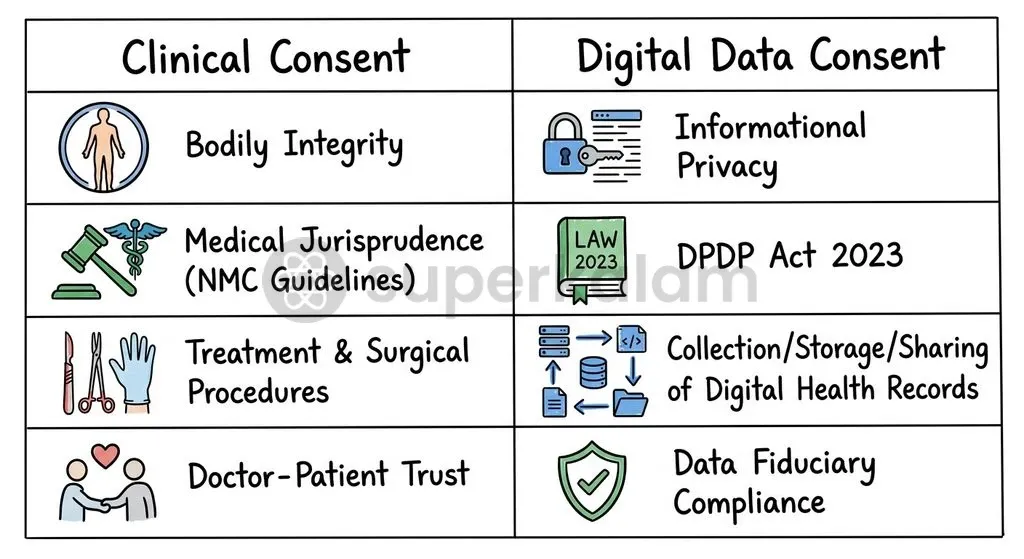
Data consent, by contrast, protects informational self-determination rather than bodily integrity. Governed by Section 6(1) of the DPDP Act, 2023, it demands explicit permission to process digital personal data for designated purposes. A patient may willingly consent to an emergency appendectomy while refusing to let the hospital transfer diagnostic records to marketing networks or third-party insurers.
| Dimension | Clinical Consent | Digital Data Consent |
|---|---|---|
| Governing Framework | NMC Regulations; Samira Kohli (2008) precedent | Digital Personal Data Protection Act, 2023 |
| Primary Legal Objective | Safeguards bodily integrity against battery | Safeguards informational privacy under Article 21 |
| Scope of Authorisation | Authorises physical examination and surgery | Authorises digital data processing and transfer |
| Revocability | Cannot be revoked retroactively once surgery starts | Revocable at any stage under Section 6(4) |
| Consequence of Breach | Medical negligence or disciplinary action by NMC | Statutory penalties of up to ₹250 crore |
Discuss with Superkalam
What is the maximum financial penalty stipulated under the DPDP Act, 2023 for failure to maintain verifiable data security safeguards?
Ask NowWhen Hospitals Must Ask for Patient Permission Under the DPDP Act
Section 6(1) of the Digital Personal Data Protection Act, 2023 requires hospitals to secure consent that is freely given, specific, informed, unconditional, and unambiguous through clear affirmative action. Standard pre-ticked checkboxes and vague non-disclosure clauses buried in multi-page admission forms fail every legal test laid out in the statute.
Compliance requires hospitals to follow clear operational standards:
- Itemised Pre-Consent Notice: Under Section 5 of the DPDP Act, 2023, hospitals must present patients with a distinct, itemised notice before requesting consent, detailing the exact categories of data collected, specific processing purposes, and complaint procedures.
- Prohibition of Conditional Service: Section 6(1) forbids conditioning the provision of a service on data consent that is not directly necessary for that service. A hospital cannot refuse admission or clinical consultation simply because a patient declines optional data sharing.
- Simple Withdrawal Mechanisms: Section 6(4) provides patients the statutory right to withdraw data consent at any time, mandating that the process of revoking consent must be as effortless as granting it.
- Unbundled Commercial Permissions: Sharing patient profiles with pharmaceutical companies or diagnostic marketing chains requires separate, explicit opt-ins rather than bundled administrative agreements.
- Protection for Minors: Section 9 strictly prohibits processing a child's digital data without verifiable parental consent, barring behavioural tracking or targeted promotions directed at paediatric patients.
When Patient Consent Is Not Required: Medical Emergencies and Public Health
Section 7 of the Digital Personal Data Protection Act, 2023 provides narrow legitimate-use exemptions where healthcare institutions may process patient data without prior consent. The legislature incorporated these non-consensual processing grounds to ensure data governance rules do not hinder urgent, life-saving medical responses.
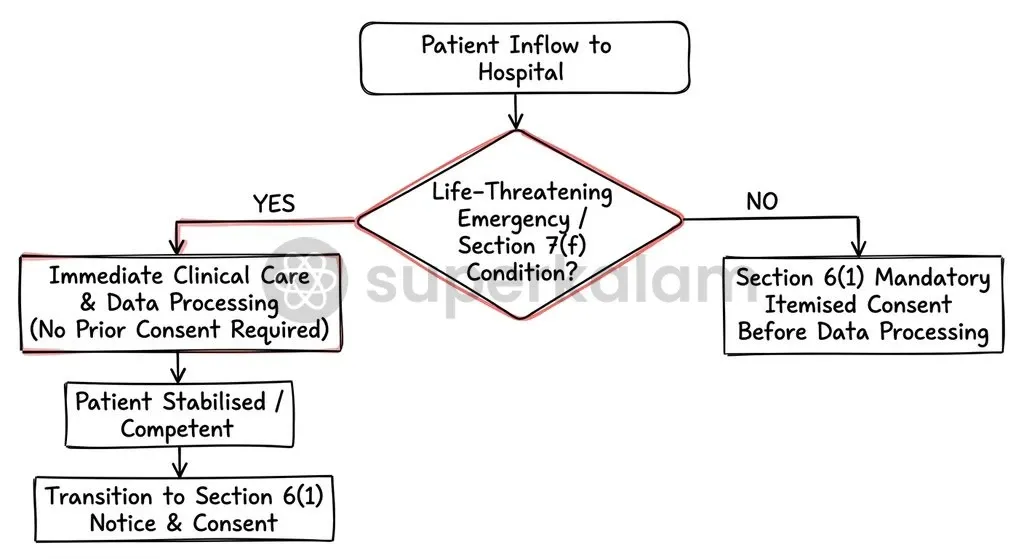
The statute outlines three specific healthcare situations that waive standard consent requirements:
- Medical Emergencies: Under Section 7(f), a Data Fiduciary may process personal data without consent to respond to a medical emergency involving a threat to the life or an immediate threat to the health of the individual. When an unconscious trauma victim arrives at an emergency department, clinicians can extract identifying records and medical history immediately.
- Epidemics and Disease Outbreaks: Section 7(g) authorises non-consensual processing when taking measures to deliver medical treatment or health services during an epidemic, outbreak, or public health threat. This enables municipal monitoring and disease containment without requiring bureaucratic clearance from individual patients.
- Disaster Relief: Section 7(h) permits data processing without consent to ensure safety or provide relief services during disasters or public order breakdowns.
These exemptions apply strictly to immediate clinical response. Once an emergency patient stabilises, hospitals cannot invoke Section 7(f) to retain, process, or monetize that data for secondary administrative or commercial purposes.
Discuss with Superkalam
Explain how the Supreme Court's ruling in Samira Kohli v. Dr. Prabha Manchanda differs in legal scope from the Puttaswamy judgment regarding patient rights.
Ask NowEthical Dilemmas: Medical Care vs Procedural Data Rights
Emergency medical triage creates an immediate philosophical friction between the bioethical duty of beneficence and statutory informational self-determination under the DPDP Act, 2023. In classical medical ethics, physicians follow the principle of beneficence—prioritising the immediate preservation of life and physical well-being above administrative formalities. Digital privacy statutes, however, champion individual autonomy and informational sovereignty.
This tension becomes acute during critical triage admissions. When clinical staff must act within seconds, forcing patients or distressed family members to read detailed digital notices undermines urgent care delivery. While Section 7(f) resolves this by suspending consent during immediate life threats, hospital administrators often err on the side of caution by thrusting comprehensive consent forms onto patients before treating them.
Conditioning emergency admissions or urgent surgical procedures on signing broad data-processing agreements violates the non-conditionality mandate of Section 6(1). Research published by the National Institutes of Health highlights that psychiatric documentation requires exceptional procedural safeguards. Because secondary leaks of mental health histories cause severe social stigma and workplace discrimination, hospitals face a profound moral and legal duty to segregate clinical treatment records from broader institutional databases.
Discuss with Superkalam
If an unconscious accident victim is admitted to an emergency room, how should the hospital apply Section 7(f) versus Section 6 of the DPDP Act as the patient transitions from surgery to recovery?
Ask NowWhat Healthcare Providers Must Do: Actionable Steps for Compliance
Healthcare facilities operating as Data Fiduciaries under Section 2(i) of the DPDP Act, 2023 must fundamentally restructure their digital and administrative intake workflows. Meeting statutory requirements requires a systematic overhaul of patient registration, digital record management, and third-party vendor oversight.
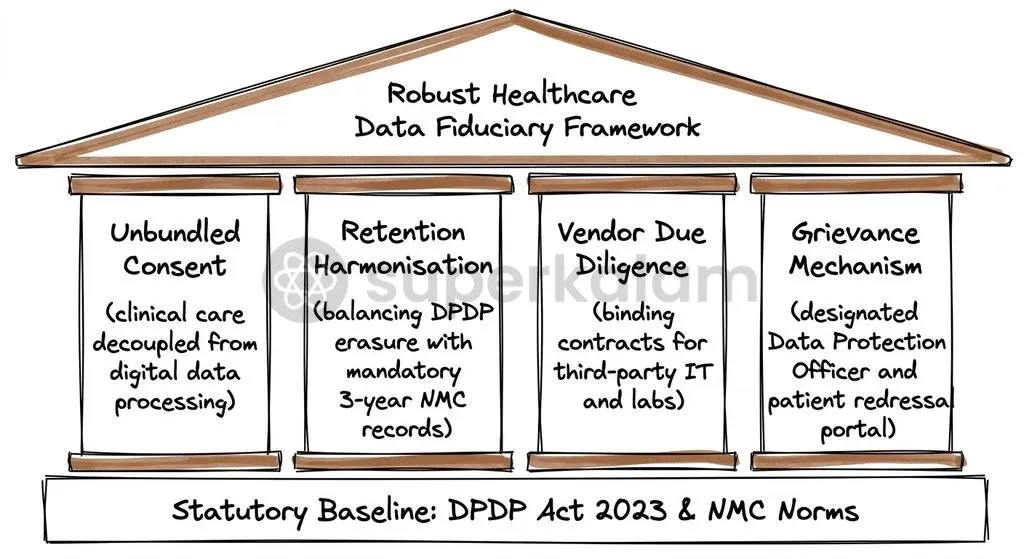
Healthcare providers must implement four structural changes:
- Decouple Documentation Workflows: Hospitals must completely segregate clinical treatment consent from digital data notices. Emergency care, outpatient consultations, and standard diagnostic services must proceed without requiring patients to sign commercial data-sharing waivers.
- Reconcile Record Retention Policies: Section 8(7) of the DPDP Act mandates data erasure once a specified clinical purpose is fulfilled or when a patient withdraws consent, unless retention is legally required. Healthcare administrators must align this with Regulation 1.3 of the NMC Regulations, 2002, which requires doctors to preserve medical records for a minimum of 3 years from treatment commencement.
- Establish Grievance Redressal Mechanisms: Under Section 8(9), every hospital must institute a dedicated grievance redressal mechanism and publish the official contact information of a designated officer to handle patient privacy complaints.
- Comply with Significant Data Fiduciary Mandates: Large hospital networks designated by the Central Government as Significant Data Fiduciaries under Section 10 must appoint an India-resident Data Protection Officer, commission annual independent audits, and carry out periodic Data Protection Impact Assessments.
The Way Forward: Protecting Privacy Without Delaying Critical Care
Balancing patient privacy and emergency healthcare delivery requires the National Medical Commission and the Data Protection Board of India to establish harmonised operational protocols. Data protection rules must safeguard sensitive physiological records without introducing bureaucratic bottlenecks into acute clinical settings.
Hospitals must adopt a dual-track documentation pathway. Under this design, life-saving triage proceeds immediately under the legitimate-use provisions of Section 7(f) without consent paperwork. Standard data consent and notice protocols under Section 6(1) apply only after the medical emergency has been fully resolved and the patient is stable.
Software providers building hospital management infrastructure must embed privacy-by-design principles into electronic systems. Role-based access controls, automatic end-to-end encryption, and dynamic consent dashboards empower patients to manage secondary disclosures to insurers and researchers directly. By aligning day-to-day administrative practices with the DPDP Act, Indian healthcare institutions can protect constitutional privacy under Article 21 while maintaining clinical efficiency.
Discuss with Superkalam
Analyse why bundling medical consent with commercial data sharing violates the principle of informational self-determination under Article 21.
Ask NowKey Takeaways
- Distinct Legal Foundations: Clinical consent under Samira Kohli (2008) authorises physical medical interventions, whereas data consent under Section 6(1) of the DPDP Act, 2023 governs the digital collection, processing, and sharing of personal health records.
- Data Fiduciary Accountability: Hospitals operate as Data Fiduciaries under Section 2(i) and bear primary legal liability for personal data breaches, facing financial penalties of up to ₹250 crore under Section 8(5) for failing to implement reasonable security safeguards.
- Narrow Emergency Exemptions: Section 7(f) permits hospitals to process patient data without prior consent during acute medical emergencies, but this carve-out expires once the patient is stabilised.
- Unbundled and Free Consent: Section 6(1) explicitly prohibits hospitals from conditioning clinical admission or medical care on patient consent for optional data processing or commercial third-party sharing.
- Retention Harmonisation: Section 8(7) mandates data erasure upon consent withdrawal or purpose completion, but hospitals must maintain records for at least 3 years to satisfy Regulation 1.3 of the NMC Regulations, 2002.
Mains Question
"Clinical consent under medical jurisprudence safeguards bodily integrity, whereas digital consent under the DPDP Act, 2023 enforces informational self-determination." Elucidate the legal and operational necessity of decoupling bedside clinical care from digital health data processing. (10 Marks)
Evaluate NowMains Question
"Section 7 of the Digital Personal Data Protection Act, 2023 establishes narrow legitimate-use exemptions for healthcare providers, balancing individual privacy against urgent medical needs." Critically examine the scope and limitations of these non-consensual processing provisions during emergencies and public health crises. (15 Marks)
Evaluate NowPractice MCQs
QUESTION 1
Consider the following statements regarding the processing of personal data under the Digital Personal Data Protection (DPDP) Act, 2023 in healthcare settings:
- Under Section 2(i) of the Act, hospitals operate as Data Fiduciaries because they determine the purpose and means of processing personal health data.
- Obtaining informed clinical consent under National Medical Commission guidelines automatically satisfies the statutory requirements for processing digital personal health data.
- The DPDP Act, 2023 strictly prohibits making the provision of clinical services conditional upon the patient consenting to non-essential data processing.
Which of the statements given above are correct?
QUESTION 2
With reference to the legitimate-use exemptions under Section 7 of the Digital Personal Data Protection Act, 2023, consider the following statements:
- Hospitals are permitted to process personal data without patient consent during acute medical emergencies involving threats to life or immediate health.
- Non-consensual data processing is authorised for delivering health services during an epidemic or public health threat.
- Once an emergency patient is clinically stabilised, the hospital may continue to retain and process the collected data for secondary commercial purposes under the same exemption.
Which of the statements given above is/are correct?
QUESTION 3
Consider the following statements regarding digital data consent versus clinical consent in India:
- Clinical consent is rooted in medical ethics and tort law, functioning primarily to shield physicians against allegations of battery or negligence.
- Data consent under Section 6(1) of the DPDP Act, 2023 protects informational self-determination under Article 21 of the Constitution.
- Unlike clinical consent, which cannot be revoked retroactively once a surgical intervention commences, data consent can be withdrawn at any stage under Section 6(4).
Which of the statements given above are correct?
QUESTION 4
Under the Digital Personal Data Protection Act, 2023, what is the maximum statutory financial penalty that healthcare administrators can face for lapses in data security safeguards?
QUESTION 5
Regarding the obligations of healthcare Data Fiduciaries under the Digital Personal Data Protection Act, 2023, consider the following statements:
- Under Section 5, hospitals are mandated to present an itemised pre-consent notice detailing the exact categories of data collected and processing purposes.
- Section 8(1) requires hospitals to execute valid, legally binding contracts when engaging external data processors such as cloud hosts or EHR vendors.
- Section 9 permits the processing of a child's health data for behavioural tracking and targeted promotions if implied consent is provided by guardians.
Which of the statements given above is/are correct?