Double Fortified Salt: Can It Solve India's Anaemia Crisis?
As India weighs universal food fortification against clinical risks for blood disorders, double fortified salt exposes critical public health governance trade-offs.
Oct, 2026
•13 min read

Context
Double Fortified Salt delivers both iodine and iron through everyday dietary consumption. It provides a targeted bio-chemical solution to combat widespread micronutrient deficiencies across India. Scaling this intervention requires navigating chemical stability challenges, overcoming sensory hurdles, and protecting vulnerable clinical groups.
The scale of the problem is substantial. According to the National Family Health Survey-5 (2019-21) compendium published by the Ministry of Health and Family Welfare, 67.1% of children aged 6 to 59 months and 57.0% of women aged 15 to 49 years suffer from anaemia.
Household coverage of iodised salt exceeds 93% under the Universal Salt Iodisation programme. Because of this reach, salt offers an established distribution channel to deliver elemental iron without demanding shifts in eating habits.
Yet the public health equation is rarely straightforward. Double Fortified Salt offers an economically viable mechanism to reduce anaemia. However, its long-term success hinges on overcoming sensory rejection, funding state-level procurement differentials, and resolving clinical safety concerns for populations with inherited blood disorders.
Why Double Fortified Salt Is Back in the Public Health Debate
A 27 October 2026 editorial calls double fortified salt (DFS), which carries both iodine and iron, an effective but underused way to fight anaemia, which still affects over half of Indian women and nearly three-fourths of children. According to the National Family Health Survey (NFHS-5), anaemia affects 52.2% of pregnant women and 25.0% of men aged 15 to 49 years.
These stubborn figures have forced a rethink in policy. Traditional programmes relied heavily on medicinal iron-folic acid tablets. However, clinical supplements frequently stumble against poor patient compliance and recurring supply chain bottlenecks.
To bridge this gap, public health authorities are prioritising staple food fortification:
- Universal reach: Over 93% of Indian households consume salt daily in predictable amounts, making it an ideal carrier.
- Passive intake: Fortification improves nutritional quality without demanding conscious dietary changes from consumers.
- Standards and mandates: FSSAI has issued a standard for DFS, and its use is mandated in PM POSHAN and the Integrated Child Development Services (ICDS).
- Cost: The editorial puts the cost at roughly ₹14 to ₹20 per person a year, with a benefit-cost ratio of 4.2:1.
- Real bottleneck: Uptake is held back by institutional barriers, such as uneven integration into the Public Distribution System (PDS), which reaches about 800 million beneficiaries, rather than technical ones.
Discuss with Superkalam
Which specific chemical agent is used in the National Institute of Nutrition's formulation to chelate iron and prevent potassium iodate degradation?
Ask NowThe FSSAI decision triggered intense discussion among haematologists, nutrition experts, and consumer rights groups. At stake is the delicate balance between universal public nutrition and clinical patient safety.
What Is Double Fortified Salt and How Does It Work?
Double Fortified Salt (DFS) delivers biological iron and iodine simultaneously in a single commodity. Iodised salt alone protects populations against iodine deficiency disorders like goitre and mental impairment. Adding iron turns ordinary salt into a direct weapon against iron deficiency anaemia, which impairs oxygen transport in the blood.
Combining both minerals in one crystal lattice triggers a harsh chemical reaction. Unprotected iron and iodine degrade quickly in the packet. Ferrous iron catalyses the chemical reduction of iodate into elemental iodine gas, which sublimates and escapes into the air.
Simultaneously, the oxidised iron turns into insoluble ferric compounds. This reaction discolours the salt into an unappealing yellow, brown, or dull grey.
| Reaction Component | Chemical Process | Physical Outcome |
|---|---|---|
| Ferrous Iron (Fe²⁺) + Iodate (IO₃⁻) | Unstabilised contact catalyses mutual redox degradation | Destabilises crystalline salt structure |
| Elemental Iodine (I₂) | Iodate reduces into elemental halogen gas | Sublimates and escapes into the atmosphere |
| Ferric Iron (Fe³⁺) | Ferrous iron oxidises into insoluble compounds | Causes yellow, brown, or dull grey discolouration |
Food scientists developed two distinct chemical methods to overcome this degradation:
- The Chelated Chemical Formulation: Developed by the National Institute of Nutrition (NIN), Hyderabad, this method blends ferrous sulphate with a stabiliser. According to studies by the Indian Council of Medical Research and NIN published in the Indian Journal of Medical Research, the formulation uses 1% sodium hexametaphosphate (SHMP) as a chelating agent. A chelating agent binds free metal ions to inhibit unwanted chemical reactions. In this formulation, SHMP sequesters moisture and binds iron, preventing it from oxidising potassium iodate.
- The Physical Microencapsulation Technique: Developed by the University of Toronto and Nutrition International, this technology isolates the iron physically rather than chemically. Research published in the American Journal of Clinical Nutrition details how ferrous fumarate is encapsulated within hydrogenated vegetable oil. The tiny iron spheres are subsequently coated with titanium dioxide, a food-grade white pigment, matching the physical colour and dimensions of standard salt crystals.
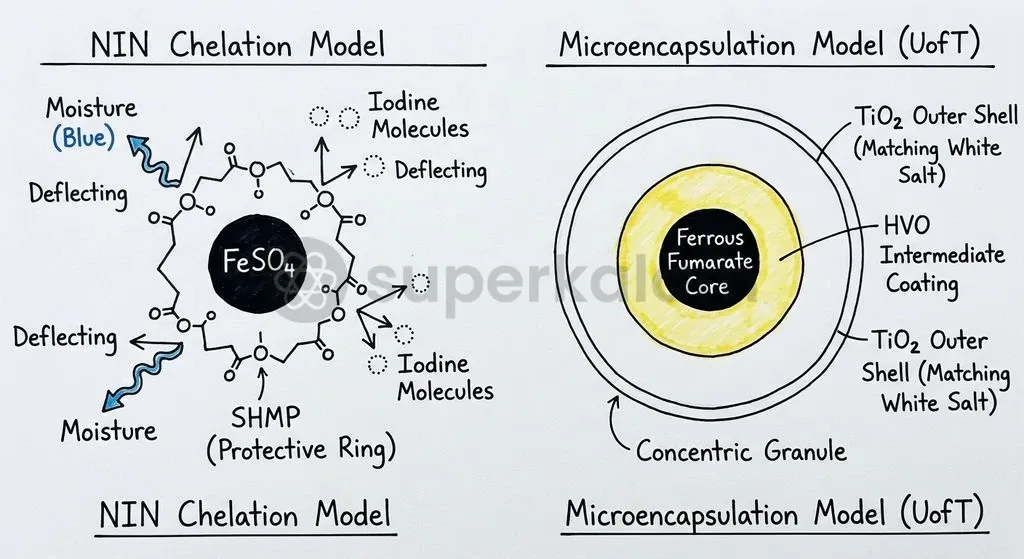
Clinical trials show that overcoming these chemical barriers yields clear physiological gains. According to a systematic review published by the Iodine Global Network and the American Society for Nutrition, regular consumption of Double Fortified Salt reduces anaemia prevalence by up to 21%. The meta-analysis also observed significant biological improvements in both haemoglobin concentrations and serum ferritin levels among regular consumers.
FSSAI Standards: How Iron and Iodine Levels Are Regulated
The Food Safety and Standards Authority of India enforces statutory benchmarks for fortified commodities through formal technical schedules. Standardisation ensures that fortified staples supply sufficient biological nutrients while preventing inadvertent toxicity from excessive intake.
Nutritional standards for Double Fortified Salt are codified under the Food Safety and Standards (Fortification of Foods) Regulations, 2018. Schedule-I of these statutory regulations governs manufacturing, packaging, and distribution parameters:
- Iron Content: The salt must contain between 850 to 1,100 parts per million (ppm) of iron as Fe on a dry weight basis.
- Iodine Content: The regulations require a minimum iodine concentration of 30 ppm at manufacture. The level must not fall below 15 ppm at retail and distribution level.
- Approved Chemical Sources: According to FSSAI operationalisation guidelines, manufacturers may use Potassium Iodate as the source of iodine. For iron fortification, processors must use either Ferrous Sulphate or Encapsulated Ferrous Fumarate.
Packages meeting these quality standards carry the statutory '+F' logo. This emblem signifies endorsement by the Food Fortification Resource Centre, operating under FSSAI. The logo assures consumers and state procurement agencies that the staple contains verified micronutrient additions complying with statutory food safety laws.
Discuss with Superkalam
How does physical microencapsulation of ferrous fumarate prevent the mutual degradation of iron and iodine in a salt packet?
Ask NowThe Anaemia Mukt Bharat Strategy: Where DFS Fits into the 7x7x7 Framework
The Ministry of Health and Family Welfare spearheads the Anaemia Mukt Bharat (AMB) initiative to address micronutrient malnutrition across the country. According to official operational guidelines from the Ministry of Health and Family Welfare, the programme aims to reduce anaemia prevalence by 3 percentage points per year.
To achieve this goal, the programme, relaunched as Anaemia Mukt Bharat Abhiyaan with revised operational guidelines in June 2026, has expanded its earlier 7x7x7 strategy into a 7x7x7 framework. It coordinates seven target beneficiary groups, seven programmatic interventions and seven institutional delivery mechanisms across central and state departments.
The 7x7x7 Intervention Architecture
- 7 Target Beneficiary Groups:
- Children (6–59 months)
- Children (5–9 years)
- Adolescents (10–19 years)
- Women of Reproductive Age (15–49 years)
- Pregnant Women
- Lactating Mothers
- Low birth weight babies (up to 6 months)
- 7 Specific Health Interventions:
- Prophylactic Iron and Folic Acid (IFA) supplementation
- Periodic deworming campaigns
- Year-round behaviour change communication (BCC)
- Mandatory provision of iron-fortified foods in public safety net programmes
- Point-of-care testing and treatment of clinical anaemia
- Addressing non-nutritional causes (malaria, fluorosis, haemoglobinopathies)
- Eating Right (regular consumption of iron-rich and diverse diets)
- 7 Institutional Delivery Mechanisms:
- Inter-ministerial coordination committee
- National Anaemia Mukt Bharat Unit
- National Centre of Excellence and Advanced Research on Anaemia
- Strengthening logistics and supply chain management
- Digital monitoring via AMB dashboard
- Convergence with National Health Mission review mechanisms
- Strengthened monitoring and evaluation with digital tracking
Double Fortified Salt forms an integral piece of the intervention on iron-fortified foods. According to a Ministry of Health and Family Welfare release issued via the Press Information Bureau, the AMB operational strategy mandates using iron and folic acid fortified staples—specifically fortified wheat flour, fortified rice, and double fortified salt—in all public safety net schemes.
Implementation relies heavily on institutional feeding channels. Operational guidelines from the Ministry of Women and Child Development and the Ministry of Education direct the supply of Double Fortified Salt through PM POSHAN (formerly the Mid-Day Meal Scheme) and Anganwadi services under Mission Poshan 2.0.
These safety net programmes provide hot cooked meals to school-going children, toddlers, and nursing mothers. By embedding fortified salt into school and daycare kitchens, the state bypasses private retail costs and delivers micronutrients straight to nutritionally vulnerable cohorts.
Comparing Salt Fortification with Rice Fortification
India utilises multiple food vehicles to deliver dietary micronutrients, with fortified rice and double fortified salt serving as primary instruments. Evaluating their operational attributes reveals distinct administrative and technological trade-offs.
| Assessment Dimension | Double Fortified Salt (DFS) | Fortified Rice (FRK Blending) |
|---|---|---|
| Nutrients Delivered | Iodine (15–30 ppm) and Iron (850–1,100 ppm) | Iron, Folic Acid, and Vitamin B12 |
| Technological Process | Chemical chelation with SHMP or physical microencapsulation with vegetable oil | Extrusion technology blending Fortified Rice Kernels (FRK) with milled rice at a 1:100 ratio |
| Universal Reach | Exceeds 93% household coverage across all dietary and income groups | High in rice-consuming states; lower penetration in wheat-consuming regions |
| Organoleptic Stability | Prone to colour changes and grey discolouration when cooked with polyphenols | Generally preserves appearance, though floating kernels can trigger consumer apprehension |
| Incremental Cost | Adds approximately ₹1.50 to ₹3.00 per kilogram over iodised salt per market reports | Adds approximately ₹0.60 to ₹0.80 per kilogram over custom milled rice |
Both food vehicles present unique advantages. Fortified rice supplies essential B-vitamins alongside iron. In contrast, Double Fortified Salt leverages universal salt consumption habits across every regional cooking tradition in India.
Discuss with Superkalam
If a state government plans to switch its school feeding programmes from medicinal IFA tablets to DFS in PM POSHAN meals, how would this affect beneficiary compliance and logistics?
Ask NowWhy India Has Stumbled in Scaling DFS Across States
Scaling Double Fortified Salt has proven difficult despite clear backing under Anaemia Mukt Bharat. The operational shift from ordinary iodised salt to double fortified salt has stalled across state jurisdictions, hamstrung by three main obstacles:
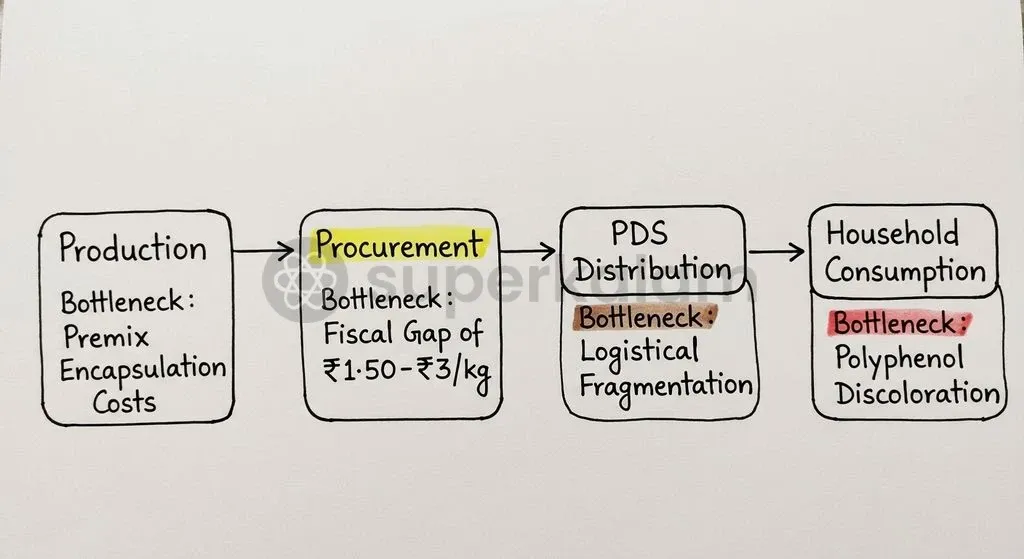
- Organoleptic and culinary rejection: Iron salts interact chemically with dietary polyphenols naturally present in tea, pulses, and vegetables. According to a pilot evaluation published in Maternal & Child Nutrition examining social safety net programmes in Madhya Pradesh and Gujarat, cooking yellow lentils or greens with DFS frequently turned dishes dark purple or grey. This unappealing discolouration triggered community suspicion and led cooks to reject the salt.
- State-level procurement premiums: Standard iodised salt distribution through welfare schemes operates on thin margins. Market assessments published in The Hindu indicate that fortificant premix and microencapsulation add an incremental cost of ₹1.50 to ₹3.00 per kilogram over standard iodised salt. In mass feeding programmes, this premium creates an additional fiscal burden of roughly ₹14 to ₹20 per beneficiary each year.
- Decentralised PDS funding gaps: As reported by The Hindu in an analytical review of food fortification, DFS distribution under the Targeted Public Distribution System (PDS) remains fragmented across states. State governments must independently fund this procurement differential from their own food subsidy outlays. Faced with competing fiscal demands, many states have deferred DFS procurement, opting instead for centrally subsidised fortified rice allocations.
Safety Concerns, Thalassemia Risks, and Bioethical Questions
Universal mandatory food fortification presents complex clinical dilemmas when implemented across diverse populations. Delivering nutrients through basic dietary staples inevitably provides iron to individuals who do not need it or who cannot metabolise it safely.
In July 2024, the FSSAI sparked medical debate by issuing a statutory direction under Sections 16(5) and 18(2)(d) of the Food Safety and Standards Act, 2006. This order omitted sub-regulation 7(4) of the Food Safety and Standards (Fortification of Foods) Regulations, 2018. The omitted clause had required packaged iron-fortified foods to display an explicit advisory:
- Advising individuals with Thalassemia to consume iron-fortified food only under medical supervision.
- Warning individuals with Sickle Cell Anaemia to avoid iron-fortified foods entirely.
| Utilitarian Welfare Objective | Deontological Safety Imperative |
|---|---|
| Deliver bioavailable iron to over 50% of the anaemic population via everyday, unmonitored dietary staples | Protect inherited blood disorder carriers from secondary iron overload and toxic organ damage |
The regulatory rollback prompted immediate pushback from clinical specialists. As reported by The Hindu, civil society networks and haematologists raised concerns regarding the omission of warning labels. Thalassemia Major and Sickle Cell Disease are inherited haemoglobinopathies characterised by abnormal red blood cell production. Patients frequently require regular blood transfusions, which flood the body with iron.
Human physiology lacks an active biological pathway to excrete excess iron. Consequently, unmonitored dietary iron accumulates in soft tissues. This accumulation can cause secondary haemochromatosis, potentially damaging the liver, pancreas, and heart muscle.
Discuss with Superkalam
Compare the technological and logistical advantages of salt fortification against rice fortification using Fortified Rice Kernels.
Ask NowOverlapping public health interventions also create risks of micronutrient overexposure. A review paper published on the NITI for States portal warned against uncoordinated fortification strategies. A child attending an Anganwadi centre might consume iron-fortified rice, food cooked with Double Fortified Salt, and weekly Iron and Folic Acid (IFA) syrups concurrently.
Without integrated tracking, cumulative iron consumption could surpass the tolerable upper intake levels for young children. This tension pits collective utilitarian gains against individual clinical safeguards. Public health policy must address widespread nutritional anaemia without endangering genetically vulnerable minorities.
The Road Ahead: How to Overcome Sensory and Supply Hurdles
Reinvigorating Double Fortified Salt as an anti-anaemia tool requires technical refinement and coordinated administrative backing. Policymakers can resolve existing bottlenecks through four targeted interventions:
- Adopting Microencapsulation to Prevent Discolouration: State procurement agencies should transition away from unstable, raw iron formulations toward encapsulated ferrous fumarate. While encapsulation adds processing costs, coating the iron particles prevents contact with food polyphenols. This technological fix eliminates dark discolouration in cooked food, safeguarding meal appeal and community acceptance.
- Standardising Inter-Ministerial Financing: The central government should introduce a targeted viability gap funding model under Mission Poshan 2.0 to cover the incremental cost of DFS. Equalising the price between standard iodised salt and DFS would remove financial barriers, enabling states to distribute DFS through fair price shops alongside fortified grains.
- Harmonising Household Screening with Digital Health Records: Health departments must coordinate nutritional interventions with screening for inherited blood disorders. Frontline workers can screen populations in tribal belts and endemic areas under the National Sickle Cell Anaemia Elimination Mission. Linking diagnosis records to Ayushman Bharat Digital Mission (ABDM) profiles would enable local fair price shops to provide unfortified salt alternatives to affected households.
- Deploying Community-Level Behavioural Communication: Institutional feeding programmes should educate school cooks, anganwadi helpers, and mothers on how to prepare food with fortified staples. Explaining that minor colour shifts do not signal spoilage can dispel local myths, prevent food rejection, and improve compliance.
Economic studies confirm that resolving these implementation hurdles delivers high social returns. Macroeconomic evaluations published in the American Journal of Clinical Nutrition report an estimated benefit-cost ratio of 4.2 to 1 for Double Fortified Salt programmes. The economic gains stem from improved childhood cognitive development and enhanced worker productivity in adulthood.
Combining stable formulation chemistry, coordinated financing, and clear clinical safeguards will enable Double Fortified Salt to realise its full potential in tackling India's anaemia crisis.
Discuss with Superkalam
How should public health policymakers weigh the benefits of universal food fortification against the clinical safety risks for individuals with inherited haemoglobinopathies?
Ask NowKey Takeaways
- According to the National Family Health Survey-5 (2019-21) compendium, anaemia affects 67.1% of children aged 6 to 59 months and 57.0% of women aged 15 to 49 years across India.
- Double Fortified Salt (DFS) provides between 850 to 1,100 ppm of iron and a minimum of 30 ppm of iodine at production, complying with FSSAI regulations under the Food Safety and Standards (Fortification of Foods) Regulations, 2018.
- DFS addresses severe chemical instability through two main techniques: chelation using sodium hexametaphosphate (developed by NIN Hyderabad) or physical microencapsulation of ferrous fumarate (developed by the University of Toronto and Nutrition International).
- Within the Anaemia Mukt Bharat 7x7x7 framework, DFS is a core programmatic staple distributed through institutional channels including PM POSHAN and Anganwadi services under Mission Poshan 2.0.
- Public scale-up has faced hurdles due to organoleptic issues—where iron reacts with polyphenols to discolour cooked food—and fiscal gaps that leave states bearing an incremental cost of ₹1.50 to ₹3.00 per kilogram over iodised salt.
- In July 2024, the FSSAI omitted sub-regulation 7(4) warning labels for iron-fortified foods, prompting debates regarding secondary haemochromatosis risks for individuals with Thalassemia Major and Sickle Cell Disease.
Mains Question
"Food fortification provides an effective passive vehicle for public nutrition, yet the institutionalization of Double Fortified Salt (DFS) exposes complex technological and organoleptic barriers." Elucidate. (10 Marks)
Evaluate NowMains Question
Examine the role of the Anaemia Mukt Bharat 7x7x7 framework in addressing micronutrient malnutrition through institutional safety nets. What regulatory and clinical challenges must statutory bodies like the FSSAI navigate while expanding iron fortification? (15 Marks)
Evaluate NowPractice MCQs
QUESTION 1
With reference to the chemical stabilization of Double Fortified Salt (DFS), consider the following statements:
- Unstabilized contact between ferrous iron and potassium iodate leads to the reduction of iodate into elemental iodine gas, which sublimates.
- The formulation developed by the National Institute of Nutrition (NIN) utilizes sodium hexametaphosphate as a chelating agent to sequester moisture and bind iron.
- The physical microencapsulation technique encapsulates ferrous sulphate within hydrogenated vegetable oil and coats it with titanium dioxide. Which of the statements given above are correct?
QUESTION 2
Regarding the regulatory standards for Double Fortified Salt under the Food Safety and Standards (Fortification of Foods) Regulations, 2018, consider the following statements:
- The prescribed iron content on a dry weight basis must be between 850 to 1,100 parts per million (ppm).
- The iodine concentration must be at least 30 ppm at retail and not fall below 15 ppm at manufacture.
- The '+F' logo signifies compliance and endorsement by the Food Fortification Resource Centre operating under FSSAI. Which of the statements given above is/are correct?
QUESTION 3
Under the Ministry of Health and Family Welfare's Anaemia Mukt Bharat Abhiyaan 7x7x7 framework, Double Fortified Salt is incorporated under which of the following programmatic intervention pillars?
QUESTION 4
Consider the following statements regarding the Anaemia Mukt Bharat (AMB) framework:
- When Anaemia Mukt Bharat was launched in 2018, it aimed to reduce the prevalence of anaemia by 3 percentage points per year.
- The revised 7x7x7 framework encompasses seven target beneficiary groups, seven specific interventions, and seven institutional delivery mechanisms.
- Lactating mothers and children aged 5 to 9 years are among the target beneficiary age groups defined under the strategy. Which of the statements given above are correct?
QUESTION 5
According to data from the National Family Health Survey-5 (NFHS-5) cited in the article, which demographic cohort exhibits the highest prevalence of anaemia in India?