Divyastra Mk3: Strategic Role of Jet-Powered Loitering Munitions
The maiden flight of Divyastra Mk3 introduces indigenous turbojet loitering munitions, closing vital tactical gaps along contested mountain borders.
Aug, 2026
•8 min read

Overview
The maiden flight of Divyastra Mk3 represents a decisive transition in Indian military modernisation. It replaces slow propeller systems with indigenous jet-powered loitering munitions capable of high-speed tactical penetration.
Developed within seven months through domestic aerospace collaboration, the platform integrates real-time aerial reconnaissance with terminal kinetic impact. As of August 2026, India's move toward indigenous turbojet propulsion addresses long-standing thrust penalties in rarefied mountain air. Crucially, it compresses adversary air defence reaction windows, marking the convergence of self-reliance and asymmetric deterrence along contested frontiers.
Why in the News: India's Push for Jet-Powered Loitering Munitions
The Indian aerospace firm Kawa UAV Pvt. Ltd. conducted the maiden flight of Divyastra Mk3, India's first indigenously designed jet-powered loitering munition, on August 11, 2026. According to reports from the Times of India and ANI, the flight trial took place at a designated drone testing airstrip in Uttar Pradesh.
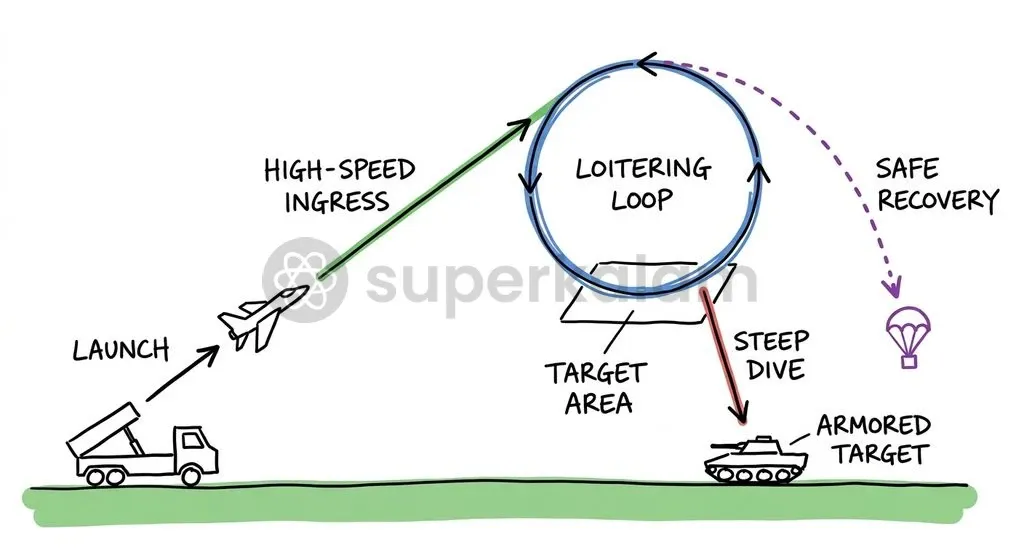
- Phase 1 (Launch & Boost): Munition deploys from ground canisters or mobile vehicles to reach altitude.
- Phase 2 (Ingress): Platform transits contested airspace via satellite and inertial navigation.
- Phase 3 (Persistent Loiter): Real-time electro-optical sensors search for high-value targets.
- Phase 4A (Terminal Strike): If target is designated, platform enters a high-speed terminal dive.
- Phase 4B (Safe Abort): If no target is confirmed, system aborts and enters safe recovery.
Platform development moved from concept to maiden flight in seven months without foreign propulsion imports, according to the Times of India. The platform runs on an indigenous turbojet engine developed by New Delhi-based DG Propulsion. This milestone signals a strategic move by the Ministry of Defence to accelerate high-speed kamikaze drone deployment against dense electronic warfare and radar tracking.
What Is a Loitering Munition and How Does It Work?
A loitering munition combines the intelligence-gathering role of a surveillance drone with the strike payload of a guided missile. According to the Ministry of Defence's Innovations for Defence Excellence (iDEX) framework, these expendable systems search within holding airspace before executing direct terminal detonation.
The operational architecture spans five distinct phases, as categorised by the Manohar Parrikar Institute for Defence Studies and Analyses:
- Launch and Boost: The munition is deployed from ground canisters, pneumatic launchers, or mobile tactical vehicles to achieve cruising altitude.
- Transit and Ingress: The platform navigates through contested airspace toward the designated target area using onboard satellite navigation and inertial guidance.
- Loitering and Surveillance: The munition maintains persistent holding patterns over the operational zone, utilising electro-optical sensors to locate high-value or fleeting targets.
- Terminal Engagement: Upon target designation, the platform enters a high-speed dive, detonating its integrated warhead upon impact to neutralise the objective.
- Mission Abort and Recovery: If tactical parameters change or no legitimate target is identified, the system can abort its attack run and be safely recovered or ditch in a safe zone.
Discuss with Superkalam
What are the five operational phases of a loitering munition mission architecture?
Ask NowDivyastra Mk3: Key Features and the Jet-Propulsion Advantage
The Divyastra Mk3 transitions loitering munition design from conventional piston engines to indigenous turbojet propulsion, raising platform survivability. According to technical briefings reported by the Times of India and Raksha Anirveda, the indicative specifications for the Divyastra Mk3 place its operational flight range between 300 km and 500 km, cruising speed between 250 km/h and 300 km/h, and warhead capacity between 15 kg and 20 kg.
Jet propulsion provides distinct tactical advantages over legacy propeller-driven designs:
- Compressed Air Defence Reaction Windows: Jet engines allow loitering platforms to achieve operational speeds exceeding 250–350 km/h, according to the Times of India Strategic Technology Analysis. This high velocity drastically narrows enemy radar tracking durations and shortens counter-battery response times.
- Rapid Transit to Target Zones: The platform rapidly traverses contested ingress corridors, minimising exposure to short-range air defence systems before initiating search patterns.
- Enhanced Terminal Kinetic Energy: Higher dive velocities increase the impact force of the munition, amplifying the destructive capability of its integrated warhead against hardened fortifications.

Comparing Loitering Munitions, Cruise Missiles, and Combat UAVs
Modern precision-strike doctrines deploy loitering munitions alongside Uncrewed Combat Aerial Vehicles (UCAVs) and cruise missiles to achieve tactical operational flexibility. According to research published by the Manohar Parrikar Institute for Defence Studies and Analyses, each platform fulfills distinct operational profiles across cost, endurance, and guidance parameters.
| Operational Dimension | Loitering Munition (e.g., Divyastra Mk3) | Cruise Missile | Uncrewed Combat Aerial Vehicle (UCAV) |
|---|---|---|---|
| Primary Mission Role | Persistent search and strike on fleeting targets | Stand-off strike against fixed strategic assets | Long-endurance surveillance and stand-off attack |
| Loiter Capability | High (orbits target area to search and verify) | None (flies direct pre-programmed flight path) | High (long-duration orbits outside threat zones) |
| Propulsion Type | Electric, Piston, or Turbojet | Turbojet or Turbofan | Turboprop or Turbofan |
| Reusability | Expendable (with abort-recovery option) | Strictly non-reusable (single-use munition) | Fully reusable (returns to base post-strike) |
| Mission Abort Capability | Full in-flight redirection or abort control | Extremely limited once terminal phase begins | Complete real-time mission control |
| Cost Profile | Low to medium per unit | High to very high per unit | Very high capital and maintenance cost |
Discuss with Superkalam
How does turbojet propulsion specifically resolve the aerodynamic limitations faced by legacy drones in Himalayan border warfare?
Ask NowStrategic Significance for India's High-Altitude Borders
High-altitude frontiers along the Line of Actual Control (LAC) and Line of Control (LOC) demand specialised aerodynamic performance due to thin mountain air. According to SP's Land Forces Aerospace & High-Altitude Warfare Review, jet-powered loitering systems provide superior thrust margins in rarefied air, overcoming the severe engine de-rating and density altitude penalties that handicap piston and battery-powered drones.
These high-speed munitions deliver vital operational capabilities in mountainous sectors like Eastern Ladakh:
- Neutralising Fleeting Targets: Mountain warfare features brief windows of visibility where artillery positions, radar nodes, or troop convoys move between valleys. Jet munitions rapidly close the distance to strike before targets relocate behind ridgelines.
- Overcoming High-Altitude Wind Turbulence: Powerful turbojet thrust ensures stable flight profiles and precise terminal tracking despite unpredictable Himalayan crosswinds.
- Suppression of Enemy Air Defences (SEAD): Loitering munitions can bait, locate, and destroy surface-to-air missile batteries and forward electronic monitoring stations without risking crewed aircraft.

Discuss with Superkalam
Weigh the operational benefits of full autonomy in swarm drone strikes against the ethical risks of command accountability gaps under International Humanitarian Law.
Ask NowStrengthening Indigenisation and the Atmanirbhar Defence Ecosystem
The rapid development of Divyastra Mk3 highlights the maturation of India's indigenous defence manufacturing under the Make in India initiative. In June 2024, the Indian Army inducted the Nagastra-1, a man-portable electric loitering munition developed by Solar Industries and Economic Explosives Limited with over 75% indigenous content under emergency procurement provisions.
Private aerospace firms are increasingly providing operational solutions across services. Tata Advanced Systems Limited developed the ALS-50 vertical loitering munition with a 50 km range supplied to the Indian Air Force for mountain strikes, as reported by the Department of Defence Production.
The Ministry of Defence nurtures this innovation through structured funding and test infrastructure:
- iDEX and ADITI Schemes: The Innovations for Defence Excellence and Acing Development of Innovative Technologies with iDEX schemes provide targeted grant funding to deep-tech aerospace startups.
- Uttar Pradesh Defence Industrial Corridor: The corridor features six dedicated nodes in Lucknow, Kanpur, Jhansi, Agra, Aligarh, and Chitrakoot to house testing airstrips and advanced component fabrication units, according to the Uttar Pradesh Expressways Industrial Development Authority.
Operational Challenges and Ethical Concerns Around Autonomous Weapons
Lethal Autonomous Weapons Systems (LAWS) introduce serious command dilemmas regarding battlefield accountability and machine error.
India balances these operational realities across distinct multilateral and domestic frameworks:
- Multilateral Mandate for Human Control: At the United Nations Convention on Certain Conventional Weapons Group of Governmental Experts, the Permanent Mission of India maintains that human-in-the-loop control is mandatory to satisfy International Humanitarian Law principles of distinction, proportionality, and military necessity.
- Accountability Gaps in Command: Autonomous target selection creates a fundamental accountability gap in command. If an automated seeker misidentifies a civilian vehicle or hospital due to algorithmic error, legal culpability cannot attach to software models, eliminating the human moral agency required to weigh combat proportionality.
- Domestic Governance Protocols: To regulate these operational risks domestically, the Ministry of Defence and the Chief of Defence Staff released official guidelines in October 2024 on AI integration for trustworthy adoption of Artificial Intelligence in military decision-making systems.
Discuss with Superkalam
Propose policy and doctrinal measures India should adopt to scale indigenous micro-turbojet manufacturing and integrate swarm munitions into tri-service operations.
Ask NowThe Way Forward: Building India's Modern Drone and Swarm Doctrine
Integrating advanced loitering munitions into standard military doctrine requires synchronising hardware acquisition, joint logistics, and autonomous control protocols.
- Developing Unified Swarm Protocols: Tri-service doctrines must standardise communication datalinks, enabling jet loitering munitions to coordinate autonomously with crewed fighters and reconnaissance drones in multi-domain operations.
- Scaling Domestic Engine Manufacturing: Sustained investments under the iDEX and ADITI schemes must transition micro-turbojet production from prototype batches to mass industrial manufacturing to ensure steady supply during prolonged conflicts.
- Standardising Rules of Engagement: The Armed Forces should institutionalise strict operational rules ensuring human-in-the-loop oversight across all autonomous strike systems to prevent algorithmic collateral damage.
- Strengthening Counter-EW Hardening: Next-generation loitering munitions require jam-resistant optical navigation and anti-radiation seekers to maintain precision guidance in heavily degraded electromagnetic operating environments.
Key Takeaways
- Indigenous Jet Breakthrough: The maiden flight of the Divyastra Mk3 on August 11, 2026, marks India's transition to indigenously designed turbojet loitering munitions developed in seven months.
- Tactical Speed Advantage: Turbojet propulsion enables operational cruising speeds exceeding 250–350 km/h, dramatically compressing adversary air defence reaction and counter-battery windows.
- High-Altitude Border Relevance: Jet engines overcome the severe density altitude penalties and engine de-rating typical of piston and electric systems in Eastern Ladakh.
- Expanding Indigenous Portfolio: The Divyastra Mk3 builds on earlier systems like the Army's Nagastra-1 (Solar Industries) and the Air Force's ALS-50 (TASL).
- Ethical and Legal Stance: India advocates for strict human-in-the-loop oversight at the UN-CCW GGE on Lethal Autonomous Weapons Systems, supported by the Ministry of Defence's October 2024 AI governance guidelines.
Mains Question
"The transition from conventional piston-driven platforms to jet-powered loitering munitions addresses critical thrust penalties along India's high-altitude frontiers while transforming modern border deterrence." Elucidate. (10 Marks)
Evaluate NowMains Question
The deployment of Lethal Autonomous Weapons Systems (LAWS) creates critical accountability gaps in command and challenges established International Humanitarian Law principles. In this context, critically analyse the strategic imperative of human-in-the-loop control and India's emerging defence policy frameworks. (15 Marks)
Evaluate NowPractice MCQs
QUESTION 1
With reference to the 'Divyastra Mk3' loitering munition, consider the following statements:
- It is India's first indigenously designed jet-powered loitering munition.
- It operates using an imported turbofan engine to overcome high-altitude thrust penalties.
- It incorporates a mission abort and safe recovery mechanism if no target is designated. Which of the statements given above are correct?
QUESTION 2
Consider the following statements regarding the comparative characteristics of modern precision-strike platforms:
- Loitering munitions possess persistent holding capability over target areas, unlike conventional cruise missiles which fly pre-programmed flight paths.
- Uncrewed Combat Aerial Vehicles (UCAVs) are expendable single-use strike systems, whereas loitering munitions are fully reusable.
- Loitering munitions provide real-time in-flight target redirection and abort options. Which of the statements given above is/are correct?
QUESTION 3
With reference to defence indigenisation initiatives in India, consider the following pairs:
- Nagastra-1 : Man-portable electric loitering munition
- ALS-50 : Vertical loitering munition for mountain strikes
- Divyastra Mk3 : Jet-powered loitering munition Which of the pairs given above are correctly matched?
QUESTION 4
Consider the following statements regarding the deployment of jet-powered loitering munitions along high-altitude borders:
- Jet propulsion overcomes severe engine de-rating and density altitude penalties associated with rarefied mountain air.
- Higher operational speeds compress adversary radar tracking durations and counter-battery response windows.
- Jet-powered loitering munitions cannot be utilised for Suppression of Enemy Air Defences (SEAD) roles due to radar reflection. Which of the statements given above is/are correct?
QUESTION 5
Which of the following nodes are designated under the Uttar Pradesh Defence Industrial Corridor?
- Lucknow
- Kanpur
- Jhansi
- Chitrakoot Select the correct answer using the code given below: