District Mineral Foundation (DMF): ₹1 Lakh Crore, Rules and PMKKKY
District Mineral Foundation collections have crossed ₹1 lakh crore under PMKKKY, funding tribal welfare and ecological repair in mining-affected districts amid governance gaps.
Sep, 2026
•11 min read
Overview
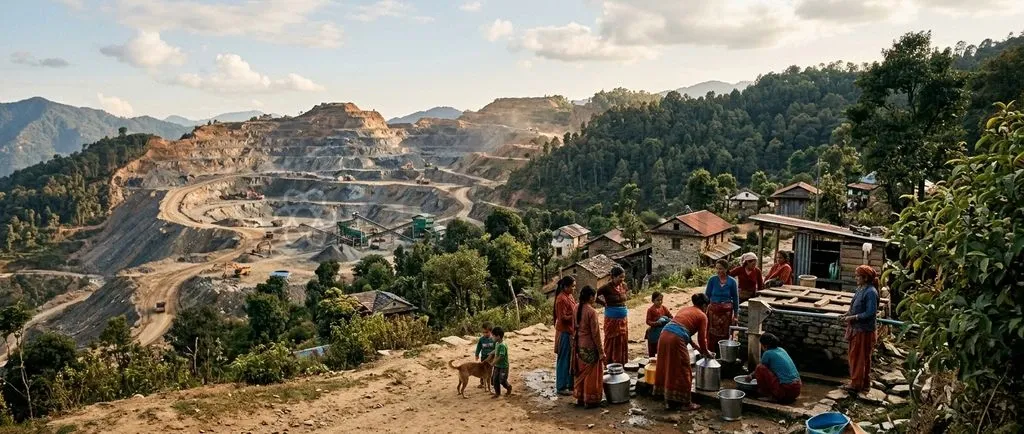
The District Mineral Foundation is a statutory non-profit trust established under Section 9B of the Mines and Minerals (Development and Regulation) Act, 1957, designed to channel mining revenue directly into social infrastructure, environmental restoration, and socio-economic welfare for local communities enduring the ecological and health impacts of mineral extraction. Funded through mandatory royalty contributions from mining leaseholders, the institution operationalises local benefit-sharing to reverse the historical "resource curse" across mineral-bearing regions. However, persistent implementation challenges—including bureaucratic centralisation, unspent fiscal balances, and inadequate consultation with grassroots institutions—continue to test its transformative governance potential.
Why the District Mineral Foundation Remains Crucial for Mining Districts
As of January 2025, cumulative collections across 645 District Mineral Foundations reached ₹1,04,251 crore, according to the Ministry of Mines. This substantial capital pool establishes the District Mineral Foundation (DMF) as one of India's most significant sub-district developmental funding mechanisms.
The institutional framework translates industrial resource extraction into tangible local development. Out of the total collections, authorities have sanctioned ₹88,483 crore across 3.69 lakh individual projects, with actual expenditure standing at ₹55,924 crore across 2.08 lakh completed projects. These investments target historically neglected mining tracts that bear severe ecological degradation, air pollution, and groundwater depletion.
To accelerate developmental impact in underperforming regions, the Ministry of Mines launched the Aspirational DMF Programme in July 2025. This initiative directly converges DMF funding with NITI Aayog’s Aspirational Districts Programme (ADP) and Aspirational Blocks Programme (ABP). This structural alignment ensures targeted resource allocation in the country's most vulnerable socio-economic geographies.
Discuss with Superkalam
What percentage of the royalty amount must post-2015 auctioned mining leaseholders contribute to the District Mineral Foundation?
Ask NowWhat is the District Mineral Foundation (DMF)?
The District Mineral Foundation is a statutory non-profit trust established by State Governments in every district affected by mining-related operations. Its core statutory mandate, defined under Section 9B(2) of the Mines and Minerals (Development and Regulation) (MMDR) Act, 1957, is to work for the interest and benefit of persons and areas affected by mining.
From an ethical and constitutional standpoint, the DMF framework addresses the paradox of plenty (or resource curse). Mining regions frequently generate immense macroeconomic wealth while local tribal and rural populations face displacement, poor healthcare, and loss of livelihoods. By legally ring-fencing local mineral revenues, the DMF framework operationalises the public trust doctrine and intergenerational equity, principles upheld by the Supreme Court of India in cases such as Goa Foundation v. Union of India.
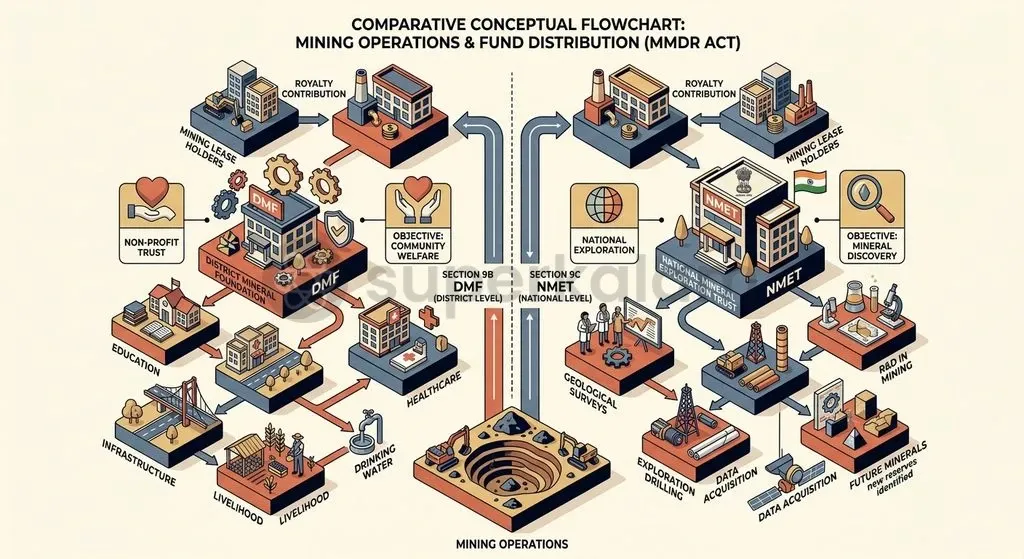
Aspirants must distinguish the District Mineral Foundation from the National Mineral Exploration Trust (NMET). While both were established under the 2015 amendments to the MMDR Act, their institutional mandates, revenue channels, and geographic scopes differ entirely.
| Dimension | District Mineral Foundation (DMF) | National Mineral Exploration Trust (NMET) |
|---|---|---|
| Statutory Provision | Section 9B of the MMDR Act, 1957 | Section 9C of the MMDR Act, 1957 |
| Establishment Authority | State Governments (at the district level) | Central Government (national level) |
| Legal Entity | Non-profit trust | Autonomous statutory trust |
| Primary Objective | Welfare of mining-affected persons and areas | Funding regional and detailed mineral exploration |
| Jurisdictional Scope | Mining-affected districts | Pan-India exploration projects |
Discuss with Superkalam
Explain the structural difference between the primary mandates of the District Mineral Foundation and the National Mineral Exploration Trust.
Ask NowStatutory Backing: MMDR Amendment Act and Institutional Setup
Section 9B of the MMDR Act, 1957, inserted through the MMDR Amendment Act, 2015, provides the legal foundation for DMFs across India. The statute establishes DMFs as autonomous district trusts, leaving specific institutional rules, governing structures, and administrative procedures to state-level discretion.
The governance architecture of a DMF typically comprises a two-tier structure:
- Governing Council: A policy-setting body responsible for reviewing annual plans, approving project allocations, and monitoring overall financial expenditure.
- Managing Committee: An executive body responsible for day-to-day project execution, fund management, and processing administrative approvals.
To address governance bottlenecks and political representation, the regulatory landscape underwent significant legislative refinement:
- Central Directing Power: The MMDR Amendment Act, 2021 inserted a proviso to Section 9B(3), empowering the Central Government to issue binding directions regarding the composition and utilization of DMF funds.
- Legislative Representation: On 23 April 2021, the Ministry of Mines issued a statutory order requiring State Governments to include Members of Parliament (MPs), Members of Legislative Assemblies (MLAs), and Members of Legislative Councils (MLCs) in DMF Governing Councils.
Discuss with Superkalam
If a mining district receives ₹100 crore in DMF contributions, how must the funds be divided between High Priority and Other Priority sectors under the Revised PMKKKY Guidelines (2024)?
Ask NowConnecting DMF to PMKKKY: High Priority vs Other Priority Spending
The Ministry of Mines framed the Pradhan Mantri Khanij Kshetra Kalyan Yojana (PMKKKY) on 16 September 2015 under Section 20A of the MMDR Act. This national directive mandates State Governments to integrate developmental guidelines directly into their state DMF rules to prevent misdirection of funds.
PMKKKY enforces a clear division between basic human development sectors and broader physical infrastructure. In January 2024, the Ministry of Mines notified Revised PMKKKY Guidelines, updating the spending thresholds to prioritize communities directly affected by mining.
| Priority Tier | 2015 Baseline PMKKKY Guidelines | Revised PMKKKY Guidelines (2024) | Eligible Developmental Sectors |
|---|---|---|---|
| High Priority Sectors | Minimum 60% of total funds | Minimum 70% of total funds | Drinking water supply, healthcare facilities, education, sanitation, environmental preservation, welfare of women and children, and aged/disabled care. |
| Other Priority Sectors | Maximum 40% of total funds | Maximum 30% of total funds | Physical infrastructure, road connectivity, irrigation structures, alternate energy sources, and watershed development. |
The revised 2024 framework also requires that at least 70% of funds be deployed exclusively within directly affected areas—villages within immediate proximity to mining leases—before allocating resources to indirectly affected peripheral zones.
Discuss with Superkalam
Analyze why bureaucratic centralisation and the bypassing of Gram Sabhas undermine the core objectives of the PESA Act and DMF governance.
Ask NowKey Governance Bottlenecks: Bureaucratic Capture and Unspent Funds
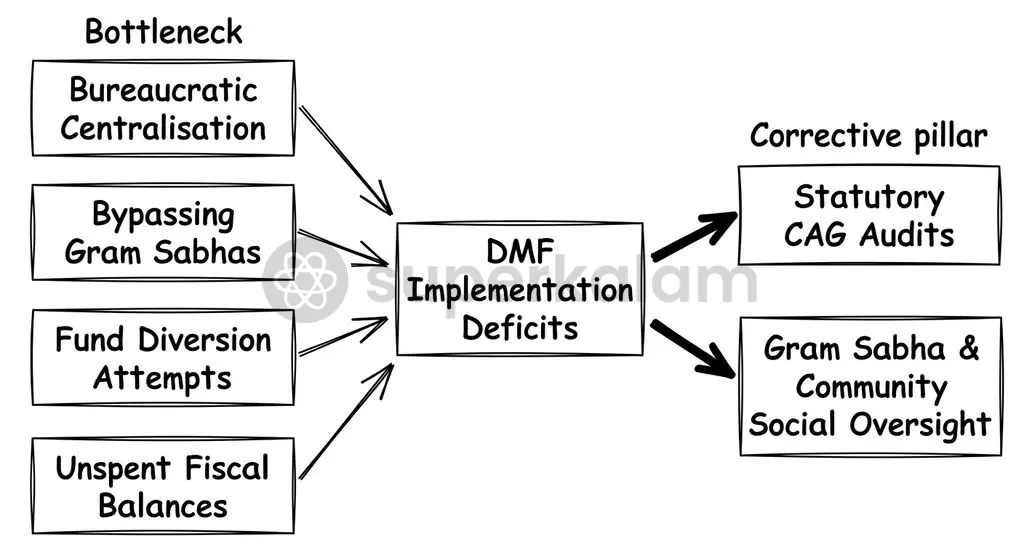
Despite substantial revenue generation, District Mineral Foundations face structural implementation bottlenecks across several states. These issues stem from bureaucratic centralisation, non-compliance with planning mandates, and attempts by state executives to repurpose local trust funds.
A performance audit by the Comptroller and Auditor General of India (CAG) on the implementation of PMKKKY and DMFT in Chhattisgarh highlighted these systemic gaps. The audit revealed that 44% (754 of 1,734) of directly affected villages remained uncovered by any DMF projects, while funds were spent ad hoc without the mandatory annual perspective plans.
Major institutional challenges include:
- Bureaucratic Centralisation: District-level managing committees are often dominated by administrative officers and local political representatives, sidelining affected tribal and rural communities.
- Neglect of Panchayati Raj Institutions: Despite legal protections under the PESA Act, 1996 and the Forest Rights Act (FRA), 2006, Gram Sabhas are frequently bypassed during project identification and social audit processes.
- Fund Diversion and Central Interventions: Several State Governments attempted to pool district revenues into State Consolidated Funds or Chief Minister Relief Funds. This prompted the Central Government to issue a binding directive on 12 July 2021 prohibiting any transfer of DMF funds away from district trust accounts.
- Large Unspent Balances: Administrative delays in drafting detailed project reports (DPRs) and issuing work orders have led to substantial gaps between sanctioned amounts and actual ground-level expenditure.
Discuss with Superkalam
How would you design an institutional mechanism to prevent state-level diversion of DMF revenues and ensure timely fund utilization in directly affected villages?
Ask NowWay Forward: Reforming Fund Utilization and Strengthening Local Consent
Strengthening District Mineral Foundations requires structural reforms in bottom-up planning, statutory accountability, and community participation. The Revised PMKKKY Guidelines (2024) provide a framework to address these operational challenges.
To maximise developmental outcomes, implementation should focus on key institutional priorities:
- Strengthening Grassroots Consent: In Scheduled Areas under Article 244 and the Fifth and Sixth Schedules, project selection must involve genuine consultation and approval from Gram Sabhas pursuant to the PESA Act, 1996 and FRA, 2006.
- Institutionalising Oversight: State Governments must operationalise the State Level Monitoring Committee chaired by the Chief Secretary, while enforcing mandatory annual financial audits by the Comptroller and Auditor General (CAG).
- Strategic Convergence: District administrations should utilize the Aspirational DMF Programme framework to integrate mineral funds with national health, education, and nutrition indicators.
- Mandatory Social Audits: Setting up independent social audit units at the block level will ensure public transparency, curb corruption in infrastructure procurement, and guarantee that benefits reach directly affected families.
Key Takeaways
- Statutory Authority: Established as non-profit trusts under Section 9B of the MMDR Act, 1957 (inserted via the 2015 Amendment) to benefit mining-affected populations.
- Contribution Formulas: Leaseholders pay 10% of royalty for post-2015 auctioned leases and 30% of royalty for pre-2015 leases; minor mineral rates are set by State Governments under Section 15A.
- PMKKKY Spending Mandates: The Revised 2024 Guidelines require at least 70% allocation to High Priority sectors (drinking water, health, education, environment) and cap Other Priority infrastructure at 30%.
- Financial Scale: As of January 2025, cumulative DMF collections exceeded ₹1,04,251 crore, with actual ground expenditures standing at ₹55,924 crore.
- Governance Safeguards: Central directives prohibit transferring DMF funds to State Consolidated Funds, while the 2024 rules mandate CAG annual financial audits and compliance with PESA and Forest Rights Act provisions.
Mains Question
"Despite accumulating substantial revenues under the MMDR framework, District Mineral Foundations (DMFs) continue to grapple with bureaucratic centralisation and poor grassroots inclusion." In light of findings from the CAG performance audit, critically examine the implementation bottlenecks of the PMKKKY-DMF architecture. (15 Marks)
Evaluate NowMains Question
Differentiate between the institutional mandates of the District Mineral Foundation (DMF) and the National Mineral Exploration Trust (NMET). How does the DMF framework operationalise the principles of the public trust doctrine and intergenerational equity? (10 Marks)
Evaluate NowPractice MCQs
QUESTION 1
With reference to the District Mineral Foundation (DMF), consider the following statements:
- It is established as a statutory non-profit trust under Section 9B of the Mines and Minerals (Development and Regulation) Act, 1957.
- Holders of mining leases granted prior to 12 January 2015 must contribute 10% of their royalty to the DMF.
- State Governments are empowered to formulate separate rules prescribing contribution rates payable by minor mineral concession holders.
Which of the statements given above are correct?
QUESTION 2
Consider the following statements regarding the Revised PMKKKY Guidelines (2024):
- The minimum allocation mandated for High Priority Sectors has been increased from 60% to 70% of total DMF funds.
- Spending on physical infrastructure and road connectivity is categorized under High Priority Sectors.
- At least 70% of the funds must be deployed exclusively within directly affected areas before allocating to peripheral zones.
Which of the statements given above is/are correct?
QUESTION 3
Consider the following pairs regarding institutional frameworks under the MMDR Act, 1957:
- District Mineral Foundation: Established by the Central Government at the national level under Section 9C
- National Mineral Exploration Trust: Established to fund regional and detailed mineral exploration pan-India
- Aspirational DMF Programme: Converges DMF funding with NITI Aayog's Aspirational Districts and Blocks Programmes
How many of the pairs given above are correctly matched?
QUESTION 4
With reference to the Supreme Court ruling in Federation of Indian Mineral Industries (FIMI) v. Union of India (2017), which one of the following statements is correct?
QUESTION 5
Consider the following statements regarding the governance and institutional updates of the District Mineral Foundation:
- The MMDR Amendment Act, 2021 empowered the Central Government to issue binding directions regarding the composition and utilization of DMF funds.
- A statutory order issued in April 2021 mandates the inclusion of MPs, MLAs, and MLCs in DMF Governing Councils.
- The Managing Committee of a DMF functions as the supreme policy-setting body, while the Governing Council handles day-to-day administrative execution.
Which of the statements given above is/are correct?