Digital Twins and XR in India: Sangam, Geospatial Policy and the Hardware Gap
India is building city digital twins under Project Sangam and the National Geospatial Policy 2022 while immersive XR devices still depend on specialised imported hardware. Here is what UPSC aspirants need on policy, data protection and the hardware gap.
Oct, 2026
•10 min read

Overview
India's immersive extended reality sector is shifting from media entertainment into cyber-physical digital twins for infrastructure planning. However, securing strategic autonomy requires bridging severe domestic vulnerabilities in spatial silicon, optical hardware, and proprietary simulation engines.
According to the Press Information Bureau, India's immersive technology market is projected to expand from USD 1,259.5 million in 2023 to USD 7,818.7 million by 2030, registering a compound annual growth rate of 29.8%. This growth aligns with national programmes like the Department of Telecommunications' 'Sangam: Digital Twin' initiative and the National Geospatial Policy 2022.
Yet an acute industrial chokepoint persists:
- Hardware dependency: India's immersive devices rely on specialised components such as micro-OLED displays, optical waveguides and spatial processing silicon, a strategic dependency.
- Software risk: Critical spatial models rely on foreign, closed-source simulation engines.
- Policy disconnect: Creative media incentives under AVGC policies remain disconnected from the India Semiconductor Mission.
Why in the News? The Convergence of AVGC Policy and Industrial Digital Twins
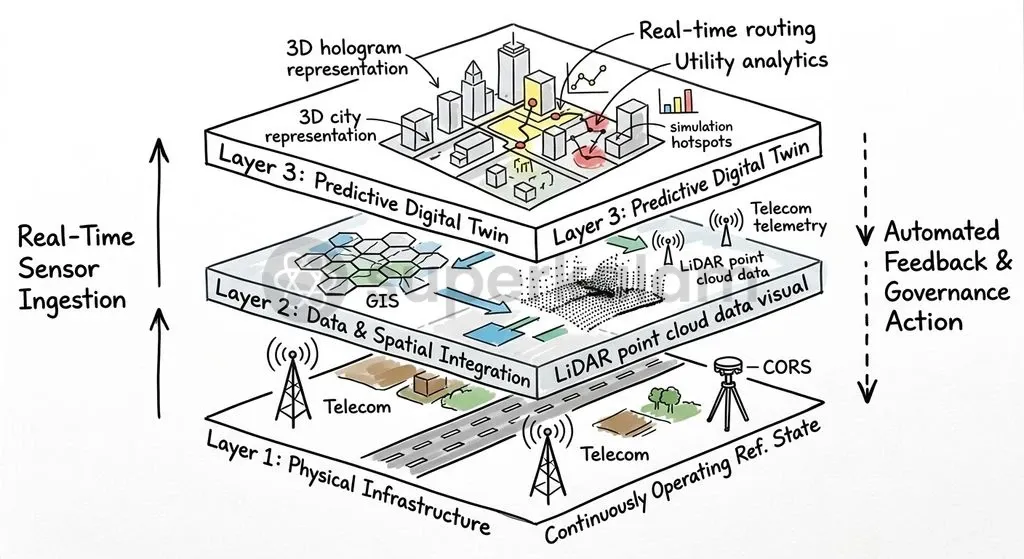
The Department of Telecommunications launched the 'Sangam: Digital Twin' initiative on 15 February 2024 to integrate telecom, sensor, and spatial datasets for infrastructure governance. This deployment marked an institutional pivot from visual entertainment toward high-fidelity engineering models.
Recent policy decisions demonstrate this accelerating convergence:
- Inter-ministerial mobility twins: As of October 2025, the Department of Telecommunications collaborated with the Ministry of Housing and Urban Affairs through an Inter-Ministerial Joint Working Group to demonstrate telecom-enabled transport digital twins at the India Mobile Congress.
- Foundational spatial labs: The Union Budget 2026–27 allocated ₹250 crore to establish AVGC Content Creator Labs across 15,000 secondary schools and 500 colleges to cultivate foundational spatial design talent.
Public agencies now recognise that graphic assets, spatial computing environments, and real-time 3D rendering pipelines built for entertainment provide the baseline architecture for industrial twins.
Beyond Entertainment: Distinguishing Media XR from Industrial Digital Twins
Extended Reality encompasses virtual, augmented, and mixed reality, serving distinctly different operational mandates across creative media and cyber-physical engineering.
Virtual Reality (VR) immerses users within fully synthetic digital environments. Augmented Reality (AR) superimposes digital data onto the physical world, while Mixed Reality (MR) enables dynamic interaction between real and virtual objects. In the creative sector, the Animation, Visual Effects, Gaming, and Comics (AVGC) framework applies these tools to narrative storytelling and consumer gaming.
In contrast, cyber-physical twins operate as dynamic, living virtual models of physical infrastructure, industrial plants, or biological systems. As the Department of Telecommunications highlighted during the launch of Project Sangam, digital twins do not merely visualise 3D geometry; they synchronise continuously with physical counterparts via real-time IoT sensor telemetry and bidirectional operational feedback loops. While an entertainment engine optimises for sensory aesthetics, an industrial digital twin demands engineering-grade physical fidelity, mathematical tolerance, and deterministic sensor integration.
| Parameter | Media & Creative XR (AVGC) | Industrial Digital Twins |
|---|---|---|
| Primary Mandate | Consumer entertainment, gaming, visual media, artistic storytelling | Cyber-physical asset management, predictive maintenance, urban planning |
| Data Ingestion | Pre-rendered graphics, static 3D assets, script-driven state changes | Continuous real-time IoT telemetry, edge sensors, SCADA networks |
| Operational Loop | Open loop (user input alters local display) | Closed bidirectional loop (digital simulations trigger physical interventions) |
| Accuracy Metric | Perceptual realism, high visual fidelity, frame stability | Millimetre-level geospatial precision, mathematical and physical fidelity |
| Key Vulnerability | Consumer copyright infringement, platform distribution monopolies | Critical infrastructure disruption, national spatial espionage, telemetry sabotage |
Discuss with Superkalam
Recall the specific year by which the National Geospatial Policy 2022 aims to establish comprehensive National Digital Twins for major urban centres.
Ask NowMapping the Nation: DoT's 'Sangam' and Survey of India's Geospatial Twins
The National Geospatial Policy 2022 sets goals of a high-resolution topographical survey and mapping system by 2030 and a National Digital Twin for major urban centres by 2035. Indian administrative bodies are pursuing these goals by replacing legacy two-dimensional mapping with high-density dimensional spatial computing.
Key nationwide initiatives driving this transition include:
- Two-stage metropolitan twin: The Department of Telecommunications structured its Sangam initiative as a two-stage Proof of Concept in a major Indian metropolis, advancing from exploratory computational architectures to real-time traffic routing and disaster response simulation.
- National 3D urban mapping: The Survey of India entered into a strategic collaboration with Genesys International in November 2023 to generate 3D digital twins across Indian cities. This pipeline couples a nationwide network of Continuously Operating Reference Stations (CORS) with airborne and terrestrial LiDAR.
- Municipal deployment in Kashi: Under the Smart Cities Mission and the Kashi Integrated Command and Control Centre, Varanasi Smart City deployed an urban spatial 3D digital twin, mapping 160 square kilometres at 4-centimetre resolution.
- Unified geospatial data backbone: The Survey of India developed the National Geo-Spatial Platform as an authoritative, API-driven platform standardising geospatial datasets for urban master planning.
Discuss with Superkalam
Explain how closed bidirectional feedback loops distinguish industrial digital twins from standard 3D virtual reality models.
Ask NowThe Strategic Blind Spot: India's Hardware and Optical Dependency Trap
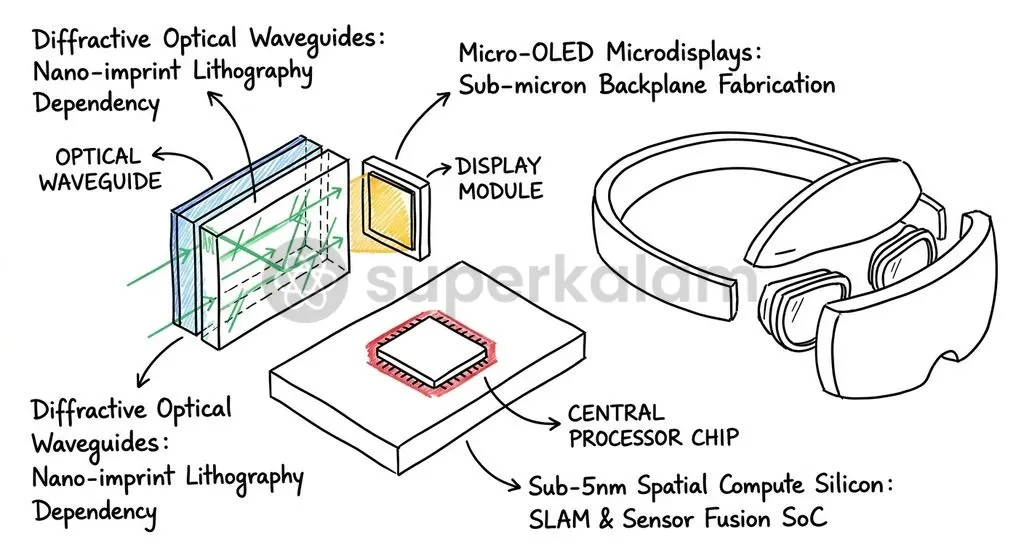
India's spatial computing ecosystem depends on specialised hardware: micro-OLED microdisplays, diffractive optical waveguides and low-power spatial computing processors. The physical devices that deliver immersive experiences rely on these components, and a fabrication base for them is still being built.
Three hardware layers explain why this matters:
- Sub-micron display backplanes: Micro-OLED panels demand pixel densities exceeding 3,000 pixels per inch to eradicate screen-door distortions. MeitY has been weighing micro-OLED technology as one option for India's first display fab.
- Diffractive optical waveguides: Waveguides direct light into human pupils using nanometre-scale surface relief gratings. Manufacturing them requires precision nano-imprint lithography and specialised optical etching.
- Spatial processing silicon: Spatial headsets run simultaneous localisation and mapping (SLAM) algorithms alongside computer vision pipelines. These require dedicated, low-power spatial computing silicon built on advanced process nodes.
Where public agencies and defence units trial headsets built on foreign hardware stacks, strategic infrastructure is exposed to physical-layer vulnerabilities and unverified firmware.
Discuss with Superkalam
If an Indian municipal authority deploys a city twin using foreign closed-source software, how might offshore export controls affect its day-to-day public utility management?
Ask NowPlatform Vulnerability: Why Relying on Foreign Engines Threatens Data Sovereignty
Proprietary foreign simulation platforms like Unreal Engine and Unity present serious security challenges when used to build critical national infrastructure models. Originally engineered for commercial gaming, these systems have evolved into default operating environments for spatial data.
According to an enterprise knowledge paper from the Geospatial World Chambers of Commerce, deploying closed foreign simulation engines poses major operational risks:
- Source-code opacity: Proprietary engines run precompiled, closed-source binaries, preventing sovereign defence agencies from auditing background network calls.
- Spatial telemetry exfiltration: Security teams cannot verify whether high-precision asset coordinates and site telemetry are routed to offshore cloud servers.
- Licensing vulnerabilities: Foreign software is bound to overseas export control frameworks. If geopolitical friction occurs, vendors can unilaterally revoke licenses, freezing the control systems that manage Indian ports, metro lines, and power utilities.
Discuss with Superkalam
Analyse the structural disconnect between creative incentives provided under the AVGC Task Force and the hardware priorities of the India Semiconductor Mission.
Ask NowPolicy Architecture: Linking the AVGC Task Force with the Semiconductor Mission
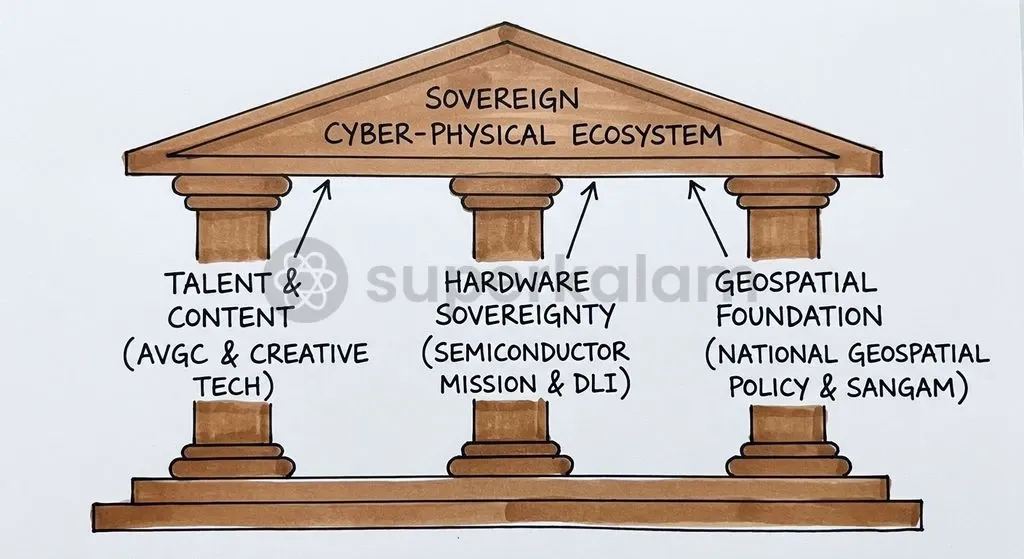
The Ministry of Information and Broadcasting constituted the AVGC Promotion Task Force in April 2022 to establish a formal institutional framework for immersive media technologies. The Task Force submitted its recommendations in December 2022, advising the government to initiate a dedicated National AVGC-XR Mission and launch an overarching 'Create in India' campaign.
Institutional execution followed through Union Cabinet approvals. The government approved the establishment of the National Centre of Excellence (NCoE) for AVGC-XR, operationalised as the Indian Institute of Creative Technologies (IICT) in Mumbai with an approved outlay of ₹391.15 crore.
The IICT operates under a hub-and-spoke model, running initial academic sessions from the NFDC campus while developing a permanent campus at Film City, Goregaon. It offers 18 specialised courses spanning real-time rendering, spatial computing, and game design.
| Institutional Pillar | Core Authority | Mandate & Strategic Deliverable |
|---|---|---|
| Creative & Human Capital | Ministry of Information and Broadcasting (MIB) | National AVGC-XR Mission, IICT Mumbai, 3D talent pipelines |
| Spatial Hardware & Compute | Ministry of Electronics and IT (MeitY) / ISM | Design Linked Incentive (DLI) scheme, edge-AI spatial ASICs |
| Geospatial & Sensor Data | DoT & Survey of India | Project Sangam metropolitan twins, CORS positioning infrastructure |
Hardware sovereignty requires cross-ministerial integration. To eliminate foreign component reliance, MeitY is aligning its Design Linked Incentive (DLI) scheme and the India Semiconductor Mission (ISM) to support domestic fabless startups designing smart vision chips and edge-AI spatial processors. Connecting creative talent from MIB with domestic silicon incentives prevents India from remaining an offshore service layer for foreign hardware.
Spatial Privacy and Governance: Managing Volumetric and Geospatial Data Risks
Continuous room mapping and eye-tracking data generated by immersive devices can qualify as personal data under the Digital Personal Data Protection Act 2023 where it relates to an identifiable individual. Spatial computing captures intimate personal environments that go far beyond standard digital telemetry.
Head-mounted displays utilise outward-facing infrared and depth cameras to continuously scan domestic spaces, recording architectural layouts, room dimensions, and household objects. Concurrently, inward-facing sensors register ocular movements, pupillary dilations, and gaze fixation points. Under Section 6 of the Digital Personal Data Protection Act 2023, data fiduciaries must obtain free, specific, informed and unambiguous consent, valid consent before processing such personal data.
| Sensor Modality | Raw Data Stream | Derived Strategic Threat |
|---|---|---|
| Inward Optical Sensors | Gaze vectors, involuntary pupillary shifts | Biometric psychography, cognitive exploitation, subconscious profiling |
| Outward Spatial LiDAR | Volumetric depth meshes, room dimensions | Domestic structural mapping, unauthorized architectural surveillance |
Spatial computing specialists at the XR Safety Initiative warn that immersive volumetric data creates severe risks of 'biometric psychography', wherein unconscious pupil dilation and gaze duration are analysed to map cognitive weaknesses and intimate behavioural traits.
Concurrently, Section 17 of the Digital Personal Data Protection Act 2023 grants broad state exemptions on grounds of state sovereignty, public order, and national security. When municipal bodies construct high-resolution urban digital twins that ingest real-time CCTV, telecom mobility pings, and facial recognition data, the boundary between public predictive planning and pervasive state surveillance becomes constitutionally fragile, testing the privacy guarantees established under the K.S. Puttaswamy doctrine.
Discuss with Superkalam
Evaluate whether India's open-source developer ecosystem can help mitigate spatial telemetry exfiltration in immersive devices.
Ask NowWay Forward: A Strategic Blueprint for Indigenous Deep-Tech Sovereignty
Achieving deep-tech sovereignty requires India to align its creative media incentives with industrial hardware manufacturing and open-source simulation architectures. The country must systematically disassemble the structural dependencies that threaten its spatial computing ecosystem.
A comprehensive national policy response should focus on four structural interventions:
- Fabless spatial silicon: MeitY must expand the Design Linked Incentive scheme to provide dedicated grants for fabless startups developing RISC-V-based spatial computing system-on-chips (SoCs) and low-latency edge-AI sensor hubs.
- Open-source simulation engine: India's scientific institutions, including the Centre for Development of Advanced Computing (C-DAC), must lead a national consortium to build an open-source, deterministic digital twin engine, ending public infrastructure dependence on proprietary game engines.
- Spatial privacy standards: The Data Protection Board of India must formulate specific spatial data regulations mandating edge processing for volumetric room telemetry and prohibiting the raw transmission of biometric eye-tracking data to cloud servers under the DPDPA.
- Inter-ministerial strategic coordination: Institutionalise an overarching National Spatial Computing Council combining the Ministry of Information and Broadcasting, DoT, MeitY, and the Ministry of Defence to coordinate dual-use spatial research and standardise secure cyber-physical APIs across municipal digital twins.
Key Takeaways
- Immersive Extended Reality spans consumer-focused AVGC storytelling and cyber-physical digital twins, with the latter defined by bidirectional operational feedback and real-time IoT synchronization.
- The Department of Telecommunications launched the 'Sangam: Digital Twin' initiative on 15 February 2024 to harness telecom and spatial datasets for predictive national infrastructure planning.
- The National Geospatial Policy 2022 sets goals to construct high-resolution topographical mapping systems by 2030 and a National Digital Twin covering major urban centres by 2035.
- India's immersive devices depend on specialised hardware such as micro-OLED displays, diffractive optical waveguides and spatial processing silicon, which creates a strategic dependency.
- Sovereign critical infrastructure models built on foreign game engines like Unreal Engine and Unity face security risks including source-code opacity, potential backdoors, and licensing revocations.
- The Indian Institute of Creative Technologies (IICT) in Mumbai, approved with an allocation of ₹391.15 crore, anchors the human-capital pillar of the National AVGC-XR Mission.
Mains Question
"The institutional transition from media entertainment XR to industrial digital twins marks a shift from perceptual aesthetics to engineering-grade, deterministic cyber-physical governance." Elucidate with reference to the Department of Telecommunications' 'Sangam: Digital Twin' initiative. (10 Marks)
Evaluate NowMains Question
"While India's immersive technology sector is projected to expand significantly, achieving strategic autonomy is challenged by a foundational hardware dependency and reliance on proprietary foreign simulation engines." Critically analyse. (15 Marks)
Evaluate NowPractice MCQs
QUESTION 1
With reference to the distinction between Media/Creative Extended Reality (AVGC) and Industrial Digital Twins, consider the following statements:
- Media Extended Reality operates primarily on an open loop where user inputs modify the local display.
- Industrial digital twins rely on static 3D assets and script-driven states rather than live telemetry.
- Industrial digital twins establish closed bidirectional loops where digital simulations can trigger physical interventions. Which of the statements given above are correct?
QUESTION 2
Consider the following statements regarding geospatial and spatial mapping initiatives in India:
- The National Geospatial Policy 2022 aims to establish high-resolution topographical survey systems by 2030 and a National Digital Twin for major urban centres by 2035.
- The Survey of India's 3D urban mapping pipeline couples a nationwide network of Continuously Operating Reference Stations (CORS) with LiDAR technologies.
- Under the Smart Cities Mission, Varanasi Smart City deployed an urban spatial 3D digital twin covering 160 square kilometres at 4-centimetre resolution. Which of the statements given above are correct?
QUESTION 3
Regarding the hardware and policy landscape for spatial computing and digital twins in India, consider the following statements:
- The Digital Personal Data Protection Act 2023 exempts eye-tracking data from every consent requirement.
- Micro-OLED panels need pixel densities exceeding 3,000 pixels per inch to avoid screen-door distortion.
- Diffractive optical waveguides are manufactured using precision nano-imprint lithography. Which of the statements given above is/are correct?
QUESTION 4
Consider the following statements regarding policy and institutional developments in India's digital twin and AVGC ecosystems:
- The 'Sangam: Digital Twin' initiative was launched by the Department of Telecommunications to integrate telecom, sensor, and spatial datasets.
- The National Centre of Excellence for AVGC-XR has been operationalised as the Indian Institute of Creative Technologies (IICT) in Mumbai.
- The Union Budget 2026–27 allocated ₹250 crore to set up AVGC Content Creator Labs across secondary schools and colleges. Which of the statements given above are correct?
QUESTION 5
In the context of geospatial digital twin development in India, which foundational infrastructure network is being integrated with terrestrial and airborne LiDAR by the Survey of India to generate nationwide 3D urban models?