Digital Hawala: How Crypto Layering Challenges India's PMLA Net
As illicit finance shifts to crypto mixers and unhosted wallets, India tightens PMLA mandates to track cross-border digital hawala networks.
Sep, 2026
•10 min read

Overview
Digital hawala represents an evolving method of illicit value transfer where bad actors replace traditional physical couriers with peer-to-peer cryptocurrency networks, over-the-counter desks, and automated blockchain layering mechanisms. This technological shift creates acute regulatory challenges for Indian enforcement bodies attempting to trace dirty money across decentralized and cross-border protocols. In response, the Ministry of Finance brought Virtual Digital Asset Service Providers directly under the Prevention of Money Laundering Act, 2002. Under this statutory framework, the Financial Intelligence Unit – India acts as the sector regulator, enforcing mandatory client due diligence, transaction record-keeping, and the Financial Action Task Force Travel Rule. However, illicit actors continue to exploit decentralized finance, privacy coins, and unhosted non-custodial wallets to bypass centralized compliance gateways.
Why in the News: The Rise of Virtual Assets in Money Laundering
As of October 2025, the Financial Intelligence Unit – India (FIU-IND) escalated enforcement actions against offshore cryptocurrency platforms operating without mandatory registration under Indian anti-money laundering laws. The regulatory crackdown intensified after FIU-IND issued statutory compliance notices to 25 offshore Virtual Digital Asset Service Providers (VDASPs), including platforms such as Paxful, Changelly, BitMEX, and Huione.
This regulatory offensive follows earlier enforcement measures, including show-cause notices issued on 28 December 2023 against nine major offshore exchanges such as Binance, KuCoin, Kraken, and Huobi. In June 2024, the Director of FIU-IND levied an administrative monetary penalty of ₹18.82 crore on Binance for sustained non-compliance with statutory obligations.
These actions highlight the expanding vulnerability of the domestic financial system to digital money laundering. Sovereign enforcement bodies now treat virtual asset channels as primary conduits for illicit capital flight, cyber fraud proceeds, and informal remittance settlement.
What is Digital Hawala and How Does Virtual Asset Layering Work?
Digital hawala is an informal value transfer system that settles cross-border debts using virtual digital assets rather than formal banking channels or physical cash handoffs. The operational architecture substitutes human bookkeepers with peer-to-peer (P2P) crypto networks and over-the-counter (OTC) settlement desks.
The classic money laundering lifecycle—placement, layering, and integration—adapts to decentralized technology through specific technical steps:
- Placement: Illicit fiat currency enters the ecosystem through local P2P trades, cash deposits at informal OTC desks, or mule bank accounts linked to Unified Payments Interface (UPI) IDs. The physical cash is converted into liquid, US dollar-pegged stablecoins such as Tether (USDT).
- Layering: The launderer obscures the audit trail by routing funds across diverse blockchain ecosystems. This process involves executing rapid swaps on decentralized exchanges (DEXs), moving assets across cross-chain bridges, and utilizing smart-contract-based privacy tools.
- Integration: Cleaned digital assets re-enter the formal economy. Launderers convert stablecoins back into fiat at foreign exchanges, purchase high-value physical assets, or execute Trade-Based Money Laundering (TBML) by using stablecoins to settle balance discrepancies from under-invoiced or over-invoiced trade goods.
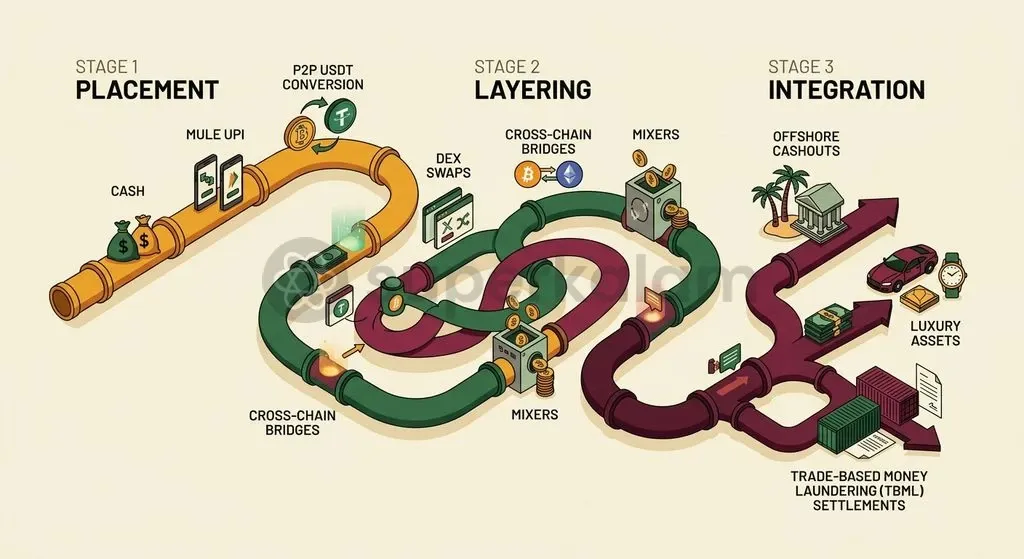
Launderers frequently employ crypto mixers and tumblers (such as Tornado Cash and Blender.io) during the layering phase. These smart-contract protocols pool diverse cryptocurrency deposits together before disbursing them to fresh addresses, effectively severing the deterministic mathematical link between deposit and withdrawal wallets.
Comparing Old and New: Traditional Hawala vs. Crypto Layering
Traditional hawala systems depend on trust networks and parallel ledger balancing, whereas digital hawala leverages decentralized, immutable software protocols. Understanding the operational divergence between these mechanisms is essential for modern financial surveillance.
| Analytical Dimension | Traditional Hawala | Digital Hawala (Crypto Layering) |
|---|---|---|
| Primary Settlement Mechanism | Informal trust networks, physical ledger books, and verbal commitments | Smart contracts, peer-to-peer blockchain transfers, and USD-pegged stablecoins |
| Settlement Velocity | Hours to days, limited by banking business hours and physical transport | Near-instantaneous execution across automated distributed ledger networks |
| Transaction Records | Destroyed paper chits, phone codes, and off-the-books accounting books | Publicly viewable pseudonymous ledger trails, obscured via mixers and privacy protocols |
| Intermediary Structure | Specialized human brokers (Hawaladars) located in specific jurisdictions | Automated market makers, decentralized liquidity pools, and unhosted private wallets |
| Cross-Border Friction | Constrained by local physical reach, currency availability, and courier logistics | Borderless capital mobility executed without cross-border customs checkpoints |
| Primary Vulnerability | Interception of human brokers, seized physical books, and phone taps | Blockchain analytics mapping wallet clusters to regulated fiat off-ramps |
Discuss with Superkalam
Which statutory gazette notification formally brought Virtual Digital Asset Service Providers under the PMLA perimeter, and in which year was it issued?
Ask NowIndia's Legal Net: Bringing Virtual Digital Assets under PMLA
The Ministry of Finance plugged a major regulatory loophole on 7 March 2023 by issuing Gazette Notification S.O. 1072(E). This statutory instrument formally brought Virtual Digital Asset Service Providers (VDASPs) into the regulatory perimeter of the Prevention of Money Laundering Act, 2002 (PMLA) as designated reporting entities.
Under Section 12 of the PMLA, 2002, entities conducting these designated activities bear specific compliance obligations:
- Client Due Diligence: Entities must perform robust Know Your Customer (KYC) verification of all users, beneficial owners, and account operators before onboarding.
- Maintenance of Records: Regulated service providers must preserve complete transaction logs and customer identity documentation for a statutory period of at least five years.
- Suspicious Transaction Reporting: Entities must file Suspicious Transaction Reports (STRs) with FIU-IND within seven working days of detecting red-flag indicators under Rule 8 of the Prevention of Money-laundering (Maintenance of Records) Rules, 2005.
To consolidate oversight, the central government designated the Director of FIU-IND as the official sector regulator for virtual digital asset businesses through Notification S.O. 4877(E).
Discuss with Superkalam
Explain how crypto mixers and cross-chain bridges alter the traditional layering phase of money laundering.
Ask NowEnforcement in Action: FIU-IND Mandates and Offshore Exchange Scrutiny
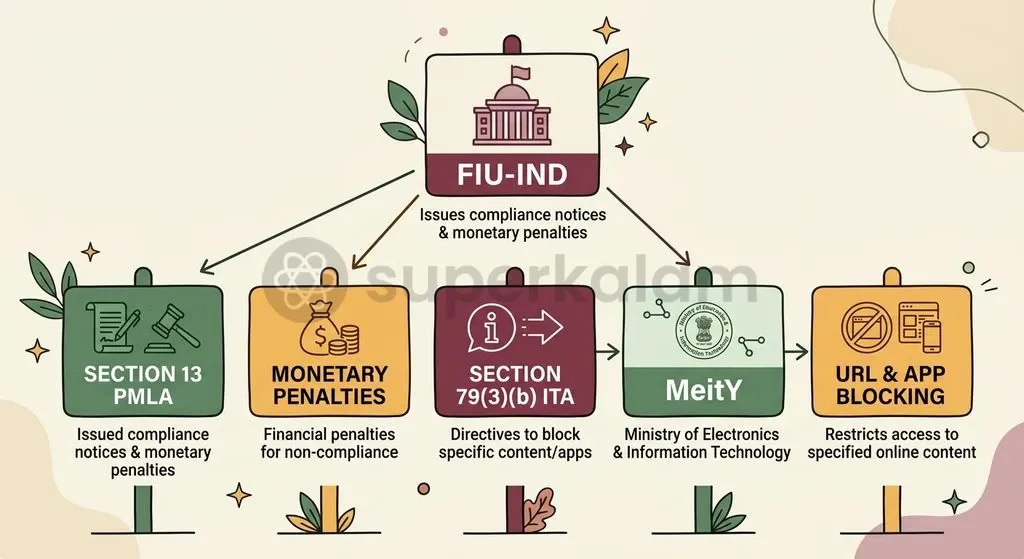
The Financial Intelligence Unit – India serves as the national intelligence agency responsible for receiving, processing, and disseminating information relating to suspect financial transactions. Operating as the sector regulator, FIU-IND exercises statutory enforcement powers under Section 13 of the PMLA to issue notices, initiate audits, and levy financial penalties against non-compliant entities.
Enforcement reaches beyond domestic platforms to encompass foreign platforms serving Indian residents. When offshore exchanges fail to register or comply with Indian client due diligence mandates, the Director of FIU-IND invokes statutory authority under Section 79(3)(b) of the Information Technology Act, 2000. This provision empowers the regulator to instruct the Ministry of Electronics and Information Technology (MeitY) to block public access to non-compliant websites and mobile applications.
Investigative agencies such as the Enforcement Directorate (ED) complement these regulatory sanctions on the ground. Domestic enforcement bodies reportedly utilize specialized blockchain intelligence suites, including Chainalysis and TRM Labs, to cluster tainted addresses, de-anonymize illicit transactions, and track digital assets back to regulated bank accounts.
Major Roadblocks: P2P Trades, Mixers, and Decentralized Wallets
Enforcement agencies face significant technological impediments when virtual asset laundering shifts away from centralized exchanges to non-custodial environments. The PMLA compliance framework rests on the presence of an identifiable, regulated intermediary—a structural assumption that breaks down across decentralized architectures.
Key systemic bottlenecks include:
- Unhosted (Non-Custodial) Wallets: Software and hardware wallets store cryptographic private keys locally without third-party custodianship. Because direct peer-to-peer transfers between private wallets require no intermediary, they operate outside the statutory purview of PMLA reporting entity mandates.
- Decentralized Finance (DeFi) Protocols: DeFi platforms deploy self-executing smart contracts on distributed ledgers to facilitate lending, borrowing, and token swaps. These protocols function without an identifiable board of directors or designated Principal Officer, frustrating legal liability models under anti-money laundering statutes.
- Privacy Coins: Anonymity-enhanced cryptocurrencies like Monero and Zcash integrate advanced cryptography—such as zero-knowledge proofs (zk-SNARKs), ring signatures, and stealth addresses—to hide sender identities, transaction values, and destination addresses from public blockchain explorers.
- Cross-Jurisdictional Latency: While on-chain crypto transfers execute in seconds, international evidentiary cooperation remains burdened by bureaucratic delays. Navigating Mutual Legal Assistance Treaties (MLATs) and issuing Letters Rogatory takes months, giving illicit actors ample time to liquidate or re-layer assets.
Discuss with Superkalam
How can investigative agencies utilize blockchain analytics suites like Chainalysis or TRM Labs to de-anonymize illicit P2P transactions?
Ask NowGlobal Standards: The FATF Travel Rule and Cross-Border Coordination
The Financial Action Task Force (FATF) provides the global policy standard for preventing virtual asset abuse through Recommendation 15 on New Technologies. This standard mandates that member jurisdictions license or register Virtual Asset Service Providers and subject them to strict risk-based anti-money laundering supervision.
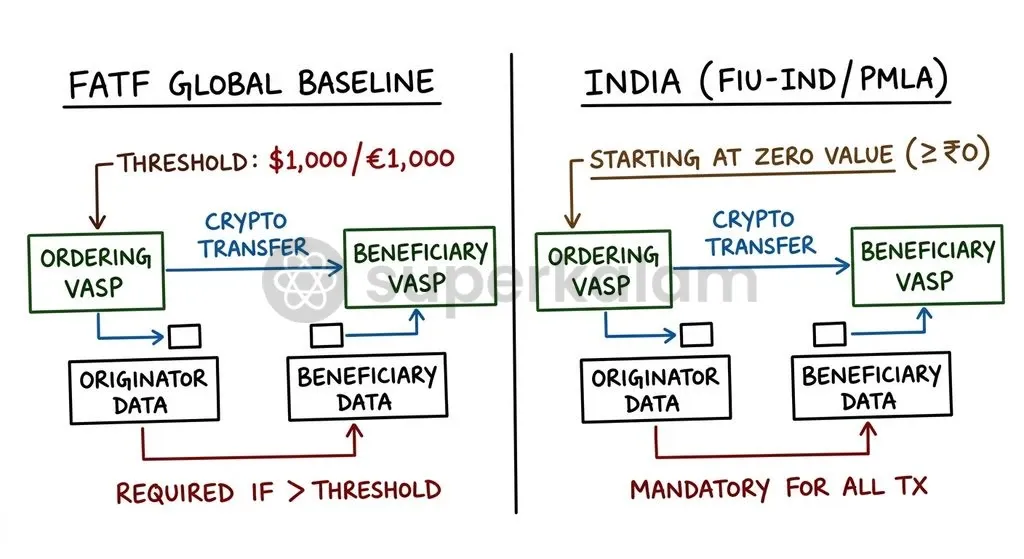
A core pillar of this framework is the FATF Travel Rule, codified under Recommendation 16. The global standard establishes a baseline transaction threshold of USD 1,000 / EUR 1,000, requiring originating service providers to obtain, verify, and transmit sender and recipient identity data to beneficiary institutions during asset transfers.
India's domestic regulatory stance is stricter than the global baseline. The FIU-IND AML & CFT Guidelines require domestic reporting entities to enforce the Travel Rule on all virtual digital asset transfers without any de minimis threshold.
To close global tax and ownership transparency loopholes, international bodies are establishing automated data-sharing architectures. The Organisation for Economic Co-operation and Development (OECD) finalized the Crypto-Asset Reporting Framework (CARF), which establishes a standardized system for automatic annual cross-border tax information exchange on virtual asset transactions.
Way Forward: Building a Modern Enforcement and Regulatory Architecture
Addressing digital hawala requires India to modernize its financial surveillance toolkits while maintaining fundamental constitutional safeguards. Regulators must look beyond basic portal blocking and develop dynamic supervisory systems.
- Upgrading Technical Capacity in Investigating Agencies: The Enforcement Directorate and state cybercrime cells must invest in specialized blockchain forensic laboratories, trained on-chain data analysts, and heuristic clustering technologies. Developing institutional capability to trace cross-chain liquidity and parse smart contracts is critical to countering advanced crypto layering.
- Operationalising Multilateral Information Pipelines: Relying on slow judicial treaties is inadequate for high-speed crypto tracking. India should accelerate bilateral regulatory arrangements under FIU networks and fully implement automatic data exchanges through frameworks such as the OECD Crypto-Asset Reporting Framework (CARF).
- Balancing Surveillance with Constitutional Proportionality: Financial data collection and real-time metadata monitoring must satisfy the constitutional test of proportionality established by the Supreme Court in Justice K.S. Puttaswamy v. Union of India (2017). Regulators must build clear procedural guardrails to ensure surveillance pursues a legitimate state aim without sanctioning arbitrary mass surveillance.
Discuss with Superkalam
Compare the systemic vulnerabilities of traditional hawala (human brokers, physical books) with digital hawala (mixers, unhosted wallets, smart contracts).
Ask NowKey Takeaways
- Statutory Integration: Ministry of Finance Notification S.O. 1072(E) brought Virtual Digital Asset Service Providers under the PMLA, 2002, designating five core cryptocurrency activities as regulated reporting operations.
- Compliance Obligations: Reporting entities under PMLA Section 12 must verify client identities, retain transaction records for five years, and submit Suspicious Transaction Reports to FIU-IND within seven working days.
- Regulatory Oversight: FIU-IND acts as the sector regulator under Notification S.O. 4877(E), utilizing Section 13 PMLA penalties and Section 79(3)(b) IT Act blocking powers against non-compliant offshore platforms.
- Zero Threshold Travel Rule: FIU-IND guidelines mandate full originator and beneficiary data transmission for crypto transactions with zero de minimis threshold, exceeding the FATF Recommendation 16 baseline.
- Structural Vulnerabilities: Decentralized finance protocols, unhosted wallets, and crypto mixers create regulatory blind spots by removing centralized intermediaries from the transaction chain.
Mains Question
"The transition from traditional physical networks to digital hawala and crypto layering presents an unprecedented challenge to the domestic anti-money laundering architecture." Examine the efficacy and limitations of bringing Virtual Digital Asset Service Providers under the PMLA. (15 Marks)
Evaluate NowMains Question
"Smart-contract protocols and decentralized tools have fundamentally altered the placement, layering, and integration stages of illicit value transfers." Elucidate. (10 Marks)
Evaluate NowPractice MCQs
QUESTION 1
With reference to the regulatory framework governing Virtual Digital Asset Service Providers (VDASPs) under the Prevention of Money Laundering Act, 2002 (PMLA), consider the following statements:
- Gazette Notification S.O. 1072(E) designates both fiat-to-crypto and crypto-to-crypto exchange activities as reporting entities under PMLA.
- Regulated service providers are mandated to preserve complete transaction logs and identity records for at least five years.
- Reporting entities must submit Suspicious Transaction Reports (STRs) to FIU-IND within thirty days of detecting red-flag indicators. Which of the statements given above is/are correct?
QUESTION 2
Consider the following statements regarding the mechanics of 'Digital Hawala' and crypto layering:
- Placement in digital hawala commonly utilizes mule bank accounts linked to UPI IDs to convert fiat currency into USD-pegged stablecoins.
- Smart-contract-based mixers sever mathematical links between addresses by pooling diverse cryptocurrency deposits before disbursement.
- Digital hawala systems rely on physical chits and specialized human hawaladars for ledger balancing. Which of the statements given above is/are correct?
QUESTION 3
Regarding enforcement actions taken by the Financial Intelligence Unit – India (FIU-IND) against offshore virtual asset platforms, consider the following statements:
- The Director of FIU-IND is designated as the official sector regulator for virtual digital asset businesses.
- Section 79(3)(b) of the Information Technology Act, 2000 is invoked to instruct MeitY to block non-compliant offshore exchange domains and applications.
- Under Section 13 of PMLA, FIU-IND has the statutory power to levy monetary penalties against non-compliant entities. Which of the statements given above are correct?
QUESTION 4
Under Gazette Notification S.O. 1072(E), which of the following activities bring a Virtual Digital Asset entity under the purview of the Prevention of Money Laundering Act, 2002?
- Safekeeping or administration of virtual digital assets
- Participation in and provision of financial services related to an issuer's offer and sale of a virtual digital asset
- Transfer of virtual digital assets Select the correct answer using the code given below:
QUESTION 5
In the context of blockchain-enabled money laundering, what role do 'cross-chain bridges' and 'decentralized exchanges (DEXs)' primarily play in the money laundering lifecycle?