Digital Content Takedowns in India: Section 69A and Executive Secrecy
As executive secrecy under Section 69A shields mounting digital censorship from judicial review, the constitutional balance of free expression faces severe tests.
Nov, 2026
•11 min read
Overview
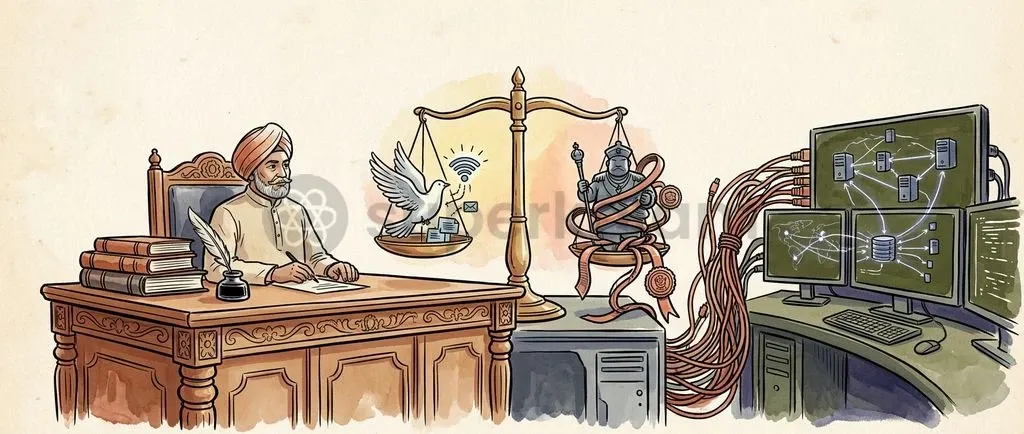
Corporate transparency disclosures from Meta and Google establish that Indian state agencies are directing record volumes of digital content removals. These actions rely primarily on executive blocking powers that bypass open judicial processes and curtail expressive rights under Article 19.
Between January and June 2026, Meta restricted access to 54.39 lakh items in India under local laws. Google received 4,006 removal requests targeting 65,091 individual pieces of content over the same span.
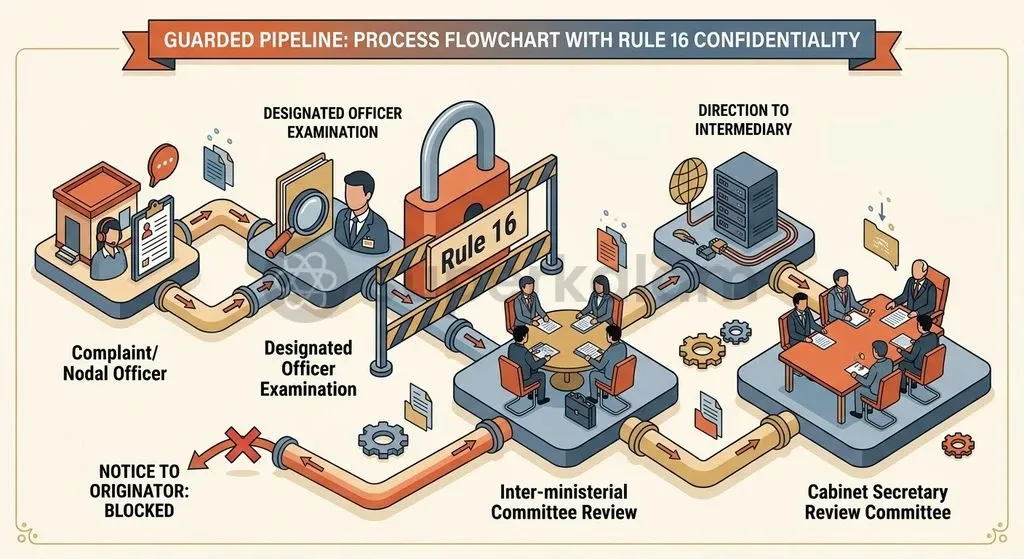
These interventions reflect a structural shift. Statutory secrecy under Rule 16 of the Information Technology (Procedure and Safeguards for Blocking for Access of Information by Public) Rules, 2009 insulates executive orders from public scrutiny and judicial review. Balancing legitimate state security requirements against constitutional freedoms demands transparent public repositories and independent post-action audits.
Why in the News?
As of June 2026, transparency reports published by Meta and Google show that India ranks among the top three nations globally in state-directed digital content takedowns. These disclosures highlight expanding executive intervention in online discourse, raising pressing questions regarding administrative overreach and constitutional safeguards.
The legal debate centres on Article 19(1)(a) expressive freedoms and the permissible reasonable restrictions enumerated under Article 19(2) of the Constitution. State-directed blocking orders remain strictly confidential under executive rules. Corporate transparency reports have therefore become the principal empirical window through which citizens, researchers, and courts observe digital censorship in India.
Why Big Tech Transparency Reports Matter for Indian Governance
Corporate disclosures from Google and Meta provide the primary external audit of state-directed censorship within India's otherwise opaque digital governance ecosystem. While government ministries routinely issue binding blocking orders, official administrative records regarding individual content takedowns remain shielded from public inspection.
Voluntary corporate transparency reporting bridges this informational deficit through three key functions:
- Quantifying state intervention: Aggregating raw numbers on removal notices, legal provisions invoked, and compliance rates across services.
- Tracking permissible speech: Revealing how administrative agencies interpret red lines and shift boundaries of public discourse over time.
- Supplying empirical records: Providing constitutional courts and policy researchers with verifiable data required to test whether executive actions observe legal boundaries.
Democratic accountability relies on public awareness of state interventions. When digital platforms publish periodic data breakdowns, citizens gain the empirical evidence required to scrutinise administrative power.
What the Numbers Show: India's Surging Content Removal Requests
Official transparency filings from Meta and Google document unprecedented growth in Indian content restrictions during the first half of 2026. This data establishes India as one of the most active regulatory jurisdictions for digital content suppression worldwide.
The headline metrics across major platforms highlight the sheer scale of enforcement:
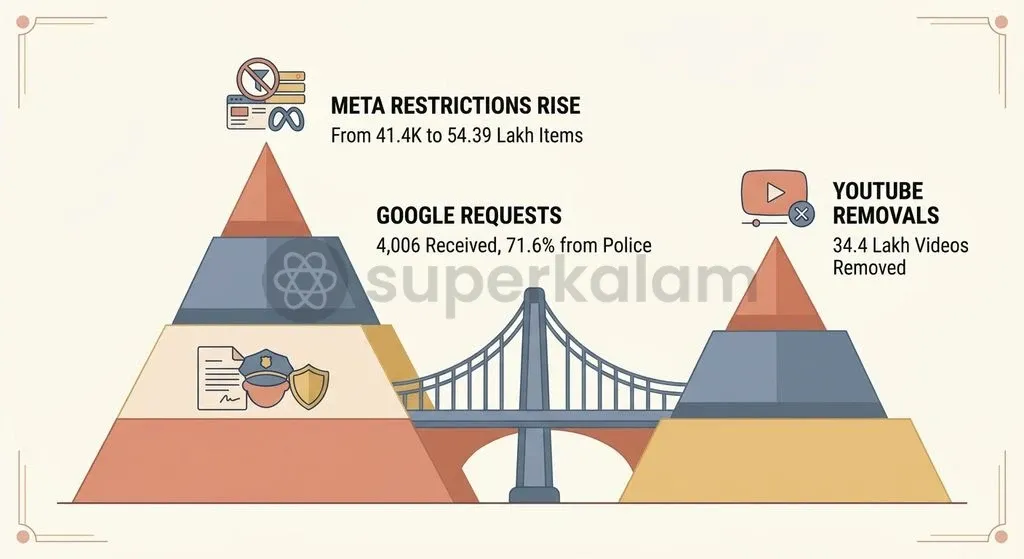
- Meta local law takedowns: The company restricted access to 54.39 lakh pieces of content and user accounts in India under local laws between January and June 2026. This intervention marked a roughly 131-fold increase from the 41,400 items restricted during July to December 2025. India ranked second globally in domestic legal restrictions on Meta platforms during this period, trailing only Indonesia's 20.6 million restrictions and accounting for nearly 20% of Meta's 27.1 million restrictions globally.
- Google removal notices: Google received 4,006 government and judicial requests flagging 65,091 items between January and June 2026, representing a 61.3% increase in requests compared to the preceding six-month period. India was the third-highest requesting jurisdiction globally on Google services, behind Russia's 21,240 requests and South Korea's 9,884 requests.
- Police and investigative demands: Police and investigative authorities submitted 2,870 requests, comprising 71.6% of all removal requests sent by Indian authorities. Defamation emerged as the single most cited justification, appearing in 2,130 separate notices.
- Algorithmic video removals: Automated and algorithmic platform enforcement expanded simultaneously. YouTube removed 34.4 lakh Indian videos under Community Guidelines between April and June 2026, accounting for nearly 31% of worldwide removals and placing India first globally.
Discuss with Superkalam
Recall the six specific grounds enumerated under Section 69A(1) of the IT Act that authorise the Central Government to block online content.
Ask NowExecutive Orders vs Court Mandates: Deconstructing the Takedown Channels
Indian public authorities pursue digital content removal through three distinct legal pathways anchored in the Information Technology Act, 2000. Each channel exhibits varying degrees of procedural scrutiny, executive discretion, and constitutional friction.
Direct executive blocking operates primarily through Section 69A(1) of the Information Technology Act, 2000. This provision empowers the Central Government to block public access to digital material exclusively on six grounds aligned with Article 19(2).
These statutory grounds include India's sovereignty and integrity, defence of India, security of the State, friendly relations with foreign states, public order, or preventing incitement to cognisable offences relating to these grounds. Non-compliance by an intermediary carries criminal sanctions under Section 69A(3), including up to seven years' imprisonment and statutory fines.
Judicial takedowns follow an adversarial process where courts evaluate content legality against established statutory standards. Under the Supreme Court's ruling in Shreya Singhal v. Union of India (2015), intermediary safe harbour protection under Section 79(3)(b) remains intact unless a platform fails to remove content after receiving actual knowledge via a court order or an authorised government notice.
The third pathway involves direct law enforcement notifications transmitted through administrative portals. In October 2024, the Ministry of Home Affairs launched the 'Sahyog' portal, permitting designated central ministries and state police agencies to transmit unlawful content notices directly to participating intermediaries. Meta's 2026 disclosures confirmed that the Indian Cybercrime Coordination Centre (I4C) actively issues restriction notices invoking Section 79(3)(b) through these administrative mechanisms.
| Dimension | Section 69A Executive Blocking | Court-Mandated Takedown Orders | Law Enforcement Notices (Section 79) |
|---|---|---|---|
| Statutory Authority | Section 69A, IT Act, 2000 | Inherent judicial power under civil/criminal procedural codes | Section 79(3)(b) read with IT Rules 2021 |
| Issuing Authority | Designated Officer, MeitY (or MIB under Part III) | Competent Civil or Criminal Court | Police agencies, MHA 'Sahyog' portal, I4C |
| Statutory Grounds | Six specific grounds aligned with Article 19(2) | Broad legal violations (e.g., copyright, defamation) | Cognisable offences and unlawful acts |
| Public Transparency | Strictly confidential under Rule 16 of 2009 Rules | Public court orders and judgments | Internal administrative notices |
| Intermediary Penalty | Up to 7 years' imprisonment under Section 69A(3) | Contempt of Court proceedings | Loss of safe harbour immunity under Section 79 |
Discuss with Superkalam
Explain how the statutory confidentiality under Rule 16 creates an informational deficit for citizens seeking judicial review.
Ask NowCorporate Compliance Patterns: How Meta and Google Handle Indian Demands
Technology intermediaries like Google and Meta evaluate Indian government demands against statutory safe harbour protections under Section 79 of the Information Technology Act. Intermediaries maintain safe harbour immunity from third-party liabilities only by observing statutory due diligence and responding expeditiously to lawful orders.
Compliance calculations shifted significantly following sequential regulatory expansions:
- Mandatory grievance officers: The Information Technology (Intermediary Guidelines and Digital Media Ethics Code) Rules, 2021 required significant social media intermediaries to appoint a Resident Grievance Officer and implement structured internal grievance mechanisms under Rule 3(1)(b) and Rule 3(2).
- Executive appellate tribunals: In October 2022, the Central Government inserted Rule 3A, instituting state-appointed Grievance Appellate Committees (GACs) empowered to overturn intermediary content moderation decisions.
- Expanded ministerial remit: Part III and Rule 16 of the IT Rules 2021 vested emergency blocking authority over digital news publishers and video streaming platforms with the Ministry of Information and Broadcasting.
Faced with severe operational risks, corporate platforms routinely comply with executive directives rather than mounting protracted constitutional litigation. When intermediaries contest blocking orders, judicial outcomes have produced divergent legal interpretations regarding executive reach.
In X Corp. v. Union of India (2023), a single judge of the Karnataka High Court ruled that Section 69A authorises the executive to block entire user accounts rather than restricting action to specific URLs or posts. Although a Division Bench stayed the associated ₹50 lakh cost order in August 2023 while admitting the appeal, the substantive question of account-level censorship remains a critical point of constitutional friction.
Discuss with Superkalam
Weigh the necessity of administrative speed and state secrecy during public emergencies against the originator's right to natural justice under Article 19.
Ask NowConstitutional Toll: Silent Censorship and Article 19 Protections
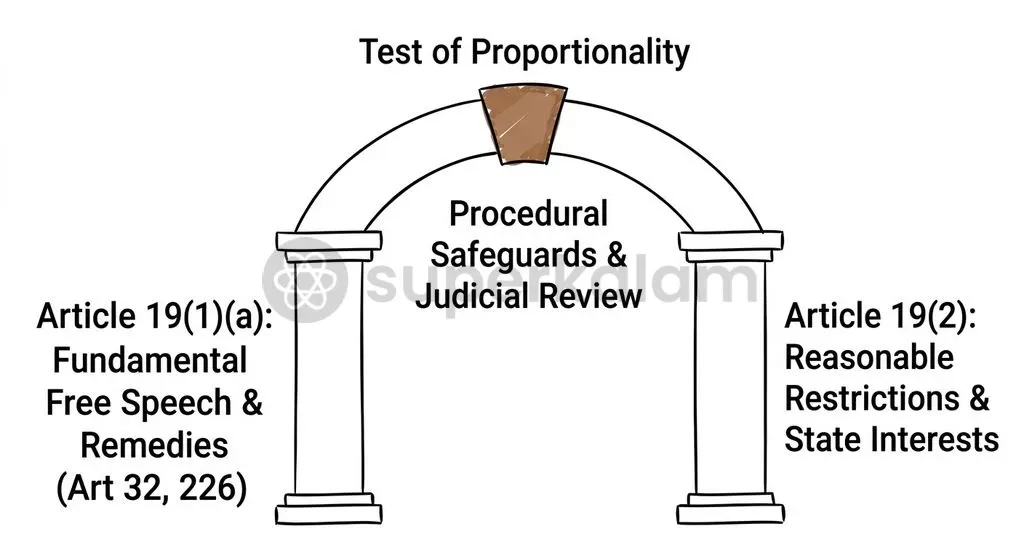
Executive blocking directives issued under Section 69A directly impinge on fundamental expressive freedoms guaranteed by Article 19(1)(a) of the Constitution of India. While the State possesses legitimate authority to safeguard public order and national security, procedural secrecy undermines the principle of proportionality.
This friction surfaces across three central constitutional dimensions:
- Erosion of judicial review: In Shreya Singhal v. Union of India (2015), the Supreme Court upheld the constitutional validity of Section 69A precisely because the 2009 Blocking Rules contained procedural safeguards, including recorded reasons and committee review. The Court presumed that administrative recorded reasons would be amenable to constitutional review under writ jurisdiction.
- The secrecy paradox: Blanket confidentiality enforced through Rule 16 creates a constitutional paradox. When the State withholds the written blocking order, the affected speaker cannot demonstrate the absence of a rational nexus between the restriction and Article 19(2) grounds before a High Court.
- Disproportionate account-level bans: Constitutional proportionality mandates that any fundamental rights restriction must employ the least intrusive administrative means. The prevailing practice of issuing account-level blocks—silencing future speech rather than removing specific unlawful utterances—is a prior restraint that exceeds the constitutional boundaries recognised in Indian jurisprudence.
Fixing Digital Oversight: Blueprint for an Auditable Takedown Regime
Reforming India's digital censorship regime requires statutory amendments grounded in long-standing recommendations from digital rights organisations and transparency advocates. The existing framework prioritises administrative convenience at the expense of procedural fairness and constitutional accountability.
In its , the Parliamentary Standing Committee urged the Union Government to establish centrally consolidated records of blocking orders and systematically re-evaluate safe harbour provisions. To give practical effect to these recommendations, Parliament should reform the blocking framework across four structural pillars:
- Adoption of Public Transparency Repositories: Administrative bodies should implement a public, anonymised registry modelled on the international 'Lumen Database', publishing redacted versions of blocking notices to enable academic, legal, and civil society analysis.
- Statutory Notice to Originators: Rule 8 must be strictly enforced by barring intermediaries from executing blocking orders unless the Designated Officer provides verified proof of service of notice to the content creator.
- Independent Judicial and Parliamentary Oversight: Section 69A review mechanisms should incorporate biannual judicial audits conducted by a retired High Court judge, alongside an annual compliance summary presented to the Parliamentary Standing Committee.
- Mandatory Sunset Clauses on Blocking Orders: Administrative blocking orders should carry a statutory expiration limit of six months, requiring positive executive renewal supported by fresh evidence of ongoing security threats.
Discuss with Superkalam
Design an oversight framework for digital content takedowns that balances state security imperatives with independent audits and public transparency.
Ask NowKey Takeaways
Digital content moderation disclosures from Meta and Google highlight systemic tensions between state security objectives and constitutional rights in India.
- Meta restricted 54.39 lakh content items in India during the first half of 2026, marking a 131-fold surge and ranking India second globally.
- Google received 4,006 removal requests targeting 65,091 items in the first half of 2026, with police agencies accounting for 71.6% of notices and defamation representing the top legal reason.
- YouTube removed 34.4 lakh videos uploaded from India under Community Guidelines in Q2 2026, ranking India first worldwide and comprising nearly 31% of global removals.
- Blanket confidentiality mandated by Rule 16 of the 2009 Blocking Rules conceals executive orders, preventing affected users from mounting effective judicial challenges under Article 32 or Article 226.
- Institutional reforms require moving beyond internal executive committees by enacting sunset clauses, adopting an open Lumen-style repository, and instituting independent judicial audits.
Mains Question
"Statutory confidentiality under Rule 16 of the Information Technology Blocking Rules, 2009 transforms legitimate regulatory oversight into an institutional secrecy trap." Critically examine the impact of executive content blocking mechanisms on Article 19 expressive freedoms and procedural fairness. (15 Marks)
Evaluate NowMains Question
Corporate transparency reports have emerged as an external audit mechanism for digital censorship in India. In this context, elucidate how data disclosures by intermediaries bridge the informational deficit in administrative actions. (10 Marks)
Evaluate NowPractice MCQs
QUESTION 1
Regarding digital content regulation under the Information Technology Act, 2000, consider the following statements:
- Section 69A(1) empowers the Central Government to issue blocking directives on six specific grounds aligned with Article 19(2) of the Constitution.
- Non-compliance by an intermediary with a blocking order under Section 69A carries a maximum punishment of up to three years' imprisonment.
- Under Rule 16 of the Information Technology Blocking Rules, 2009, all blocking requests and official actions taken are maintained under statutory confidentiality. Which of the statements given above are correct?
QUESTION 2
With reference to legal mechanisms for digital content removal in India, consider the following statements:
- In Shreya Singhal v. Union of India (2015), the Supreme Court ruled that an intermediary's safe harbour immunity is lost only if it fails to act after receiving actual knowledge via a court order or an authorised government notice.
- The 'Sahyog' portal, launched by the Ministry of Home Affairs, allows designated central ministries and state police agencies to send unlawful content notices to intermediaries.
- The Indian Cybercrime Coordination Centre (I4C) relies exclusively on judicial warrants rather than administrative notices under Section 79(3)(b). Which of the statements given above is/are correct?
QUESTION 3
Consider the following statements regarding the Information Technology (Procedure and Safeguards for Blocking for Access of Information by Public) Rules, 2009:
- Rule 8 mandates that the Designated Officer make reasonable efforts to identify and notify the content originator to provide an opportunity for a hearing.
- Rule 9 permits emergency blocking orders without a prior hearing, provided they undergo post-facto review by an inter-ministerial committee within 48 hours.
- Rule 14 mandates that the executive Review Committee must convene at least once every month. Which of the statements given above is/are correct?
QUESTION 4
According to corporate transparency reports published in 2026, which of the following grounds was the single most cited justification by Indian police and investigative authorities in content removal notices sent to Google?
QUESTION 5
Consider the following statements regarding corporate transparency reports from digital platforms between January and June 2026:
- India ranked first globally in content restrictions under local laws on Meta platforms.
- Google received 4,006 government and judicial requests flagging over 65,000 items from Indian authorities.
- Police and investigative authorities submitted over 70% of all content removal requests received by Google from India. Which of the statements given above are correct?