Delhi High Court IP Division: Meaning, Role and IPAB Abolition
Delhi High Court created its IP Division in 2021 after IPAB abolition. See its role, jurisdiction, 2022 rules and importance for intellectual property disputes.
Sep, 2026
•8 min read
Overview
The Delhi High Court established its specialised Intellectual Property Division by an office order dated 7 July 2021 following the abolition of the Intellectual Property Appellate Board under the Tribunals Reforms Act, 2021. This created an integrated judicial forum to streamline patent, trademark, and copyright dispute resolution across India.
The institutional shift resolved longstanding procedural bottlenecks. It consolidated original suits, statutory appeals, and revocation petitions under one specialised bench.
The division pairs expedited case management with procedural mechanisms such as concurrent expert evidence and confidentiality clubs. By bridging legal adjudication and scientific inquiry, the bench provides commercial certainty for global investors while fulfilling international treaty obligations.
Why in the News: The Creation of Dedicated IP Benches
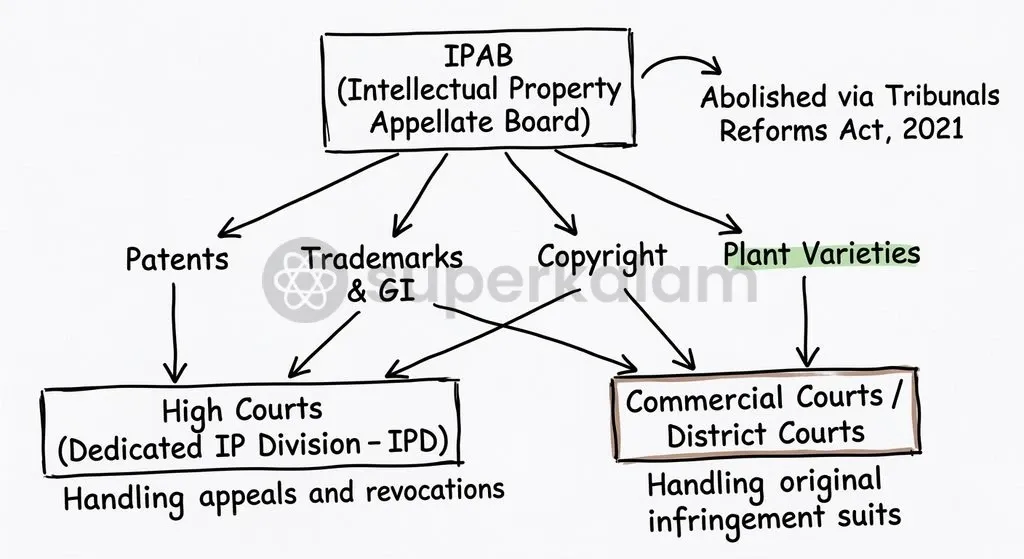
The Parliament of India restructured national commercial dispute resolution by passing the Tribunals Reforms Act, 2021, which dissolved several parallel appellate tribunals. Under the Tribunals Reforms Act, 2021, the Union government formally abolished the Intellectual Property Appellate Board (IPAB) and returned its jurisdiction over patents, trademarks, geographical indications, and plant varieties back to the High Courts.
To prevent docket overload and maintain judicial efficiency, the Delhi High Court constituted a dedicated committee comprising Justice Prathiba M. Singh and Justice Sanjeev Narula in July 2021. This administrative initiative led to the creation of the specialised Intellectual Property Division (IPD), setting a benchmark for commercial dispute resolution across India.
Discuss with Superkalam
What key statutory enactment dissolved the IPAB and transferred intellectual property dispute jurisdiction back to the High Courts?
Ask NowBackground: Why Was the Intellectual Property Appellate Board (IPAB) Scrapped?
The Intellectual Property Appellate Board faced persistent institutional paralysis due to prolonged judicial vacancies, administrative delays, and recurring jurisdictional conflicts. Established to deliver speedy adjudication of intellectual property disputes, the tribunal frequently operated without technical members or a regular chairperson. These persistent vacancies caused thousands of commercial appeals and patent revocation petitions to languish for years.
The Department-related Parliamentary Standing Committee on Commerce noted that systemic delays compromised dispute resolution speed. Parties frequently approached High Courts through writ petitions against procedural orders, creating parallel proceedings. Consequently, the Tribunals Reforms Act, 2021 transferred original rectification powers and statutory appeals back to constitutional courts to guarantee continuous judicial access.
What is the Delhi High Court Intellectual Property Division (IPD)?
The Delhi High Court created the Intellectual Property Division by an office order dated 7 July 2021. The Delhi High Court Intellectual Property Rights Division Rules, 2022 were notified on 24 February 2022 under Section 7 of the Delhi High Court Act, 1966. The IPD operates as a permanent specialised division of the High Court, staffed by designated Single Judges assigned to handle intellectual property matters exclusively.
Key milestones and caseload dynamics of the division include:
- Initial Docket Absorption: Absorbed between 2,000 and 3,000 transferred matters from the abolished IPAB alongside an existing docket of 4,000 to 5,000 pending IPR disputes.
- First-Year Case Clearance: Disposed of over 600 transferred tribunal cases and resolved more than 750 total IPR disputes during 2022-23.
- New Filings Intake: Processed over 1,000 newly instituted filings during its first operational year.
Discuss with Superkalam
Explain how the consolidation of original suits and statutory appeals under one judicial division resolves the issue of parallel proceedings.
Ask NowJurisdiction and Scope of the IPD
The Delhi High Court IPD exercises comprehensive subject-matter jurisdiction over all original and appellate intellectual property disputes arising under Indian statutory law. Under Rule 2(i) and Rule 3 of the IPD Rules, 2022, the division handles original infringement suits, statutory appeals under Section 117A of the Patents Act, 1970, trademark cancellations, design disputes, and copyright matters.
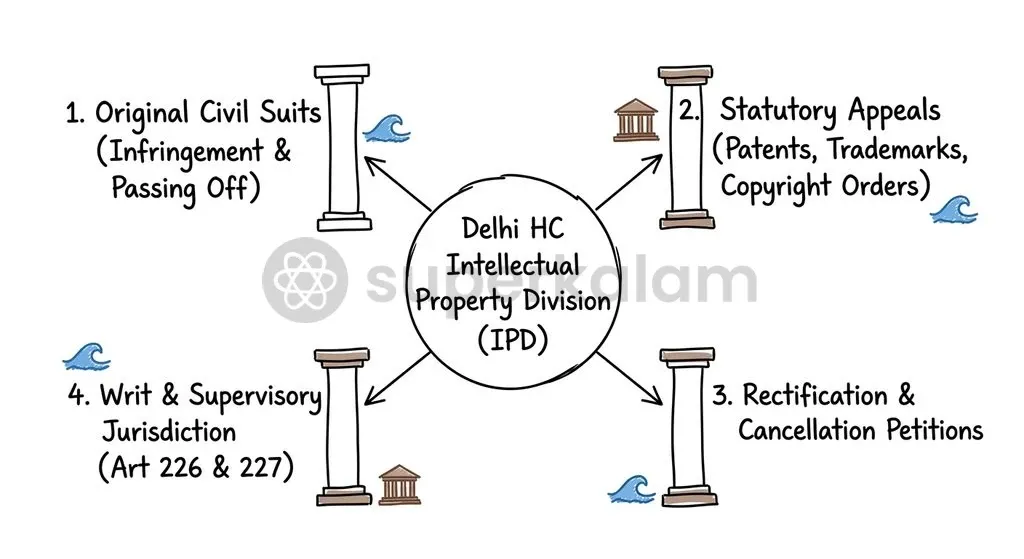
The division also exercises statutory and administrative oversight over decisions rendered by intellectual property offices:
- Statutory Appeals: Direct appeals against rejection or cancellation orders issued by the Controller General of Patents, Designs and Trade Marks (CGPDTM) and the Registrar of Copyrights.
- Original Civil Suits: High-value commercial infringement actions, passing off disputes, and claims involving trade dress or breach of confidence.
- Rectification and Cancellation Petitions: Applications seeking the removal or variation of entries in the official registers for patents, trademarks, and geographical indications.
- Supervisory and Writ Petitions: Revisional petitions arising from lower commercial courts and writ challenges against procedural orders of administrative registries.
Key Provisions of the Delhi High Court Intellectual Property Rights Division Rules
The Delhi High Court Intellectual Property Rights Division Rules, 2022 established modern procedural standards designed to eliminate prolonged commercial litigation. These codified mechanisms integrate international best practices into domestic civil procedure:
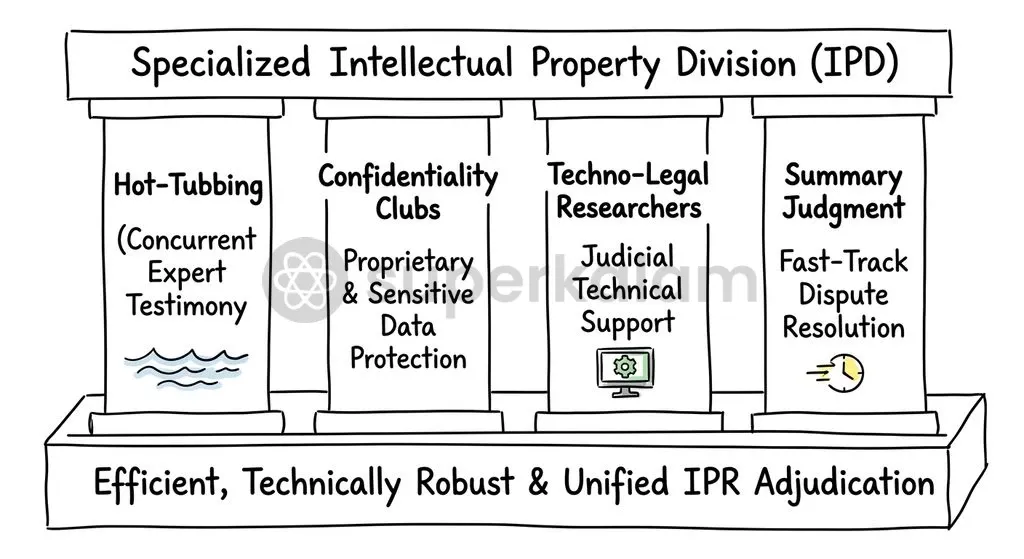
- Summary Adjudication: The court may grant summary judgment without oral trials where a claim or defence demonstrates no real prospect of success.
- Hot-Tubbing (Concurrent Expert Evidence): Rule 16 permits opposing technical expert witnesses to testify simultaneously, enabling the judge to examine conflicting scientific opinions in real time.
- Techno-Legal Support: The framework authorises a panel of technical experts and permits the appointment of up to two techno-legal law researchers (such as engineers, chemists, or pharmacists) per IPD judge to assess complex scientific claims.
- Confidentiality Clubs and Redaction: Rule 19 provides for confidentiality clubs to protect sensitive trade secrets, financial licensing terms, and proprietary software source codes from public disclosure during discovery.
- Structured Patent Timelines: The High Court of Delhi Rules Governing Patent Suits, 2022 impose strict deadlines for pleadings, mandatory discovery schedules, claim construction briefs, and non-tamperable video recording of evidence.
- Concurrent ADR Mechanisms: integrates court-annexed mediation and early neutral evaluation (ENE), which can proceed alongside main judicial hearings without pausing adjudication.
- Appellate Route: Rule 38 stipulates that appeals against orders of an IPD Single Judge lie before a Division Bench as a Letters Patent Appeal or under Section 13 of the Commercial Courts Act, 2015.
Discuss with Superkalam
How does concurrent expert evidence ('hot-tubbing') improve judicial efficiency in highly complex patent litigation compared to traditional sequential cross-examination?
Ask NowComparison: IPAB vs Dedicated High Court IP Division
The transition from an executive-administered tribunal to a specialised judicial division marks a structural evolution in India's intellectual property framework.
| Feature / Dimension | Erstwhile Intellectual Property Appellate Board (IPAB) | Specialized High Court IP Division (IPD) |
|---|---|---|
| Institutional Nature | Statutory quasi-judicial tribunal under executive ministry oversight | Specialized constitutional court division under High Court administration |
| Jurisdictional Reach | Appellate and rectification jurisdiction only; could not try original infringement suits | Comprehensive jurisdiction over original infringement suits, appeals, and writs |
| Technical Assistance | Dependent on appointed technical members; suffered from persistent vacancies | Employs techno-legal law researchers and court-appointed independent expert panels |
| Procedural Timelines | Governed by general tribunal rules with frequent procedural delays | Structured case management, mandatory claim construction, and strict discovery schedules |
| Evidence Mechanisms | Traditional sequential cross-examination of expert witnesses | Institutionalized hot-tubbing (concurrent expert witness testimony) under Rule 16 |
| Appellate Pathway | High Court writ petitions (Articles 226/227) against interim and final orders | Commercial Division Bench appeals under Section 13 of Commercial Courts Act, 2015 |
Why the IPD Model Matters for India's Innovation Ecosystem and Ease of Doing Business
The Delhi High Court IP Division enhances India's global commercial standing by providing predictable and transparent intellectual property enforcement.
The strategic and economic contributions of the IPD include:
- Investment and Innovation Security: Predictable IPR enforcement drives foreign direct investment (FDI) and domestic research commercialisation while reducing legal risk for technology sectors like pharmaceuticals and electronics.
- Elimination of Conflicting Forums: Consolidating original actions and appellate reviews under one court prevents contradictory rulings between tribunals and civil courts.
- International Treaty Compliance: Directly reinforces India's obligations under Part III (Articles 41-42) of the WTO TRIPS Agreement, ensuring fair, equitable, and expeditious enforcement.
- Parliamentary Endorsement: The Parliamentary Standing Committee on Commerce highlighted the model's success in its 169th Report, reversing its previous call to restore the IPAB and recommending nationwide IP Divisions.
Challenges Ahead: Judicial Capacity, Technical Expertise, and Nationwide Rollout
The national expansion of the IP Division framework faces institutional and infrastructural constraints across various state jurisdictions. While the Madras High Court became the second High Court to notify dedicated IPD Rules in April 2023, most other High Courts have not yet established specialised benches.
Key systemic hurdles include:
- Uneven Institutional Adoption: Most non-metro High Courts distribute complex patent suits across general civil rosters, leading to procedural delays.
- Technical Capacity Constraints: Evaluating emerging technologies such as artificial intelligence, standard-essential patents, and biological molecules requires specialised techno-legal proficiency.
- Accumulated Civil Backlogs: The continuous influx of original commercial filings alongside transferred registry appeals strains existing judicial rosters.
Discuss with Superkalam
Weigh the advantages of specialized High Court IP Divisions against executive-administered specialized tribunals in delivering speedy commercial justice.
Ask NowWay Forward: Building a Cohesive Specialized Commercial Justice System
The Department-related Parliamentary Standing Committee on Commerce recommended establishing dedicated IP Divisions across all High Courts in India to create a uniform commercial justice framework. Standardising procedural rules across high courts will prevent forum shopping and establish legal consistency nationwide.
To support this institutional rollout, the National Judicial Academy should introduce continuous training programmes in patent claim construction and techno-legal analysis for commercial judges. Implementing end-to-end digital courtrooms with automated docket tracking and paperless filings will ensure rapid adjudication and strengthen India's position as a global innovation hub.
Key Takeaways
- The Tribunals Reforms Act, 2021 abolished the Intellectual Property Appellate Board (IPAB), returning statutory appeals and revocation powers to the High Courts.
- The Delhi High Court created India's first specialised Intellectual Property Division (IPD) by an office order dated 7 July 2021 pursuant to recommendations by a committee of Justice Prathiba M. Singh and Justice Sanjeev Narula.
- Key procedural innovations under the IPD Rules include hot-tubbing for technical experts (Rule 16), confidentiality clubs (Rule 19), summary adjudication, and the deployment of techno-legal researchers.
- The Parliamentary Standing Committee on Commerce endorsed the IPD framework in its 169th Report, prompting the Madras High Court to establish a similar division in April 2023.
Mains Question
"The abolition of the Intellectual Property Appellate Board (IPAB) under the Tribunals Reforms Act, 2021 and the subsequent constitution of specialized Intellectual Property Divisions (IPD) in High Courts mark a structural transition in India's commercial justice architecture." Elucidate. (10 Marks)
Evaluate NowMains Question
Examine how procedural innovations introduced under the Delhi High Court Intellectual Property Rights Division Rules, 2022 address the technical complexities and institutional delays historically associated with IPR litigation in India. (15 Marks)
Evaluate NowPractice MCQs
QUESTION 1
With reference to the Delhi High Court Intellectual Property Division (IPD), consider the following statements:
- It was established following the abolition of the Intellectual Property Appellate Board (IPAB) under the Tribunals Reforms Act, 2021.
- It exercises both original civil jurisdiction over infringement suits and statutory appellate jurisdiction over decisions of the Controller General of Patents, Designs and Trade Marks.
- The IPD was created by exercising statutory rule-making powers under Section 7 of the Delhi High Court Act, 1966.
Which of the statements given above are correct?
QUESTION 2
Regarding procedural mechanisms under the Delhi High Court Intellectual Property Rights Division Rules, 2022, consider the following statements:
- The mechanism of 'Hot-Tubbing' allows opposing technical expert witnesses to testify concurrently in court.
- Judges are prohibited from engaging external technical experts or techno-legal researchers to assist with scientific claims.
- 'Confidentiality Clubs' are established under the rules to safeguard trade secrets and proprietary source codes from public disclosure during discovery.
Which of the statements given above is/are correct?
QUESTION 3
Consider the following statements comparing the erstwhile Intellectual Property Appellate Board (IPAB) and the Delhi High Court Intellectual Property Division (IPD):
- While the IPAB lacked the power to try original infringement suits, the IPD possesses comprehensive jurisdiction to decide both original suits and statutory appeals.
- Under the IPD framework, appeals against orders of a Single Judge lie before a Division Bench as a Letters Patent Appeal or under Section 13 of the Commercial Courts Act, 2015.
Which of the statements given above is/are correct?
QUESTION 4
Under the Delhi High Court Intellectual Property Rights Division Rules, 2022, what procedural provision allows the court to grant a summary judgment without proceeding to an oral trial?
QUESTION 5
Which Parliamentary enactment dissolved the Intellectual Property Appellate Board (IPAB) and transferred its jurisdictions back to the High Courts?