Delhi Declaration on Drylands: Transforming Rainfed Agriculture
With rainfed drylands generating 40 percent of India's foodgrains, the Delhi Declaration charts a crucial blueprint for climate-resilient agri-food systems.
Sep, 2026
•8 min read
Overview
The Delhi Declaration on Drylands establishes a strategic international roadmap adopted at the Dryland Congress 2026. Its goal is turning vulnerable rainfed agricultural ecosystems into climate-resilient production systems through South–South cooperation and seed-system sharing.
Rainfed drylands generate most of India's nutrient-dense pulses and millets. Yet, these tracts remain acutely vulnerable to land degradation and erratic monsoon cycles. Bridging the gap between institutional research and smallholder field adoption across the Global South is vital to meet long-term food security and land restoration targets.
Why is the Delhi Declaration on Drylands in the News?
The Delhi Declaration on Drylands was adopted at the Dryland Congress 2026 in New Delhi to coordinate agricultural transformation across semi-arid regions of the Global South. The conference was jointly organised by the Indian Council of Agricultural Research (ICAR) and the International Crops Research Institute for the Semi-Arid Tropics (ICRISAT), commemorating 50 years of partnership between the two institutions.
The adoption coincided with the United Nations Day for South-South Cooperation on 12 September 2026, reinforcing multilateral commitments to agricultural knowledge exchange. Policy leaders emphasised that drylands must shift from being viewed as drought-prone liabilities into vibrant hubs of climate-resilient agri-food systems.
Understanding Drylands and Rainfed Farming: The Global and Indian Reality
Dryland agriculture sustains billions of smallholder farmers globally and forms the core of India's pulse, millet, and oilseed production. Conference data shows that drylands cover approximately 45 percent of the global land surface and support over two billion people facing heightened vulnerability to desertification.
In India, rainfed agriculture underpins both national food output and household nutrition:
- Rainfed tracts constitute 50 to 60 percent of net sown area across the country, generating roughly 40 percent of total foodgrain output.
- Dryland farms produce approximately 85 to 90 percent of millets, 85 percent of pulses, and 65 to 70 percent of domestic oilseeds.
- These regions support the bulk of India's livestock population, providing vital income diversification against seasonal crop failures.
Discuss with Superkalam
Can you recall the six core thematic pillars established under the Delhi Declaration on Drylands (3D)?
Ask NowKey Pillars of the Delhi Declaration on Drylands (3D)
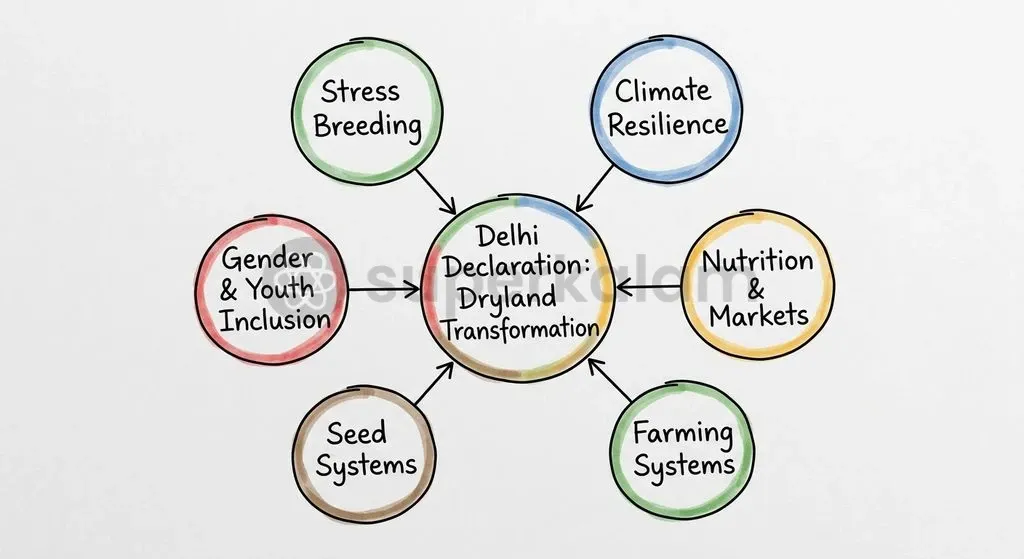
The Delhi Declaration on Drylands establishes six core thematic pillars to build climate resilience and economic growth across dryland farming systems. Deliberations at the Dryland Congress 2026 focused on actionable interventions spanning research, market integration, and social inclusion.
The six foundational pillars comprise:
- Breeding for Stress Tolerance: Developing crop varieties capable of withstanding extreme heat, terminal drought, and emergent biological pests.
- Climate Resilience and Adaptation: Scaling up soil-moisture conservation, watershed structures, and agro-ecological management practices.
- Nutrition and Market Integration: Strengthening value chains for nutri-cereals and protein-rich legumes to enhance farmer remuneration.
- Farming Systems Approach: Transitioning from monoculture cropping to diversified crop-livestock-agroforestry models.
- Robust Seed Systems: Ensuring decentralised access to certified, drought-tolerant seed varieties for smallholders.
- Gender and Youth Inclusion: Mainstreaming female farmers and rural youth through dedicated agri-enterprises, aligning with the United Nations declaration of 2026 as the International Year of the Woman Farmer.
To drive evidence-based policy, the Secretary of the Department of Agricultural Research and Education (DARE) and Director General of ICAR announced that the ICAR-National Institute of Agricultural Economics and Policy Research (ICAR-NIAP) will lead institutional foresight research on drylands.
Discuss with Superkalam
How does transitioning from monoculture cropping to an Integrated Farming System (IFS) reduce climate vulnerability in rainfed drylands?
Ask NowHow South–South Cooperation Drives Dryland Resilience
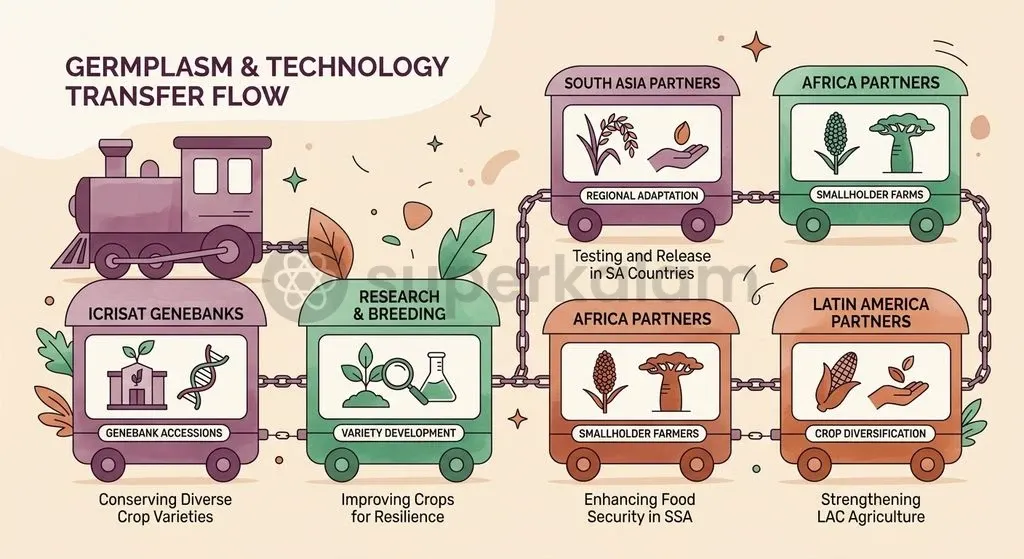
South–South cooperation provides an operational bridge for transferring adapted germplasm and scalable dryland technologies among vulnerable agrarian economies. Agro-ecological zones across sub-Saharan Africa, South Asia, and Latin America face similar climatic stresses. Collaborative technology transfer is therefore far more cost-effective than standard North-South models.
The ICRISAT Centre of Excellence for South-South Cooperation in Agriculture (ISSCA) anchors this operational framework:
- ISSCA has engaged 19 partner institutions across the developing world to co-create agricultural solutions.
- The platform has identified and validated over 100 scalable technologies, ranging from micro-dosing fertilisers to solar-powered community irrigation modules.
- More than 300 agricultural professionals across 40 countries have received advanced technical training through these collaborative exchanges.
Preserving plant genetic resources underpins this cooperative framework. The ICRISAT Genebank at Patancheru, Hyderabad, conserves over 129,000 germplasm accessions of mandate dryland crops collected from 144 countries. To expand these networks, new multilateral partnerships were signed at the Dryland Congress 2026 with the Global Crop Diversity Trust.
Major Challenges Facing Rainfed Agriculture and Drylands
Rainfed dryland ecosystems face structural hurdles ranging from accelerating land degradation to persistent funding disparities. Historically, national agricultural investments, input subsidies, and assured procurement mechanisms favoured canal-irrigated cereal belts. This left rainfed farmers exposed to recurrent weather shocks.
The core structural vulnerabilities include:
- Severe Land Degradation and Desertification: Continuous wind and water erosion deplete shallow topsoils, reducing organic carbon content and soil moisture-holding capacity.
- Extreme Climate Sensitivity: Unpredictable monsoon patterns and recurring El Niño events disrupt sowing calendars and trigger severe mid-season droughts.
- Capital and Credit Gaps: Smallholders in semi-arid zones face higher credit risks, leading to lower institutional lending and inadequate farm mechanisation.
- Market and Price Disincentives: Rainfed produce such as millets and minor pulses often lack the assured public procurement networks that support irrigated rice and wheat systems.
Discuss with Superkalam
If you were designing an agricultural extension plan for a semi-arid district, how would you integrate the stress-tolerant varieties developed by ICAR and CAZRI?
Ask NowComparison: Irrigated Agriculture vs Rainfed Dryland Systems
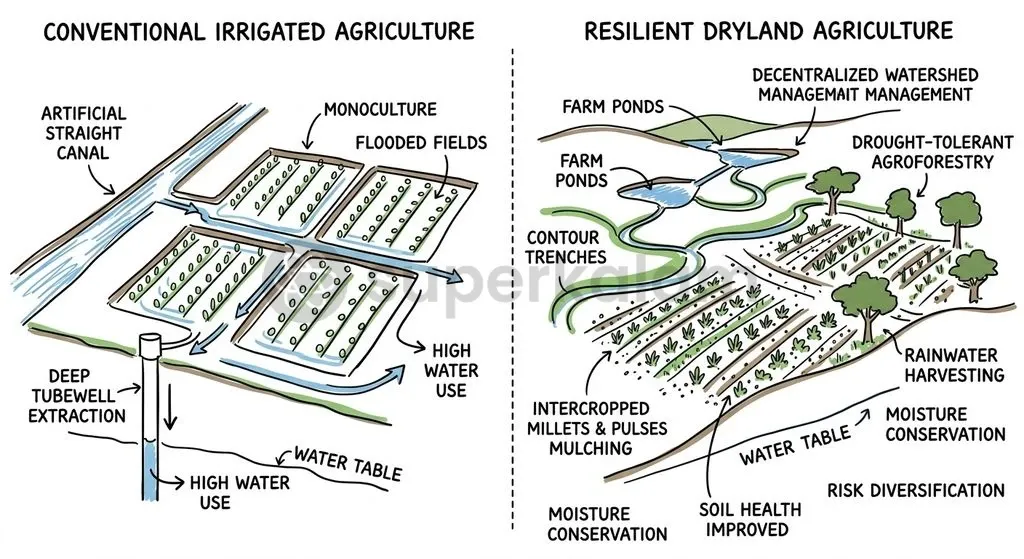
Agricultural production models in India diverge sharply between canal-fed irrigated zones and moisture-dependent rainfed dryland systems across key economic and ecological metrics.
| Dimension | Irrigated Agriculture Systems | Rainfed Dryland Systems |
|---|---|---|
| Primary Water Source | Perennial canals, deep tube-wells, and ground aquifers | Seasonal monsoon precipitation and conserved soil moisture |
| Dominant Cropping Pattern | Water-intensive monocultures (paddy, sugarcane, wheat) | Climate-hardy polycultures (millets, pulses, oilseeds, cotton) |
| Input Intensity & Subsidies | High chemical fertiliser use and heavy power subsidies | Low external inputs with growing adoption of natural farming |
| Ecological Vulnerability | Waterlogging, secondary soil salinisation, and aquifer depletion | Accelerated soil erosion, land degradation, and drought shocks |
| Share of National Food Output | ~60% of total foodgrain production | ~40% of foodgrains; 85–90% of millets and 85% of pulses |
Government of India Initiatives Supporting Dryland Ecosystems
The Ministry of Agriculture and Farmers Welfare implements several targeted schemes to stabilise dryland productivity and reverse soil degradation across rainfed tracts. Public interventions focus on integrated farm designs, micro-irrigation efficiency, and broad-scale land reclamation.
Key national programmes include:
- Rainfed Area Development (RAD): Implemented under the National Mission for Sustainable Agriculture (NMSA), RAD promotes Integrated Farming Systems (IFS) combining crops, livestock, and agroforestry. The scheme has utilised ₹2,119.84 crore to cover 8.50 lakh hectares, benefiting 14.35 lakh farmers.
- Per Drop More Crop (PDMC): Focused on micro-irrigation through drip and sprinkler networks, PDMC has covered approximately 109 lakh hectares with ₹26,325 crore released in central assistance.
- Climate-Resilient Crop Breeding: Between 2014 and 2025, the National Agricultural Research System under ICAR released 2,996 stress-tolerant crop varieties. Research institutes like ICAR-CAZRI (Jodhpur) have demonstrated drought-hardy moth bean varieties that maintain stable yields during severe El Niño dry spells.
- Land Degradation Neutrality (LDN) Targets: India committed under the UNCCD Bonn Challenge to restore 26 million hectares of degraded land by 2030, directly supporting Sustainable Development Goal Target 15.3. As of June 2026, restoration measures have covered 21.76 million hectares toward this target.
- Carbon Sink Expansion: India's Nationally Determined Contribution (NDC) aims to create an additional carbon sink of 2.5 to 3 billion tonnes of CO2 equivalent by 2030 through tree cover and dryland agroforestry.
Discuss with Superkalam
Compare the ecological trade-offs and structural challenges between canal-irrigated cereal systems and rainfed dryland farming in India.
Ask NowWay Forward: Building Sustainable, Climate-Resilient Dryland Economies
Sustaining rainfed agricultural transformation requires institutional foresight, decentralised seed networks, and integrated farming models tailored to fragile dryland ecologies. While public investments through schemes like RAD and PDMC have expanded physical coverage, closing the productivity gap demands structural policy reforms that treat rainfed ecosystems as dynamic agro-ecological zones.
Strategic priorities for policy implementation include:
- Strengthening Institutional Foresight: Operationalising the dryland foresight mandate at ICAR-NIAP to anticipate shifting climatic baselines and model long-term commodity supply risks.
- Deepening South–South Technology Sharing: Expanding platforms like ISSCA to transfer validated, low-cost water harvesting techniques and drought-tolerant seed varieties across semi-arid countries.
- Expanding Integrated Farming Systems (IFS): Scaling up integrated crop-tree-livestock models to smooth seasonal income shocks and rebuild depleted soil organic carbon.
- Reforming Market and Price Incentives: Expanding public procurement and mid-day meal inclusion for dryland nutri-cereals to create stable, decentralised market demand.
- Empowering Women Farmers: Designing gender-targeted agricultural machinery and securing land-tenure rights in line with the International Year of the Woman Farmer 2026.
Key Takeaways
- The Delhi Declaration on Drylands (3D) was adopted at the Dryland Congress 2026, marking 50 years of ICAR–ICRISAT collaboration and coinciding with UN Day for South-South Cooperation.
- Drylands cover 45 percent of global land and support over two billion people; in India, rainfed regions generate 40 percent of foodgrains, 85 percent of pulses, and 85–90 percent of millets.
- The declaration's six thematic pillars span breeding, climate resilience, nutrition and markets, farming systems, seed systems, and gender inclusion.
- The ICRISAT Genebank in Hyderabad preserves 129,000 accessions from 144 nations, forming the foundational biological repository for South–South breeding exchanges.
- As of June 2026, India has brought 21.76 million hectares under active restoration toward its national target of 26 million hectares by 2030 under the UNCCD LDN framework.
Mains Question
"Rainfed agriculture in India is not merely a deficit production zone, but a vital pillar of national nutrition and climate resilience." In light of the Delhi Declaration on Drylands, elucidate the significance of rainfed farming systems and examine the major structural challenges confronting them. (10 Marks)
Evaluate NowMains Question
"Achieving Land Degradation Neutrality (LDN) and sustainable dryland economies requires bridging institutional research with smallholder adoption through South–South cooperation and integrated farming systems." Critically analyse this statement in the context of recent institutional frameworks and national missions. (15 Marks)
Evaluate NowPractice MCQs
QUESTION 1
With reference to rainfed agriculture in India, consider the following statements:
- Rainfed agricultural tracts constitute 50 to 60 percent of India's net sown area.
- Dryland farms account for approximately 85 to 90 percent of domestic millet production and 85 percent of pulse production.
- Rainfed dryland systems generate nearly 60 percent of the nation's total foodgrain output.
Which of the statements given above is/are correct?
QUESTION 2
Consider the following statements regarding the Delhi Declaration on Drylands and institutional initiatives:
- The declaration was adopted at the Dryland Congress 2026, jointly organised by ICAR and ICRISAT.
- The ICAR-National Institute of Agricultural Economics and Policy Research (ICAR-NIAP) was designated to lead institutional foresight research on drylands.
- The ICRISAT Genebank at Patancheru conserves over 129,000 germplasm accessions of mandate dryland crops.
Which of the statements given above is/are correct?
QUESTION 3
With reference to India's land restoration targets and environmental commitments, consider the following statements:
- Under the UNCCD Bonn Challenge, India has committed to restoring 26 million hectares of degraded land by 2030.
- India's Nationally Determined Contribution (NDC) aims to create an additional carbon sink of 2.5 to 3 billion tonnes of CO2 equivalent by 2030.
- The Rainfed Area Development (RAD) scheme operates as an independent mission focused exclusively on chemical-intensive monocultures.
Which of the statements given above is/are correct?
QUESTION 4
Consider the following statements regarding the ICRISAT Centre of Excellence for South-South Cooperation in Agriculture (ISSCA):
- It engages partner institutions across the developing world to co-create scalable agricultural solutions.
- It has identified and validated technologies including micro-dosing fertilisers and solar-powered community irrigation modules.
Which of the statements given above is/are correct?
QUESTION 5
Which of the following is a primary ecological vulnerability predominantly associated with irrigated agriculture systems rather than rainfed dryland systems?