Delhi Air Pollution: Can AI War Rooms Fix the Airshed Crisis?
While Shastri Park's AI command centre automates municipal policing, Delhi's toxic winter smog exposes the limits of tracking pollution at city boundaries.
Oct, 2026
•9 min read
Overview
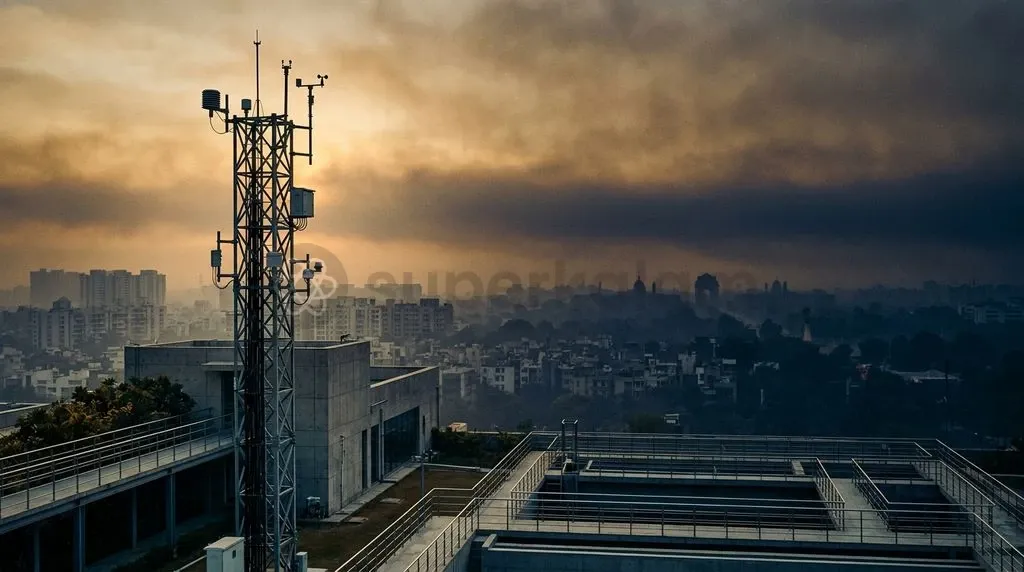
The Delhi Government inaugurated an artificial intelligence-enabled Integrated Command and Control Centre at Shastri Park on October 1, 2026. This setup establishes continuous municipal surveillance across 1,483 square kilometres to flag local emission violations.
According to the Delhi Pollution Control Committee and Chief Minister's Office, the facility monitors construction dust, open waste burning, and municipal fleet movements across identified hotspots. Yet, technological optimisation within municipal limits encounters a hard ecological boundary. Regional trans-boundary pollution across the Indo-Gangetic Plain accounts for over half of Delhi's winter particulate load. High-tech municipal surveillance optimises local compliance, but air pollution governance fails whenever digital tracking stops at administrative borders.
Why in the News: The Shastri Park Green War Room Rollout
The Delhi Government launched an artificial intelligence-enabled Integrated Command and Control Centre (ICCC) on October 1, 2026, at the DMRC IT Park in Shastri Park. Developed for the Delhi Pollution Control Committee (DPCC), the facility operates as a 24x7 municipal environmental surveillance hub to identify micro-level emission sources across the National Capital Territory.
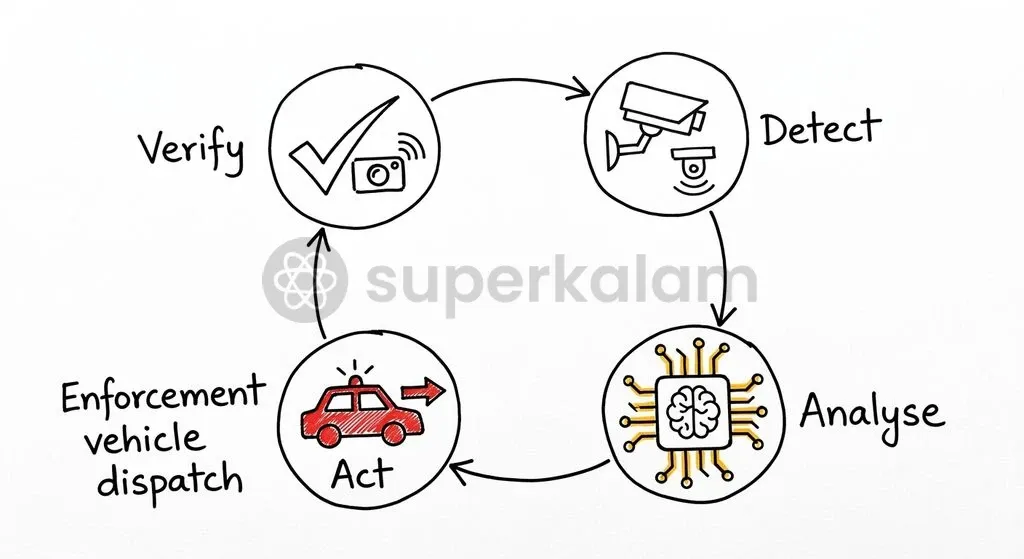
The rollout operationalises a four-stage regulatory doctrine—'Detect, Analyse, Act, Verify'—to bridge digital detection with field-level administrative action. As of October 2026, the hub integrates telemetry from 60 Continuous Ambient Air Quality Monitoring Stations (CAAQMS), incorporating 13 new stations commissioned to expand baseline data collection.
This high-tech deployment attempts to curb hyper-local municipal infractions ahead of the severe winter atmospheric dispersion window.
From Green Delhi App to ICCC: How Delhi's Tech Response Evolved
The Delhi Pollution Control Committee initiated civic environmental surveillance on October 29, 2020, through the launch of the 'Green Delhi' mobile application. That platform established a crowdsourced grievance redressal conduit that connected citizens with 27 separate urban agencies managed through a central DPCC Green War Room.
Citizen crowdsourcing exposed severe operational bottlenecks. The earlier mechanism relied entirely on post-facto reporting, where physical smoke plumes or illegal debris were logged hours after combustion had occurred.
The Shastri Park ICCC marks an architectural transition from citizen-initiated, post-facto grievance filing to automated, continuous sensor-driven surveillance of dispersed emission sources. Instead of waiting for resident complaints, municipal authorities deploy computer vision to detect infractions instantaneously.
| Dimension | Green Delhi App Model (2020) | Shastri Park ICCC Architecture (2026) |
|---|---|---|
| Detection Mode | Citizen-initiated, post-facto photo upload | Automated, real-time optical and sensor surveillance |
| Surveillance Scope | Dispersed public grievances across 27 civic agencies | Continuous CCTV feeds, fleet GPS, and 60 CAAQMS stations |
| Field Dispatch | Manual ticket allocation to jurisdictional departments | Automated dispatch to 78 sub-divisional patrol units |
| Enforcement Tracking | Static resolution status uploaded by field staff | Streaming body-worn cameras and live GPS audit trails |
| Primary Limitation | Significant lag between pollution event and reporting | Inability to track trans-boundary airshed inflows |
Discuss with Superkalam
What are the four operational stages comprising the regulatory doctrine implemented at Delhi's Shastri Park ICCC?
Ask NowInside the Shastri Park ICCC: What the AI Systems Monitor on the Ground
The Shastri Park command centre automates video analytics to identify fugitive dust and open biomass incineration without human intervention. Computer-vision algorithms continuously scan live closed-circuit television (CCTV) feeds across more than 700 construction and demolition sites exceeding 500 square metres. When dust plumes elevate coarse particulate matter (PM10) levels, the system automatically triggers an inspection alert.
The command centre runs optical detection across designated urban hotspots to identify municipal solid waste dumping and open biomass combustion. Physical inspection units receive digital geo-coordinates immediately:
- Sub-Divisional Dispatch: Alerts stream directly to 78 sub-division-level enforcement units deployed with GPS-tracked mobile inspection vehicles.
- Officer Accountability: Inspection teams utilise streaming body-worn cameras to record site conditions and document compliance audits in real time.
- Fleet Audit Telemetry: The platform tracks GPS transponders installed on municipal mechanical road sweepers and water sprinklers, verifying route adherence and operating hours to ensure scheduled road-dust suppression.
Field enforcement faces institutional friction during live handovers. Centre for Science and Environment (CSE) reported that automated AI violation alerts generated at the Shastri Park ICCC frequently face delays during physical site dispatch, inspection, and formal compounding handover to municipal sanitary officers (as reported in December 2025).
The Core Friction: Municipal Hotspot Policing Versus Regional Airshed Realities
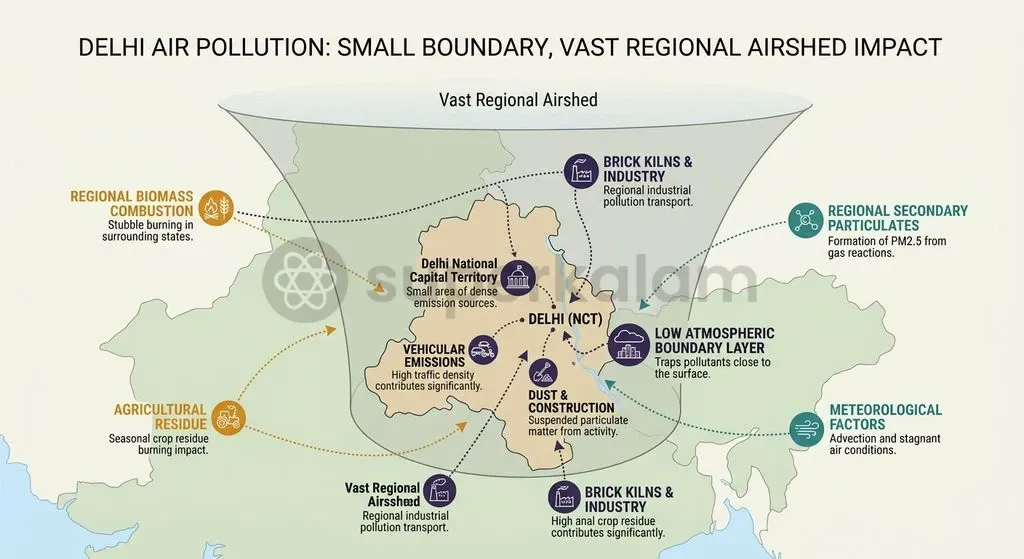
The Municipal Corporation of Delhi (MCD) exercises administrative jurisdiction over an area of just 1,483 square kilometres. In contrast, the geographical airshed of the Indo-Gangetic Plain spans hundreds of thousands of square kilometres, rendering purely municipal surveillance structurally incomplete.
Source apportionment research conducted by The Energy and Resources Institute (TERI) and ARAI established that between 50% and 60% of Delhi's winter PM2.5 pollution load originates from outside Delhi's territorial borders. Regional emissions travel across state boundaries, overwhelming municipal mitigation:
- Agricultural Residue and Industrial Plumes: The Decision Support System (DSS) developed by the Indian Institute of Tropical Meteorology (IITM) attributes a majority share of Delhi's ambient winter PM2.5 to regional sources in neighbouring National Capital Region (NCR) districts, biomass burning, and regional secondary particulate formation.
- Winter Meteorological Inversion: Seasonal atmospheric dynamics trap incoming external emissions close to the ground. These dynamics feature severe temperature inversions, boundary layer heights plunging below 300 metres, and surface wind speeds under 3 km/h.
- Secondary Aerosol Chemistry: Optical CCTV surveillance cannot track secondary particulate aerosols like sulphates and nitrates formed through regional atmospheric gas-to-particle reactions.
Automated municipal cameras cannot overcome the physics of thermal inversion or halt trans-boundary particulate transport.
Discuss with Superkalam
Why do optical CCTV cameras and municipal computer-vision systems fail to monitor secondary particulate aerosols?
Ask NowJurisdictional Overlap: MCD, DPCC, and CAQM's Multi-State Mandate
Delhi's environmental administration exhibits severe institutional fragmentation among multiple public authorities. Regulatory and enforcement responsibilities remain split between the Municipal Corporation of Delhi, Delhi Pollution Control Committee, Delhi Development Authority, Public Works Department, and Delhi Traffic Police.
To address inter-state coordination failures, Parliament enacted the Commission for Air Quality Management in National Capital Region and Adjoining Areas Act, 2021. The statutory framework distributes authority hierarchically:
- Comprehensive Mandate: Under Section 12 of the CAQM Act, 2021, the Commission holds statutory power to issue binding directions and coordinate abatement measures across Delhi, Punjab, Haryana, Rajasthan, and Uttar Pradesh.
- Statutory Supremacy: Section 12(2)(i) of the CAQM Act, 2021 establishes the legal supremacy of CAQM orders over directions issued by the DPCC and State Pollution Control Boards in adjoining states.
- Penal Authority: Section 14 of the CAQM Act, 2021 empowers the Commission to impose environmental compensation and file complaints for non-compliance, vesting enforcement authority far beyond municipal corporations.
Data fragmentation complicates regional alignment. As of October 2026, 9 of the 15 external governmental and municipal data streams planned for the Shastri Park ICCC have been operationalised, while inter-agency integration for state transport and regional industrial databases remains incomplete.
Discuss with Superkalam
If you were municipal commissioner, how would you resolve the reported dispatch delay between automated AI alerts and physical inspections by field officers?
Ask NowGlobal Case Study: How Beijing and California Tackled Cross-Border Airsheds
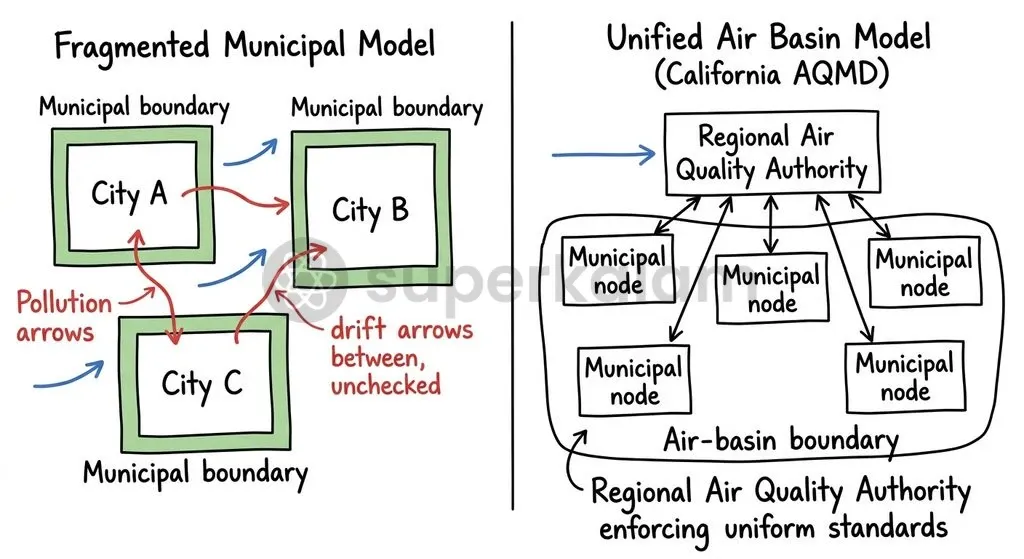
International jurisdictions confronted identical administrative mismatches between municipal borders and physical airsheds by establishing unified supra-municipal governance structures.
China tackled severe pollution across the Beijing-Tianjin-Hebei (Jing-Jin-Ji) region by creating a joint prevention and control mechanism across provincial lines. The programme unified regional industrial emission standards, mandated harmonised emergency responses, and penalised cross-border spillovers across administrative units.
In the United States, the California Air Resources Board (CARB) divided the state into 15 distinct geographic air basins governed by 35 regional Air Quality Management Districts that transcend municipal boundaries.
| Governance Parameter | California CARB Air Basin Framework | China Jing-Jin-Ji Regional Mechanism | Delhi NCR CAQM Framework |
|---|---|---|---|
| Legal Basis | California Clean Air Act framework | National Air Pollution Prevention Action Plan | CAQM in NCR and Adjoining Areas Act, 2021 |
| Airshed Definition | 15 continuous topographically defined air basins | Integrated economic-industrial mega-region | National Capital Region plus adjoining districts |
| Division of Powers | CARB sets vehicle standards; regional districts regulate stationary sites | Central ministry coordinates unified provincial enforcement targets | CAQM issues statutory directives; states enforce on the ground |
| Inter-Agency Data | Fully unified regional monitoring and emissions inventory | Unified regional monitoring network and joint forecasting | Partial integration (9 of 15 data streams live at Shastri Park) |
The Structural Limits of Municipal Technology
Surveillance algorithms cannot substitute for basic civic infrastructure. Automated surveillance technologies are incapable of halting open waste burning in Delhi's informal settlements and unauthorised colonies where formal municipal door-to-door solid waste collection infrastructure is absent. When civic services fail to collect refuse, punitive camera tracking merely disperses dumping to blind spots.
Technological tools optimise regulatory detection. However, lasting environmental gains require capital investment in municipal waste infrastructure and coordinated airshed management.
Discuss with Superkalam
Compare the governance models of California's Air Resources Board and Delhi's CAQM in addressing regional airsheds.
Ask NowWay Forward: Connecting Local Digital Sensing with Regional Enforcement
The Shastri Park ICCC provides a functional blueprint for local automated surveillance, but resolving Delhi's air crisis requires linking municipal sensing to statutory airshed enforcement.
Policy reforms must bridge the gap between municipal detection and regional accountability:
- Complete Data Integration: Accelerate integration of the remaining 6 regional and transport data streams into the Shastri Park system to enable cross-departmental coordination.
- Operationalise CAQM Primacy: Channel local ICCC violation analytics directly to CAQM enforcement wings under Section 12 of the CAQM Act, 2021 to penalise trans-boundary industrial and transport infractions.
- Expand Basic Civic Infrastructure: Deploy dedicated door-to-door solid waste collection fleets across all unauthorised colonies and informal clusters to eliminate the root structural cause of open burning.
- Establish a Unified Indo-Gangetic Airshed Council: Institutionalise formal coordination platforms across northern states modelled after California's Air Quality Management Districts, anchoring airshed science above administrative frontiers.
Key Takeaways
- The Delhi Government commissioned an AI-enabled Integrated Command and Control Centre at Shastri Park on October 1, 2026, using computer vision to monitor dust at over 700 construction sites, track open fires, and audit municipal fleets.
- Delhi's 1,483 square kilometre municipal territory is subordinate to the broader Indo-Gangetic Plain airshed, with research from TERI and ARAI demonstrating that 50% to 60% of winter PM2.5 originates outside Delhi's borders.
- The Commission for Air Quality Management (CAQM) exercises statutory supremacy over state bodies like the DPCC under Section 12(2)(i) of the CAQM Act, 2021, holding trans-boundary coordination and penal mandates under Section 14.
- Digital surveillance tools cannot eliminate open waste combustion without universal municipal door-to-door waste collection services across informal settlements.
- Successful international frameworks, including California's 15 air basins and China's Jing-Jin-Ji mechanism, demonstrate that airshed-wide regulatory integration must supersede city-level policing.
Mains Question
'High-tech municipal surveillance optimises local compliance, but air pollution governance fails whenever digital tracking stops at administrative borders.' Critically analyse this statement in light of Delhi's airshed challenges. (15 Marks)
Evaluate NowMains Question
Examine the statutory powers of the Commission for Air Quality Management (CAQM) under the CAQM Act, 2021, in resolving institutional fragmentation across NCR states. (10 Marks)
Evaluate NowPractice MCQs
QUESTION 1
With reference to the Commission for Air Quality Management in National Capital Region and Adjoining Areas Act, 2021, consider the following statements:
- The Commission is empowered to coordinate air pollution abatement measures across Delhi, Punjab, Haryana, Rajasthan, and Uttar Pradesh.
- In cases of conflict, directions issued by State Pollution Control Boards take precedence over orders issued by the Commission.
- The Commission is vested with statutory authority under Section 14 to impose environmental compensation for non-compliance.
Which of the statements given above are correct?
QUESTION 2
Consider the following statements regarding air quality surveillance and urban pollution governance in Delhi:
- The Green Delhi mobile app operated on automated computer-vision algorithms to initiate preventive field dispatches.
- The Shastri Park Integrated Command and Control Centre (ICCC) incorporates telemetry from 60 Continuous Ambient Air Quality Monitoring Stations (CAAQMS).
- Computer-vision systems at the Shastri Park ICCC monitor construction and demolition sites exceeding 500 square metres for fugitive dust plumes.
Which of the statements given above is/are correct?
QUESTION 3
Regarding the regional dynamics of winter air pollution in Delhi, consider the following statements:
- Research by TERI and ARAI indicates that 50% to 60% of Delhi's winter PM2.5 pollution load originates from outside its territorial boundaries.
- The Decision Support System (DSS) developed by IITM Pune attributes a majority of Delhi's ambient winter PM2.5 to local vehicular emissions within municipal borders.
- Winter meteorological inversion can cause atmospheric boundary layer heights to plunge below 300 metres in Delhi.
Which of the statements given above is/are correct?
QUESTION 4
Which of the following describes the operational regulatory doctrine operationalised by the Shastri Park Integrated Command and Control Centre (ICCC)?
QUESTION 5
Consider the following statements regarding international models of airshed management mentioned in the context of cross-boundary pollution:
- The Beijing-Tianjin-Hebei (Jing-Jin-Ji) mechanism established unified regional industrial emission standards across provincial lines.
- The California Air Resources Board (CARB) divided California into 15 distinct geographic air basins governed by 35 regional Air Quality Management Districts.
Which of the statements given above is/are correct?