Definition of Industry: How Supreme Court Rulings and Labour Codes Impact Worker Rights
As new labour codes ease hiring norms and raise retrenchment thresholds, judicial definitions of industry remain vital to protect vulnerable workers.
Sep, 2026
•7 min read
Overview
The legal definition of an industry under Indian labour law sets statutory dispute-resolution boundaries. It acts as the primary legal shield for workers facing unequal bargaining power across formal and informal enterprises. In the landmark Bangalore Water Supply ruling, the Supreme Court established the Triple Test, widening statutory safeguards across varied workplaces.
Yet the expansion of contract labour and the Industrial Relations Code, 2020 have altered this framework. The reforms broaden employer flexibility while raising statutory thresholds for retrenchment and standing orders. Balancing enterprise competitiveness with constitutional protections for worker dignity remains a core governance test.
Why in the News: The Ongoing Debate Over Who Counts as a Worker
The Supreme Court of India reaffirmed the authority of the landmark Bangalore Water Supply precedent for pending industrial disputes.
As of August 2026, a nine-judge Constitution Bench in State of Uttar Pradesh v. Jai Bir Singh confirmed that the Bangalore Water Supply 'Triple Test' continues to govern industrial disputes pending under the repealed Industrial Disputes Act, 1947. This decision provides judicial continuity as Parliament transitions toward the newer Industrial Relations Code, 2020.
The ruling arrives amid intense debate over labour flexibility, union bargaining power, and the vulnerability of precarious workers across India. Understanding how judicial tests interact with statutory overhauls remains essential for assessing workplace protections.
Discuss with Superkalam
Can you recall the three cumulative criteria that form the 'Triple Test' under the Bangalore Water Supply judgment?
Ask NowUnderstanding the Legal Concept: What Constitutes an 'Industry' Under Indian Law?
Section 2(j) of the Industrial Disputes Act, 1947 establishes the statutory baseline for what constitutes an industrial undertaking across Indian economic sectors.
This statutory classification controls several key industrial safeguards:
- Tribunal jurisdiction: It dictates whether labour tribunals can hear and settle disputes.
- Strike legality: It governs statutory rules for strikes and lockouts.
- Retrenchment compensation: It mandates compensation formulas and notice periods before job termination.
Without industrial classification, employees rely on standard individual employment contracts. This exposure leaves workers vulnerable to unilateral termination and severe bargaining imbalances.
From Bangalore Water Supply to Today: Evolution of the 'Triple Test'
The Supreme Court of India established the definitive 'Triple Test' for industrial classification in the 1978 Bangalore Water Supply and Sewerage Board ruling.
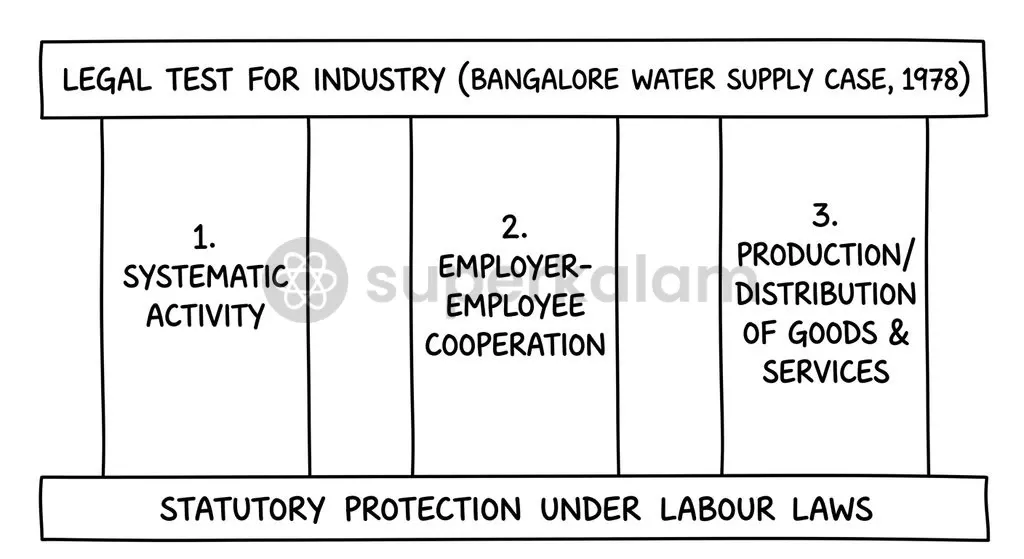
In Bangalore Water Supply & Sewerage Board v. A. Rajappa, the bench interpreted Section 2(j) broadly to protect labour welfare. The Court held that an enterprise constitutes an industry if it satisfies three cumulative criteria:
- Systematic activity: The operation must be organised and conducted regularly rather than casually.
- Cooperation between employer and employee: The work relies directly on mutual, coordinated effort.
- Production or distribution of goods and services: The activity satisfies human wants and wishes, regardless of whether it is driven by a profit motive.
This ruling brought educational institutions, research bodies, hospitals, and charitable organisations within the ambit of industrial dispute resolution. The judgment established that the absence of profit motive or the presence of philanthropic objectives does not strip an establishment of its industrial character.
Discuss with Superkalam
How does the exclusion of contract expiry from the definition of retrenchment under Section 2(zh) impact the adoption of Fixed-Term Employment by enterprises?
Ask NowThe Reality of Contractualisation: Structural Imbalance in Modern Workplaces
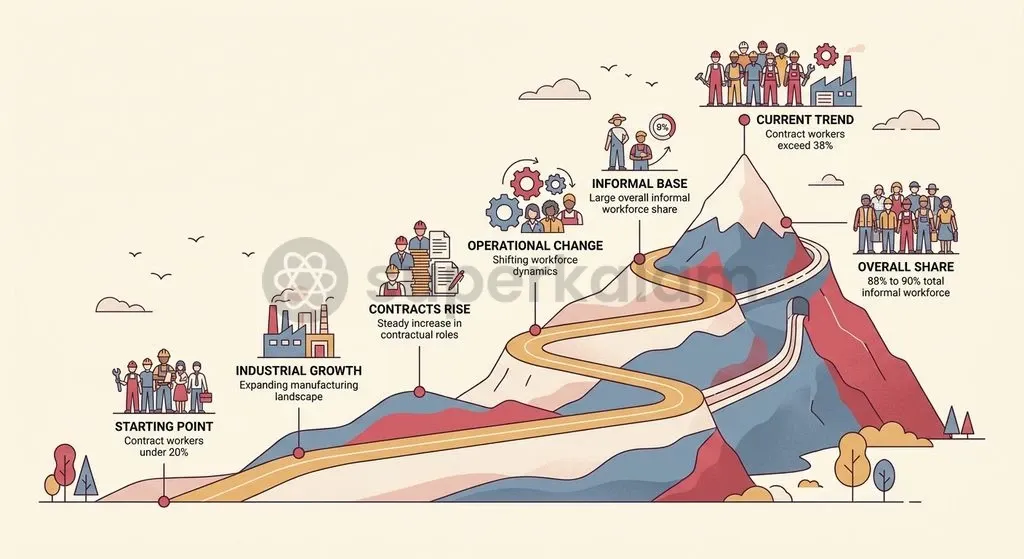
The Annual Survey of Industries reveals a profound structural shift toward contract labour across India's formal manufacturing landscape.
Key empirical and legal shifts highlight the growing informalisation of factory floors:
- Rising contract workforce: According to the Annual Survey of Industries by the Ministry of Statistics and Programme Implementation, the share of contract workers in factory employment rose from under 20% in 2000-01 to over 38% in recent rounds. This reliance allows firms to bypass rigid retrenchment regulations while dampening aggregate collective bargaining.
- Preponderance of informal jobs: Data from the Periodic Labour Force Survey and NITI Aayog shows that informal employment accounts for approximately 88% to 90% of India's total workforce across unorganised sectors and formal enterprises.
- No automatic regularisation: In Steel Authority of India Ltd. v. National Union Waterfront Workers, the Supreme Court established that the abolition of contract labour under Section 10(1) of the Contract Labour (Regulation and Abolition) Act, 1970 does not grant contract workers automatic absorption into regular service.
Discuss with Superkalam
Assess whether raising the retrenchment threshold to 300 workers effectively balances enterprise competitiveness with the constitutional mandate for worker protection under Part IV.
Ask NowKey Supreme Court Rulings on Bargaining Power and Unfair Labour Practices
Supreme Court jurisprudence consistently curbs unconscionable employment conditions by anchoring worker rights in constitutional guarantees and public policy safeguards.
Key judicial interventions include:
- Central Inland Water Transport Corp. v. Brojo Nath Ganguly: The Supreme Court held that arbitrary standard-form termination clauses are void under Section 23 of the Indian Contract Act, 1872 for being opposed to public policy and violative of Article 14. Freedom of contract fails when an employer holds overwhelming bargaining supremacy over a worker.
- State of Punjab v. Jagjit Singh: The Court applied the principle of equal pay for equal work under Articles 14 and 39(d) to temporary, daily-wage, and contract employees discharging identical responsibilities.
- Olga Tellis v. Bombay Municipal Corporation: The bench affirmed that Article 21 encompasses the right to livelihood, linking economic survival directly to human dignity.
Old Dispute Act vs New Industrial Relations Code: A Comparative Shift
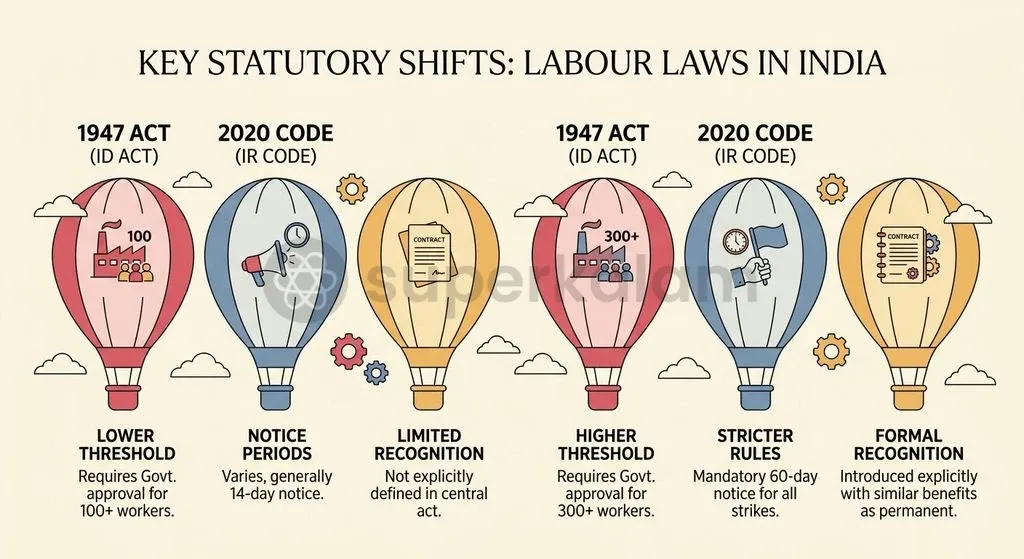
The Industrial Relations Code, 2020 replaces the Industrial Disputes Act, 1947, introducing statutory recalibrations to managerial discretion and worker protections.
The following comparison highlights the primary structural modifications introduced between the historical 1947 Act and the 2020 Code:
| Dimension | Industrial Disputes Act, 1947 | Industrial Relations Code, 2020 |
|---|---|---|
| Definition of Industry | Defined under Section 2(j); wide scope expanded by Bangalore Water Supply | Section 2(p) statutorily excludes charitable bodies, domestic services, and sovereign functions |
| Lay-off and Retrenchment Threshold | Prior government permission required for units with 100 or more workers under Chapter V-B | Threshold raised to 300 or more workers under Chapter X, Section 77 |
| Standing Orders Mandate | Mandatory formulation applicable to units with 100 or more workers | Threshold raised to 300 or more workers under Section 28(1) |
| Right to Strike Notice | 14-day advance notice restricted primarily to Public Utility Services | Mandatory 14-day advance notice within 60 days applied to all establishments under Section 62 |
| Fixed-Term Employment (FTE) | Not codified uniformly; terminations often triggered retrenchment rules | Institutionalised under Section 2(o); contract expiry excluded from retrenchment under Section 2(zh) |
| Worker Re-skilling Fund | No statutory provision existed | Section 83 mandates 15 days of wages deposited per retrenched worker within 45 days |
| Bargaining Recognition | Lacked standardised national criteria for sole negotiating agents | Section 14 mandates Negotiating Union (51% support) or Negotiating Council (at least 20% membership) |
Discuss with Superkalam
Propose institutional mechanisms that could be integrated into the Grievance Redressal framework to better protect contract workers who face barriers to collective bargaining.
Ask NowThe Road Ahead: Rebalancing Worker Rights and Ease of Doing Business
The Ministry of Labour and Employment must implement progressive regulatory safeguards to reconcile enterprise flexibility with basic social protections.
Two immediate institutional mechanisms stand out:
- Independent grievance redressal: Section 4 of the Industrial Relations Code, 2020 mandates internal Grievance Redressal Committees in establishments with 20 or more workers to resolve individual disputes within 30 days.
- Aggregator welfare funding: Section 114 of the Code on Social Security, 2020 levies aggregator contributions between 1% and 2% of annual turnover, capped at 5% of worker payouts.
Deploying these funds effectively will provide vulnerable gig workers with meaningful social safety nets without stifling commercial enterprise.
Key Takeaways
- The Supreme Court's 1978 Bangalore Water Supply ruling established the Triple Test (systematic activity, employer-worker cooperation, and production/distribution of goods/services) under Section 2(j) of the Industrial Disputes Act, 1947.
- A nine-judge Constitution Bench in State of Uttar Pradesh v. Jai Bir Singh affirmed that the Bangalore Water Supply test continues to govern pending disputes under the 1947 Act.
- The Industrial Relations Code, 2020 alters statutory protections by narrowing the definition of industry under Section 2(p), raising lay-off and standing-order thresholds to 300 workers, and institutionalising Fixed-Term Employment.
- Contract labour in formal manufacturing has expanded beyond 38% of factory employment, while total informal employment stands at 88% to 90% across the economy.
- Constitutional safeguards under Article 21 (livelihood) and Directive Principles (Articles 39, 41, 42, 43, 43A), paired with aggregator welfare levies under Section 114 of the Code on Social Security, 2020, remain vital to counter unequal bargaining power.
Mains Question
The Industrial Relations Code, 2020 modifies statutory thresholds for retrenchment and standing orders while codifying Fixed-Term Employment. In this context, critically analyse the balance between managerial flexibility and statutory protections for industrial workers. (15 Marks)
Evaluate NowMains Question
'Judicial interpretation of the definition of industry and employment contracts has served as a primary legal shield against unequal bargaining power.' In light of landmark Supreme Court rulings, elucidate. (10 Marks)
Evaluate NowPractice MCQs
QUESTION 1
With reference to the legal concept of an 'Industry' under Indian labour jurisprudence, consider the following statements:
- The 'Triple Test' formulated in the Bangalore Water Supply case requires systematic activity, employer-employee cooperation, and production or distribution of goods and services regardless of profit motive.
- In State of Uttar Pradesh v. Jai Bir Singh (2026), a nine-judge Constitution Bench held that the Triple Test continues to govern pending industrial disputes under the repealed Industrial Disputes Act, 1947.
- Section 2(p) of the Industrial Relations Code, 2020 incorporates charitable institutions and domestic services within the statutory definition of an industry.
Which of the statements given above are correct?
QUESTION 2
Consider the following statements regarding the structural modifications introduced by the Industrial Relations Code, 2020:
- The threshold requiring prior government permission for lay-off and retrenchment has been increased from 100 to 300 workers.
- The mandatory requirement of a 14-day advance notice for strikes has been extended to all industrial establishments.
- The non-renewal of a fixed-term employment contract upon expiry is classified as retrenchment under the Code.
Which of the statements given above is/are correct?
QUESTION 3
With reference to landmark Supreme Court judgments on worker rights and contract labour, consider the following statements:
- In Central Inland Water Transport Corp. v. Brojo Nath Ganguly, arbitrary standard-form termination clauses were held void under Section 23 of the Indian Contract Act, 1872.
- In Steel Authority of India Ltd. v. National Union Waterfront Workers, the Court held that the abolition of contract labour under Section 10(1) of the 1970 Act leads to automatic absorption into regular service.
- In State of Punjab v. Jagjit Singh, the principle of 'equal pay for equal work' was extended to temporary and daily-wage employees.
Which of the statements given above are correct?
QUESTION 4
Consider the following statements regarding dispute resolution and worker welfare provisions under recent labour reforms:
- Section 4 of the Industrial Relations Code, 2020 mandates internal Grievance Redressal Committees in establishments employing 20 or more workers.
- Section 83 of the Industrial Relations Code, 2020 provides for a Worker Re-skilling Fund requiring 15 days of wages per retrenched worker to be deposited within 45 days.
Which of the statements given above is/are correct?
QUESTION 5
Under Section 2(p) of the Industrial Relations Code, 2020, which of the following are statutorily excluded from the definition of an 'industry'?