Defence Indigenisation: DAP 2020, Make Routes, and SRIJAN Portal Explained
How DAP 2020, targeted Make procurement routes, and the SRIJAN portal are transforming domestic defence manufacturing to secure India's strategic autonomy.
Aug, 2026
•10 min read
Overview
India's defence indigenisation framework systematically transforms military procurement by prioritising domestic manufacturing, curbing foreign supply vulnerabilities, and fostering a self-reliant defence industrial base under the Defence Acquisition Procedure 2020 and phased embargo lists. Under this policy architecture, the Ministry of Defence combines prioritized capital acquisition categories like Buy (Indian-IDDM) with targeted prototype-development channels known as Make-I, Make-II, and Make-III. By supplementing these procurement routes with digital vendor-onboarding tools such as the SRIJAN portal, the government provides micro, small, and medium enterprises with direct access to import-substitution opportunities. These coordinated mechanisms collectively aim to retain strategic autonomy, reduce foreign-exchange outflows, and convert India from a major arms importer into a competitive global defence manufacturer.
Why India's Push for Defence Indigenisation Matters Now
India's strategic security environment demands sovereign defence industrial capabilities to insulate military readiness from global supply chain disruptions and geopolitical volatility. As of August 2026, the Ministry of Defence has reinforced this imperative by earmarking 75% of the total capital acquisition budget specifically for domestic industry, according to Union Budget and Ministry of Defence data.
Historical over-reliance on imported military hardware creates operational vulnerabilities during extended conflicts, where foreign supply chains can face sanctions, diplomatic embargoes, or wartime component shortages. Developing an indigenous production base ensures uninterrupted lifecycle support, rapid field modifications, and technological sovereignty across critical operational theatres.
Beyond national security, domestic defence manufacturing functions as a powerful economic multiplier. Channelling capital expenditure into domestic supply chains stimulates advanced manufacturing, generates skilled engineering employment, and builds high-value research ecosystems. This strategic shift forms the bedrock of India's long-term deterrence posture and industrial resilience.
Discuss with Superkalam
What percentage of prototype development cost can the Ministry of Defence fund under the Make-I route?
Ask NowUnderstanding the Framework: DAP 2020 and Positive Indigenisation Lists
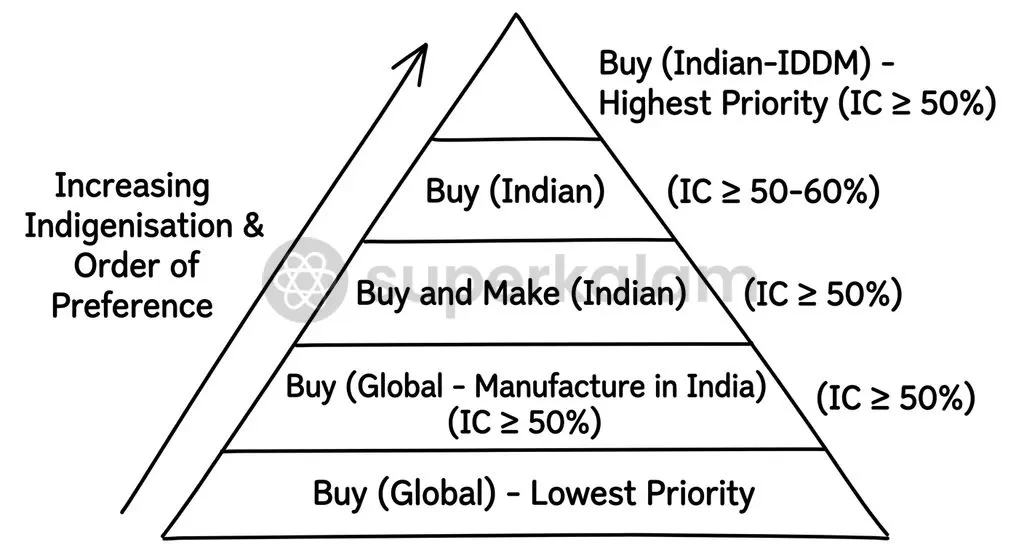
The Defence Acquisition Procedure 2020 establishes a structured procurement hierarchy that mandates clear domestic content thresholds across all capital acquisition categories. Under Chapter I of the Defence Acquisition Procedure 2020, capital acquisitions accord the highest priority to the 'Buy (Indian-IDDM)' category, which mandates indigenously designed, developed, and manufactured platforms with at least 50% Indigenous Content.
The second-tier preference, designated as 'Buy (Indian)', requires a minimum of 50% Indigenous Content for indigenously designed products, or 60% Indigenous Content for platforms without indigenous design. To build long-term private manufacturing capacity for complex platforms, Chapter VII of DAP 2020 provides the Strategic Partnership model, which selects domestic system integrators to manufacture fighter aircraft, helicopters, submarines, armoured vehicles, and niche systems in collaboration with global partners. Foreign direct investment norms support this ecosystem by permitting up to 74% foreign investment through the automatic route for new industrial licences, and up to 100% via government approval for access to modern technology.
Positive Indigenisation Lists complement DAP 2020 by enforcing progressive import bans on specified military equipment, platforms, and sub-assemblies. These embargo lists function along two distinct institutional tracks:
- Department of Military Affairs track: Notifies weapon platforms, major sensors, and complete combat systems destined for the three Armed Services.
- Department of Defence Production track: Notifies sub-systems, line replaceable units, assemblies, and spares to compel Defence Public Sector Undertakings to source locally.
According to a Press Information Bureau release, the Department of Defence Production notified the 6th Positive Indigenisation List in August 2026, covering 405 items (389 for Defence PSUs and 16 for the Indian Coast Guard) representing an estimated business potential of ₹3,070 crore.
Discuss with Superkalam
Explain how the dual-track mechanism of Positive Indigenisation Lists divides responsibilities between the DMA and the DDP.
Ask NowDecoding the Procurement Routes: Make-I, Make-II, and Make-III
Chapter III of the Defence Acquisition Procedure 2020 operationalises domestic prototype development through three dedicated Make routes tailored to differing capital and technological risk profiles. Each route allocates financial liability, research ownership, and operational responsibility differently between the government and private industry.
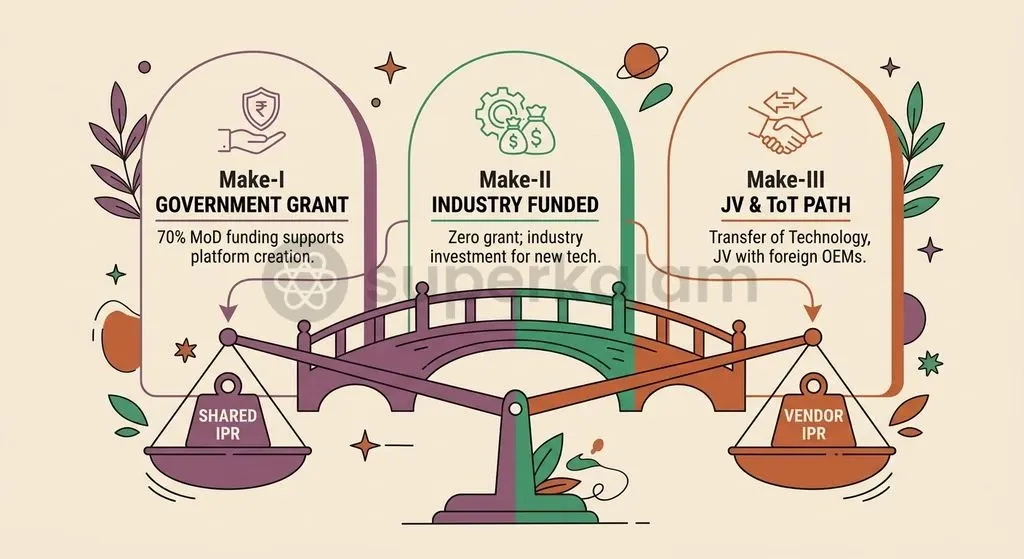
The Make-I route covers government-funded prototype development for complex, high-technology systems, weapon platforms, and equipment. Because capital requirements and technological uncertainties are substantial, the Ministry of Defence provides financial grants of up to 70% of the prototype development cost, capped at ₹250 crore per Development Agency.
The Make-II route focuses on industry-funded development of military equipment, spares, and sub-systems, involving zero financial contribution from the Ministry of Defence. Designed primarily for import substitution and innovative industry-led solutions, Make-II simplifies entry for agile commercial vendors. While the developing vendor assumes all financial risk, the vendor retains complete Intellectual Property Rights over the resulting technology.
The Make-III route provides a collaborative import-substitution mechanism for defence items not designed or developed indigenously. Under Make-III, Indian vendors manufacture platforms or sub-assemblies domestically through Transfer of Technology or Joint Ventures with foreign Original Equipment Manufacturers. Like Make-II, Make-III involves zero prototype funding from the Ministry of Defence, focusing instead on rapid local manufacturing capability.
In February 2026, the Ministry of Defence placed the Draft Defence Acquisition Procedure 2026 in the public domain for stakeholder consultation, per official notifications. As reported in February 2026, this draft framework proposes to streamline these routes under the theme of 'Jointness, Atmanirbharta, and Innovation' (JAI) by integrating schemes like Innovations for Defence Excellence directly into mainstream capital acquisition pipelines.
Make-I vs Make-II vs Make-III: A Direct Comparison
The three Make categories establish clear trade-offs between sovereign financial support, intellectual property ownership, and technological risk. Evaluating these parameters highlights how the Ministry of Defence matches specific operational needs to appropriate industrial channels.
| Procurement Parameter | Make-I (Govt-Funded) | Make-II (Industry-Funded) | Make-III (Collaborative Import Substitution) |
|---|---|---|---|
| Primary Strategic Focus | Complex platforms and high-technology combat systems | Import substitution and vendor-initiated innovative solutions | Domestic manufacturing of foreign-designed components |
| Government Funding Share | Up to 70% of prototype cost (capped at ₹250 crore per agency) | Nil (0% government funding; 100% industry funded) | Nil (0% government funding; 100% industry funded) |
| Intellectual Property Rights (IPR) | Retained by Indian developer; MoD holds irrevocable royalty-free rights | Retained entirely by the commercial industry vendor | Retained under terms negotiated via ToT or Joint Venture agreements |
| Entry & Technology Route | Indigenous design and developmental research by Indian industry | Indigenous design and development by private or public vendors | Transfer of Technology (ToT) or Joint Venture with foreign OEMs |
| Risk-Bearing Profile | Shared financial and technical risk between MoD and developer | Entire commercial and financial risk borne by private vendor | Financial risk borne by domestic vendor and foreign OEM partner |
Discuss with Superkalam
How might a private MSME leverage the SRIJAN portal to transition from a civilian component maker to a certified defence supplier?
Ask NowRole of the SRIJAN Portal in Catalysing Domestic Vendors
The SRIJAN defence portal functions as a transparent, centralised marketplace that connects Defence Public Sector Undertakings with domestic manufacturers for component-level import substitution. Launched by the Department of Defence Production in August 2020, the portal (srijandefence.gov.in) publicly displays imported defence components, sub-assemblies, and raw materials that domestic industry can indigenise.
According to the Ministry of Defence, more than 15,700 defence items were uploaded on the SRIJAN portal by Defence PSUs and Service Headquarters for domestic development by mid-2026. Domestic private industry and MSMEs have successfully indigenised over 12,300 of these items, directly lowering foreign-exchange outflows.
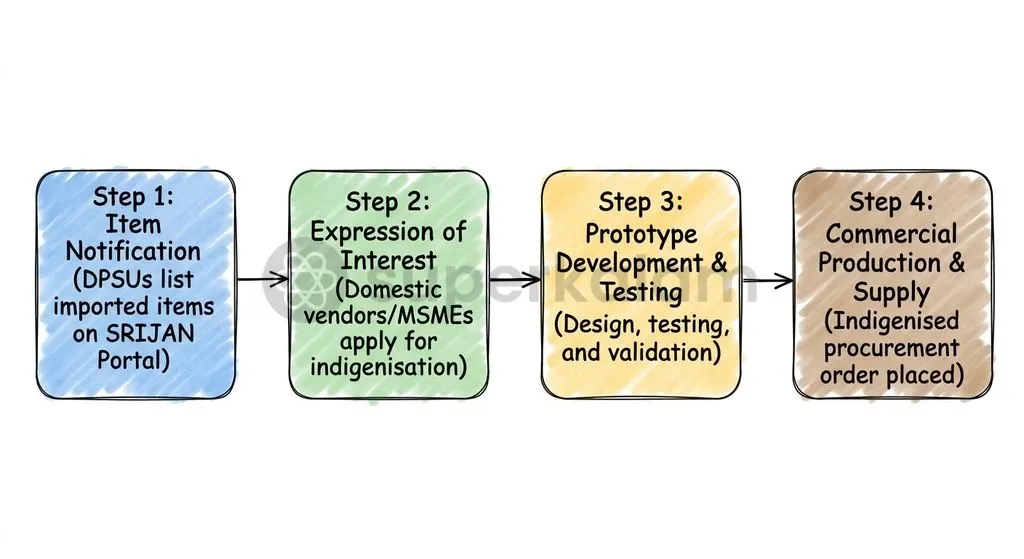
The SRIJAN mechanism operates through four sequential operational stages:
- Item Notification: Defence PSUs and Armed Services identify high-value or single-source imported components and upload technical specifications, annual consumption quantities, and target prices to the portal.
- Vendor Expression of Interest: Private firms, startups, and MSMEs review technical requirements and register Expressions of Interest (EoI) based on their manufacturing capabilities.
- Prototype Development and Testing: Registered vendors receive technical guidance and sample units from the concerned Defence PSU to develop domestic prototypes.
- Qualification and Supply Orders: Successfully tested and quality-certified items enter the formal procurement supply chain, replacing imported foreign parts.
Structural Bottlenecks in India's Defence Manufacturing Ecosystem
India's defence indigenisation drive faces persistent institutional bottlenecks that impede rapid commercialisation and private research investments. Prolonged testing protocols and unpredictable procurement cycles remain the primary barriers to building a competitive domestic defence industrial base.
Protracted Field Evaluation Trials (FET) represent a critical structural impediment. According to research by the Observer Research Foundation, multi-terrain trial protocols across seasonal cycles often extend acquisition timelines to 36 to 48 months from initial Request for Proposal. These lengthy trial timelines impose severe financial carrying costs on participating domestic vendors.
Absence of sovereign purchase guarantees after prototype qualification creates severe second-order financial distress for private industry. Under current Make-II norms, successfully qualifying a prototype does not legally guarantee subsequent commercial order placement. This policy gap generates a stalled private R&D investment cycle:
- Private firms absorb high upfront capital expenditure during prototype development without assured commercial off-take.
- Unhedged balance-sheet risks cause domestic banks and venture capital funds to restrict credit to private defence developers.
- Constrained private research spending forces the armed services to rely on repetitive imports or government-funded laboratories for advanced technologies.
Limited access to sovereign test ranges, environmental test chambers, and certification facilities further restricts MSME participation, as private vendors cannot independently finance multimillion-dollar testing infrastructure.
Discuss with Superkalam
Analyse why prolonged Field Evaluation Trials (36 to 48 months) create disproportionate financial risks for vendors operating under the Make-II route.
Ask NowWay Forward: Building an Agile and Self-Reliant Defence Industry
Strengthening India's defence ecosystem requires institutionalising predictable procurement pipelines, modernising testing infrastructure, and de-risking private sector capital investments. Policy reforms must bridge the gap between prototype qualification and commercial production to sustain industrial momentum.
Policy recommendations from the Standing Committee on Defence and defence research bodies highlight several critical priorities:
- Institutionalising Long-Term Capability Plans: Transitioning procurement planning into binding 10-year Integrated Capability Development Plans provides private manufacturers with the order visibility necessary to justify long-term capital investments.
- Sovereign Testing Infrastructure Access: Opening defence test facilities, firing ranges, and laboratories to private MSMEs on a non-discriminatory basis lowers capital expenditure barriers for emerging developers.
- Trial by Simulation and Digital Certification: Adopting modern simulation technologies and digital twin testing can compress Field Evaluation Trials from multiple years into manageable months without compromising quality standards.
- Contractual Off-Take Guarantees: Embedding minimum order commitments into the Make-II framework upon successful technical qualification would restore investor confidence and unlock private debt financing.
Integrating these institutional reforms will ensure that India's domestic defence industry evolves from low-tier component fabrication to world-class system integration and advanced defence export leadership.
Key Takeaways
- DAP 2020 Priority Hierarchy: Capital procurement prioritises the 'Buy (Indian-IDDM)' category with a minimum of 50% Indigenous Content, followed by 'Buy (Indian)' requiring 50% to 60% indigenous content.
- Make Route Distinctions: Make-I provides up to 70% government prototype funding (capped at ₹250 crore), whereas Make-II (industry-funded) and Make-III (collaborative ToT/JVs) require 100% industry financing with zero government development funding.
- Two-Track Indigenisation Lists: The Department of Military Affairs notifies major weapon platforms and combat systems, while the Department of Defence Production notifies sub-systems, line replaceable units, and spares for Defence PSUs.
- SRIJAN Vendor Engagement: The SRIJAN portal transparently lists imported defence components, achieving domestic indigenisation of over 12,300 items out of more than 15,700 uploaded by mid-2026.
- Core Structural Reform: Overcoming the stalled private R&D cycle requires streamlining multi-year Field Evaluation Trials, opening sovereign testing ranges to MSMEs, and providing contractual purchase guarantees following prototype qualification.
Mains Question
The Defence Acquisition Procedure 2020 classifies prototype development into Make-I, Make-II, and Make-III categories based on capital risk and technological complexity. Critically analyse how these routes distribute financial risk and intellectual property rights to foster self-reliance. (10 Marks)
Evaluate NowMains Question
'While progressive embargoes via Positive Indigenisation Lists and platforms like SRIJAN have stimulated MSME participation, structural bottlenecks continue to constrain the rapid expansion of India's defence industrial base.' Discuss. (15 Marks)
Evaluate NowPractice MCQs
QUESTION 1
With reference to the Defence Acquisition Procedure (DAP) 2020, consider the following statements:
- The 'Buy (Indian-IDDM)' category requires platforms to have at least 50% Indigenous Content along with indigenous design and development.
- Under the 'Buy (Indian)' category, a minimum of 60% Indigenous Content is mandatory if the product does not possess an indigenous design.
- Foreign Direct Investment in defence manufacturing is permitted up to 74% under the automatic route for new industrial licences. Which of the statements given above are correct?
QUESTION 2
With reference to prototype development routes under Chapter III of DAP 2020, consider the following statements:
- Under the Make-I route, the Ministry of Defence provides financial grants covering up to 70% of the prototype development cost, capped at ₹250 crore per agency.
- In the Make-II route, the Ministry of Defence provides 50% viability gap funding while the vendor retains complete Intellectual Property Rights.
- The Make-III route is an import-substitution channel based on Transfer of Technology or Joint Ventures with foreign Original Equipment Manufacturers with zero prototype funding from the Ministry of Defence. Which of the statements given above is/are correct?
QUESTION 3
Consider the following statements regarding the institutional tracks of Positive Indigenisation Lists in India:
- The Department of Military Affairs notifies embargo lists covering weapon platforms, major sensors, and complete combat systems.
- The Department of Defence Production notifies embargo lists covering sub-systems, line replaceable units, assemblies, and spares for Defence PSUs. Which of the statements given above is/are correct?
QUESTION 4
Regarding the SRIJAN defence portal, consider the following statements:
- It was launched by the Department of Defence Production to display imported defence items that domestic industry can indigenise.
- It functions as a single-window portal that mandates 100% government equity funding for registered MSME prototypes. Which of the statements given above is/are correct?
QUESTION 5
In the context of defence procurement reforms, the Draft Defence Acquisition Procedure 2026 integrates schemes like Innovations for Defence Excellence (iDEX) under which of the following themes?