DDU-GKY 2.0 Guidelines: Key Changes in Rural Skill Development
The upgraded DDU-GKY 2.0 guidelines reshape rural skilling under the National Rural Livelihoods Mission: revised training hours, placement-linked support, migration centres and digital monitoring.
Sep, 2026
•7 min read

Overview
The Ministry of Rural Development restructured its flagship rural placement scheme by rolling out the DDU-GKY 2.0 operational guidelines on 1 April 2025, fundamentally shifting India's rural skilling paradigm from mere training throughput to verified employment retention, captive employer partnerships, and long-term career progression. This revamped architecture addresses persistent structural hurdles in rural livelihoods by doubling the mandatory placement retention milestone to six continuous months. It also institutes batch-mode milestone disbursements, mandates digital audit trails via EPFO and ESIC linkages, and expands training into green sectors. These operational shifts ensure that public skilling investments translate into sustainable socio-economic mobility for underprivileged rural youth across Indian states.
Why is DDU-GKY in the News?
The Ministry of Rural Development allocated over 9 lakh training targets across 31 participating States and Union Territories for the two-year 2026–2028 implementation cycle under DDU-GKY 2.0. As of September 2026, around 70,000 rural youth across 2,015 batches in 24 States and Union Territories were scheduled to commence training in October 2026 under the upgraded guidelines. According to the Ministry of Rural Development, cumulative achievements since inception in FY 2014-15 up to September 2026 stand at over 18.47 lakh candidates trained across 800 job roles and over 12.43 lakh candidates placed in formal employment.
Discuss with Superkalam
Recall the mandatory placement retention milestone introduced under DDU-GKY 2.0 compared to the previous 1.0 guidelines.
Ask NowWhat is Deen Dayal Upadhyaya Grameen Kaushalya Yojana?
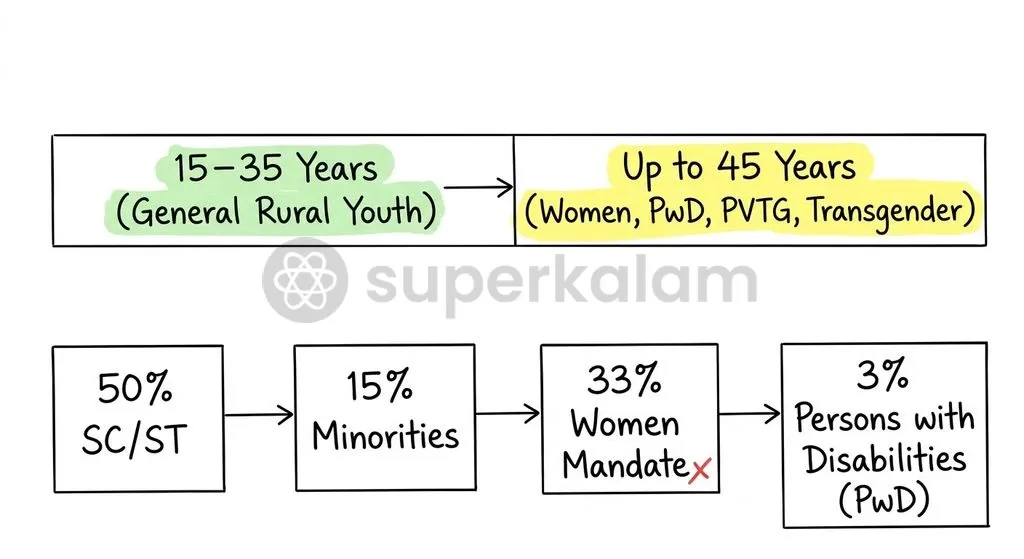
The Deen Dayal Upadhyaya Grameen Kaushalya Yojana (DDU-GKY) is a centrally sponsored, placement-linked skill development programme launched on 25 September 2014 by the Ministry of Rural Development under the Deendayal Antyodaya Yojana – National Rural Livelihoods Mission (DAY-NRLM). The scheme specifically targets poor rural youth aged 15 to 35 years, extending the upper age limit to 45 years for women, Persons with Disabilities (PwDs), Transgender persons, and vulnerable tribal groups.
Special geographical coverage exists through dedicated sub-programmes and fiscal incentives. The Himayat programme operates as a 100% centrally funded sub-initiative under DDU-GKY dedicated to skilling both rural and urban youth across Jammu & Kashmir and Ladakh across BPL and APL categories. For hard-to-reach geographies, a Special Area Allowance provides Project Implementing Agencies (PIAs) an additional 10% over the base training cost per candidate, alongside a mandatory 10% fund earmarking for North Eastern States. Working alongside DDU-GKY, the Ministry also supports Rural Self Employment Training Institutes (RSETIs), which have trained 63.47 lakh candidates and settled 45.60 lakh individuals across 647 institutes in 634 districts as of September 2026.
Why Was a 2.0 Overhaul Needed for Rural Skilling?
Operational audits of rural skilling schemes highlighted that high initial placement numbers masked widespread post-placement dropouts and rapid urban attrition. Under the original DDU-GKY guidelines, Project Implementing Agencies frequently focused on short-term training throughput to claim macro-level project disbursements rather than ensuring sustained job security. Many candidates relocated to distant urban centres only to exit employment within weeks due to unviable living costs and inadequate post-placement assistance.
Structural rigidities in training delivery also limited candidate absorption into modern industries. The legacy framework lacked adequate integration with captive industry employers, offered limited scope for emerging industrial sectors, and suffered from weak verification mechanisms that allowed cash deposits as salary proof. Upgrading to DDU-GKY 2.0 became essential to align rural training directly with verified market demand, rigorous digital monitoring, and enforceable long-term retention benchmarks.
Discuss with Superkalam
Explain how batch-mode milestone disbursements improve accountability compared to macro project-level disbursements.
Ask NowKey Changes: DDU-GKY 1.0 vs DDU-GKY 2.0 Guidelines
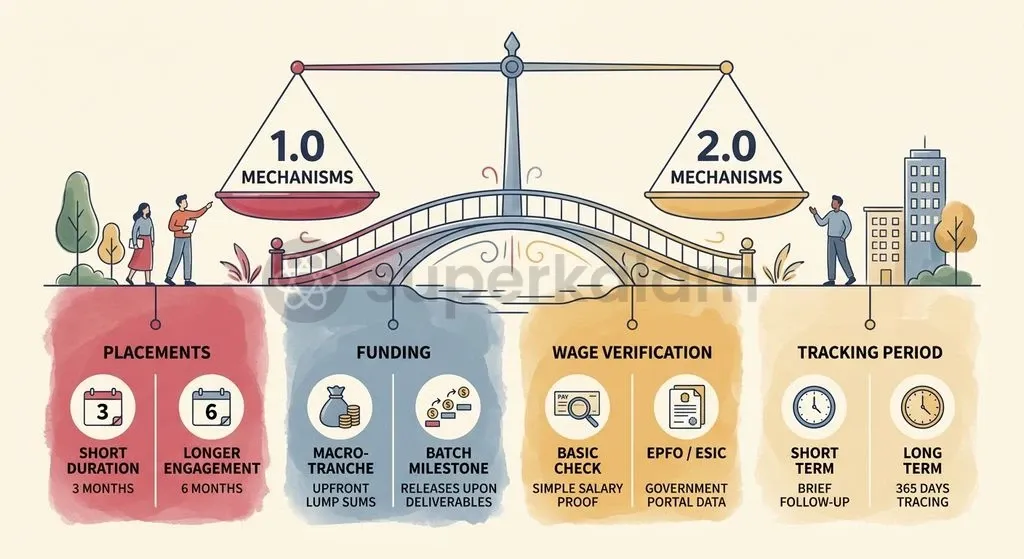
The Ministry of Rural Development transformed operational parameters across eligibility, funding, verification, and course structures when implementing the DDU-GKY 2.0 framework on 1 April 2025.
| Feature / Dimension | DDU-GKY 1.0 Framework | DDU-GKY 2.0 Operational Guidelines |
|---|---|---|
| Mandatory Placement Duration | 3 continuous months of employment to claim completion | 6 continuous months of verified employment |
| Funding & Disbursement Mode | Macro project-level tranche disbursements | Batch-mode payments tied directly to training milestones and 6-month placement outcomes |
| Course Duration & Composition | Variable across trade levels | Standardised 576 hours for a 3-month course (396 hours technical domain + 180 hours mandatory non-domain) |
| Industry Integration | General Project Implementing Agency (PIA) placement model | 20% target reservation specifically for captive employers |
| Post-Placement Tracking | Limited short-term monitoring | Mandatory tracking up to 365 days (12 months) post-placement |
| Career Progression Support | No structured follow-up skilling | Structured upskilling and reskilling windows after 12 months of sustained placement |
| Wage Verification Standards | Bank account statements and basic documentation | Strict electronic wage remittances (NEFT/RTGS/IMPS/UPI) cross-verified with EPFO/ESIC returns (no cash deposits allowed) |
| Digital Architecture | Multiple disconnected reporting portals | Unified kaushal.rural.gov.in portal with biometric attendance and geo-tagged tracking |
How DDU-GKY 2.0 Links Rural Training to Industry Demand
The Ministry of Rural Development designed DDU-GKY 2.0 to anchor skilling to direct industry demand by mandating that Project Implementing Agencies place at least 70% of trained candidates into regular wage employment, self-employment, or gig employment. Reserving a dedicated 20% quota for captive employers guarantees that industrial enterprises train candidates directly for their in-house production and service lines.
Curriculum modernisation bridges the gap between rural education and technological transformation. The revised framework integrates courses in emerging sectors:
- Green and Renewable Energy: Maintenance of solar installations and renewable generation units.
- Electric Mobility: Assembly, diagnostics, and servicing of Electric Vehicles (EVs).
- Care Economy and Healthcare: Allied healthcare assistance and geriatric care roles.
- Modern Logistics & Services: Supply chain management, warehousing, and digital media production.
Digital transparency underpins the entire delivery chain through the dedicated kaushal.rural.gov.in portal. The portal manages end-to-end operations including PIA onboarding, candidate Aadhaar-based registration, real-time biometric attendance, assessment certification, and automated PF/ESIC reconciliation.
Discuss with Superkalam
How can a state skill development mission effectively utilize the 20% captive employer quota to reduce post-placement attrition in manufacturing clusters?
Ask NowMajor Implementation Challenges in Rural Placement Schemes
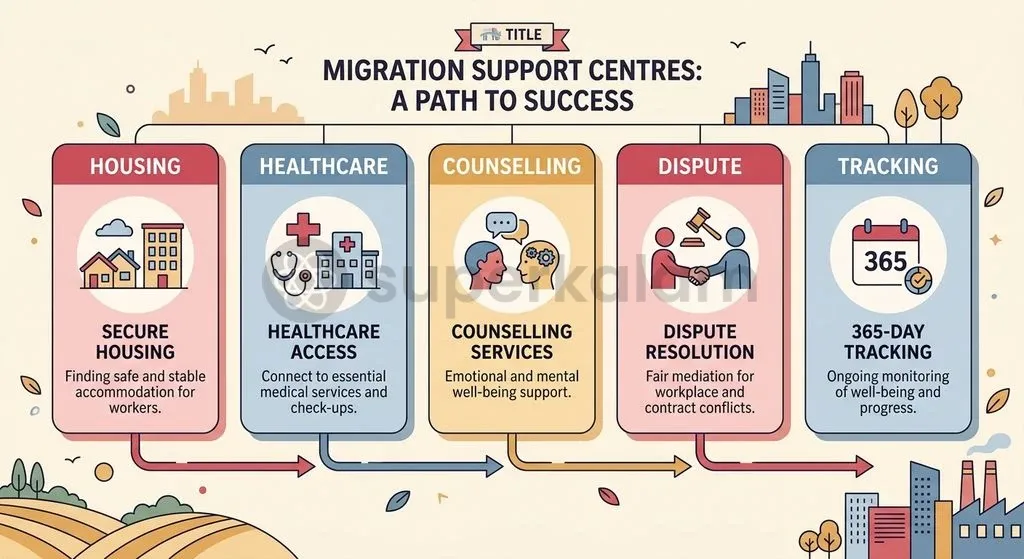
High post-placement urban attrition remains a critical bottleneck in rural skill development initiatives across Indian states. Rural youth placed in metropolitan clusters frequently confront severe social disconnect, high living expenses, and an acute lack of affordable rental housing. When entry-level wages stagnate near minimum-wage baselines, living costs erode candidate savings and trigger premature returns to home villages.
Capacity variations among Project Implementing Agencies present another institutional hurdle. Smaller PIAs in remote districts often struggle to establish institutional ties with tier-1 industrial employers, leading to placement clustering in low-paying service jobs. Ensuring strict compliance with the mandatory 576-hour curriculum across all training centres requires constant monitoring to prevent quality dilution.
Way Forward: Making Rural Skill Development Sustainable
Migration Support Centres (MSCs) must be scaled across all major industrial and metropolitan hubs to provide a robust safety net for rural migrant workers. These centres offer critical services including transit accommodation, legal aid, mental health counselling, healthcare access, and workplace dispute resolution. Expanding these facilities softens the transition shock for first-time urban migrants and bolsters employment retention.
Long-term socio-economic mobility requires institutionalising lifelong learning pathways for rural workers. Utilizing the structured upskilling and reskilling windows after 12 months of continuous placement allows candidates to transition from entry-level positions into supervisory and technical roles. Deepening collaboration with Sector Skill Councils and captive employers will ensure that rural workforce training continuously evolves alongside industrial automation and green economic transitions.
Discuss with Superkalam
Analyze the socioeconomic factors that cause rural youth to return home despite securing formal urban placements.
Ask NowKey Takeaways
- Nodal Framework: DDU-GKY was launched on 25 September 2014 under the Ministry of Rural Development as part of DAY-NRLM, focusing on rural youth aged 15–35 (relaxed up to 45 years for women, PwDs, Transgender persons, and vulnerable tribal groups).
- Core 2.0 Structural Shift: The DDU-GKY 2.0 guidelines (effective 1 April 2025) shift focus from training volume to employment retention by extending the mandatory placement completion milestone from 3 to 6 continuous months.
- Industry Anchoring: PIAs must place a minimum of 70% of trained candidates, with 20% of skilling targets reserved for captive employers and training expanded into green and emerging sectors (EVs, renewable energy, modern logistics).
- Strict Verification & Transparency: Wage verification strictly disallows cash deposits, mandating electronic remittances cross-verified against EPFO/ESIC returns via the integrated kaushal.rural.gov.in portal.
- Social & Regional Inclusion: The scheme reserves 50% funds for SC/ST, 15% for minorities, 33–40% for women, and includes dedicated initiatives like Himayat (J&K and Ladakh) and a 10% Special Area Allowance for difficult terrains.
Mains Question
"Shifting the benchmark of rural skill development from mere training throughput to verified employment retention is vital to prevent post-placement dropouts." In light of the DDU-GKY 2.0 operational guidelines, critically examine how the revamped framework addresses structural bottlenecks in rural livelihoods. (15 Marks)
Evaluate NowMains Question
Elucidate the key institutional and digital mechanisms introduced under DDU-GKY 2.0 to enhance transparency, industry alignment, and social inclusion in rural skilling. (10 Marks)
Evaluate NowPractice MCQs
QUESTION 1
With reference to the Deen Dayal Upadhyaya Grameen Kaushalya Yojana (DDU-GKY) 2.0 operational guidelines, consider the following statements:
- The mandatory placement retention milestone required to claim completion has been extended from three months to six continuous months.
- Under the updated framework, Project Implementing Agencies must place at least 50% of trained candidates into employment.
- The guidelines reserve a 20% training target specifically for captive employers. Which of the statements given above are correct?
QUESTION 2
Consider the following statements regarding the target group and social inclusion norms under DDU-GKY:
- The scheme covers rural youth aged 15 to 35 years, with the upper age limit relaxed up to 45 years for women and Persons with Disabilities.
- A minimum of 50% of funds are earmarked for Scheduled Castes and Scheduled Tribes.
- The Himayat programme is a 50:50 cost-sharing initiative between the Centre and the UT administration of Jammu & Kashmir. Which of the statements given above is/are correct?
QUESTION 3
With reference to the digital governance and wage verification architecture under DDU-GKY 2.0, consider the following statements:
- Wage payments can be verified through authenticated cash receipt vouchers countersigned by the Project Implementing Agency.
- Electronic wage remittances must be cross-verified against EPFO and ESIC returns.
- The scheme utilizes the unified kaushal.rural.gov.in portal for real-time biometric attendance and geo-tagged tracking. Which of the statements given above is/are correct?
QUESTION 4
Which of the following sub-initiatives or fiscal incentives is specifically provided under DDU-GKY for difficult and remote terrains?
QUESTION 5
Consider the following statements regarding the training design under DDU-GKY 2.0:
- A standardized 3-month course comprises 576 hours, divided into 396 hours of technical domain training and 180 hours of mandatory non-domain training.
- Post-placement tracking of candidates is mandated for a maximum period of 90 days.
- The revised framework incorporates training in emerging sectors including Electric Vehicles and Green and Renewable Energy. Which of the statements given above are correct?