Dark Patterns vs Platform Fees: CCPA Rules and Consumer Autonomy
While unbundled platform fees remain legally protected commercial pricing, concealing them through deceptive drip pricing breaches digital consumer autonomy.
Oct, 2026
•10 min read
Context
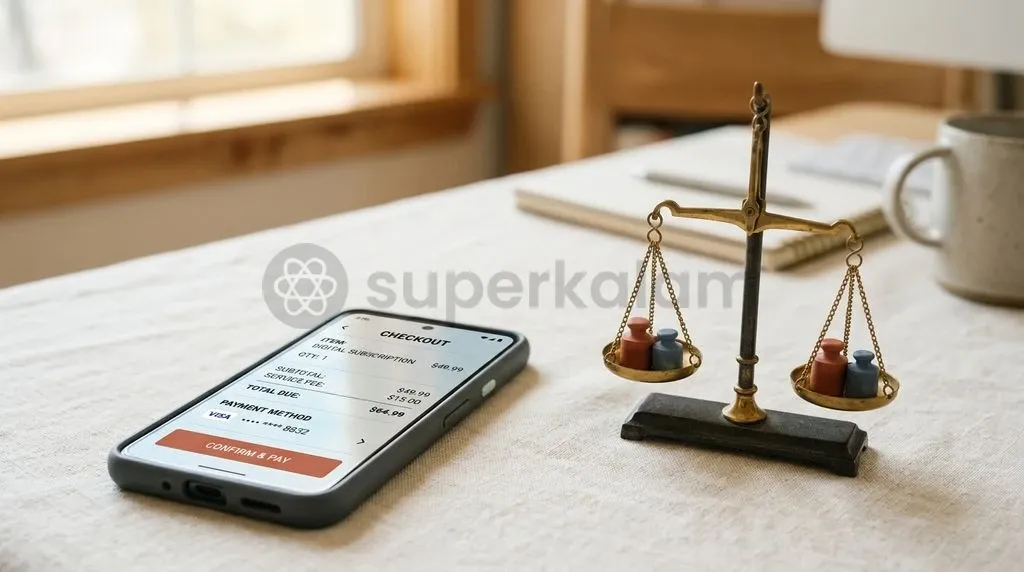
Digital platforms balance valid monetisation against user exploitation. Unbundled service charges remain permissible platform revenue. In contrast, manipulative interface design subverts digital consumer autonomy into unlawful deception under Indian law.
Online delivery apps and ticketing aggregators routinely break commissions into separate platform fees. These levies enjoy legal protection under freedom of contract when disclosed early. The moment checkout screens conceal or sneak mandatory additions into final tallies, ordinary unbundling mutates into deceptive dark patterns.
Why in the News: Regulatory Scrutiny on Sneaky Online Billing
India's consumer regulator is cracking down on hidden checkouts. The Central Consumer Protection Authority has intensified enforcement against digital aggregators that deploy deceptive interface designs and unconsented checkout levies.
Three enforcement mechanisms anchor this regulatory offensive:
- Statutory Guidelines: Exercising powers under Section 18 of the Consumer Protection Act, 2019, the Central Consumer Protection Authority notified the Guidelines for Prevention and Regulation of Dark Patterns, 2023.
- Consumer Grievance Portals: The Department of Consumer Affairs expanded operational monitoring through the National Consumer Helpline short code 1915 and the Jagriti portal.
- Targeted Penalties: Regulators penalised platforms for tacking on unconsented donations, opt-ins, and surprise service levies.
As of April 2025, regulatory scrutiny has widened from individual deceptive apps to the systemic billing mechanics of platform duopolies, requiring a rigorous legal demarcation between valid commercial pricing and deceptive user design.
Defining the Divide: Behavioural Manipulation vs Unbundled Pricing
Commercial pricing strategies and deceptive interfaces occupy fundamentally distinct legal ground. A platform or convenience fee is an unbundled charge for matchmaking, payment routing, or software infrastructure. The Competition Commission of India affirmed in R. Suresh v. Eternal Ltd. that an e-commerce platform fee is legally permissible under Indian law, provided it is disclosed to the consumer before final payment rather than concealed through deceptive billing.
In contrast, dark patterns target human cognitive processing. They manipulate user choice architecture to steer buyers into decisions contrary to their informed self-interest.
Annexure 1 of the 2023 Central Consumer Protection Authority Guidelines details these prohibited manipulative methods:
- False Urgency: Falsely creating or implying a sense of urgency or scarcity, such as misleading countdown clocks or fictitious purchase counters, to manipulate immediate purchasing decisions.
- Disguised Advertisements: Embedding paid commercial advertisements or promotional content disguised as organic consumer reviews, editorial posts, or natural search results.
- Basket Sneaking: Adding supplemental products, recurring subscription fees, or charitable donations to a user cart without explicit opt-in confirmation.
A platform fee is merely a price component. A dark pattern is an exploitative behavioural mechanism baked directly into software design.
Discuss with Superkalam
What are the two official digital consumer grievance redressal channels expanded by the Department of Consumer Affairs?
Ask NowWhere the Line Blurs: When Does a Platform Fee Become Drip Pricing?
A legitimate platform fee becomes an unlawful dark pattern when developers withhold disclosure until the buyer has invested substantial effort. The Central Consumer Protection Authority defines drip pricing under Clause 8 of Annexure 1 as the practice where elements of the price are not revealed upfront or are revealed incrementally as the user proceeds, or charging a higher amount than confirmed at checkout.
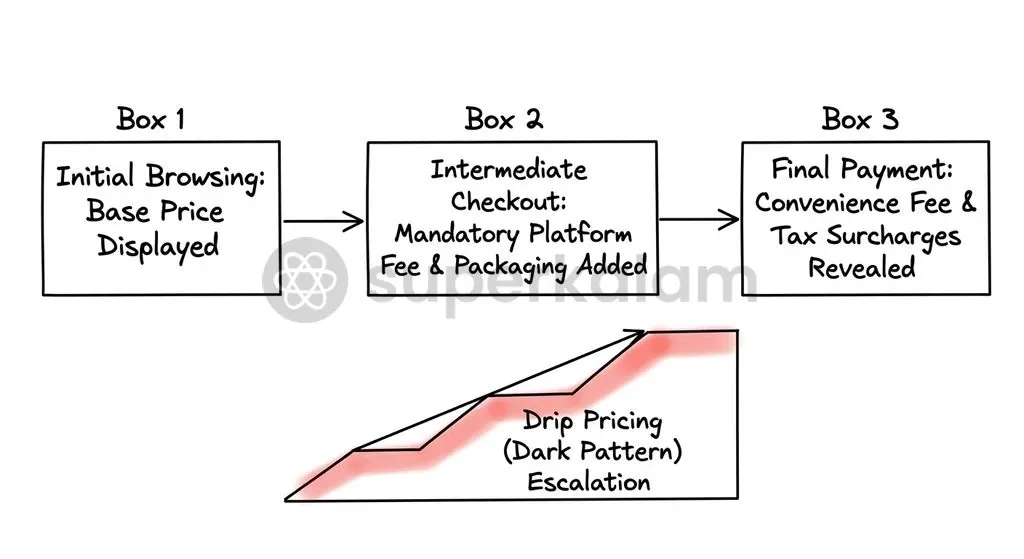
Withholding fees until the final screen weaponises the sunk cost fallacy. Buyers who spend several minutes curating a basket develop strong behavioural inertia. They pay the surprise packaging charges, surge levies, and convenience fees rather than abandon the transaction.
Indian regulatory records demonstrate this boundary in practice:
- Concealment of Mandatory Charges: If a platform charges a mandatory platform fee of ₹6, omitting this figure from initial browsing screens constitutes unlawful drip pricing under the 2023 Guidelines.
- Unsolicited Cart Additions: The Central Consumer Protection Authority initiated enforcement against BookMyShow and quick-commerce platform Zepto for basket sneaking involving default pre-ticked donations and unconsented membership charges added during checkout.
- Terminal Checkouts: When the final debited sum exceeds the initial confirmed summary, the price variance represents an unfair trade practice under Indian consumer law.
Discuss with Superkalam
How does late-stage fee disclosure leverage the 'sunk cost fallacy' against digital consumers?
Ask NowSide-by-Side Breakdown: Dark Patterns vs Platform Convenience Fees
Comparing lawful fees with illegal interface manipulations clarifies where commercial freedom ends and deceptive practice begins. The primary dividing line under Indian law remains informed consent, transparency of unbundled items, and the total absence of interface trickery.
| Dimension | Platform Convenience Fee | Dark Pattern (e.g., Drip Pricing / Sneaking) |
|---|---|---|
| Legal Status | Permissible under freedom of contract if disclosed | Prohibited under the Consumer Protection Act, 2019 |
| Primary Intent | Direct monetisation for operational software access | Behavioural steering to extract unconsented revenue |
| Disclosure Timing | Stated upfront before the transaction commitment | Incrementally revealed at late checkout screens |
| User Volition | User retains explicit choice to exit transaction | Exploits cognitive friction and choice defaults |
| Regulatory Benchmark | Governed under fair pricing and disclosure norms | Violates Central Consumer Protection Authority 2023 Guidelines |
| Remedy Required | Clear line-item invoice unbundling | Mandatory redesign of the digital user interface |
The legal difference hinges on autonomous digital agency: a transparent fee allows meaningful consumer exit, whereas deceptive interface design subverts voluntary decision-making.
Discuss with Superkalam
If an online app automatically ticks a ₹2 donation during checkout, which prohibited dark pattern under the 2023 CCPA Guidelines does this represent?
Ask NowLegal Standing in India: The Consumer Protection Act 2019 and CCPA Guidelines
The statutory framework under the Consumer Protection Act, 2019 provides robust legal remedies against manipulative digital designs. Section 2(47) defines an unfair trade practice as any practice adopting unfair methods or deceptive practices, explicitly covering misleading electronic representations and deceptive digital interface interactions.
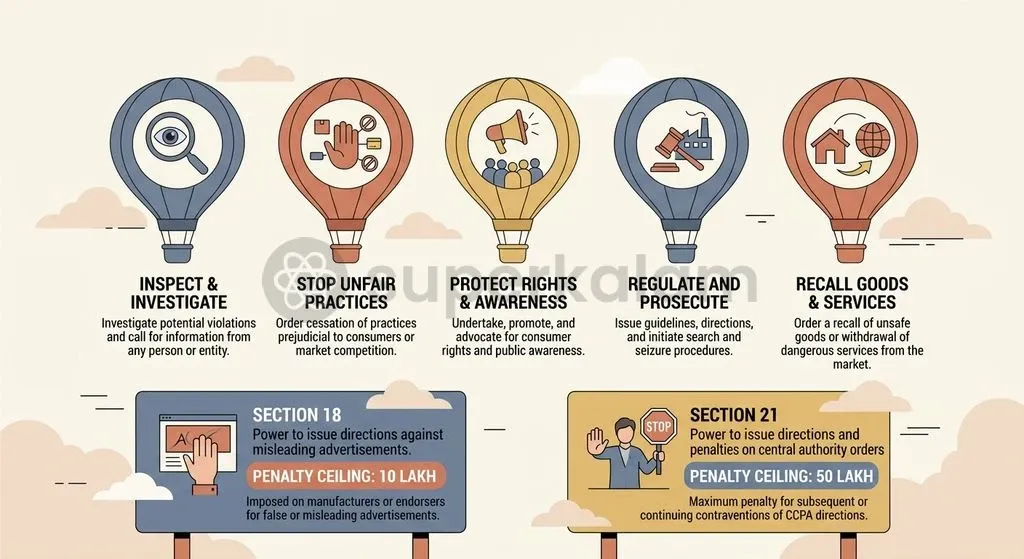
The statutory architecture combines regulatory powers, inquiries, and fiscal sanctions across dedicated provisions:
- Substantive Prohibition: Section 18 empowers the Central Consumer Protection Authority to formulate mandatory regulations preventing consumer rights violations and commercial exploitation.
- Investigative Authority: The Director General of the Central Consumer Protection Authority holds sweeping search, seizure, and inquiry powers to audit backend algorithmic mechanics and application interfaces.
- Penal Sanctions: Under Section 21 of the Consumer Protection Act, 2019, the authority possesses the statutory authority to issue directions to discontinue unfair trade practices and impose financial penalties up to ₹10 lakh for a first violation and up to ₹50 lakh for subsequent violations.
- Antitrust Limitations: While the consumer framework strictly penalises deceptive interfaces, the Competition Act, 2002 faces statutory constraints regarding duopolies. Section 4 does not recognise collective dominance, meaning parallel pricing or simultaneous platform fee hikes by food aggregators cannot be prosecuted as abuse of dominance without proof of an explicit anti-competitive agreement under Section 3.
- Antitrust Rulings on Fee Structures: The Competition Commission of India ruled in April 2025 in Lalit Wadher v. Zomato Ltd. that platform fees, packaging fees, and delivery charges imposed by food delivery aggregators do not constitute unfair or discriminatory pricing under Section 4(2)(a)(ii) of the Competition Act, 2002.
The Competition Commission's earlier 2020 Market Study on E-Commerce in India cautioned that opaque fee unbundling, search manipulation, and algorithmic opacity systematically distort digital marketplace competition.
Digital Ethics and Autonomy: Choice Architecture vs Monopolistic Rents
Manipulative interfaces weaponise behavioural economics against consumers. In their work on choice architecture, Richard Thaler and Cass Sunstein framed Nudge Theory as interface design that steers people toward welfare-enhancing outcomes without restricting freedom. Dark patterns invert this mechanism, generating deliberate friction known as sludge.
According to research by the Organisation for Economic Co-operation and Development, dark commercial patterns systematically exploit innate human cognitive limits, such as default inertia, asymmetric framing, and price anchoring, to bypass rational evaluation.
Key cognitive vulnerabilities targeted by predatory checkout flows include:
- Default Inertia: Pre-ticked checkboxes take advantage of human passivity, forcing consumers to spend cognitive effort deselecting unwanted add-ons.
- Asymmetric Framing: Interface designs highlight discounts in prominent typography while burying mandatory packaging and handling fees in fine print.
- Sunk Cost Exploitation: Delaying final cost disclosures until users have completed multiple ordering steps discourages cart abandonment.
In concentrated markets, behavioural manipulation reinforces extraction. Food delivery and ride-hailing platforms operate as tight duopolies, leaving buyers without transparent alternative options. Consumers must absorb cognitive taxations and mandatory convenience fees because high network effects eliminate realistic platform switching.
Discuss with Superkalam
Why is the CCPA better positioned statutorily than the CCI to address consumer harms arising from surprise checkout fees?
Ask Now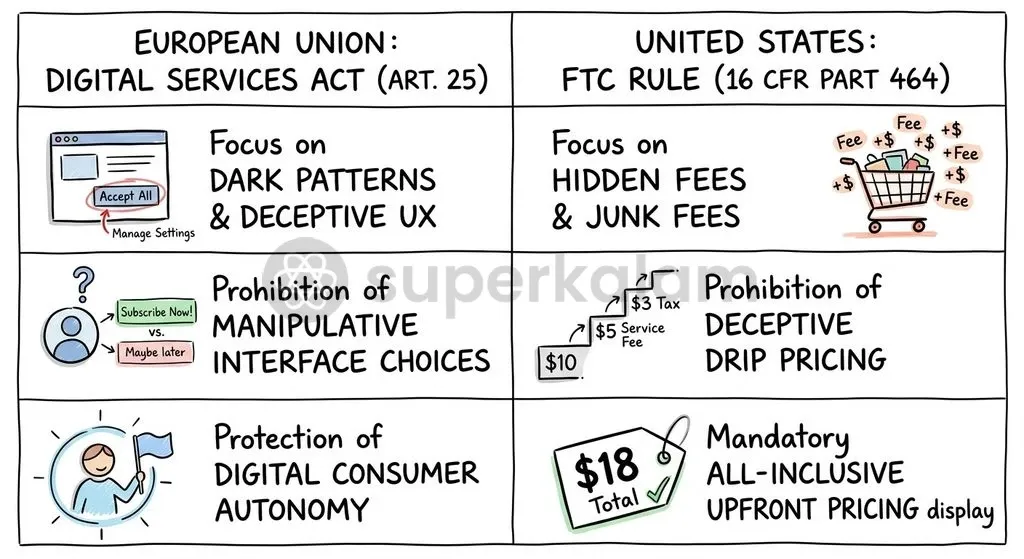
The European Union and the United States exhibit two complementary regulatory frameworks:
- The European Union Framework: Article 25 of the European Union Digital Services Act (Regulation EU 2022/2065) prohibits online platform providers from designing, organising, or operating digital interfaces in a manner that deceives, manipulates, or materially impairs user autonomy. This establishes a general, omnibus ban on dark patterns across the single market, backed by substantial global turnover fines.
- The United States Approach: The United States Federal Trade Commission finalised its Trade Regulation Rule on Unfair or Deceptive Fees (16 CFR Part 464, commonly known as the Junk Fees Rule) in December 2024 to mandate upfront all-inclusive pricing and ban concealed mandatory charges. The rule forces businesses to state total fees, including mandatory processing levies, at the very first interaction stage.
These cross-border standards highlight that Indian jurisprudence aligns with global best practices by addressing asymmetric digital power through administrative enforcement.
Way Forward: Building Transparent Checkouts and Enforcing Digital Consumer Rights
Securing digital consumer rights requires institutional reform, algorithmic audits, and statutory amendments addressing digital concentration. Voluntary self-regulation by technology firms has proven inadequate when revenue targets directly incentivise friction-filled user flows and unbundled platform fees.
First, regulatory authorities must enforce mandatory all-inclusive pricing. Every digital aggregator must display the definitive final payable price, inclusive of platform fees, packaging surcharges, and taxes, on initial search and cataloguing screens. Removing drip pricing eliminates information asymmetry and restores fair price discovery.
Second, the Union Parliament should amend the Competition Act, 2002 to introduce the concept of collective dominance. This amendment would enable the Competition Commission of India to investigate simultaneous platform fee increases and coordinated user-interface practices across duopolies without requiring direct proof of explicit cartels.
Finally, consumer protection bodies must build capabilities for automated code inspections. The Central Consumer Protection Authority should partner with technical research institutions to deploy open-source auditing bots. These bots can crawl checkout interfaces, detect pre-ticked checkboxes, and report basket sneaking directly to the National Consumer Helpline portal.
Key Takeaways
- Platform convenience fees remain legal unbundled charges under Indian law when fully disclosed upfront, but transform into unlawful dark patterns if introduced incrementally via drip pricing.
- The Central Consumer Protection Authority notified the Guidelines for Prevention and Regulation of Dark Patterns, 2023 under Section 18 of the Consumer Protection Act, 2019, specifically penalising practices like basket sneaking and false urgency.
- Section 2(47) of the Consumer Protection Act, 2019 classifies manipulative digital interfaces as unfair trade practices, granting the Central Consumer Protection Authority statutory power to levy penalties up to ₹50 lakh.
- Section 4 of the Competition Act, 2002 currently lacks provisions for collective dominance, meaning simultaneous fee hikes by market duopolies cannot be prosecuted as abuse of dominance without proof of concerted collusion.
- International standards, including Article 25 of the EU Digital Services Act and the US FTC Junk Fees Rule (16 CFR Part 464), mandate upfront all-inclusive pricing to preserve consumer autonomy.
Mains Question
'A platform convenience fee is an unbundled price component permissible under freedom of contract, yet weaponising user choice architecture mutates commercial pricing into an unfair trade practice.' In light of the Central Consumer Protection Authority (CCPA) Guidelines, 2023, elucidate. (10 Marks)
Evaluate NowMains Question
Critically analyse the statutory efficacy of India's dual regulatory architecture—comprising the Consumer Protection Act, 2019 and the Competition Act, 2002—in policing deceptive digital interfaces and systemic platform pricing models. (15 Marks)
Evaluate NowPractice MCQs
QUESTION 1
With reference to the regulation of digital platforms in India under the Consumer Protection Act, 2019, consider the following statements:
- The Central Consumer Protection Authority (CCPA) is empowered under Section 18 of the Act to issue guidelines preventing unfair trade practices.
- The CCPA has the statutory authority under Section 21 to impose financial penalties of up to ₹50 lakh for a first violation.
- The National Consumer Helpline short code 1915 and the Jagriti portal are operational monitoring mechanisms under the Department of Consumer Affairs.
Which of the statements given above are correct?
QUESTION 2
Regarding digital interface practices defined under the Central Consumer Protection Authority (CCPA) Guidelines for Prevention and Regulation of Dark Patterns, 2023, consider the following statements:
- 'Basket sneaking' includes adding supplemental products or donations to a user cart without explicit opt-in confirmation.
- Omitting a mandatory platform fee from initial browsing screens and revealing it incrementally constitutes 'drip pricing'.
- Embedding paid commercial advertisements disguised as natural search results is categorized as 'false urgency'.
Which of the statements given above is/are correct?
QUESTION 3
Consider the following statements regarding the legal and regulatory treatment of platform fees under Indian competition and consumer law:
- Under the Competition Act, 2002, parallel platform fee increases by digital aggregators can be prosecuted as abuse of collective dominance under Section 4.
- In Lalit Wadher v. Zomato Ltd. (2025), the Competition Commission of India ruled that platform fees and delivery charges do not constitute unfair or discriminatory pricing under Section 4(2)(a)(ii) of the Competition Act, 2002.
- The Competition Commission of India affirmed in R. Suresh v. Eternal Ltd. that an e-commerce platform fee is legally permissible if disclosed to the consumer prior to final payment.
Which of the statements given above is/are correct?
QUESTION 4
Which of the following practices is explicitly identified as an 'unfair trade practice' under Section 2(47) of the Consumer Protection Act, 2019?
QUESTION 5
With reference to behavioural economics and digital design concepts discussed in the context of consumer autonomy, consider the following pairs:
- Nudge: Deliberate interface friction designed to subvert user decision-making
- Sludge: Weaponised interface design generating friction against rational consumer choice
- Sunk Cost Fallacy: Behavioural inertia where buyers proceed with surprise fees after curating a basket
How many of the pairs given above are correctly matched?