Critical Minerals to Semiconductors: Geopolitics of Tech Supply Chains
As tech monopolies turn into instruments of state coercion, India balances overseas resource acquisition through KABIL with domestic semiconductor subsidies.
Sep, 2026
•8 min read
Context
Global critical mineral and semiconductor supply chains have evolved from cost-optimised trading networks into asymmetric instruments of geopolitical leverage and state coercion. Upstream extraction, midstream refining of rare earth elements, and downstream advanced photolithography fabrication remain concentrated within narrow geographical hubs and single-firm monopolies. As major powers deploy export restrictions and targeted subsidies, nations like India must transition from passive import dependence to active industrial derisking through domestic mining reforms, semiconductor incentive programmes, and multilateral resource partnerships.
Why in the News: The Global Scramble for Minerals and Semiconductors
The Ministry of Mines identified a foundational list of 30 critical minerals essential for economic resilience and national security in June 2023. As of March 2026, intensified trade controls across raw extraction and advanced lithography have turned technological self-reliance into a strategic imperative.
Geopolitical frictions have accelerated since China imposed export licensing mandates on gallium and germanium in August 2023, followed by restrictions on graphite in December 2023. In parallel, China banned the export of rare-earth extraction, separation, and magnet-manufacturing technologies. These moves disrupted international supply lines across renewable energy, electric mobility, and defence manufacturing.
Discuss with Superkalam
Which 30 critical minerals did the Ministry of Mines identify in June 2023, and what are the primary midstream bottlenecks in their processing?
Ask NowThe Value Chain Explained: From Raw Ore to Permanent Magnets to Microchips
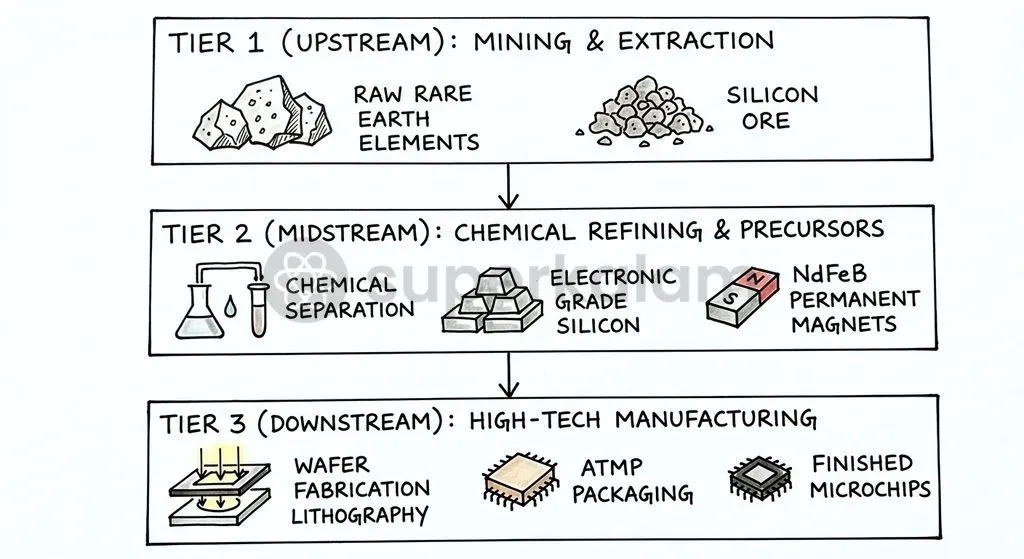
The advanced technology supply chain operates across three distinct tiers spanning upstream extraction, midstream intermediate processing, and downstream precision fabrication. Each stage exhibits extreme capital intensity and technical complexity.
The upstream tier involves mining raw geological deposits such as lithium spodumene, cobalt ore, and raw heavy rare earths. These unrefined ores lack immediate industrial utility and require intensive chemical processing.
The midstream tier converts raw concentrates into high-purity chemical compounds and precision components. According to the International Energy Agency, neodymium-iron-boron permanent magnets—composed primarily of neodymium, praseodymium, dysprosium, and terbium—represent the vital midstream link converting mined rare earths into functional inputs for electric vehicle drivetrains, wind turbine generators, and precision missile guidance systems.
The downstream tier encompasses wafer fabrication, advanced lithography, and final assembly, testing, marking, and packaging (ATMP/OSAT). Here, refined silicon ingots undergo micro-patterning to emerge as functional integrated circuits powering civil infrastructure and aerospace systems.
| Value Chain Tier | Key Industrial Processes | Primary Output Commodities | Strategic Risk Profile |
|---|---|---|---|
| Upstream Extraction | Open-pit and brine mining, physical crushing | Raw ores, mineral concentrates, unrefined heavy minerals | Geological concentration, long mine development lead times |
| Midstream Processing | Solvent extraction, metallurgical smelting, chemical reduction | High-purity oxides, battery precursors, NdFeB magnets | Severe refining monopolies, environmental externalities |
| Downstream Fabrication | Photolithography, chemical vapour deposition, ATMP/OSAT | Integrated circuits, microchips, display modules | Extreme capital costs, proprietary intellectual property chokepoints |
Where Are the Choke Points? Understanding Global Supply Chain Concentration
The International Energy Agency reports that China controls approximately 60% of worldwide rare earth mining and over 90% of global refined rare earth output. This creates structural midstream bottlenecks across global clean technology manufacturing.
Downstream semiconductor manufacturing faces severe technical concentration in precision machinery. Advanced extreme ultraviolet photolithography, essential for sub-7nm leading-edge microchip fabrication, is monopolised by Dutch firm ASML, whose high-end machinery shipments remain restricted by Dutch and United States export control frameworks.
Discuss with Superkalam
How does the 'chokepoint effect' differ from the 'panopticon effect' when applied to international semiconductor supply chains?
Ask NowWeaponized Interdependence: How Nations Use Mineral and Tech Monopolies as Leverage
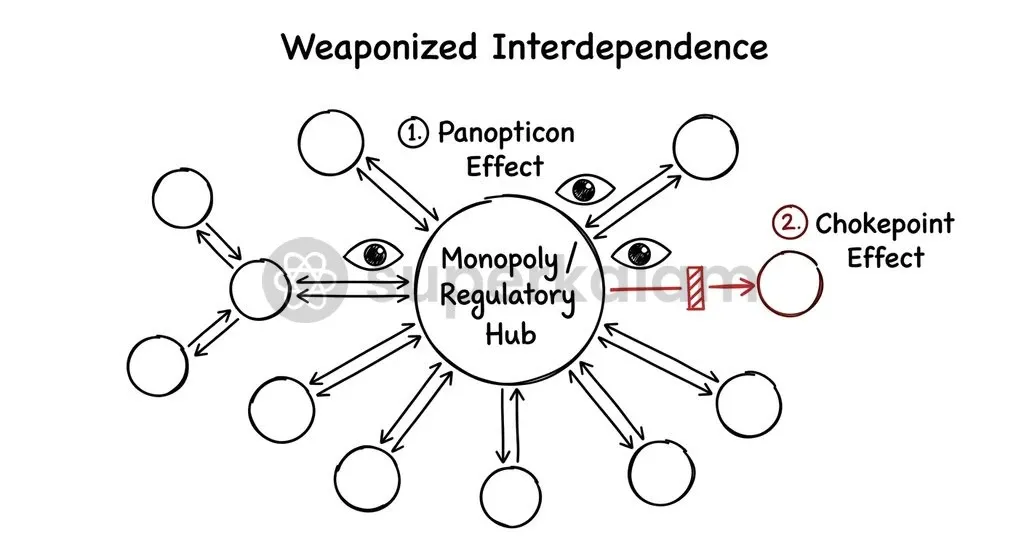
Henry Farrell and Abraham Newman conceptualised weaponized interdependence to explain how asymmetric global network architectures allow hub-controlling states to exert coercive power. Their framework identifies two structural mechanisms of state pressure: the chokepoint effect and the panopticon effect.
The chokepoint effect occurs when an actor leverages sovereign jurisdiction over a centralised node to sever access for rival states. When a state withholds critical inputs—such as China curbing exports of gallium and germanium or the United States restricting advanced chip architectures—it turns an economic hub into an instrument of strategic denial.
The panopticon effect emerges when an authority exploits information flows passing through a central hub to observe, track, and anticipate rival activities. In physical and digital supply chains, monitoring transaction corridors enables dominating states to map vulnerabilities and design targeted technological embargoes.
Global Responses Compared: The US, EU, and China's Strategic Industrial Policies
The United States enacted the CHIPS and Science Act of 2022 to counter technological dependence through domestic subsidies. The legislation directs $52.7 billion toward manufacturing incentives and research programmes.
The American framework includes strict statutory guardrail provisions that prohibit subsidy recipients from expanding leading-edge semiconductor manufacturing capacity within countries of concern. In parallel, China continues to restrict the outflow of proprietary processing technology to defend its dominance in midstream rare-earth separation.
Discuss with Superkalam
If an export embargo were placed on advanced lithography machinery, how would domestic electronics manufacturing in developing economies be affected?
Ask NowIndia's Critical Vulnerabilities: Import Reliance in Refining and Fabrication
The Ministry of Mines reports that India faces 100% import dependence for its domestic consumption of raw lithium, cobalt, and nickel. India also remains over 90% import reliant across the broader list of 30 identified critical minerals.
Domestic manufacturing vulnerabilities are exacerbated by the complete absence of operational commercial wafer fabrication plants. While India maintains domestic design expertise, raw component manufacturing and advanced midstream processing remain situated in external jurisdictions, leaving local industrial value chains exposed to overseas geopolitical disruptions.
India's Countermeasures: KABIL, the India Semiconductor Mission, and Global Alliances
The Parliament of India enacted the Mines and Minerals Amendment Act, 2023, to enable private participation in strategic mineral extraction. The statute inserted Section 11D and Part D into the First Schedule of the principal Act, empowering the Central Government to auction exploration and mining leases for 24 critical and strategic minerals.
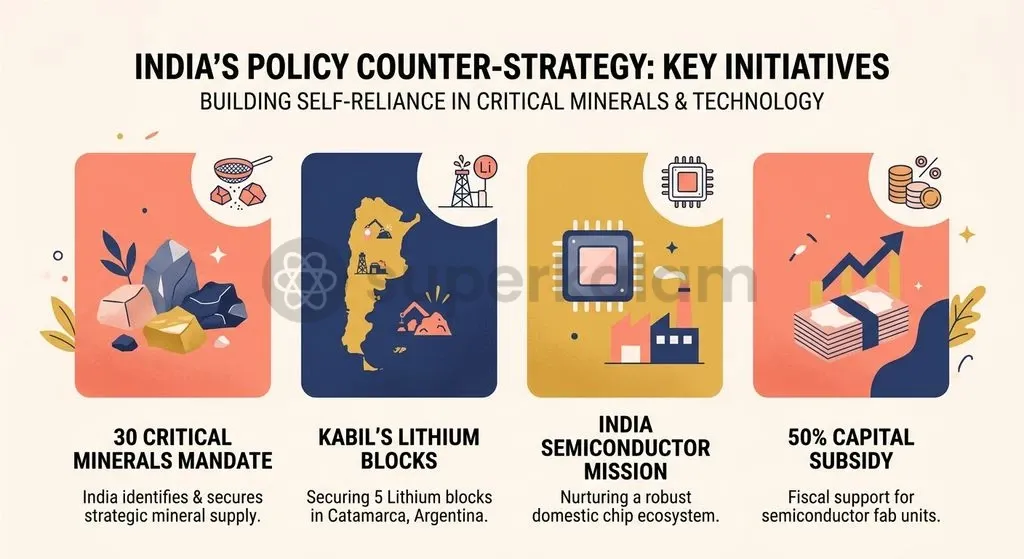
Khanij Bidesh India Limited (KABIL) operates as a dedicated joint venture between NALCO (40%), Hindustan Copper Limited (30%), and MECL (30%) under the Ministry of Mines. On 15 January 2024, KABIL signed an exploration agreement with CAMYEN SE of Argentina, securing exclusivity rights across five lithium brine blocks covering 15,703 hectares in Catamarca province.
The Union Cabinet approved the Modified Semiconductor Programme, offering a uniform 50% fiscal subsidy across all technology nodes on a pari-passu basis for silicon fabs, display fabs, compound semiconductors, and ATMP/OSAT packaging facilities.
On the multilateral front, India joined the US-led Minerals Security Partnership in June 2023 and entered its Finance Network in September 2024. In parallel, the Quad Critical and Emerging Technology Working Group coordinates joint supply chain mapping across semiconductor networks and rare-earth supply corridors.
Way Forward: Securing Mineral Supplies and Scaling Domestic Tech Manufacturing
The Government of India launched the National Critical Mineral Mission covering a 7-year implementation framework from 2024–25 to 2030–31. The mission focuses on creating 7 Centres of Excellence, offering recycling incentives, and establishing national stockpiling mechanisms.
To achieve durable supply chain resilience, policymakers must bridge the gap between upstream acquisition and domestic midstream processing. Building domestic separation facilities for permanent magnets and expediting project execution under the India Semiconductor Mission will safeguard national economic sovereignty against future geoeconomic shocks.
Discuss with Superkalam
Compare China's export control measures on rare earths with the United States' statutory guardrails under the CHIPS Act in terms of geopolitical impact.
Ask NowKey Takeaways
- The global advanced technology supply chain is concentrated across upstream extraction, midstream refining, and downstream fabrication, creating asymmetric vulnerability to geopolitical coercion.
- Farrell and Newman's conceptual framework of weaponized interdependence demonstrates how centralised hubs are leveraged through chokepoint and panopticon effects.
- China controls roughly 60% of rare earth extraction and over 90% of refining, while advanced sub-7nm EUV photolithography remains a commercial monopoly under Dutch firm ASML.
- India faces over 90% import reliance across its 30 identified critical minerals, including complete dependence on foreign suppliers for raw lithium, cobalt, and nickel.
- Key Indian countermeasures include the MMDR Amendment Act 2023, KABIL's lithium exploration agreement in Argentina, the India Semiconductor Mission's 50% fiscal incentives, and membership in the Minerals Security Partnership.
Mains Question
"Global critical mineral and semiconductor supply chains have transformed from cost-optimised networks into asymmetric instruments of geopolitical leverage." In light of the concept of weaponized interdependence, elucidate how chokepoints in midstream refining and downstream fabrication impact India's strategic autonomy. (10 Marks)
Evaluate NowMains Question
Highlighting the provisions of the Mines and Minerals (Development and Regulation) Amendment Act, 2023, critically analyse India's strategy to address vulnerabilities across the upstream, midstream, and downstream tiers of the high-tech supply chain. (15 Marks)
Evaluate NowPractice MCQs
QUESTION 1
With reference to the concept of 'Weaponized Interdependence' formulated by Henry Farrell and Abraham Newman, consider the following statements:
- The chokepoint effect occurs when an actor leverages jurisdiction over a centralized node to deny access to rival states.
- The panopticon effect refers to an authority exploiting information flows through a central hub to observe and anticipate rival activities.
- The framework posits that decentralized open networks naturally lead to strategic coercion by non-state actors. Which of the statements given above is/are correct?
QUESTION 2
Consider the following statements regarding critical mineral supply chains:
- Neodymium-iron-boron (NdFeB) permanent magnets serve as a vital midstream link for wind turbines and precision missile guidance systems.
- China accounts for approximately 60% of worldwide rare earth mining and over 90% of global refined rare earth output.
- India maintains complete self-sufficiency in domestic processing and refining of lithium and cobalt ores. Which of the statements given above is/are correct?
QUESTION 3
Regarding the Mines and Minerals (Development and Regulation) Amendment Act, 2023, consider the following statements:
- It introduced Section 11D and Part D into the First Schedule of the principal Act.
- It empowers the Central Government to auction exploration and mining leases for 24 critical and strategic minerals.
- It completely prohibits private sector participation in the extraction of strategic minerals. Which of the statements given above is/are correct?
QUESTION 4
In the context of the downstream semiconductor manufacturing value chain, advanced extreme ultraviolet (EUV) photolithography machinery essential for sub-7nm microchip fabrication is monopolised by which of the following entities?
QUESTION 5
Consider the following statements regarding the United States CHIPS and Science Act of 2022:
- It allocates $52.7 billion toward domestic semiconductor manufacturing incentives and research programmes.
- It incorporates statutory guardrail provisions prohibiting subsidy recipients from expanding leading-edge manufacturing capacity in countries of concern. Which of the statements given above is/are correct?