Calling Name Presentation: India's KYC Caller ID and Privacy Debate
While DoT's caller identity mandate curbs fraud, its clash with constitutional privacy and data protection principles makes it a pivotal issue for governance.
Oct, 2026
•9 min read
Overview
Calling Name Presentation is a network-level telecommunications architecture designed to replace crowdsourced caller identification. It displays government-verified subscriber names, drawn directly from Know Your Customer records, on receiving mobile handsets. Under directions from the Department of Telecommunications, originating operators must transmit these verified records alongside standard telephone numbers during call setup.
The service shifts caller identification from third-party apps to core telecommunication signalling protocols. This transition establishes a statutory mechanism to curb financial fraud, spam calls, and caller spoofing across cellular networks, while raising critical questions around personal privacy and subscriber consent.
Why is Calling Name Presentation in the News?
The Department of Telecommunications issued a circular directing all licensed access service providers to operationalise Calling Name Presentation across India starting 1 November 2026. As of October 2026, the regulatory directive transitions caller identification from an optional software feature to a standard telecommunications supplementary service.
The implementation instructions follow formal regulatory advice submitted earlier by the Telecom Regulatory Authority of India. Under these guidelines, the government seeks to eliminate fraudulent caller-identity spoofing by displaying authenticated personal names on incoming calls without requiring internet access on the receiving device.
This policy establishes three structural shifts at the core network layer:
- Statutory Identification: Replaces crowdsourced address books with verified legal identities backed by official telecom records.
- Universal Access: Delivers caller names directly through network signalling, removing the need for data connections on receiving handsets.
- State-Mandated Verification: Shifts identity governance from private mobile applications to a mandatory network standard.
What is CNAP and How Does It Work at the Network Level?
Calling Name Presentation transmits a caller's verified legal identity to the recipient's handset during initial network call setup. The Telecom Regulatory Authority of India formulated this framework to enhance Calling Line Identification by pairing standard E.164 numbers with authenticated text records.
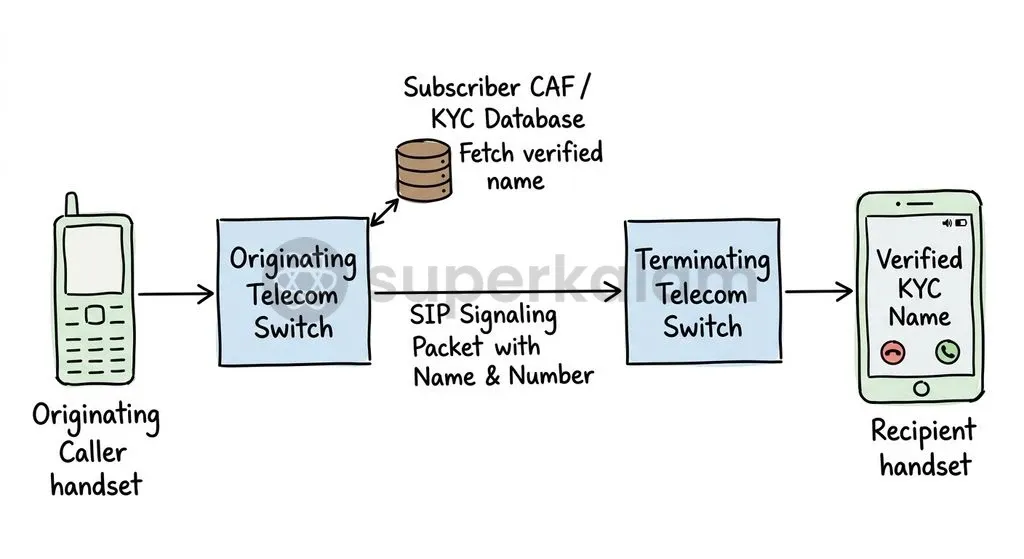
The service runs through a four-stage lookup sequence across telecom networks:
- Identity Extraction: The originating provider pulls the caller's legal name directly from Customer Application Form records and verified Know Your Customer databases.
- Signalling Transmission: When a user makes a call over 4G or 5G, the core network utilises an IP Multimedia Subsystem (IMS) to package the name into Session Initiation Protocol (SIP) signalling headers.
- Inter-Operator Dip Query: For calls across different networks, the terminating operator executes a real-time dip query to the originating operator's subscriber registry.
- Display Presentation: The terminating network delivers the fetched name directly to the recipient's incoming call screen alongside the telephone number.
Local device storage retains operational precedence over network signalling. If an incoming number is already saved in the recipient's local address book, that saved contact name overrides the network-provided identity.
Telecommunications regulations prohibit data hoarding during these handshakes. The regulatory circular mandates a security-by-design protocol prohibiting terminating telecom operators from caching or retaining subscriber names obtained via query-response lookups once the voice call terminates.
Discuss with Superkalam
Which statutory document forms the primary source of caller names in the CNAP architecture?
Ask NowCNAP vs Truecaller: Comparing Verified KYC with Crowdsourced Data
Third-party identification platforms such as Truecaller and Bharat Caller rely heavily on crowdsourced address books. In contrast, Calling Name Presentation draws exclusively from verified regulatory documentation. Commercial apps harvest contact lists uploaded by their user base, which frequently results in inaccurate names, outdated tags, and malicious identity misattributions.
The two systems diverge across data origin, network dependency, and statutory accountability:
| Feature Dimension | Calling Name Presentation (CNAP) | Commercial Apps (e.g., Truecaller) |
|---|---|---|
| Data Source | Customer Application Form and statutory telecom KYC records | Crowdsourced contacts, address-book scraping, and voluntary user profiles |
| Authentication Standard | Government-verified identity backed by statutory documentation | Unverified crowd consensus subject to manipulation and spoofing |
| Network Layer | Embedded within core telecom signalling protocols (SIP and IMS) | Over-the-top software application functioning at the application layer |
| Internet Requirement | Operates natively without mobile data or packet-switched internet | Requires active mobile packet data or Wi-Fi connectivity to query remote servers |
| Device Compatibility | Native operating system and firmware support on 4G/5G mobile devices | Limited to smartphones capable of running external mobile operating systems |
| Data Retention | Mandatory zero-caching rule prohibiting name retention post-call termination | Centralised proprietary databases that store, profile, and monetise caller metadata |
Calling Name Presentation is a telco-native signalling service embedded directly within telecommunication circuit and IP layers. This architecture ensures verified identification even when a user is in a mobile data dead zone.
Discuss with Superkalam
How does CNAP manage to display verified names on basic mobile networks without requiring mobile internet access?
Ask NowWhy Regulators Are Pushing for Mandatory Caller Name Display
The primary regulatory objective driving Calling Name Presentation is the systematic containment of financial cyber fraud, caller-ID spoofing, and unsolicited commercial communications. Fraudsters routinely exploit numeric anonymity to impersonate banking institutions, law enforcement bodies, and corporate utilities.
The framework addresses persistent regulatory gaps through targeted display rules:
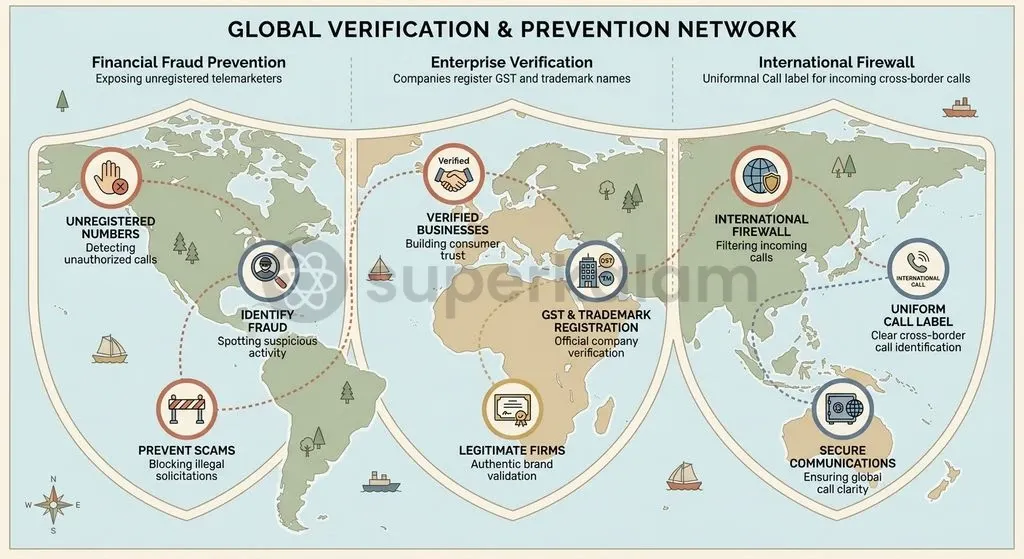
- Curbing Telemarketing Evasion: Unregistered telemarketers frequently bypass Do Not Disturb registries by purchasing standard retail SIM cards. Displaying verified legal names removes personal anonymity and lets citizens screen promotional calls.
- Enterprise Identity Management: Subscribers using enterprise bulk connections can display a registered trademark or GST-registered trade name as their preferred title, subject to documentary verification by the telecom provider.
- Screening Cross-Border Fraud: International incoming calls terminating on Indian networks are exempt from domestic name display. Instead, screens will show 'International Call' to warn recipients against answering overseas phishing attempts masquerading as domestic authorities.
Privacy and Safety Concerns: The Debate Over Unconditional Name Sharing
Civil liberties advocates argue that mandatory default broadcasting of verified legal names without granular caller opt-out compromises informational privacy recognised under Article 21 in Justice K.S. Puttaswamy v. Union of India. The constitutional doctrine affirms that personal identity constitutes an essential facet of individual autonomy.
Default name dissemination poses safety risks for vulnerable demographics:
- Women and Vulnerable Individuals: Routine economic transactions, such as calling cab drivers, delivery agents, or retail vendors, expose a user's full legal name, facilitating targeted harassment or stalking.
- Whistleblowers and Journalists: Investigating corruption or contacting administrative authorities often relies on informal confidentiality, which automated identification compromises.
- Informal Workers: Micro-entrepreneurs and gig workers managing multiple clients lose control over how their professional identity appears.
Statutory licensing terms provide limited exemptions. Subscribers who have subscribed to the Calling Line Identification Restriction supplementary facility under existing telecom licensing terms are exempted from having their name broadcasted over CNAP. However, this facility is historically reserved for specific governmental or security offices, leaving general citizens without flexible daily privacy controls.
Discuss with Superkalam
Compare how CNAP and crowdsourced caller identification platforms affect consumer data security and privacy.
Ask NowTechnical Bottlenecks: Network Latency, Legacy Handsets, and Telco Costs
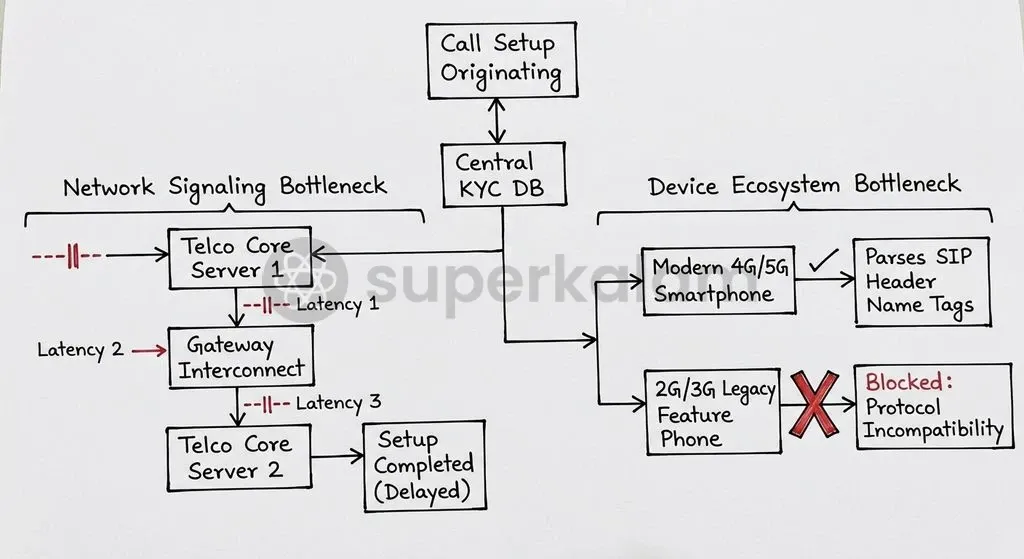
The Cellular Operators Association of India and telecom service providers raised concerns that real-time database queries across interconnected networks would introduce call setup latency and network congestion. In a multi-operator ecosystem, resolving cross-network lookups during the few seconds between dialing and ringing demands high computational capacity.
Field trials conducted by telecom operators across circles including Haryana and Himachal Pradesh tested inter-operator database query latency before the national mandate was formulated. These pilots demonstrated that cross-network synchronisation requires heavy capital expenditure to upgrade signalling transfer points.
Infrastructure constraints forced a phased deployment:
- Modern Network Focus: The initial mandate of CNAP is restricted to wireless 4G and 5G networks, while implementation on legacy 2G, 3G, and Public Switched Telephone Networks has been deferred.
- Signalling Architecture: Delivering CNAP across modern wireless networks requires telecommunications operators to deploy an IP Multimedia Subsystem and utilize Session Initiation Protocol signalling headers.
- Handset Compatibility: Millions of active feature phones lack firmware capable of decoding SIP naming fields. TRAI recommended that the central government mandate handset manufacturers to ensure all mobile devices sold in India after a cut-off date natively support CNAP functionality.
Legal and Regulatory Framework: Alignment with the DPDP Act and Puttaswamy
The Digital Personal Data Protection Act, 2023 establishes statutory guardrails governing the processing and dissemination of personal digital records across India. Mandating default disclosure of KYC-registered subscriber names to unknown called parties generates potential compliance tension with the purpose limitation and consent principles under Section 6 of the Digital Personal Data Protection Act, 2023.
Key statutory and constitutional considerations include:
- Purpose Limitation Principles: Data collected for SIM verification serves national security objectives. Repurposing verified KYC records for universal public broadcast without explicit consent challenges core data governance tenets.
- The Proportionality Standard: Under the Puttaswamy precedent, state infringements on privacy must pass a four-fold proportionality test—legality, legitimate goal, rational nexus, and the least intrusive measure. Default presentation risks failing the least intrusive threshold.
- Administrative Grievance Redress: Errors in KYC records create legal exposure for subscribers. Telecom operators must institute a time-bound grievance mechanism to adjudicate disputes regarding incorrect or outdated display records.
Way Forward: Designing an Opt-In Architecture That Protects Users
The Telecom Regulatory Authority of India initially recommended the rollout of Calling Name Presentation as an opt-in supplementary service provided to telephone subscribers upon their request. Re-anchoring the national rollout to this voluntary principle ensures administrative alignment with constitutional jurisprudence.
Policy reforms must reconcile digital safety with user autonomy:
- Default-Off Privacy Architecture: Mobile subscribers should retain the statutory freedom to enable or disable outgoing name display through their operator settings or simple USSD shortcodes, reserving default identification for verified commercial businesses.
- Differential Identity Presentation: Telecommunications regulations should permit individuals to present professional aliases or first-name-only tags rather than broadcasting their full legal patronymic name to strangers.
- Strict Enterprise KYC Auditing: The Department of Telecommunications must maintain rigorous documentary standards for entities claiming registered trademark or GST names to prevent corporate impersonation.
- Grievance Redressal Enforcement: Operators must ensure their time-bound grievance mechanisms resolve incorrect identity tags within mandated service-level agreements to prevent harassment.
Balancing public cybersecurity against personal privacy ensures India builds a resilient telecommunication ecosystem without compromising fundamental civil liberties.
Discuss with Superkalam
Evaluate whether the mandatory broadcast of verified legal caller identities meets the proportionality standard established in the Justice K.S. Puttaswamy judgment.
Ask NowKey Takeaways
- The Department of Telecommunications has mandated all licensed access providers to roll out Calling Name Presentation starting 1 November 2026 across 4G and 5G networks.
- CNAP extracts verified legal subscriber names directly from Customer Application Form and Know Your Customer records, discarding the crowdsourced architecture used by applications like Truecaller.
- The technical workflow relies on IP Multimedia Subsystems and Session Initiation Protocol headers, querying originating registries in real time while prohibiting data caching by terminating operators.
- Default display of legal identities raises constitutional challenges under the Article 21 privacy standard affirmed in Justice K.S. Puttaswamy and risks tension with Section 6 consent mandates under the Digital Personal Data Protection Act, 2023.
- Network implementation on legacy 2G, 3G, and landline connections has been deferred due to call setup latency, signalling congestion concerns, and handset non-compatibility.
Mains Question
"The transition from crowdsourced caller identification to statutory Calling Name Presentation (CNAP) creates a balance between fraud prevention and the fundamental right to informational privacy." Critically examine. (15 Marks)
Evaluate NowMains Question
Highlighting the recommendations of the Telecom Regulatory Authority of India (TRAI), elucidate the network architecture and operational safeguards governing Calling Name Presentation (CNAP). (10 Marks)
Evaluate NowPractice MCQs
QUESTION 1
With reference to the Calling Name Presentation (CNAP) framework introduced in India, consider the following statements:
- It functions at the core network layer by packaging verified subscriber records into Session Initiation Protocol headers.
- Terminating telecom operators are legally permitted to cache and retain caller names after the termination of a voice call for security auditing.
- If an incoming caller's number is already stored in the recipient's phonebook, the saved contact name overrides the CNAP-transmitted name.
Which of the statements given above are correct?
QUESTION 2
Consider the following statements regarding the regulatory rules governing Calling Name Presentation (CNAP):
- International incoming calls terminating on Indian networks will be marked as 'International Call' rather than displaying domestic subscriber names.
- Commercial enterprises using bulk connections are restricted to displaying personal subscriber names and cannot display registered trademarks.
- Subscribers who have enrolled in the Calling Line Identification Restriction (CLIR) facility are exempted from having their names broadcasted.
Which of the statements given above is/are correct?
QUESTION 3
With reference to telecommunications regulation in India, consider the following statements regarding Calling Name Presentation (CNAP) and third-party caller ID applications:
- CNAP delivers identification via telecommunications network signalling without requiring active mobile data or Wi-Fi on the receiving device.
- Third-party applications authenticate caller identities through statutory Know Your Customer (KYC) documents, whereas CNAP utilizes crowdsourced address books.
- The Department of Telecommunications issued directions to operationalise CNAP based on recommendations from the Telecom Regulatory Authority of India (TRAI).
Which of the statements given above is/are correct?
QUESTION 4
Which of the following bodies formulated the technical and regulatory framework to introduce Calling Name Presentation (CNAP) alongside Calling Line Identification in the Indian telecommunication network?
QUESTION 5
Consider the following statements regarding the technical functioning of Calling Name Presentation (CNAP):
- The caller's name is extracted from Customer Application Form records and verified Know Your Customer databases.
- In inter-operator calls, a real-time dip query is executed to the originating operator's subscriber registry by the terminating operator.
Which of the statements given above is/are correct?