China TBM Export Controls: Impact on Indian Infrastructure
Beijing's chokehold on heavy tunnelling machinery reveals how dual-use trade controls can quietly delay India's border connectivity and urban metro timelines.
Oct, 2026
•13 min read
Overview
China's export controls on Tunnel Boring Machines (TBMs) and excavation equipment directly threaten India's infrastructure timelines. Beijing levers a dominant seventy-percent share of global tunnelling machinery production to exert pressure.
The regulatory framework announced on 19 October 2026 mandates selective export licensing for dual-use equipment destined for countries with active territorial disputes, according to the Ministry of Commerce of the People's Republic of China (MOFCOM) Official Announcement. This policy shift converts a routine engineering supply line into an acute geopolitical vulnerability across India's urban mass transit systems, undersea high-speed rail corridors, and strategic Himalayan border networks. Mitigating these disruptions requires India to transition from short-term equipment substitution toward domestic manufacturing joint ventures and tunnel design standardisation.
Why China's Tunnel Boring Machine Controls Matter Now
China's Ministry of Commerce and the General Administration of Customs enacted export controls on 19 October 2026. The measures target full-face Tunnel Boring Machines, walking excavators, and high-altitude shotcrete sprayers. According to the MOFCOM Official Announcement, these trade restrictions formally take effect on 18 November 2026.
The regulatory framework mandates export licences for shipments bound for "sensitive countries and regions" involved in territorial disputes with Beijing, while requiring end-user registration and non-diversion pledges elsewhere.
According to the MOFCOM Dual-Use Equipment Control Catalogue Announcement and Technical Specifications Announcement, the restricted categories encompass:
- Full-Face Shield and Hard-Rock TBMs: Complete excavation systems alongside critical subsystems such as cutterheads, screw conveyors, segment erectors, and main drive systems.
- Remanufacturing Technologies: Specialised technical documentation and proprietary tooling required to overhaul worn excavation machinery.
- Walking Excavators: Specialised machines engineered for overcoming vertical obstacles above 1.2 metres.
- High-Altitude Machinery: Plateau-type wet shotcrete machines rated above 75 kW operating at altitudes exceeding 3,000 metres.
As of October 2026, these measures create immediate operational hurdles for Indian infrastructure agencies racing to enhance border logistics. Trade controls remain nominally neutral on paper. However, Beijing exercises broad regulatory discretion to orchestrate targeted delays against strategic civil works across the Line of Actual Control (LAC).
Discuss with Superkalam
What specific percentage discount and delivery timeframe advantage did Chinese TBM manufacturers offer compared to European and Japanese alternatives?
Ask NowWhat Are Tunnel Boring Machines and Why Is India Dependent on China?
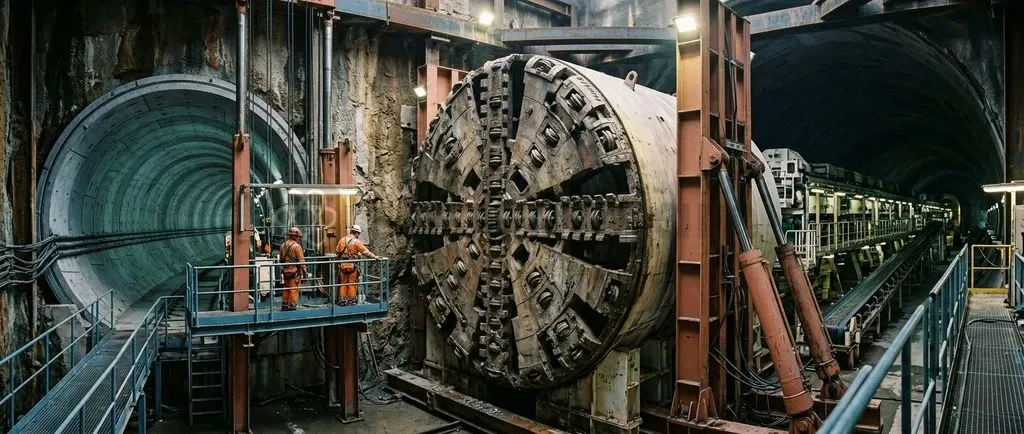
A Tunnel Boring Machine is an automated underground excavation factory. It cuts circular profiles through rock or soil while simultaneously installing permanent precast concrete linings.
The International Tunnelling and Underground Space Association (ITA) Engineering Compendium defines a TBM as an integrated mechanised excavation system that bores circular cross-sections through geological strata while concurrently erecting precast concrete lining segments to provide immediate ground support.
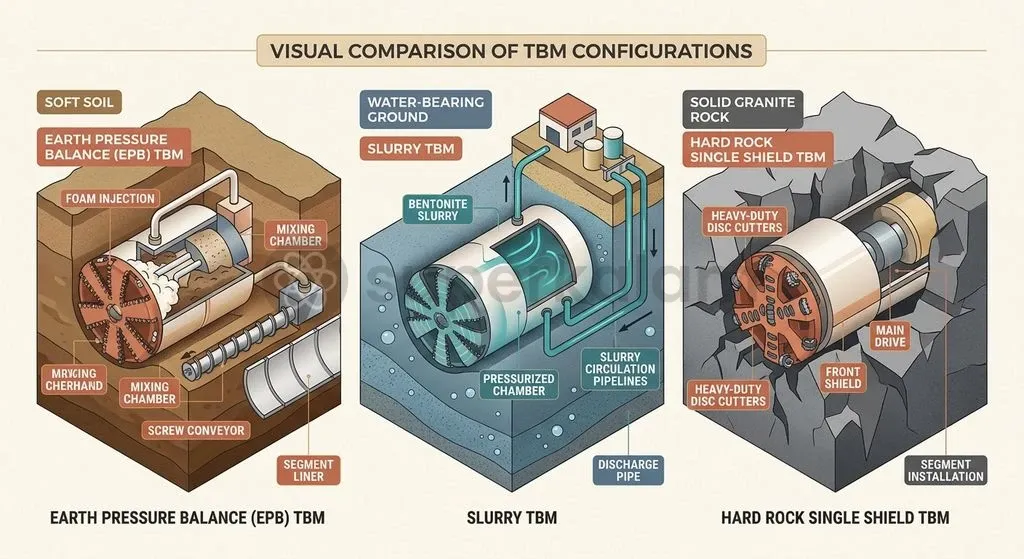
Modern civil engineering deploys three primary variants tailored to subterranean ground conditions:
| Machine Variant | Operating Mechanism | Ideal Geological Application | Common Indian Infrastructure Use |
|---|---|---|---|
| Earth Pressure Balance (EPB) | Balances excavation-face pressure using excavated soil mixed with conditioning foam | Cohesive, soft ground and clay formations | Shallow urban metro corridors |
| Slurry Shield TBM | Uses pressurised bentonite slurry suspension to stabilise the excavation face | Water-bearing, permeable soils and sub-riverbeds | Coastal roads and undersea rail tunnels |
| Hard Rock TBM (Single/Double Shield) | Uses high-tensile disc cutters mounted on a rotating cutterhead to crush rock | Competent, hard rock formations | Himalayan rail tunnels and deep mountain corridors |
According to Herrenknecht AG Technical Operations Overview, selecting between Earth Pressure Balance systems, Slurry TBMs, and Hard Rock Single or Double Shield units depends strictly on geological strata and hydrological pressures.
India's reliance on Chinese suppliers stems from substantial manufacturing concentration. UN Comtrade trade data reported by Reuters indicates that Chinese manufacturers control approximately 70 percent of the global market share in Tunnel Boring Machine manufacturing. Furthermore, data from the General Administration of Customs of China shows that China exported roughly US$793 million worth of tunnelling machinery under HS Code 843031 in 2025. This volume was approximately seven times the United States export total of US$109 million in the same category.
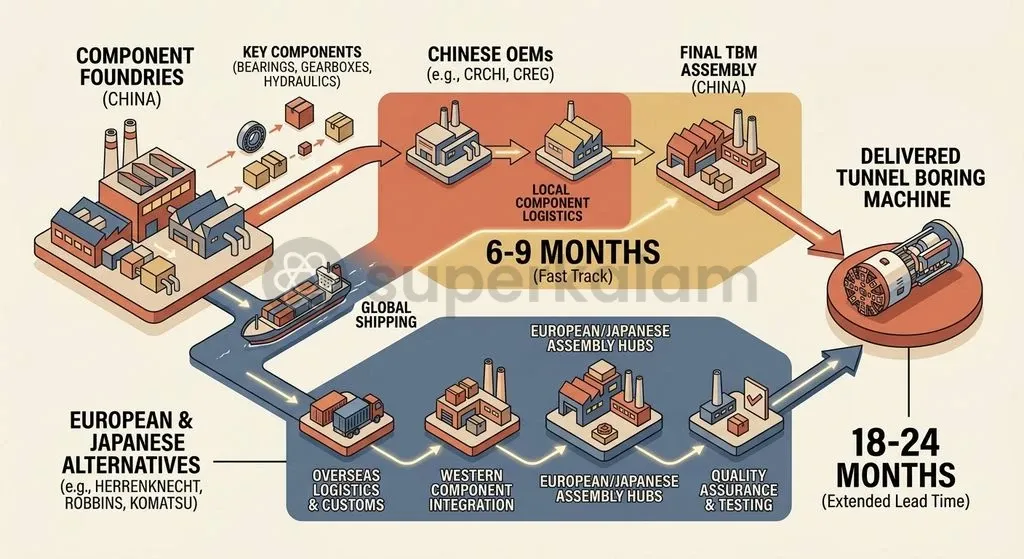
Commercial contractors in India have consistently favoured Chinese original equipment manufacturers (OEMs). As reported in an infrastructure industry analysis by The Indian Express on 21 October 2026, TBM procurement from Chinese OEMs offers an estimated 20% to 30% discount on capital costs. They also provide delivery windows of 6 to 9 months, compared to 14 to 24 months for European and Japanese OEMs.
Western equipment brands do not offer complete insulation from Beijing's administrative reach. According to a report by The Hindu on 19 October 2026, leading European and Australian-origin suppliers, including Germany's Herrenknecht and Terratec, operate primary fabrication facilities within mainland China. Consequently, Western-branded machines ordered by Indian engineering firms remain subject to Chinese export authority clearances before departing Chinese ports.
Mapping the Exposure: Which Indian Mega Projects Rely on Chinese TBMs?
Civil infrastructure projects across India rely extensively on equipment manufactured or assembled in Chinese facilities. In public infrastructure tenders governed by tight delivery milestones, engineering contractors historically selected Chinese equipment to minimise upfront capital expenditure.
Following the June 2020 Galwan Valley clash, the Department of Expenditure under the Ministry of Finance issued Public Procurement Order P-45021/112/2020 on 23 July 2020. This order imposed strict registration requirements on bidders from countries sharing a land border with India, curtailing Chinese construction firms from winning direct engineering contracts.
However, domestic engineering, procurement, and construction (EPC) contractors remained free to import Chinese machinery. This regulatory carve-out perpetuated deep supply-chain exposure across urban and regional networks.
Discuss with Superkalam
Explain how the New Austrian Tunnelling Method (NATM) differs practically from mechanised TBM excavation in unpredictable Himalayan geology.
Ask NowUrban Metro Networks and Transit Corridors
Urban mass transit projects represent the single largest consumer of mechanised shield tunnelling equipment in India. Several key transport corridors face direct timeline dependencies:
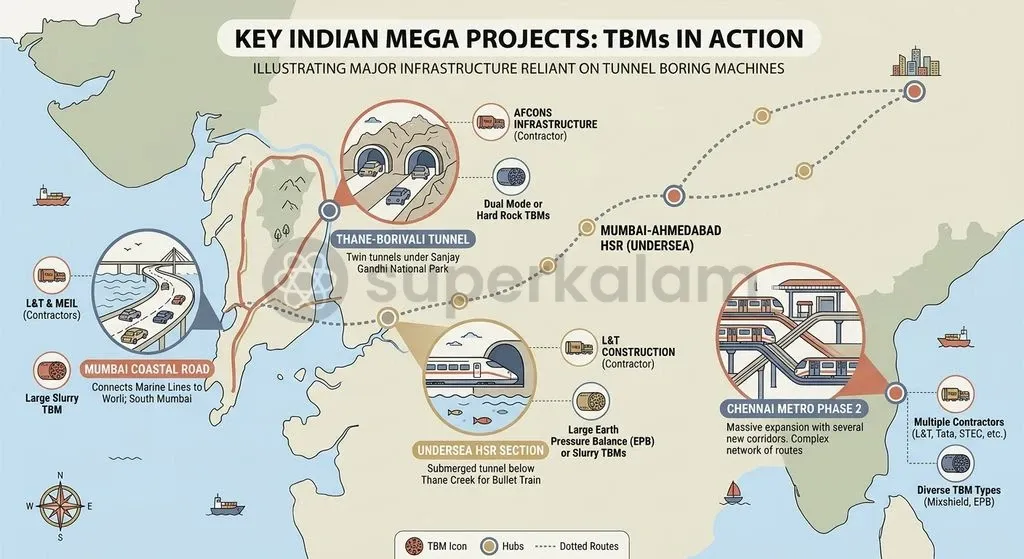
- Chennai Metro Phase 2: Spanning 118.9 kilometres across Corridors 3, 4, and 5, the project contracted over 23 TBMs primarily supplied by Herrenknecht and Terratec. Component supply chains for these units rely on manufacturing plants in southern China, according to Chennai Metro Rail Limited (CMRL) Project Technical Updates.
- Mumbai Coastal Road: The Brihanmumbai Municipal Corporation deployed a 12.19-metre diameter Slurry TBM manufactured by China Railway Construction Heavy Industry (CRCHI) in Changsha to bore a 1.92-kilometre twin road tunnel under Malabar Hill.
- Thane-Borivali Twin Road Tunnel: For this 11.84-kilometre project, Megha Engineering and Infrastructure Limited (MEIL) procured two 13.34-metre diameter Herrenknecht slurry TBMs assembled through Herrenknecht's Chennai facility.
- Mumbai-Ahmedabad High-Speed Rail: Package C-2, awarded to Afcons Infrastructure, requires high-capacity large-diameter TBMs to bore a 21-kilometre underground section. This alignment includes India's first 7-kilometre undersea rail tunnel under Thane Creek.
Even when final integration occurs within India, key components frequently originate from Chinese factories. Cutterhead disc assemblies, hydraulic drives, and structural shields remain vulnerable to border checkpoints. Prolonged export licensing holdups for specialised slurry shields directly jeopardise contractual commissioning schedules.
Strategic Himalayan Rail and Border Road Tunnels
Himalayan tunnelling presents severe geological hazards. Machinery must withstand extreme squeezing ground and unexpected seismic shear.
For Rail Vikas Nigam Limited's 125-kilometre Rishikesh-Karnaprayag rail link, contractor Larsen & Toubro used two 9.11-metre Herrenknecht Single Shield hard-rock TBMs to complete a 10.5-kilometre twin-tube tunnel through Himalayan phyllite in mid-2025.
A critical civil engineering distinction governs mountain logistics:
- Strategic Border Road Tunnels: High-altitude projects along the LAC, including the Border Roads Organisation's 13,000-foot Sela Tunnel and NHIDCL's 14.15-kilometre Zojila Tunnel, predominantly utilise the New Austrian Tunnelling Method (NATM) and drill-and-blast techniques rather than full-face TBMs. Mechanised TBMs struggle with unpredictable Himalayan faults and sudden water ingress, making NATM sequential excavation the preferred engineering route.
- High-Altitude Support Machinery: Beijing's export restrictions directly threaten Border Roads Organisation (BRO) and NHIDCL border tunnelling by curbing the supply of walking excavators and high-altitude wet shotcrete equipment that are indispensable for NATM excavation.
Walking excavators, often termed "spider excavators", are uniquely engineered to navigate 45-degree mountain slopes and debris fields. Combined with high-output shotcrete units operating above 3,000 metres, these machines provide primary rock support inside drill-and-blast cavities. Denying these systems strikes directly at high-altitude military mobility corridors.
Hydropower and River Diversion Projects
Hydroelectric installations across the Himalayas require extensive headrace and tailrace tunnels driven through fragile mountain rock. These energy corridors increasingly deploy hard-rock double-shield TBMs to bypass severe monsoon disruption and accelerate river diversion works.
When water-diversion tunnels encounter fractured geological faults, standard drill-and-blast methods prove too slow to meet commissioning windows. TBMs allow continuous excavation while maintaining an impermeable concrete barrier against loose rubble.
Restricting replacement cutterhead discs, main bearings, and remanufacturing expertise introduces severe operational vulnerability. These bottlenecks directly threaten multi-gigawatt clean energy schemes across Uttarakhand, Himachal Pradesh, and Jammu and Kashmir.
Discuss with Superkalam
How might an Indian EPC contractor alter its procurement timeline and capital expenditure if it is forced to substitute Chinese-assembled TBMs with Japanese-built alternatives?
Ask NowWhy Switching Away from Chinese TBMs Is Difficult and Costly
Switching machinery sources mid-project is technically and contractually prohibitive. TBMs are bespoke systems tailored to distinct subterranean conditions. Each machine is custom-built to match a specific geological profile, bore diameter, and curvature radius. A contractor cannot easily substitute an Earth Pressure Balance machine built for alluvial clay into a hard quartzite section.
Alternative manufacturing capacity outside China remains constrained. While Japanese firms such as Kawasaki and Hitachi Zosen, alongside European plants in Germany, build world-class machinery, their manufacturing pipelines operate near capacity. As reported by The Economic Times on 19 October 2026, switching to alternative TBM suppliers from Japan or Germany increases procurement lead times to an estimated 18 to 24 months, threatening liquidated damages and completion delays on multi-tier EPC infrastructure contracts.
Cost differentials also complicate public procurement compliance:
- Procurement Cost Premiums: Sourcing completely out of Western Europe or Japan introduces an estimated 20% to 30% premium on capital expenditure over Chinese OEMs.
- Component Pipeline Entanglement: Western TBM brands rely heavily on sub-tier Chinese vendors for structural steel shields, hydraulic jacks, and segment moulds.
- Refurbishment Bottlenecks: Rebuilding existing cutterheads requires certified original equipment parts, many of which fall under Beijing's dual-use export restrictions.
- Contractual Penalties: Public works contracts enforce steep liquidated damages for delay, leaving domestic contractors vulnerable if machinery shipments stall at export ports.
Strategic and Security Risks of Dual-Use Machinery Bottlenecks
Supply chain weaponisation creates asymmetric security vulnerabilities for India's strategic logistics. By classifying heavy excavation machinery as dual-use goods, Beijing exploits a grey-zone economic lever. This mechanism sits below the threshold of open diplomatic confrontation while achieving tangible disruption of Indian border defence capabilities.
Historical precedents confirm that regulatory holdups have already disrupted domestic transit projects:
- Piyush Goyal's 2024 Disclosure: In October 2024, Piyush Goyal publicly disclosed to Robert Habeck that Chinese authorities had halted the transit of Herrenknecht TBMs manufactured in China intended for Indian infrastructure works.
- Diplomatic Delays in 2025: In September 2025, Philipp Ackermann stated that Chinese customs had delayed and withheld clearance for at least three Herrenknecht TBMs destined for Indian civil infrastructure.
These targeted administrative delays create an acute infrastructure asymmetry along the contested border. While China has spent two decades constructing military roads, railheads, and subterranean bunkers across the Tibetan Plateau, India is actively modernising its LAC connectivity via the BRO and NHIDCL. Restricting heavy construction equipment and high-altitude shotcrete machines slows India's efforts to close this infrastructure gap.
Discuss with Superkalam
Analyze how the regulatory carve-out in Public Procurement Order P-45021/112/2020 preserved India's equipment exposure despite blocking Chinese direct contracting.
Ask NowCan India Build Its Own TBMs? The State of Domestic Manufacturing
India currently lacks end-to-end industrial capacity to manufacture full-face heavy tunnel boring machinery independently. While several multinational subsidiaries maintain final assembly plants in India, core high-technology subsystems remain imported.
According to a heavy machinery technology gap study by the Ministry of Heavy Industries, India faces domestic substitution bottlenecks due to a complete absence of domestic manufacturing facilities for large-diameter TBM cutterheads, high-load main drive slewing bearings, and variable-frequency hydrostatic drive assemblies. Domestic foundries can fabricate outer cylindrical steel shields and precast segment moulds, but high-precision metallurgy and heavy planetary gearboxes remain outside Indian commercial manufacturing.
Initial policy interventions are emerging to address this technological deficit:
- Capital Goods Production Incentives: As reported by Reuters on 21 August 2026, the Government of India is finalising a US$1.2 billion (~₹10,000 crore) incentive programme over seven years to attract approximately US$1.8 billion in private investment for manufacturing heavy construction equipment, explicitly including Tunnel Boring Machines.
- Public Sector Technical Partnerships: In April 2026, defence public sector undertaking BEML Limited executed a Memorandum of Understanding with the Delhi Metro Rail Corporation (DMRC) to develop indigenous engineering capabilities for designing and manufacturing Tunnel Boring Machines.
- Domestic Assembly Expansion: International manufacturers, including Herrenknecht, have assembled large-diameter machines at facilities in Chennai, providing a base for progressive indigenisation of structural components.
Discuss with Superkalam
Weigh the feasibility of mandating complete domestic manufacturing of TBM subsystems against the potential cost escalation and delay in national mega-projects.
Ask NowWay Forward: Derisking Critical Infrastructure Supply Chains
Derisking national infrastructure demands a coherent multi-track strategy combining domestic industrial policy, contractual flexibility, and allied supply chain partnerships. India cannot eliminate external machinery dependencies overnight, but structural policy interventions can neutralise supply coercion.
To insulate public works from future trade curbs, Indian policymaking should focus on five core initiatives:
- Accelerate the BEML-DMRC Indigenisation Programme: The Ministry of Heavy Industries should back BEML's joint initiative with earmarked capital grants under the Make in India framework. Initial development should focus on standardised soft-ground Earth Pressure Balance machines for urban transit before attempting complex hard-rock double-shield systems.
- Standardise Urban Metro Tunnel Diameters: According to an advisory on underground metro standardisation from the Ministry of Housing and Urban Affairs (MoHUA), strategic policy recommendations to mitigate TBM supply disruptions include standardising urban metro tunnel diameters to a unified 6.5-metre specification across state transit bodies, permitting multi-project machine redeployment and domestic parts pooling.
- Diversify Procurement via Trusted Partner Frameworks: EPC contractors bidding on central infrastructure projects should be incentivised to procure from Japanese and European manufacturing facilities located outside China. Bilateral infrastructure pacts should establish priority delivery corridors with Japan's Ministry of Economy, Trade and Industry (METI).
- Strategic Stockpiling of Critical High-Altitude Equipment: The Ministry of Defence and MoRTH must establish forward inventory reserves of high-wear consumables, including cutterhead disc cutters, hydraulic pumps, and high-altitude shotcrete assemblies. Stockpiles should be managed directly by the BRO to support ongoing Himalayan defence transit corridors.
- Contractual Force Majeure Harmonisation: Standard EPC bidding contracts issued by NHIDCL, CMRL, and NHSRCL must be recalibrated. Clauses should explicitly recognise unilateral foreign state export embargoes as force majeure events, shielding contractors from unfair liquidated damages while alternate machinery is certified.
Key Takeaways
- China's Ministry of Commerce and Customs enacted dual-use export controls on 19 October 2026, restricting Tunnel Boring Machines, walking excavators, and high-altitude shotcrete machines effective 18 November 2026.
- Chinese OEMs control an estimated 70 percent of global TBM manufacturing, while Western suppliers like Herrenknecht and Terratec rely heavily on fabrication facilities based in China.
- Urban rail networks, including Phase 2 of the Chennai Metro and Package C-2 of the Mumbai-Ahmedabad High-Speed Rail Corridor, face significant timeline risks due to specialised shield TBM requirements.
- Strategic Himalayan road tunnels (Sela and Zojila) utilise the New Austrian Tunnelling Method (NATM) rather than TBMs, but face direct disruption from export controls on specialised walking excavators and high-altitude wet shotcrete equipment.
- BEML Limited and DMRC executed a Memorandum of Understanding in April 2026 to pioneer domestic TBM manufacturing, supported by a planned US$1.2 billion heavy machinery incentive programme.
Mains Question
"China's dominant seventy-percent share of global tunnelling machinery manufacturing converts routine commercial engineering supply chains into acute geopolitical vulnerabilities." In this context, examine the strategic and operational risks posed to Indian infrastructure development. (10 Marks)
Evaluate NowMains Question
Following the 2020 Galwan Valley clash, India restricted direct public procurement from bordering nations under Order P-45021/112/2020, yet deep technological dependencies persist in capital-intensive infrastructure. Critically analyse the structural challenges in derisking India's tunnelling and heavy engineering equipment supply chains. (15 Marks)
Evaluate NowPractice MCQs
QUESTION 1
With reference to the geological applications of Tunnel Boring Machines (TBMs), consider the following pairs:
- Earth Pressure Balance (EPB) TBM : Cohesive, soft ground and clay formations
- Slurry Shield TBM : Water-bearing, permeable soils and sub-riverbeds
- Hard Rock TBM : Shallow urban metro corridors Which of the pairs given above is/are correctly matched?
QUESTION 2
Consider the following statements regarding the regulatory restrictions enacted by China's Ministry of Commerce (MOFCOM) in October 2026:
- The export restrictions encompass full-face shield TBMs, remanufacturing technologies, and walking excavators overcoming vertical obstacles above 1.2 metres.
- The rules target plateau-type wet shotcrete machines rated above 75 kW operating at altitudes exceeding 3,000 metres.
- The regulatory framework unconditionally bans all equipment exports globally regardless of end-user registration. Which of the statements given above is/are correct?
QUESTION 3
Consider the following statements regarding high-altitude infrastructure construction along the Line of Actual Control (LAC):
- Strategic border road tunnels such as the Sela Tunnel and Zojila Tunnel predominantly utilise full-face Tunnel Boring Machines instead of drill-and-blast methods.
- Unpredictable geological faults and water ingress in the Himalayas make the New Austrian Tunnelling Method (NATM) sequential excavation a preferred engineering route.
- Walking excavators and high-altitude shotcrete machines provide primary rock support inside drill-and-blast cavities in high-altitude border works. Which of the statements given above is/are correct?
QUESTION 4
Regarding Public Procurement Order P-45021/112/2020 issued by the Ministry of Finance following the 2020 Galwan Valley clash, what specific regulatory carve-out allowed continued reliance on Chinese tunnelling equipment?
QUESTION 5
Why do Western-branded Tunnel Boring Machines (such as those from Herrenknecht or Terratec) procured by Indian contractors remain susceptible to Chinese export controls?