China Critical Minerals Export Controls: The Midstream Tech War
As Beijing weaponises its refining monopoly against Western chip curbs, India faces strategic supply vulnerabilities across its domestic green tech ambitions.
Oct, 2026
•8 min read
Overview
China has expanded export controls over critical mineral refining and advanced processing technologies. This strategic pivot shifts trade tensions from conventional tariff disputes into asymmetric supply-chain warfare.
Beijing is weaponising its near-monopoly over the chemical processing and metallurgical separation of vital raw materials. This posture counters Western export restrictions on advanced semiconductors and lithography systems. As of October 2026, these expanding midstream curbs threaten global defence readiness, renewable hardware manufacturing, and downstream industrial value chains across major importing economies, including India.
Why China’s New Export Curbs Mark a Shift to Asymmetric Supply Warfare
China’s Ministry of Commerce (MOFCOM) has converted environmental and trade licensing rules into economic statecraft. On October 16, 2026, MOFCOM and the Ministry of Science and Technology (MOST) issued Joint Announcement No. 48 of 2026. The decree proposed export restrictions on 40 technologies spanning artificial intelligence, photovoltaics, and biomedicine.
This draft catalogue covers three core technology domains:
- 23 AI technologies placed under proposed technological export barriers.
- 12 photovoltaic manufacturing technologies targeted to shield solar processing leadership.
- 5 biomedical technologies subjected to statutory review.
Beijing targets the midstream segment of global supply networks where foreign dependency peaks. Chinese authorities do not prioritise raw ores, where alternative deposits exist globally. Instead, they restrict complex chemical separation and metallurgical refining stages.
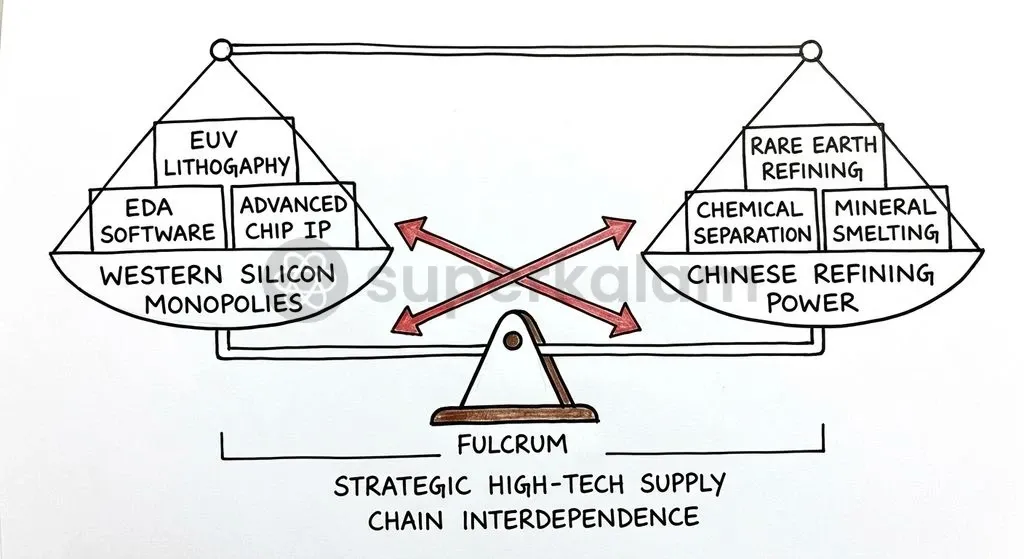
Trade relations have shifted toward weaponised economic interdependence. In this contest, Western nations deploy financial and high-tech chokepoints, while China leverages physical input constraints against advanced Western manufacturing.
Discuss with Superkalam
Which specific minerals and technologies were targeted under China's dual-use export controls between 2023 and 2024?
Ask NowThe Western Chokeholds That Triggered Beijing’s Strategic Turn
The United States Department of Commerce Bureau of Industry and Security (BIS) prompted this confrontation. Under the Export Administration Regulations, the BIS restricted China's access to advanced computing chips, electronic design automation software, and semiconductor manufacturing equipment. These unilateral measures sought to freeze Chinese semiconductor fabrication at legacy process nodes.
Multilateral export controls quickly aligned with Washington's policy:
- The Netherlands: Enacted strict licensing on ASML's advanced extreme ultraviolet (EUV) systems.
- Deep ultraviolet (DUV) tooling: Placed immersion lithography under plurilateral export curbs to block sub-7-nanometre microchip fabrication.
Western export control architectures depend on targeted chokepoints across intellectual property and capital equipment. Beijing concluded that conventional trade remedies could not bridge this gap. Chinese policymakers instead mobilised their mineral processing dominance as a geopolitical counterweight.
Which Critical Technologies and Minerals Has Beijing Blocked?
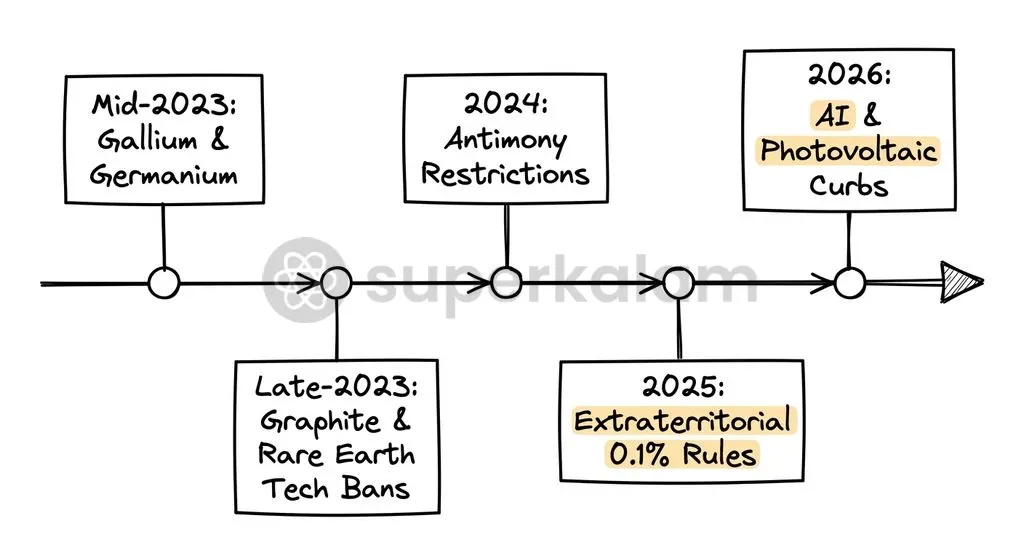
MOFCOM and the General Administration of Customs initiated targeted mineral export curbs in mid-2023. Effective August 1, 2023, Chinese authorities imposed dual-use export licensing mandates on gallium and germanium-related compounds, citing sovereign national security and non-proliferation obligations.
Beijing steadily expanded these industrial restrictions across subsequent regulatory notices:
- Graphite controls: Dual-use restrictions on natural flake and synthetic graphite took effect on December 1, 2023, impacting battery anode manufacturing.
- Antimony restrictions: Smelting technologies, ores, oxides, and metals of antimony faced export curbs on September 15, 2024.
- Refining know-how embargo: MOFCOM and MOST revised the export catalogue on December 21, 2023, prohibiting foreign transfers of technologies for rare earth extraction and separation.
Extraterritorial enforcement mechanisms further tightened Beijing's control over cross-border industrial integration. MOFCOM Announcement No. 61 of 2025 introduced an extraterritorial regulatory framework governing overseas products containing at least 0.1% Chinese-origin specified rare earths by value.
Notice No. 46 of 2024 prohibited dual-use shipments to U.S. military end-users. While MOFCOM Announcement No. 72 of 2025 suspended specific bilateral restrictions under Article 2 of Notice No. 46 until November 27, 2026, general licensing restrictions on global shipments remain operational.
Discuss with Superkalam
How does weaponised economic interdependence operate when upstream technological monopolies clash with midstream refining dominance?
Ask NowComparing Chokeholds: Western Silicon vs Chinese Refining Power
The technological confrontation between Western economies and China reflects two contrasting structural monopolies. Western powers control upstream capital goods, software tools, and foundational patents. China dominates the midstream processing, metallurgy, and industrial chemical synthesis that transform raw earth into engineering-grade materials.
According to the U.S. Geological Survey, China accounts for roughly 70% of rare earth mine production and more than 90% of global refined output. The International Energy Agency notes that China refines over 90% of global rare earth elements and between 60% and 70% of lithium and cobalt. For antimony, China accounted for approximately 48% of global mined supply in 2023, while the U.S. retained a net import reliance exceeding 60%.
| Strategic Dimension | Western Chokehold (Silicon & Equipment) | Chinese Chokehold (Refining & Midstream) |
|---|---|---|
| Primary Domain | Upstream design, EUV/DUV lithography, chip architecture | Midstream chemical extraction, smelting, metallurgy |
| Leading Entities | US BIS, ASML (Netherlands), Japanese toolmakers | MOFCOM, MOST, state-owned processing enterprises |
| Controlled Assets | Advanced computing GPUs, sub-7nm lithography equipment | Gallium, germanium, antimony, synthetic graphite, rare earths |
| Substitution Timeline | Decades required to replicate optical and software ecosystems | 5 to 10 years needed to build clean, scaled refining plants |
| Enforcement Mechanism | Export Administration Regulations, Entity List designations | Export licensing catalogues, extraterritorial value thresholds |
How Defense Systems and Green Tech Take the Hardest Hits
Gallium nitride (GaN) semiconductor substrates represent an acute vulnerability for Western military programmes. According to a U.S. Department of Defense assessment, GaN components manufactured from raw gallium are vital for Active Electronically Scanned Array (AESA) radar systems and high-frequency electronic warfare suites. Restricting refined gallium flows creates immediate procurement bottlenecks for next-generation combat aviation and maritime missile defence radars.
Military hardware and clean energy face three distinct processing bottlenecks:
- Optoelectronics and ammunition: Germanium is an indispensable input for infrared optical lenses in forward-looking infrared (FLIR) systems, night-vision equipment, and satellite surveillance sensors. Antimony hardens lead alloys in munitions and coats infrared suppression systems.
- EV traction motors: Permanent magnets made of neodymium, dysprosium, and terbium (NdFeB magnets) run electric vehicle traction motors.
- Wind generation: Direct-drive wind turbine nacelles rely on these NdFeB permanent magnets, leaving turbine supply chains exposed to mineral processing embargoes.
Because China banned the outward transfer of rare earth separation and magnet production technology, foreign manufacturers cannot quickly establish substitute facilities.
Discuss with Superkalam
Analyse why raw mineral discovery alone cannot quickly insulate downstream semiconductor and EV battery industries from external supply shocks.
Ask NowWhat Beijing’s Resource Weaponization Means for India’s Ambitions
India’s electronic manufacturing ambitions depend on secure access to imported midstream materials. The Ministry of Mines identified a priority list of 30 critical minerals essential for national security and economic growth. Chinese mineral processing controls threaten downstream domestic programmes, especially the Production Linked Incentive (PLI) Scheme for Advanced Chemistry Cell (ACC) Battery Storage, which carries an outlay of ₹18,100 crore for a 50 GWh manufacturing target.
Domestic semiconductor manufacturing initiatives face immediate risks from material chokepoints:
- India Semiconductor Mission (ISM): Backed by a fiscal outlay of ₹76,000 crore, the mission funds major commercial units.
- Dholera commercial fab: Tata Electronics' facility in Gujarat, valued at over ₹91,000 crore, requires steady supplies of chemical inputs.
Without diversified access to high-purity chemicals, polishing slurries, and specialty gases derived from gallium and germanium, domestic fabrication facilities remain exposed to external supply disruptions.
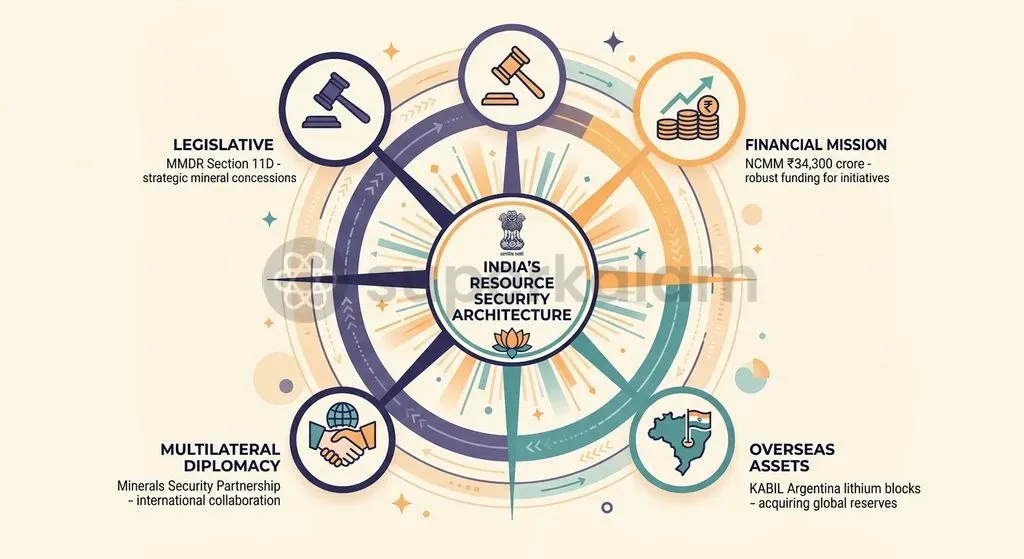
Parliament established a statutory framework to address domestic resource vulnerability. Lawmakers enacted the Mines and Minerals (Development and Regulation) Amendment Act, 2023, introducing Section 11D to empower the Central Government to exclusively auction concessions for 24 critical and strategic minerals.
Complementing this statutory lever, the Union Cabinet approved the National Critical Mineral Mission (NCMM) on January 29, 2025. This mission commits ₹34,300 crore over seven years to fast-track domestic exploration, mining, and beneficiation.
Way Forward: Building Resilient Mineral and Tech Supply Chains
Mitigating midstream processing vulnerabilities requires diplomatic alignment and domestic processing capacity. Policy action centres on three tracks:
- Multilateral partnerships: In June 2023, India joined the U.S.-led Minerals Security Partnership (MSP) as its 14th member, collaborating with industrial democracies to co-finance processing plants outside China.
- Overseas asset acquisition: Khanij Bidesh India Limited (KABIL) secured an exploration agreement with CAMYEN in Catamarca, Argentina, securing rights across 5 lithium brine blocks covering 15,703 hectares.
- Circular resource recovery: The Ministry of Environment, Forest and Climate Change notified the Battery Waste Management Rules, 2022, establishing mandatory Extended Producer Responsibility (EPR) targets and minimum resource recovery percentages for end-of-life batteries.
Developing urban mining ecosystems allows industrial economies to recapture secondary critical minerals and insulate domestic manufacturing from external export bans.
Long-term strategic autonomy requires domestic investment in capital-intensive chemical refining infrastructure. India and its partners must deploy dedicated fiscal subsidies and public-private partnerships to build hydrometallurgical refining plants and solvent extraction complexes, neutralising Beijing’s midstream leverage.
Discuss with Superkalam
Weigh the efficacy of unilateral domestic mining reforms versus multilateral trade frameworks in counteracting extraterritorial mineral controls.
Ask NowKey Takeaways
- China’s export controls mark a transition to asymmetric supply warfare, countering Western semiconductor sanctions by weaponising midstream mineral processing and extraction technologies.
- Chinese authorities control over 90% of global refined rare earths and roughly 60% to 70% of lithium and cobalt refining, creating structural dependencies across global technology supply chains.
- Regulatory curbs targeting gallium, germanium, antimony, and synthetic graphite disrupt critical components for AESA radar systems, night-vision sensors, EV traction motors, and grid-scale batteries.
- MOFCOM's 2025 extraterritorial rules apply export restrictions to foreign manufactured goods containing at least 0.1% Chinese-origin rare earths by value.
- India is responding through the National Critical Mineral Mission (₹34,300 crore), Section 11D auctions under the amended MMDR Act, 2023, and international collaboration via the Minerals Security Partnership.
Mains Question
"Trade relations have shifted toward weaponised economic interdependence, wherein Western control over upstream intellectual property is countered by Chinese dominance over midstream metallurgical refining." Examine the implications of this structural divide for global high-technology and defence manufacturing. (15 Marks)
Evaluate NowMains Question
In light of expanding midstream export curbs by external powers, evaluate the adequacy of statutory and institutional measures, such as the MMDR Amendment Act, 2023 and the National Critical Mineral Mission (NCMM), in securing India's industrial ambitions. (10 Marks)
Evaluate NowPractice MCQs
QUESTION 1
Consider the following statements regarding China's export control measures on critical minerals and technologies:
- China restricted exports of gallium and germanium compounds citing national security and non-proliferation obligations.
- In late 2023, China completely banned foreign transfers of technologies related to rare earth extraction and separation.
- MOFCOM Announcement No. 61 of 2025 created an extraterritorial regulatory mechanism targeting overseas products containing at least 0.1% Chinese-origin specified rare earths by value.
Which of the statements given above are correct?
QUESTION 2
With reference to the global critical mineral supply chains, consider the following statements:
- According to the U.S. Geological Survey, China accounts for over 90% of global rare earth mined production.
- According to the International Energy Agency, China refines between 60% and 70% of global lithium and cobalt.
- Replicating the midstream refining and processing plant capacity outside China is estimated to require decades, compared to only 5 to 10 years to replicate advanced optical semiconductor ecosystems.
Which of the statements given above is/are correct?
QUESTION 3
Consider the following statements regarding the industrial and defence applications of critical minerals:
- Gallium nitride (GaN) components are critical for Active Electronically Scanned Array (AESA) radar systems.
- Germanium is an essential input for infrared optical lenses used in forward-looking infrared (FLIR) systems.
- Neodymium, dysprosium, and terbium permanent magnets (NdFeB) are utilized in direct-drive wind turbine nacelles and electric vehicle traction motors.
Which of the statements given above is/are correct?
QUESTION 4
Regarding India's policy responses to critical mineral vulnerabilities, consider the following statements:
- The Ministry of Mines identified a priority list of 30 critical minerals essential for national security and economic growth.
- Section 11D introduced via the MMDR Amendment Act, 2023, empowers the Central Government to exclusively auction concessions for 24 critical and strategic minerals.
- The Union Cabinet approved the National Critical Mineral Mission (NCMM) on January 29, 2025, committing ₹34,300 crore.
Which of the statements given above are correct?
QUESTION 5
Which of the following critical minerals was placed under export restrictions by China on September 15, 2024, specifically covering its smelting technologies, ores, oxides, and metals?