Children's Right to Internet: Article 21A vs State Paternalism
Balancing state protection under Article 15(3) with educational liberty under Article 21A demands proportional digital rights rather than blanket prohibitions.
Oct, 2026
•10 min read

Context
The constitutional conflict between a child's right to digital access under Article 21A and state paternalism under the parens patriae doctrine centres on a critical question. Do statutory barriers protect young learners, or do they derail fundamental educational development and personal autonomy?
The State is constitutionally mandated under Article 15(3) and Article 39(f) to shield minors from predatory online harms. Even so, blanket curfews and rigid age-verification mandates under the Digital Personal Data Protection Act, 2023 risk restricting vital academic resources. This divide pits protective state surveillance against the progressive exercise of digital selfhood.
A sustainable framework must balance necessary safeguarding with adolescent agency. It must adhere to the judicial test of proportionality rather than enforcing total digital disenfranchisement.
Why in the News? The Growing Clash Over Children's Online Access
As of March 2025, debates surrounding youth internet access have intensified across India following regulatory scrutiny under the Digital Personal Data Protection Act, 2023. State authorities invoke protective duties to curb screen addiction, cyberbullying, and algorithmic exploitation among minors. Educators and civil liberties advocates resist these curbs, viewing arbitrary bans as unconstitutional barriers to modern learning.
The legal tension stems from conflicting constitutional obligations:
- Statutory compliance mandates: The Ministry of Law and Justice enforces strict verification requirements for minors, imposing monetary penalties of up to two hundred crore rupees on non-compliant platforms under Section 33.
- Judicial protection of access: Precedents firmly locate digital connectivity within fundamental rights.
Treating state protection and digital access as mutually exclusive is constitutionally flawed. Paternalistic prohibitions fail the proportionality test. A sustainable policy requires calibrating digital safeguards to the evolving capacities of adolescents.
Discuss with Superkalam
Recall the monetary penalty specified under Section 33 of the Digital Personal Data Protection Act, 2023 for non-compliant platforms handling children's data.
Ask NowUnderstanding the Two Sides: Child Autonomy vs State Protection
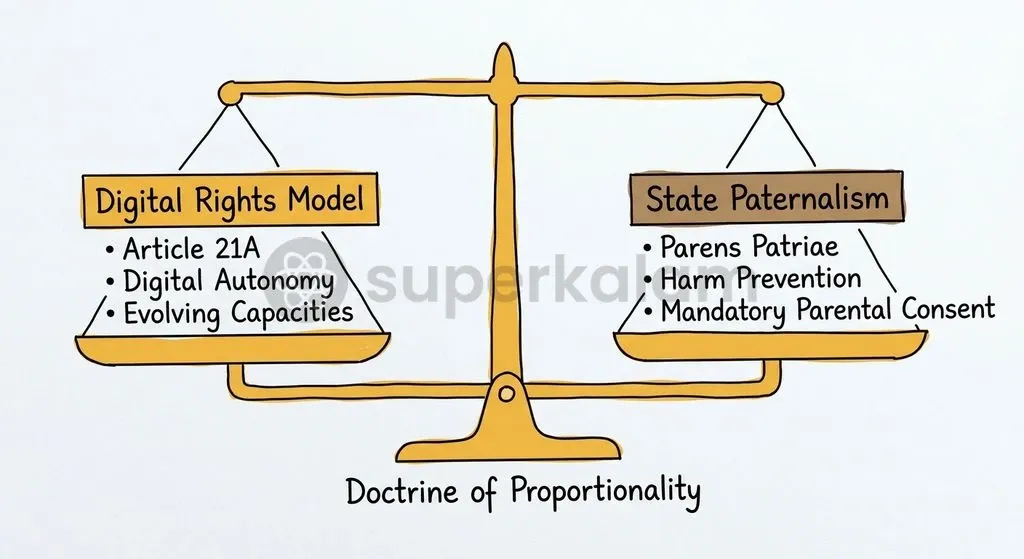
The constitutional debate balances the doctrine of parens patriae against fundamental liberties guaranteed to citizens under Part III of the Constitution. Under the parens patriae doctrine, the State possesses an inherent sovereign obligation to act as the ultimate guardian of individuals who cannot legally protect themselves, including minors.
This protective role finds explicit constitutional backing in Directive Principles and fundamental provisions:
- Article 15(3): Empowers the State to enact special protective provisions specifically tailored for women and children.
- Article 39(f): Directs state policy to provide children with opportunities to develop with dignity, ensuring youth are shielded against exploitation and moral abandonment.
Conversely, the digital rights model treats minors as rights-bearing individuals rather than passive subjects of state regulation. Digital tools are no longer recreational luxuries. They are fundamental vehicles for expression, knowledge acquisition, and civic awareness. When state paternalism operates through blunt restrictions, it frequently collides with the individual liberties safeguarded by Article 21.
Comparison at a Glance: Digital Rights Model vs State Paternalism
Constitutional governance in India distinguishes between a rights-enabling approach anchored in personal liberty and a paternalistic protection model driven by state guardianship. The table below evaluates the primary points of divergence between these two regulatory philosophies.
| Dimension | Digital Rights Model | State Paternalism Model |
|---|---|---|
| Constitutional Anchor | Article 21A (Right to Education) and Article 19(1)(a) (Expression) | Article 15(3) (Protective discrimination) and Article 39(f) (DPSP) |
| Status of the Minor | Autonomous holder of rights with evolving capacities | Vulnerable legal subject requiring sovereign custody |
| Primary Regulatory Tool | Safe design standards, digital literacy, and progressive self-regulation | Blanket age gates, platform curfews, and mandatory parental consent |
| Educational Viewpoint | Internet access is an essential prerequisite for equitable schooling | Screens pose a primary distraction requiring statutory restriction |
| International Law Standard | UNCRC General Comment 25 (balancing provision and participation) | Traditional custody models prioritising protection over agency |
Parameter 1: Right to Education (Article 21A) vs Screen Bans and Curfews
The fundamental right to education under Article 21A increasingly relies on digital infrastructure to deliver contemporary curricula in Indian schools. Modern pedagogy integrates online learning repositories into basic school education, establishing digital literacy as core competence rather than an optional skill.
Contemporary schooling relies directly on two central statutory frameworks:
- RTE Act infrastructure: Under the Right to Free and Compulsory Education (RTE) Act, 2009, contemporary schooling standards incorporate Information and Communication Technology labs and digital materials into standard curricula.
- NEP 2020 digital integration: The National Education Policy 2020 explicitly embeds public portals such as DIKSHA, SWAYAM, and PM e-Vidya into daily instruction.
Imposing blanket bans or institutional curfews disrupts this educational continuity. When regulatory regimes restrict access to curb screen time, they sever students from essential classroom materials, academic research, and peer collaboration. Paternalistic bans fail to distinguish between exploitative screen usage and constructive educational participation.
Discuss with Superkalam
Explain how the doctrine of parens patriae differs from the digital rights model in determining the status of a minor.
Ask NowParameter 2: Data Privacy and Digital Autonomy vs Mandatory Parental Consent
Section 9 of the Digital Personal Data Protection Act, 2023 establishes compliance mechanisms for handling children's data across Indian platforms. The statute creates procedural obligations designed to shield children from commercial surveillance and predatory profiling.
The statutory architecture establishes specific operational guardrails for technology providers:
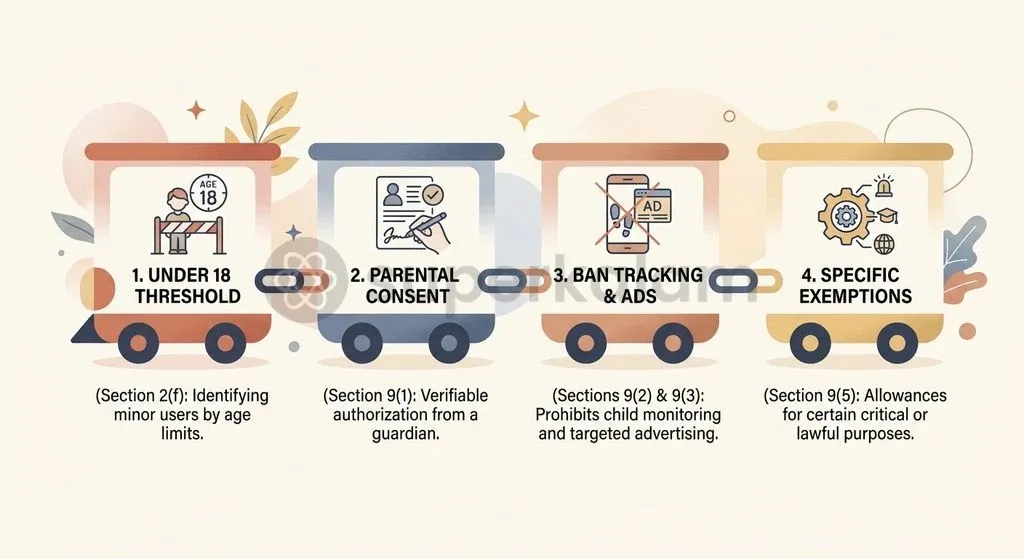
- Uniform Age Threshold: Section 2(f) categorises any individual under eighteen years of age as a child, establishing a blanket statutory threshold across all minor age groups.
- Verifiable Parental Consent: Section 9(1) mandates that data fiduciaries obtain verifiable parental consent before processing any personal data belonging to a minor.
- Prohibited Data Processing: Sections 9(2) and 9(3) prohibit behavioural tracking, targeted advertisements, and processing activities likely to cause detrimental well-being effects.
- Delegated Exemptions: Section 9(5) permits the Central Government to lower the age threshold or exempt certain fiduciaries if data handling is proven verifiably safe.
While these safeguards counter predatory commercial tracking, universal parental consent creates privacy dilemmas for older adolescents. Mandatory parental mediation allows guardians to monitor an adolescent's intellectual exploration, creative expression, and private health inquiries. According to the Supreme Court in Puttaswamy, pervasive surveillance creates chilling effects that erode individual informational privacy and intellectual self-determination.
Parameter 3: Digital Inclusion for Underprivileged Youth vs Blanket Age Gates
The Supreme Court of India held that underprivileged children cannot be denied online learning facilities under Article 21A. Delivering meaningful educational rights requires equitable distribution of digital devices and connectivity to vulnerable students.
Mandatory age-gating mechanisms threaten this socio-economic mandate across two distinct socioeconomic realities:
- Marginalised households: Per the consultation paper on the Draft Digital Personal Data Protection Rules, rigid digital parental verification requirements risk disproportionately excluding adolescents from digitally illiterate households. In families sharing a single basic smartphone or lacking formal identity documents, demanding complex digital signatures locks children out of public learning resources.
- Affluent households: Affluent minors navigate verification barriers with family assistance and dedicated hardware, widening the structural gap.
Blanket state restrictions therefore aggravate the digital divide. Marginalised youth face direct disenfranchisement when statutory compliance turns digital participation into an administrative obstacle course.
Discuss with Superkalam
How might mandatory digital parental consent mechanisms be applied in a rural household with only one shared mobile phone and limited digital literacy?
Ask NowWhat the Courts Say: Faheema Shirin, Anuradha Bhasin, and Proportionality
The Kerala High Court in Faheema Shirin v. State of Kerala formally linked internet connectivity to fundamental rights. Striking down restrictive hostel rules prohibiting mobile phone usage, the court ruled that internet access constitutes an integral component of the right to education under Article 21A and privacy under Article 21.
This doctrine was expanded to digital mediums generally by the Supreme Court in Anuradha Bhasin v. Union of India. The apex court affirmed that freedom of speech, expression, and profession over the internet enjoys explicit constitutional protection under Article 19(1)(a) and Article 19(1)(g).
State interference with digital access must satisfy a rigorous four-pronged test:
- Legitimate State Goal: The restriction must advance an authentic, legally sanctioned public objective.
- Rational Nexus (Suitability): The state measure must demonstrate a direct logical connection to the intended goal.
- Least Restrictive Measure (Necessity): The State must adopt the least intrusive regulatory tool capable of achieving its aim.
- Proportionality Stricto Sensu: The administration must maintain a fair constitutional balance between individual rights and public interest.
Under this judicial standard, blanket bans on adolescent connectivity rarely survive constitutional scrutiny. Total digital prohibition fails the necessity prong. Targeted child-safety regulations achieve protection without extinguishing foundational rights.
Discuss with Superkalam
Compare the judicial reasoning in Faheema Shirin regarding educational digital access with the state's interest under Article 15(3) and Article 39(f).
Ask NowGlobal Comparisons: How Other Democracies Balance Child Safety and Access
The United Nations Convention on the Rights of the Child provides an international benchmark for calibrating youth digital protections. Under UNCRC General Comment No. 25, the international community recognises that children's fundamental human rights apply unconditionally within the digital environment.
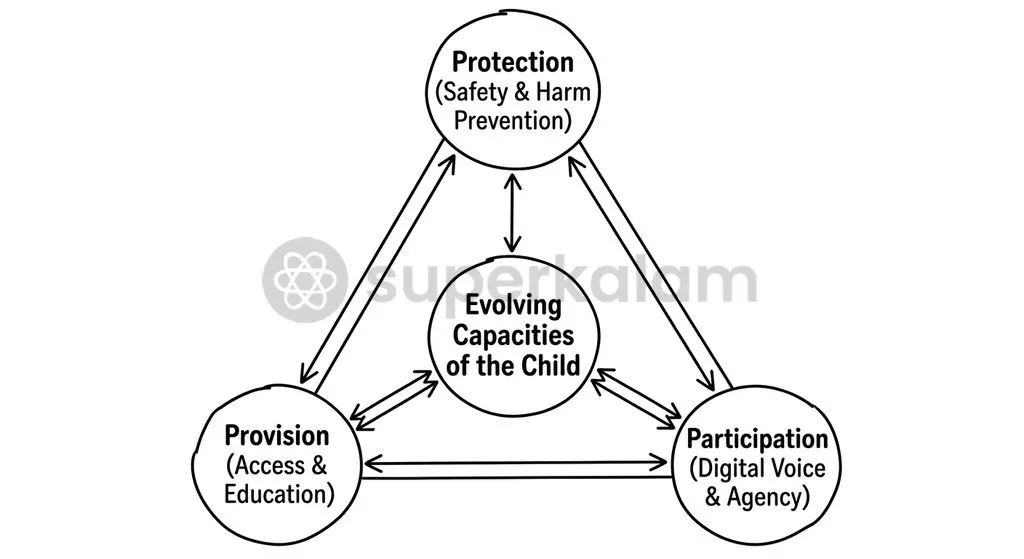
The United Nations framework integrates three interdependent operational pillars:
- Protection: Guarding minors against online abuse, algorithmic manipulation, and commercial data harvesting.
- Provision: Ensuring equitable access to information, educational resources, and public digital infrastructure.
- Participation: Facilitating freedom of expression, identity development, and meaningful civic participation in digital spaces.
The United Nations Committee explicitly cautions state parties against enacting blanket online prohibitions. Disproportionate restrictions violate children's rights to education and free expression. Furthermore, Article 5 of the UNCRC emphasises the evolving capacities of children, directing legal frameworks to grant increasing autonomy as adolescents mature rather than enforcing rigid parental vetoes up to age eighteen.
Ethical Dilemma: Does State Protection Deny Growing Agency to Minors?
The ethical dimension of state paternalism under General Studies Paper 4 pits beneficent protection against the development of moral autonomy. Two contrasting ethical philosophies frame this debate:
- Hard paternalism: In classical ethical philosophy, hard paternalism overrides an individual's voluntary choices for their presumed welfare, treating safety as superior to self-determination. Applied to digital governance, this risks infantilising youth and prevents them from cultivating critical reasoning, ethical discernment, and responsible digital citizenship.
- Stewardship doctrine: Instead of imposing coercive paternalism, parents and the State act as stewards who hold digital rights in trust for the child. Stewardship focuses on nurturing digital resilience, empowering minors to navigate online risks independently as they transition into adult citizenship.
Denying moral agency in the name of risk prevention contradicts developmental ethics. Mature autonomy emerges through gradual, guided exposure to real-world complexities rather than total isolation.
Discuss with Superkalam
Propose an alternative regulatory mechanism to blanket age gates that shields minors from commercial profiling while upholding their right to education under Article 21A.
Ask NowWay Forward: Building Child-Safe Spaces Without Digital Disenfranchisement
A balanced digital regulatory framework requires shifting administrative focus from total prohibition toward systemic safety by design. Policymakers must harmonise the State's duty of care under Article 15(3) with educational entitlements guaranteed by Article 21A.
To construct a constitutionally resilient digital environment, reform must target structural platform accountability rather than end-user exclusion:
- Calibrate Age Thresholds: The Central Government should utilise Section 9(5) of the DPDP Act, 2023 to lower consent thresholds for older adolescents, recognising progressive maturity for educational access.
- Mandate Safety by Design: Regulators must hold platforms liable for harmful algorithmic amplification and exploitative interface designs instead of banning child users.
- Promote School Digital Literacy: State educational boards should integrate safe browsing, critical media literacy, and privacy protection into standard school curricula.
- Safeguard Public Digital Repositories: Administrative bodies must ensure government learning portals remain accessible without intrusive verification barriers.
Adopting this calibrated standard allows India to protect its youth from commercial harm while preserving their constitutional right to thrive in the digital age.
Key Takeaways
- Article 21A Linkage: Internet connectivity is recognised as an integral facet of the right to education under Article 21A and privacy under Article 21.
- Constitutional Duty vs Liberty: While Article 15(3) and Article 39(f) mandate state protection, parens patriae actions must satisfy the four-pronged proportionality test established in Anuradha Bhasin.
- Statutory Compliance: The Digital Personal Data Protection Act, 2023 defines a child as anyone under eighteen under Section 2(f), requiring verifiable parental consent under Section 9(1) and penalising non-compliance up to ₹200 crore under Section 33.
- International Standards: UNCRC General Comment No. 25 rejects blanket prohibitions, balancing Protection, Provision, and Participation based on the evolving capacities of the child.
- Exclusion Risks in Draft Rules: Regulatory proposals under the Draft DPDP Rules (Rule 10 consultation stage) must be hedged, as mandatory verification risks excluding youth from digitally illiterate households.
Mains Question
"Treating state protection and digital access as mutually exclusive is constitutionally flawed." In the context of Section 9 of the Digital Personal Data Protection Act, 2023 and Article 21A of the Constitution, examine how the test of proportionality must reconcile child safety with digital empowerment. (15 Marks)
Evaluate NowMains Question
The institutional reliance on platforms like DIKSHA, SWAYAM, and PM e-Vidya has positioned digital access as a core component of the Right to Education. Critically analyse the socio-economic implications of blanket age-gating mechanisms for underprivileged learners. (10 Marks)
Evaluate NowPractice MCQs
QUESTION 1
Regarding the provisions of the Digital Personal Data Protection Act, 2023 relating to children, consider the following statements:
- An individual who has not completed eighteen years of age is defined as a child under the Act.
- The Act imposes an absolute bar on processing children's personal data that cannot be relaxed or exempted by the Central Government under any circumstances.
- The Act prohibits data fiduciaries from undertaking behavioural tracking or targeted advertising directed at children. Which of the statements given above are correct?
QUESTION 2
Consider the following statements regarding the judicial evolution of internet access as a right in India:
- In Faheema Shirin v. State of Kerala, the Kerala High Court held that internet access is an integral component of the right to education under Article 21A and privacy under Article 21.
- In Action Committee Unaided Recognized Private Schools v. Justice for All, the Supreme Court ruled that underprivileged children cannot be denied online learning facilities under Article 21A.
- The Supreme Court in Charan Lal Sahu v. Union of India established that digital connectivity constitutes an absolute non-derogable right under Article 19(1)(a). Which of the statements given above is/are correct?
QUESTION 3
Which of the following constitutional provisions are invoked to justify state paternalism and protective duties towards children in India?
- Article 15(3)
- Article 21A
- Article 39(f) Select the correct answer using the code given below:
QUESTION 4
Under the Digital Personal Data Protection Act, 2023, what is the maximum monetary penalty that can be imposed on non-compliant platforms under Section 33 for statutory violations concerning children's data verification?
QUESTION 5
Consider the following statements regarding the integration of digital education in Indian public policy:
- Contemporary schooling standards under the Right to Free and Compulsory Education (RTE) Act, 2009 incorporate ICT labs and digital materials into curricula.
- The National Education Policy (NEP) 2020 explicitly integrates digital public portals such as DIKSHA, SWAYAM, and PM e-Vidya into daily instruction. Which of the statements given above is/are correct?