Children in Political Campaigns: What the Madras High Court Ruled
While administrative guidelines forbid deploying minors in poll drives, election law demands proof of coercion to void an MLA's victory.
Oct, 2026
•11 min read
Overview
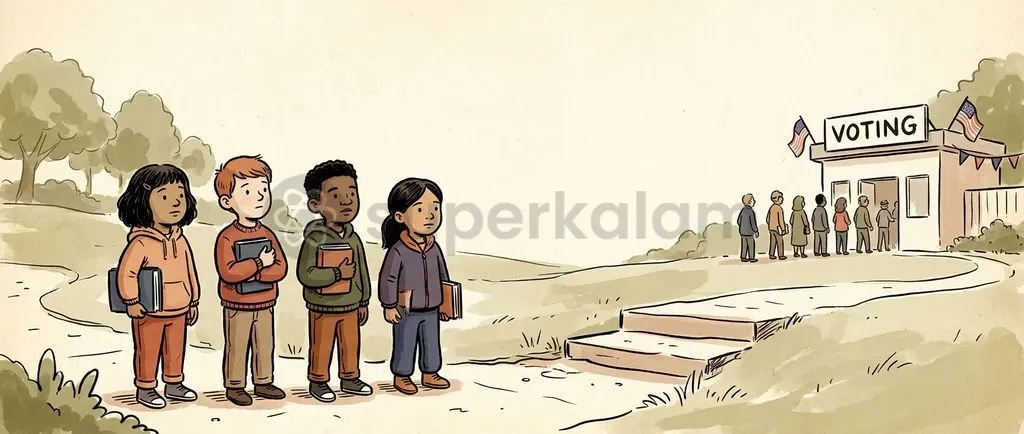
Deploying children in political campaigns presents a regulatory paradox in India. Administrative bans from the Election Commission of India clash directly with the strict statutory thresholds needed to void an election under electoral law.
Child rights statutes and constitutional safeguards denounce child canvassing. Yet election benches operate strictly within the Representation of the People Act, 1951. Executive advisories cannot substitute for legislative codification.
Political parties frequently exploit this twilight zone during election cycles. They mobilise minors for street rallies, door-to-door canvassing, and viral promotional reels. Determining whether this constitutes child labour, political exploitation, or an invalidating corrupt practice demands careful review of domestic statutes and international treaties.
Why Is the Use of Children in Poll Campaigns Under Scrutiny?
The Election Commission of India and constitutional courts face recurring violations of child welfare norms during high-stakes campaigns. As of October 2026, controversies over minors attending rallies, handing out pamphlets, and starring in political reels have drawn sharp judicial intervention and regulatory pushback.
Parties routinely use minors to project grassroots warmth and bypass voter cynicism. That exposure carries distinct dangers:
- Physical and environmental hazards: Prolonged exposure to extreme heat waves, volatile crowd surges, and exhaustion during street marches.
- Psychological stress: Exposure to aggressive partisan animosity, sloganeering, and public hostility.
- Digital commercialisation: Exploitation of childhood innocence in short-form political reels to drive viral social media reach.
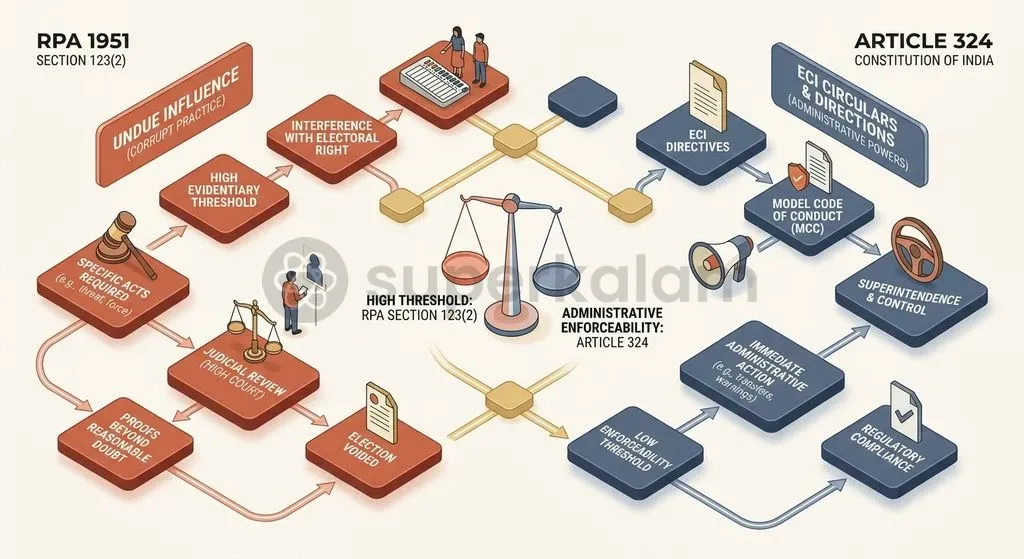
This dispute bridges multiple constitutional domains. It tests the regulatory enforcement capacity of the Election Commission under Article 324. It also tests judicial review under the Representation of the People Act, 1951, alongside domestic child protection laws.
Discuss with Superkalam
What specific penal terms and fines does Section 14 of the Child and Adolescent Labour (Prohibition and Regulation) Act, 1986 prescribe for illegal child employment?
Ask NowWhat Did the Madras High Court Rule on Child Campaigners?
The Madras High Court ruled in K. Sivakumar v. Rajendran R. that appealing to children to persuade their parents does not void an election. On 15 October 2026, the High Court dismissed an election petition challenging an MLA's victory, clarifying the boundary between political campaigning and voter volition.
The judgment set out three central legal conclusions:
- High evidentiary threshold: Proving undue influence under Section 123(2) of the Representation of the People Act, 1951 demands proof of tyranny over the mind that overpowers an adult elector's free will. Urging children to speak to their parents does not meet this coercive standard.
- Moral disapprobation: The bench noted that enlisting minors for campaign messaging and reels reflects poor parenting and remains in bad taste. The Court termed these methods cheap manoeuvres, calling on Parliament to consider statutory prohibitions.
- Status of ECI circulars: Election Commission circulars carry administrative force under Article 324. However, breaching an advisory does not amount to non-compliance with an "Order" under Section 100(1)(d)(iv) of the Representation of the People Act, 1951.
Consequently, a court cannot declare an election void solely because a candidate ignored an Election Commission campaign advisory.
What Do Election Commission of India Directives Say?
The Election Commission of India declared zero tolerance towards using minors in election tasks on 5 February 2024. In a formal press note issued to recognised political parties, the Commission barred children from all campaign operations.
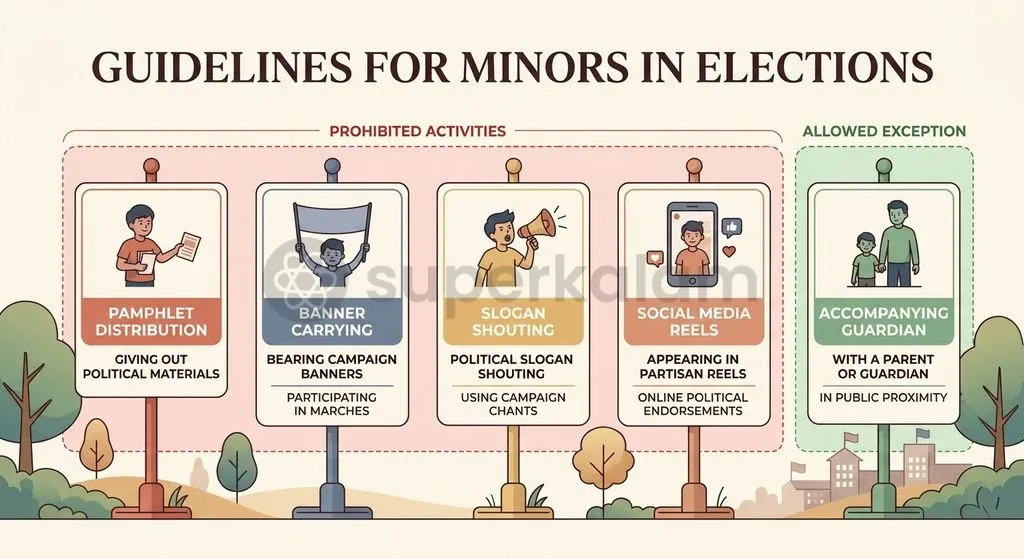
The directive sets clear boundaries to shield minors from political mobilisation. Parties, candidates, and campaign workers must not engage children in:
- Distributing political posters, handbills, and leaflets.
- Shouting partisan slogans or joining campaign processions.
- Attending rallies, roadshows, and election meetings as official campaign participants.
- Riding in campaign convoys or being held by candidates during public rallies.
- Creating the semblance of a political campaign through poems, songs, spoken appeals, or party symbols.
The Commission introduced a narrow practical carve-out. A child merely accompanying a parent or guardian near a political figure, without actively canvassing, does not breach its rules.
Administrative accountability remains strict. District Election Officers and Returning Officers face personal liability and disciplinary proceedings if staff under their supervision involve minors in election operations. This position builds on the Bombay High Court's 2014 ruling in Chetan Ramlal Bhutada v. State of Maharashtra, which ordered political parties to ensure minors do not participate in poll-related events.
Discuss with Superkalam
Explain why election tribunals differentiate between moral disapprobation of child canvassing and legal coercion under Section 123(2) of the RPA, 1951.
Ask NowStatutory Framework: How Indian Laws Address Child Participation
Indian statutory law splits child participation across distinct legislative domains. Electoral disputes fall exclusively under election law, whereas child welfare is governed by labour and juvenile justice enactments.
| Dimension | Representation of the People Act, 1951 | Child & Adolescent Labour Act, 1986 | Juvenile Justice Act, 2015 |
|---|---|---|---|
| Primary Focus | Integrity of the electoral process and corrupt practices | Prohibition of child employment in occupations | Care, protection, and criminalisation of child cruelty |
| Relevant Provisions | Section 123(2) (Undue Influence); Section 100(1) | Section 3 (Prohibition); Section 14 (Penalties) | Section 2(14) (Care need); Section 75 (Cruelty) |
| Application to Campaigns | Requires proof of coercive interference with an elector's will | Applied when monetary payment or formal employment exists | Invoked if exposure causes mental or physical suffering |
| Legal Consequence | Setting aside an election (if statutory test is satisfied) | Imprisonment (6 months to 2 years) and fines | Cognizable criminal prosecution of custodians/agents |
This division creates an enforcement loophole. The Representation of the People Act, 1951 prioritises electoral outcomes and corrupt intent, while child protection statutes focus on physical harm and welfare. An act that breaches child labour norms regularly fails to qualify as an invalidating corrupt electoral practice.
Section 123 of the RPA: Does Deploying Children Count as a Corrupt Practice?
The Representation of the People Act, 1951 limits corrupt practices to explicit statutory grounds. Under Section 123(2) of the Act, undue influence requires direct or indirect interference, or an attempt to interfere, with the free exercise of an electoral right.
To void an election under Section 100(1)(b) of the Act, the High Court must find that a candidate or their election agent committed a corrupt practice with consent. Applying this rule to child campaigners exposes four evidentiary hurdles:
- Absence of Elector Coercion: Minors cannot vote. Their presence in processions or short reels rarely coerces adult voters into altering their ballot choice.
- Strict Judicial Interpretation: Courts treat corrupt practice charges as quasi-criminal allegations, demanding proof beyond reasonable doubt rather than a balance of probabilities.
- Volition versus Persuasion: High Courts separate emotional appeals from illegal coercion. Campaigning through children does not overpower adult voter agency.
- Exclusion of Administrative Breaches: As K. Sivakumar v. Rajendran R. confirmed, violating Election Commission instructions does not satisfy Section 100(1)(d)(iv) to set aside an election.
Because the statute omits child deployment from its list of corrupt practices, election petitions citing it face dismissal.
Child Labour and Juvenile Justice Laws: Where Does Campaigning Fit?
The Child and Adolescent Labour (Prohibition and Regulation) Act, 1986 bans employing children under 14 across all occupations. Under Section 3, hiring or permitting a child to work in commercial processes is illegal, exempting only family-run businesses outside school hours or permitted audio-visual entertainment.
When parties engage minors to hand out leaflets or carry banners, two statutory mechanisms apply:
- Child Labour Penalties: Section 14 of the Child and Adolescent Labour (Prohibition and Regulation) Act, 1986 prescribes six months to two years imprisonment, a fine of twenty thousand to fifty thousand rupees, or both, for illegal employment. Political organisers often evade charges by claiming the work is voluntary.
- Cruelty and Actionable Exposure: Section 75 of the Juvenile Justice Act penalises anyone with charge or control of a minor who assaults, abandons, exposes, or neglects them, causing physical or mental suffering. Compelling children to march during heat waves amounts to actionable neglect.
- Care and Protection Mandates: Section 2(14)(ii) of the Juvenile Justice Act classifies any child working in breach of labour legislation as needing care and protection. Child Welfare Committees can step in to rescue them.
Discuss with Superkalam
If a candidate features local children singing partisan campaign slogans in viral social media reels, how would the ECI directive and the Juvenile Justice Act apply to that candidate?
Ask NowConstitutional Safeguards and International Obligations Under UNCRC
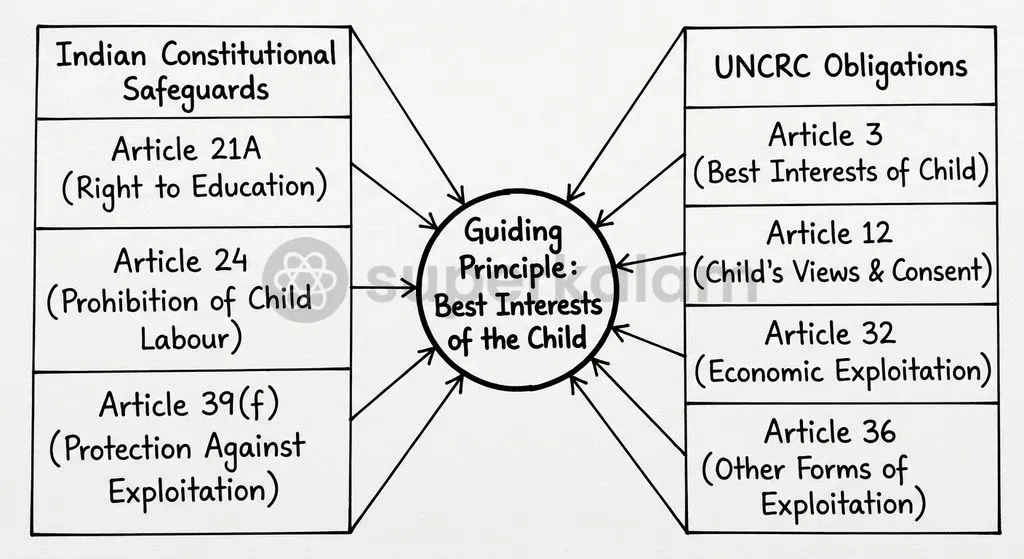
The Constitution contains explicit safeguards to shield minors from hazardous work and protect their development. Article 24 forbids employing any child below fourteen years in any factory, mine, or hazardous occupation.
Alongside this right, Article 21A guarantees free and compulsory education for children aged six to fourteen years. Multi-week political campaigns disrupt this schooling entitlement when organisers take children out of classes. Directive Principle Article 39(f) also instructs the State to ensure children develop in freedom and dignity. While Part IV directives cannot be enforced in court, they guide statutory interpretation and policy design.
India has also ratified the United Nations Convention on the Rights of the Child (UNCRC). This treaty imposes positive obligations to shield children from political opportunism across four benchmark articles:
- Best Interests of the Child (Article 3(1)): Requires that in all public actions concerning minors, the best interests of the child serve as a primary consideration.
- Freedom of Expression (Article 12): Protects the child's right to express views freely, with weight assigned according to age and maturity.
- Protection from Hazardous Work (Article 32(1)): Protects minors from economic exploitation and tasks hazardous to their health, education, or development.
- Protection from General Exploitation (Article 36): Directs States Parties to protect children against all other forms of exploitation prejudicial to their welfare.
These international treaties require India to look beyond formal wage-labour rules. A child's physical health, psychological growth, and schooling must remain insulated from partisan campaigns.
Key Ethical Issues for GS Paper 4: Autonomy, Consent, and Exploitation
Using children in election campaigns raises urgent ethical questions about autonomy, proxy consent, and commodification. In democratic ethics, child canvassing violates the principle of informed consent because developing minors lack the cognitive maturity to evaluate rival political platforms.
Three ethical issues stand out:
- Breach of Fiduciary Duty: Parents hold a fiduciary duty to protect their child's long-term interests. Exercising proxy consent to place children in partisan rallies trades their welfare for political patronage or financial handouts.
- Violation of Kantian Ethics: Parading minors on campaign trucks treats them as tools to capture votes. This breaches the categorical imperative to treat persons as ends in themselves rather than mere instruments.
- Instrumentalisation of Innocence: In K. Sivakumar v. Rajendran R., the Madras High Court denounced the commodification of innocence in political media. Exploiting a child's natural credibility shields adult politicians from voter scrutiny.
Discuss with Superkalam
Compare the legal focus of the Representation of the People Act, 1951 with the Juvenile Justice Act, 2015 regarding the harms of child participation in political rallies.
Ask NowWay Forward: Closing Statutory Loopholes to Protect Children in Elections
Protecting minors requires closing the gap between election dispute rules and child welfare laws through four concrete steps:
- Amend the Representation of the People Act, 1951: Parliament should debate amending Section 123 to make enlisting minors in rallies, sloganeering, and campaign media an explicit corrupt practice or electoral offence.
- Formalise ECI Instructions into the Model Code of Conduct: The Election Commission of India should integrate its 2024 zero-tolerance directives directly into the Model Code of Conduct, suspending campaign permits for non-compliant parties.
- Empower District Child Protection Units: District Election Officers must coordinate with District Child Protection Units and Child Welfare Committees under the Juvenile Justice Act, 2015 to monitor campaign rallies and remove minors from harm.
- Implement Digital Safeguards Against Child Exploitation: State authorities and digital platforms must work under NCPCR oversight to block the monetisation of campaign reels featuring minors delivering partisan propaganda.
Key Takeaways
- The Madras High Court held in K. Sivakumar v. Rajendran R. (October 2026) that appealing to children to persuade their parents does not constitute undue influence under Section 123(2) of the Representation of the People Act, 1951.
- Breaching an Election Commission administrative circular cannot void an election under Section 100(1)(d)(iv) of the Representation of the People Act, 1951, because such circulars do not qualify as statutory orders under the Act.
- The Election Commission of India's February 2024 circular enforces zero tolerance against political parties using children for rallies, sloganeering, distributing pamphlets, or featuring in campaign propaganda.
- Mobilising minors for campaign tasks can trigger prosecution under Section 14 of the Child and Adolescent Labour Act, 1986 and Section 75 of the Juvenile Justice Act, 2015.
- Deploying children in political campaigns breaches Article 3(1) and Article 32(1) of the UNCRC, and ethically constitutes the commodification of innocence without informed consent.
Mains Question
"Administrative bans issued by the Election Commission of India clash directly with the strict statutory thresholds needed to void an election under the Representation of the People Act, 1951." In light of recent judicial pronouncements, critically analyse the enforcement loopholes surrounding the deployment of children in political campaigns. (15 Marks)
Evaluate NowMains Question
The deployment of minors in political canvassing occupies a contentious intersection between labour regulation and juvenile protection. Elucidate how the provisions of the Child and Adolescent Labour (Prohibition and Regulation) Act, 1986 and the Juvenile Justice Act, 2015 apply to election campaigning. (10 Marks)
Evaluate NowPractice MCQs
QUESTION 1
With reference to the Madras High Court ruling in K. Sivakumar v. Rajendran R. (2026), consider the following statements:
- It held that violating an Election Commission of India campaign advisory amounts to non-compliance with an Order under Section 100(1)(d)(iv) of the Representation of the People Act, 1951.
- It ruled that establishing undue influence under Section 123(2) of the Representation of the People Act, 1951 requires demonstrating tyranny over the mind that overpowers an adult elector's free will.
- It concluded that urging children to speak to their parents does not meet the coercive standard required to void an election. Which of the statements given above is/are correct?
QUESTION 2
Regarding the Election Commission of India (ECI) directives issued on 5 February 2024 concerning child participation in elections, consider the following statements:
- Political parties and candidates are barred from using children in campaign convoys or having candidates hold them during public rallies.
- A child merely accompanying a parent or guardian near a political figure, without actively canvassing, constitutes a direct violation of the directive.
- District Election Officers and Returning Officers face personal liability and disciplinary proceedings if subordinate election machinery involves minors. Which of the statements given above is/are correct?
QUESTION 3
Consider the following statements regarding the statutory frameworks governing child welfare in India:
- Under Section 14 of the Child and Adolescent Labour (Prohibition and Regulation) Act, 1986, illegal employment of children attracts imprisonment from six months to two years.
- Section 75 of the Juvenile Justice (Care and Protection of Children) Act, 2015 penalises acts of exposure or neglect that cause mental or physical suffering to a minor.
- Under Section 2(14)(ii) of the Juvenile Justice Act, 2015, any child found working in contravention of labour legislation is categorised as a child in need of care and protection. Which of the statements given above are correct?
QUESTION 4
Consider the following statements regarding election petitions filed under the Representation of the People Act (RPA), 1951:
- Charges of corrupt practices under Section 123 of the RPA, 1951 are treated as quasi-criminal allegations requiring proof beyond reasonable doubt.
- Deploying minors in election processions is explicitly enumerated as a ground of corrupt practice under Section 123 of the RPA, 1951. Which of the statements given above is/are correct?
QUESTION 5
In which of the following cases did the Bombay High Court direct political parties to ensure that minors do not participate in election-related events?