CGTMSE Guarantee on TReDS: Unlocking MSME Working Capital and Credit Flow
By absorbing non-recourse risk on trade receivables, sovereign credit enhancement tackles delayed MSME settlements without demanding secondary collateral.
Sep, 2026
•8 min read

Overview
The integration of the Credit Guarantee Fund Trust for Micro and Small Enterprises with the Trade Receivables Discounting System provides sovereign-backed credit enhancement on factored trade receivables. This mechanism reduces financier default risk. It unlocks formal working capital for supply chains across India.
As reported by the Ministry of Micro, Small and Medium Enterprises, this digital linkage operationalises automated risk-sharing across major platforms including RXIL, M1xchange, and DTX.
By establishing a guarantee cover on eligible invoices between micro and small enterprises, the framework directly addresses structural non-recourse risk for commercial financiers. It bridges working capital constraints caused by delayed corporate settlements without requiring collateral from small suppliers.
Why in the News?
The Ministry of Micro, Small and Medium Enterprises has integrated the CGTMSE credit guarantee portal directly across operational TReDS platforms. According to a press release from the Ministry of Micro, Small and Medium Enterprises, this integration enables seamless credit guarantee coverage on platforms including M1xchange, RXIL, and DTX (KredX) to boost MSME liquidity.
Total invoice discounting value across TReDS platforms expanded from ₹40,000 crore in FY 2021-22 to ₹3.5 lakh crore in FY 2025-26. This growth highlights the rising role of digital factoring in bridging trade receivables gaps. Integrating credit guarantees ensures that financial institutions extend competitive bidding to smaller and lower-rated enterprise networks without bearing unhedged credit risk.
What is TReDS and How Does Trade Receivable Discounting Work?
The Trade Receivables Discounting System is an institutional mechanism regulated by the Reserve Bank of India to facilitate MSME invoice discounting. Established under the payment system guidelines of the Reserve Bank of India, TReDS is a secure electronic auction marketplace. It brings together micro, small, and medium enterprise suppliers, corporate or government buyers, and institutional financiers including commercial banks and registered non-banking financial companies (NBFCs).
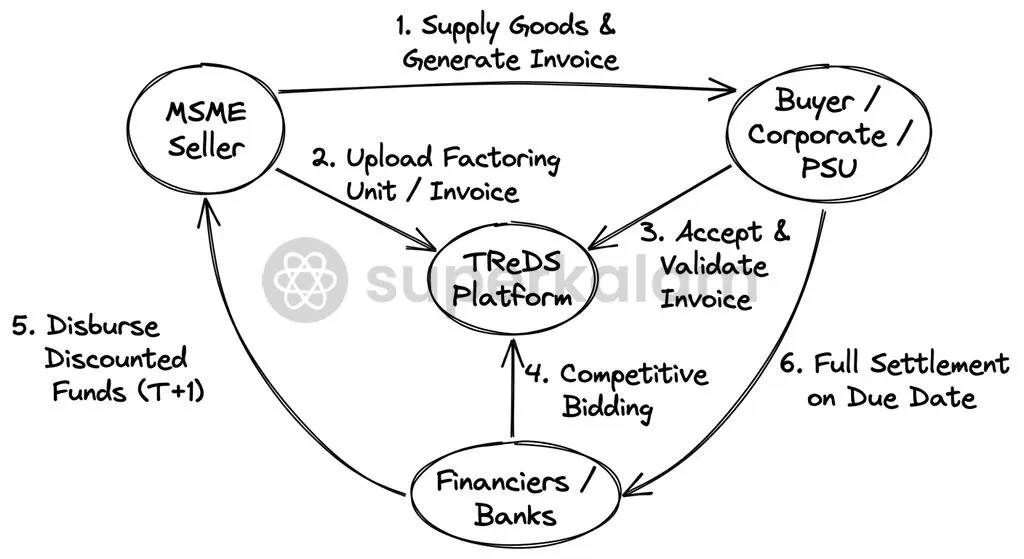
The tripartite discounting process follows five sequential stages:
- Invoice Upload: The MSME seller uploads an accepted digital trade invoice on the TReDS portal.
- Buyer Validation: The corporate or PSU buyer validates and approves the invoice details online.
- Competitive Auction: Financiers enter competitive discounting bids in a transparent electronic bidding window.
- Bid Acceptance and Payout: The MSME seller accepts the best bid and receives immediate working capital funds.
- Final Settlement: The buyer settles the full invoice value directly with the winning financier on the agreed due date.
Trade receivable discounting on TReDS is conducted on a without-recourse factoring basis. In without-recourse factoring, the financier assumes the complete credit risk of buyer non-payment, fully shielding the MSME supplier from subsequent recovery claims.
| Feature | With-Recourse Factoring | Without-Recourse Factoring (TReDS) |
|---|---|---|
| Credit Risk Bearer | MSME Seller retains ultimate default risk | Financier / Factor bears complete credit risk |
| Balance Sheet Impact | Retained as a contingent liability | Off-balance sheet financing for the MSME |
| Collateral Needs | Requires secondary collateral or security | Backed purely by the underlying trade invoice |
| Recovery Process | Factor recovers dues from seller upon default | Factor pursues legal recovery from the buyer |
Discuss with Superkalam
Recall the institutional pillars responsible for the governance and execution of the CGTMSE framework.
Ask NowUnderstanding CGTMSE: Origins, Mandate, and Core Functions
The Credit Guarantee Fund Trust for Micro and Small Enterprises was jointly established in 2000 by the Ministry of MSME and SIDBI. Operating as a public trust, the fund provides third-party credit guarantee backing to financial institutions extending collateral-free loans to micro and small enterprises (MSEs).
The trust rests on three institutional pillars:
- Ministry of MSME: Delivers overall policy guidance and budgetary capital contributions.
- SIDBI: Manages operational execution and day-to-day scheme administration.
- Member Lending Institutions (MLIs): Commercial banks and NBFCs executing guaranteed lending operations.
By absorbing a predetermined portion of default losses, CGTMSE removes the traditional prerequisite for tangible collateral security. This institutional safety net incentivises commercial lenders to finance first-generation entrepreneurs and asset-light enterprises that lack immovable property.
The Integration: How CGTMSE Credit Guarantee Operates on TReDS
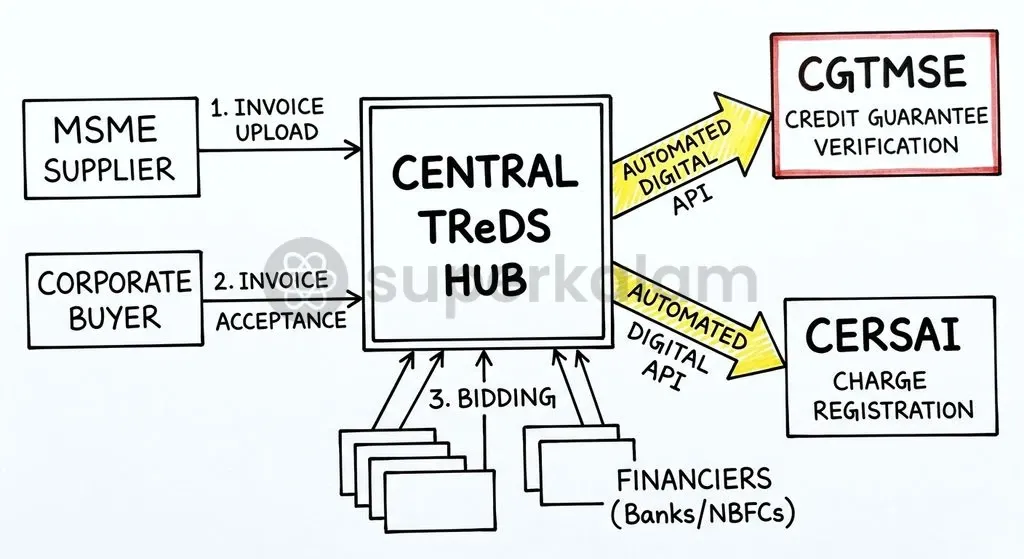
The CGTMSE-TReDS integration automates risk-sharing workflows between participating financiers, discounting platforms, and the credit guarantee trust. According to the Reserve Bank of India's Master Direction on TReDS, financiers are permitted to obtain credit guarantee cover from government-established trusts like CGTMSE, while insurance companies are allowed to participate directly on the platforms.
This digital integration embeds automated operational protocols directly into the bidding mechanism:
- Real-Time Verification: The TReDS platform conducts real-time eligibility checks against CGTMSE databases during invoice onboarding.
- Automated Fee Debit: The system calculates and executes automated guarantee fee debits based on invoice tenor and value.
- Digital Cover Issuance: Digital guarantee cover notes generate instantly upon successful bid acceptance.
Legislative reforms have reinforced this architecture. Under Section 3 of the Factoring Regulation (Amendment) Act, 2021, the statutory restriction requiring NBFCs to maintain 50% of assets and income in factoring was eliminated, allowing all registered NBFCs to participate as factors. Furthermore, Section 19 of the Act mandates TReDS platforms to register transaction particulars directly with the Central Registry of Securitisation Asset Reconstruction and Security Interest of India (CERSAI) on behalf of factors, eliminating duplicate financing risks.
Discuss with Superkalam
Explain how without-recourse factoring on TReDS differs from conventional with-recourse lending in its impact on an MSME's balance sheet.
Ask NowEligibility Criteria, Coverage Limits, and Operational Mechanism
Eligibility for CGTMSE coverage on TReDS mandates that both the trading parties qualify as Micro or Small Enterprises under the MSMED Act, 2006. According to CGTMSE Circular No. 262/2026-27, medium enterprises and large non-MSE corporate buyers are excluded from this dedicated window to focus credit enhancement on the most vulnerable supply tiers.
The operational parameters under the special provision establish defined exposure thresholds:
- Guarantee Coverage: Available on eligible factored receivables; the applicable percentage must be checked against current CGTMSE terms.
- Buyer Exposure Ceiling: Maximum revolving exposure capped at ₹10 crore per MSE buyer.
- Seller Exposure Ceiling: Maximum revolving exposure capped at ₹2 crore per MSE seller.
- Loss Absorption: The lending institution retains residual exposure, supporting disciplined credit underwriting.
Discuss with Superkalam
Apply the statutory provisions of MSMED Act Sections 15-16 and Income Tax Act Section 43B(h) to explain the legal consequences for a corporate buyer defaulting beyond 45 days.
Ask NowSignificance: Tackling Delayed Payments and Non-Recourse Risk for Financiers
Sections 15 and 16 of the MSMED Act, 2006 establish statutory timelines and punitive interest rates for delayed payments to small enterprises. Section 15 mandates that buyers must settle invoices within an agreed period not exceeding 45 days, or within 15 days if no agreement exists. If a buyer defaults beyond this window, Section 16 mandates compound interest with monthly rests at three times the RBI bank rate.
Fiscal legislation reinforces these recovery timelines. Section 43B(h) of the Income Tax Act, 1961 disallows tax deductions for business expenses payable to MSEs unless settled within the timeline prescribed under Section 15 of the MSMED Act.
The credit guarantee intervenes directly in the trade liquidity transmission bottleneck:
- Extended Credit Cycles: Unsettled corporate receivables stretch cash turnaround cycles from 60 to 120 days.
- Working Capital Depletion: Production stalls as enterprise cash flows remain trapped in pending invoices.
- Financier Risk Aversion: Commercial factors hesitate to discount invoices issued by unrated or lower-tier buyers.
- Guaranteed Resolution: CGTMSE shares eligible credit losses, supporting competitive auction bidding on unrated buyer paper.
According to an official assessment by the World Bank and IMF, sovereign credit guarantees lower risk premiums on receivables from lower-rated or unrated buyers, enabling competitive discounting interest rates for micro and small suppliers. Financiers who previously restricted bidding to AAA-rated corporate buyers can now aggressively discount paper issued by smaller buyers.
Discuss with Superkalam
Analyse the structural trade-off in restricting the CGTMSE guarantee window exclusively to transactions where both parties are MSEs.
Ask NowKey Challenges in Implementation and Platform Adoption
Platform adoption on TReDS encounters operational hurdles regarding buyer onboarding discipline and the strict mutual MSE classification requirement. Because the CGTMSE guarantee is limited to transactions where both seller and buyer are MSEs, invoices raised on large corporations and mid-market buyers fall outside this guarantee window.
Key structural impediments include:
- Buyer Hesitation: Many corporate buyers resist onboarding to TReDS to avoid public recording of trade liabilities and rigid settlement timelines.
- Awareness Gaps: Tier-2 and Tier-3 micro enterprises face digital literacy barriers when navigating online auctions and automated CERSAI registrations.
- Risk Residuals: Financiers retain residual unhedged risk, which can constrain aggressive bidding during sector-wide macroeconomic stress.
Way Forward: Scaling Liquidity Support for India's MSME Sector
Expanding India's MSME liquidity architecture requires deepening secondary market factoring and broadening sovereign credit guarantee coverage across supply tiers. Streamlining regulatory compliance and digital integration will accelerate platform maturity.
Policy interventions should focus on the following actionable priorities:
- Broadening Guarantee Scope: The Ministry of MSME and SIDBI could consider extending tiered CGTMSE guarantees to transactions involving unrated mid-corporate buyers.
- Mandatory Public Sector Onboarding: Ensuring that all central and state public sector enterprises settle sub-contractor trade bills exclusively via TReDS platforms.
- Integrating Credit Information Bureau Data: Linking TReDS transaction repayment records into commercial credit scoring engines to establish formal credit histories for micro-enterprises.
- Export Factoring Linkages: Expanding TReDS capabilities to support cross-border factoring, insulating small export units against overseas payment defaults.
Key Takeaways
- Institutional Risk Cover: CGTMSE provides a guarantee cover on eligible factored invoices defaulted on TReDS platforms.
- Operational Scope: The facility covers transactions where both seller and buyer are Micro or Small Enterprises, capped at ₹10 crore per buyer and ₹2 crore per seller.
- Statutory Framework: The mechanism operates alongside Section 15 and 16 of the MSMED Act, 2006, and tax deduction compliance under Section 43B(h) of the Income Tax Act, 1961.
- Market Expansion: Annual TReDS discounting volume surged from ₹40,000 crore (FY 2021-22) to ₹3.5 lakh crore (FY 2025-26) across platforms including RXIL, M1xchange, and DTX.
- Regulatory Enablement: Reforms under the Factoring Regulation (Amendment) Act, 2021 expanded NBFC participation and automated direct CERSAI registration via TReDS.
Mains Question
Statutory mandates under the MSMED Act, 2006 and Section 43B(h) of the Income Tax Act seek to curb delayed payments to small suppliers, yet working capital constraints persist. Examine how the integration of CGTMSE credit guarantees with TReDS addresses structural risk aversion among institutional financiers. (10 Marks)
Evaluate NowMains Question
'Legislative and digital institutionalization of invoice discounting has transformed MSME supply chain finance in India.' In light of the Factoring Regulation (Amendment) Act, 2021 and TReDS platform architecture, evaluate the efficacy of sovereign risk-sharing mechanisms in scaling formal liquidity. (15 Marks)
Evaluate NowPractice MCQs
QUESTION 1
With reference to the Credit Guarantee Fund Trust for Micro and Small Enterprises (CGTMSE) guarantee window on TReDS, consider the following statements:
- The credit guarantee covers up to 75% of the default amount on eligible factored trade receivables.
- The revolving exposure under the scheme is capped at ₹10 crore per Micro and Small Enterprise (MSE) buyer and ₹2 crore per MSE seller.
- The guarantee facility is extended to invoices where either the buyer or the seller is classified as a medium enterprise under the MSMED Act, 2006. Which of the statements given above is/are correct?
QUESTION 2
Consider the following statements regarding the regulatory framework governing factoring and TReDS in India:
- Under the Factoring Regulation (Amendment) Act, 2021, the statutory restriction requiring NBFCs to maintain at least 50% of assets and income in factoring was eliminated.
- TReDS platforms are mandated to register transaction particulars directly with CERSAI to eliminate the risk of duplicate financing.
- Factoring transactions executed on TReDS platforms operate on a with-recourse factoring basis, leaving the primary default risk with the MSE seller. Which of the statements given above is/are correct?
QUESTION 3
With reference to the statutory provisions addressing delayed payments to Micro and Small Enterprises in India, consider the following statements:
- Section 15 of the MSMED Act, 2006 mandates payment settlement within an agreed period not exceeding 45 days, or 15 days in the absence of an agreement.
- In case of delayed settlement beyond the mandated timeline, Section 16 of the MSMED Act prescribes compound interest at three times the RBI bank rate.
- Section 43B(h) of the Income Tax Act disallows tax deductions for business expenses payable to MSEs unless settled within the timelines specified in the MSMED Act. Which of the statements given above are correct?
QUESTION 4
Regarding the institutional structure and origin of the Credit Guarantee Fund Trust for Micro and Small Enterprises (CGTMSE), consider the following statements:
- It was jointly established in the year 2000 by the Ministry of MSME and the Small Industries Development Bank of India (SIDBI).
- The day-to-day scheme administration and operational execution are managed by the Reserve Bank of India. Which of the statements given above is/are correct?
QUESTION 5
In the context of the Trade Receivables Discounting System (TReDS), which of the following best defines 'without-recourse factoring'?