Centaurus X-3: X-Ray Pulsar, Accretion Disk and RRI Study
How RRI's breakthrough on a 24,000-light-year-distant pulsar rewrites standard binary accretion physics and reinforces India's deep-space observational edge.
Oct, 2026
•7 min read

Context
Researchers at the Raman Research Institute (RRI) have resolved the accretion geometry of the landmark high-mass X-ray pulsar Centaurus X-3. Their analysis demonstrates that persistent accretion occurs via a structured disk, with a rotating accretion stream that synchronises with the neutron star's rotation.
This empirical breakthrough establishes that high-mass binary systems can sustain stable disk accretion alongside secular spin-up and orbital decay. The result bridges a long-standing theoretical divide in high-energy astrophysics. Furthermore, the findings validate pulse phase-resolved spectroscopy as a sensitive probe for sub-resolution binary architecture, reinforcing India's indigenous capabilities in space science.
Why Centaurus X-3 Is in the News
Centaurus X-3 returned to global scientific attention after researchers at Bengaluru's Raman Research Institute decoded its complex accretion dynamics using high-resolution spectroscopic observations. As detailed in an official release by PIB Delhi in October 2026, the investigation led by Kinjal Roy revealed that this massive stellar system feeds its central compact object through an accretion disk rather than relying solely on diffuse stellar wind capture.
This observation confirms a rare astrophysical state for High-Mass X-ray Binaries (HMXBs). It directly provides concrete empirical geometry for a system situated 24,000 light-years away.
Discuss with Superkalam
Recall the orbital period and spin rotation period of the Centaurus X-3 neutron star.
Ask NowWhat Is Centaurus X-3: Origins and Historical Significance
Centaurus X-3 occupies a foundational place in observational astronomy. The object was initially spotted in 1967 as a cosmic X-ray source and formally confirmed in 1971 by NASA's Uhuru satellite, which identified it as the first discovered accretion-powered periodic X-ray pulsar. This discovery established empirical proof that compact stellar remnants can generate colossal high-energy radiation by drawing matter from an orbiting binary companion.
The system exhibits several defining physical and orbital characteristics:
- Spatial location: Centaurus X-3 is located approximately 24,000 light-years from Earth within the constellation Centaurus.
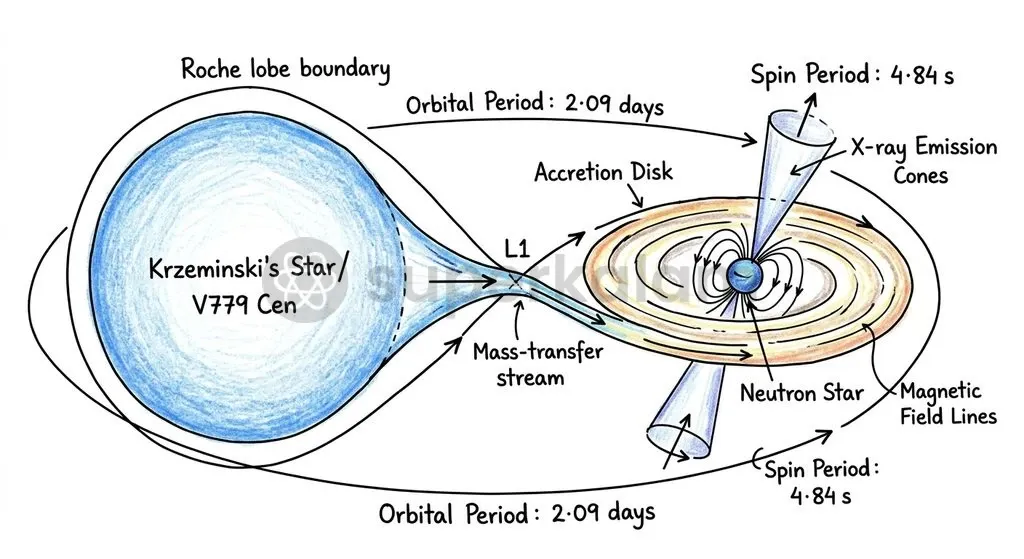
- Binary pairing: the system is classified as a High-Mass X-ray Binary, pairing a highly magnetised neutron star with an optical companion known as Krzeminski's star (V779 Cen).
- Companion mass: Krzeminski's star is a massive O-type supergiant with an estimated mass of approximately 20.5 solar masses.
- Temporal periods: the neutron star completes an intrinsic spin rotation every 4.84 seconds while executing an orbital revolution around Krzeminski's star every 2.09 days.
The intense gravitational well of the compact object steadily draws plasma across space, releasing gravitational potential energy as hard X-ray emissions.
Beyond Textbook Physics: The Riddle of Accretion in High-Mass Binaries
Accretion in binary systems typically operates via two primary channels:
- Roche-lobe overflow: in low-mass systems, the companion star swells beyond its gravitational boundary and spills gas through the inner Lagrangian point, routinely producing a broad, rotating accretion disk.
- Bondi-Hoyle-Littleton capture: High-Mass X-ray Binaries, conversely, are predominantly driven by intercepting supersonic stellar winds blown off by a luminous companion.
Centaurus X-3 defies this conventional separation. Although paired with an early-type supergiant that emits substantial stellar winds, Centaurus X-3 exhibits persistent disk accretion driven by Roche-lobe overflow. This mechanism transfers vast angular momentum to the compact remnant, altering both its spin and binary orbit over astronomical timescales.
Because Centaurus X-3 is located 24,000 light-years away, contemporary telescopes cannot spatially resolve the system's inner workings. Modern observatories view the binary merely as an unresolved point source. Unravelling whether gas fell spherically via wind or swirled into an ordered planar disk remained a major observational hurdle.
Discuss with Superkalam
Explain how phase-resolved spectroscopy allows astronomers to reconstruct structures in binary systems that cannot be spatially resolved by optical or X-ray telescopes.
Ask NowThe RRI Breakthrough: How Researchers Decoded the Pulsar's Accretion Geometry
The Raman Research Institute team overcame this spatial resolution barrier through phase-resolved X-ray spectroscopy. Utilising high-precision observations from the European Space Agency's XMM-Newton X-ray space observatory, the researchers tracked how emission spectra shifted across the pulsar's 4.84-second rotational cycle.
The researchers isolated four secondary fluorescent X-ray emission lines, tracking their intensity fluctuations against the pulsar's rotation phase. These spectral markers comprise transitions across multiple ionisation states of iron:
- Near-neutral iron fluorescent emission at 6.4 keV
- Helium-like iron (Fe XXV) emission at ~6.7 keV
- Hydrogen-like iron (Fe XXVI) line at ~6.97 keV
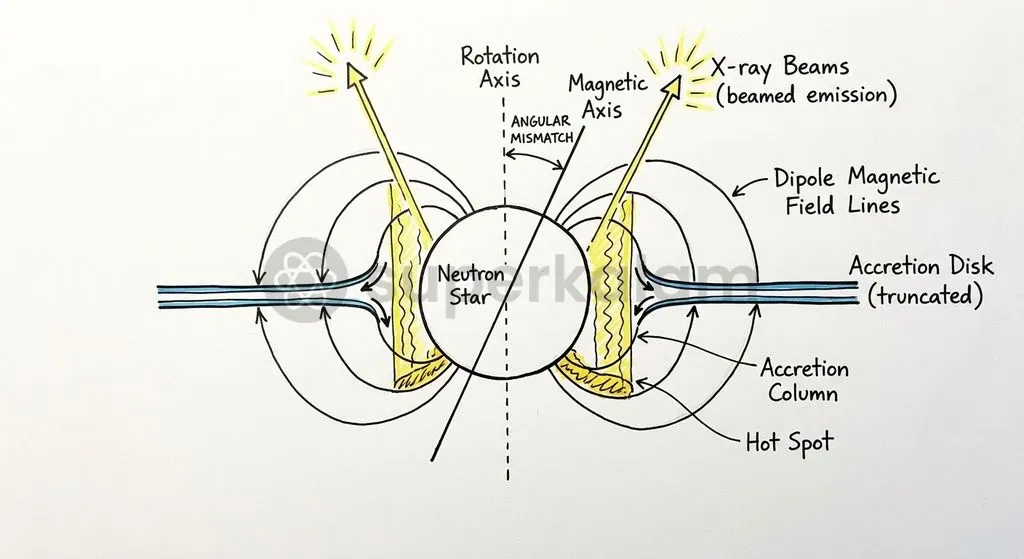
The diagnostic data revealed that the neutron star possesses a magnetic field on the order of 10^12 Gauss, which truncates the inner edge of the accretion disk. This intense magnetic pressure forces incoming plasma away from the disk plane. It channels the gas along magnetic field lines directly onto the magnetic poles to form an accretion column.
The RRI team proved that an accretion stream funnelling matter towards the pulsar rotates synchronously with the neutron star. When this dense gas stream swings across the observer's line of sight, it periodically occults the primary beamed X-rays from the magnetic poles. Concurrently, secondary fluorescent iron emissions from the stream brighten, confirming a coherent disk structure.
Complementary timing analyses revealed that the orbital decay of Centaurus X-3 proceeds alongside secular spin-up. This trend reflects efficient transfer of orbital angular momentum through tidal and accretion torques.
Comparison: Standard Accretion Disk Models vs RRI's Observed Dynamics
The following table contrasts the baseline assumptions of High-Mass X-ray Binary systems against the empirical findings established by RRI researchers for Centaurus X-3:
| Analytical Parameter | Standard HMXB Wind Model | RRI Empirical Findings for Cen X-3 |
|---|---|---|
| Primary Inflow Mechanism | Bondi-Hoyle-Littleton wind capture | Persistent Roche-lobe overflow disk accretion |
| Disk Structure | Transient, weak, or completely absent | Formed accretion disk with magnetically funnelled stream |
| Rotational Coupling | Asynchronous accretion flow relative to neutron star | Accretion stream rotates synchronously with the pulsar |
| Spectroscopic Tracers | Broad, diffuse iron lines lacking clear phase-correlated shifts | Phase-resolved variations across 6.4 keV, ~6.7 keV, and ~6.97 keV lines |
| Long-Term Evolution | Irregular timing shifts dominated by wind variability | Coupled secular spin-up and orbital decay via tidal-accretion torques |
Discuss with Superkalam
Compare how Roche-lobe overflow differs from Bondi-Hoyle-Littleton wind capture in terms of angular momentum transfer and binary orbital evolution.
Ask NowThe Strategic Relevance: What This Means for India's Space Astronomy
The Raman Research Institute's research demonstrates India's growing institutional capability to analyse high-energy astrophysical environments. Founded in 1948 by Nobel laureate Sir C.V. Raman, RRI operates as an autonomous research institution under the Department of Science and Technology (DST). Its sustained work on compact binary systems directly feeds into India's indigenous space-science missions.
Centaurus X-3 is an active target for two primary Indian space platforms:
- AstroSat: Launched in September 2015 as India's first dedicated multi-wavelength space observatory, AstroSat carries instruments that facilitate broadband X-ray spectral studies and long-term orbital timing.
- XPoSat (X-ray Polarimeter Satellite): Launched on January 1, 2024, XPoSat represents a milestone in Indian space capabilities. RRI designed and developed its primary payload, the Polarimeter Instrument in X-rays (POLIX), while the U R Rao Satellite Centre (URSC) contributed the XSPECT instrument.
The deployment of XPoSat placed India alongside the United States as the only two nations to operate a dedicated orbital X-ray polarimeter. Both platforms use target systems like Centaurus X-3 for calibration and study.

The Path Ahead: What Next-Generation X-Ray Missions Must Answer
Future investigations into High-Mass X-ray Binaries must integrate spectro-polarimetric datasets to resolve remaining questions regarding plasma dynamics. While phase-resolved spectroscopy decodes emission lines and radial occultation, measuring polarised photon scattering provides direct geometric constraints on the accretion column's opening angle.
Coordinated multi-wavelength campaigns linking AstroSat, XPoSat, and ground-based facilities will test whether the Roche-lobe overflow observed in Centaurus X-3 represents a transient evolutionary phase or a sustainable equilibrium. Determining how magnetic fields exceeding 10^12 Gauss disrupt plasma walls under varied accretion rates remains essential for modelling relativistic matter transport.
Discuss with Superkalam
Evaluate the significance of autonomous institutions like the Raman Research Institute collaborating with ISRO to build specialized observational platforms like XPoSat.
Ask NowKey Takeaways
- Centaurus X-3 was discovered as an X-ray source in 1967 and confirmed by NASA's Uhuru satellite in 1971 as the first known accretion-powered periodic X-ray pulsar, not discovered by RRI.
- RRI researchers demonstrated that Centaurus X-3 accretes via a synchronized accretion disk rather than relying solely on stellar winds, a rare dynamic for High-Mass X-ray Binaries.
- The binary pairs a neutron star spinning every 4.84 seconds with Krzeminski's star (an O-type supergiant of ~20.5 solar masses) over a 2.09-day orbital period.
- Spectral variations across three primary iron emission lines (6.4 keV, ~6.7 keV, and ~6.97 keV) tracked by XMM-Newton confirmed the presence of a magnetically channelled accretion stream.
- India is the second nation globally to deploy an orbital X-ray polarimetry satellite, following the January 1, 2024 launch of ISRO's XPoSat carrying RRI's POLIX instrument.
Mains Question
"High-Mass X-ray Binaries challenge standard astrophysical accretion models when persistent disk formation supersedes spherical wind capture." In light of the recent Raman Research Institute study on Centaurus X-3, elucidate the mechanisms governing this binary interaction and its significance for observational astrophysics. (10 Marks)
Evaluate NowMains Question
The development of indigenous scientific instruments such as POLIX on XPoSat reflects India's transition from data consumers to front-line contributors in space-based observational astronomy. Examine. (15 Marks)
Evaluate NowPractice MCQs
QUESTION 1
Consider the following statements regarding the High-Mass X-ray Binary (HMXB) system Centaurus X-3:
- It consists of a magnetised neutron star paired with an O-type supergiant known as Krzeminski's star.
- NASA's Uhuru satellite formally confirmed it in 1971 as the first discovered accretion-powered periodic X-ray pulsar.
- The system predominantly relies on spherical Bondi-Hoyle-Littleton stellar wind capture rather than Roche-lobe overflow. Which of the statements given above are correct?
QUESTION 2
Regarding the recent findings on Centaurus X-3 decoded by the Raman Research Institute (RRI), consider the following statements:
- An accretion stream funnelling matter towards the pulsar rotates synchronously with the neutron star's rotation.
- Secondary fluorescent iron emission lines at 6.4 keV, ~6.7 keV, and ~6.97 keV were tracked across the pulsar's rotational cycle.
- The magnetic field of the neutron star is on the order of 10^12 Gauss, truncating the inner accretion disk and channeling plasma to magnetic poles. Which of the statements given above are correct?
QUESTION 3
With reference to Indian space astronomy missions mentioned in high-energy astrophysics research, consider the following statements:
- AstroSat was launched in 2015 as India's first dedicated multi-wavelength space observatory.
- The Polarimeter Instrument in X-rays (POLIX) payload on XPoSat was designed and developed by the Raman Research Institute.
- With the launch of XPoSat, India became the first and only nation globally to deploy an orbital X-ray polarimeter. Which of the statements given above is/are correct?
QUESTION 4
In the context of binary stellar evolution described in the article, what observational characteristic explains the simultaneous occurrence of spin-up and orbital decay in Centaurus X-3?
QUESTION 5
Consider the following statements regarding the institutional background of the Raman Research Institute (RRI):
- It was founded in 1948 by Nobel laureate Sir C.V. Raman.
- It operates as an autonomous research institution under the Department of Science and Technology (DST). Which of the statements given above is/are correct?