CCUS in India: Why Carbon Capture Demands a Sector-Specific Strategy
Because heavy industry emissions stem from chemistry rather than power, blanket decarbonisation mandates fail without sector-specific CCUS strategies.
Nov, 2026
•11 min read
Overview
Carbon capture, utilisation, and storage cannot follow a single uniform mandate in India. Stream purity and process chemistry drive widely divergent capture economics across fertiliser, steel, and cement manufacturing plants.
According to policy findings by NITI Aayog, abatement costs range from 15 dollars per tonne in high-purity chemical off-gas to over 120 dollars per tonne in dilute cement kilns. India's decarbonisation strategy must discard blanket rules for a phased, sector-differentiated transition.
Ammonia plants can commercialise capture immediately. In contrast, primary steelmakers need transitional retrofit support, while cement producers depend entirely on shared transport networks and public storage infrastructure to avoid economic paralysis.
Why in the News? The Push for a National CCUS Policy
New fiscal allocations and research infrastructure are accelerating domestic industrial carbon management:
- Union Budget Allocation: The Ministry of Finance announced an outlay of ₹20,000 crore over five years in the Union Budget 2026–27 to incentivise CCUS technologies across heavy industries. As of October 2026, the policy specifically targets five foundational sectors: Power, Steel, Cement, Refineries, and Chemicals, per a PIB release on Carbon Capture, Utilisation and Storage.
- Commercial Transition: This targeted fiscal push marks India's deliberate transition from academic laboratory research to direct commercial deployment across high-emitting clusters.
- Pioneering Field Facility: On 11 May 2026, India's first Integrated CCUS Field Laboratory Facility was inaugurated at IIT Bombay under the 'Bharat Innovates 2026' initiative.
- Basalt Pilot Validation: Grounded in research on the Deccan Traps, the facility features a pilot capture capacity of up to 3 tonnes of carbon dioxide per day. It pairs indigenous chemical absorption with deep scientific drilling to validate domestic storage security.
How CCUS Actually Works: Capture, Transport, Utilisation, and Storage
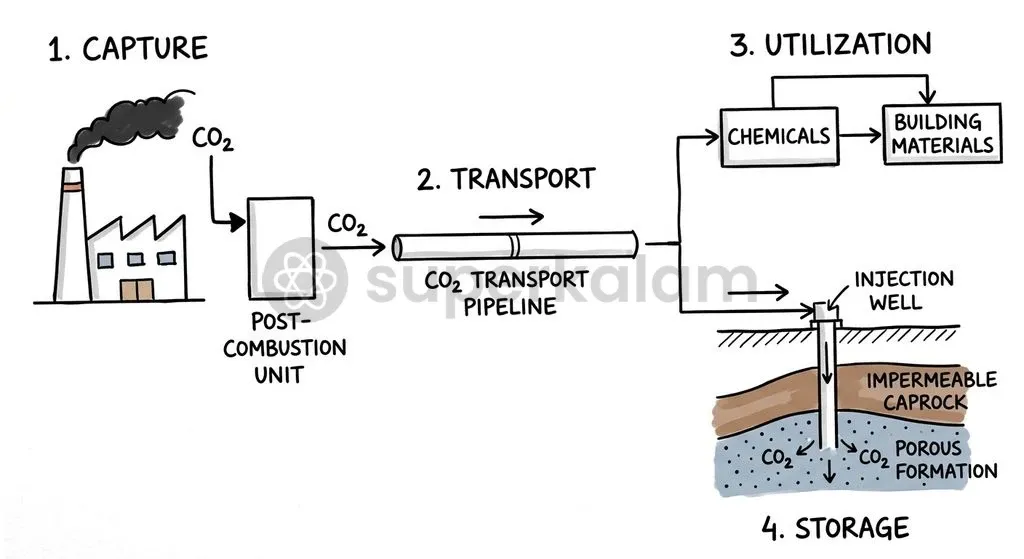
Carbon capture, utilisation, and storage is a four-stage industrial chain designed to isolate point-source emissions and trap them away from the atmosphere permanently. The sequence prevents greenhouse gases from driving radiative forcing by routing flue gas through chemical separation, pressurised transport corridors, and deep subterranean formations.
- Capture: Chemical absorption units, cryogenic separation rigs, or solid adsorbents extract carbon dioxide from combustion or industrial flue gases before atmospheric release.
- Transport: Compression systems condense gaseous emissions into a supercritical state for bulk haulage through high-pressure trunk pipelines or insulated marine tankers.
- Utilisation: Chemical plants convert captured carbon into urea, synthetic fuels, building aggregates, or secondary chemicals, cycling the gas into usable commodities.
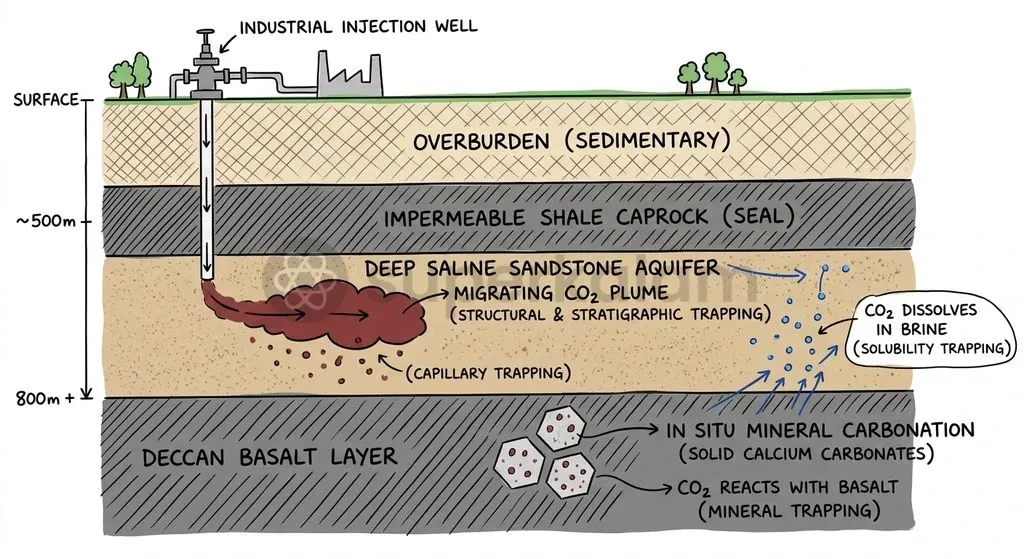
- Storage: Injection pumps drive supercritical carbon dioxide into deep geological formations at depths below 800 metres, securing the gas through physical trapping and chemical mineralisation.
Discuss with Superkalam
Recall the five heavy industrial sectors earmarked for the ₹20,000 crore CCUS allocation in the Union Budget 2026–27.
Ask NowThe Hard-to-Abate Challenge: Why Heavy Industry Cannot Just Switch to Clean Electricity
Thermal renewable energy and industrial heat pumps cannot eliminate emissions from heavy manufacturing. Their primary greenhouse gases stem from unavoidable stoichiometric reactions rather than fuel combustion.
While light manufacturing can decarbonise by electrifying boilers and purchasing renewable electricity, heavy industries generate greenhouse gases as an inherent chemical byproduct of raw material transformation:
- Limestone Calcination in Cement Kilns: According to a TERI report on cement decarbonisation, roughly 60% to 65% of direct emissions in cement manufacturing arise from the endothermic calcination of limestone. Calcium carbonate breaks down into calcium oxide and carbon dioxide. Switching kilns to zero-carbon green electricity leaves this chemical conversion unaffected, making post-combustion CCUS the sole viable pathway to mitigate process emissions.
- Primary Iron Reduction in Blast Furnaces: Conventional Blast Furnace-Basic Oxygen Furnace (BF-BOF) steelmaking relies on metallurgical coke as a chemical reducing agent rather than a simple thermal fuel. The underlying chemical reduction extracts metallic iron from iron ore according to the reaction:
$$\text{Fe}_2\text{O}_3 + 3\text{CO} \rightarrow 2\text{Fe} + 3\text{CO}_2$$
According to NITI Aayog industrial decarbonisation insights, this reaction generates between 1.8 and 2.3 tonnes of carbon dioxide for every tonne of crude steel produced. Because carbon atoms are chemically required to strip oxygen from iron ore, clean electrification cannot replace fossil carbon without replacing the entire blast furnace architecture.
Comparing the Big Three: CCUS Readiness in Steel vs Cement vs Urea
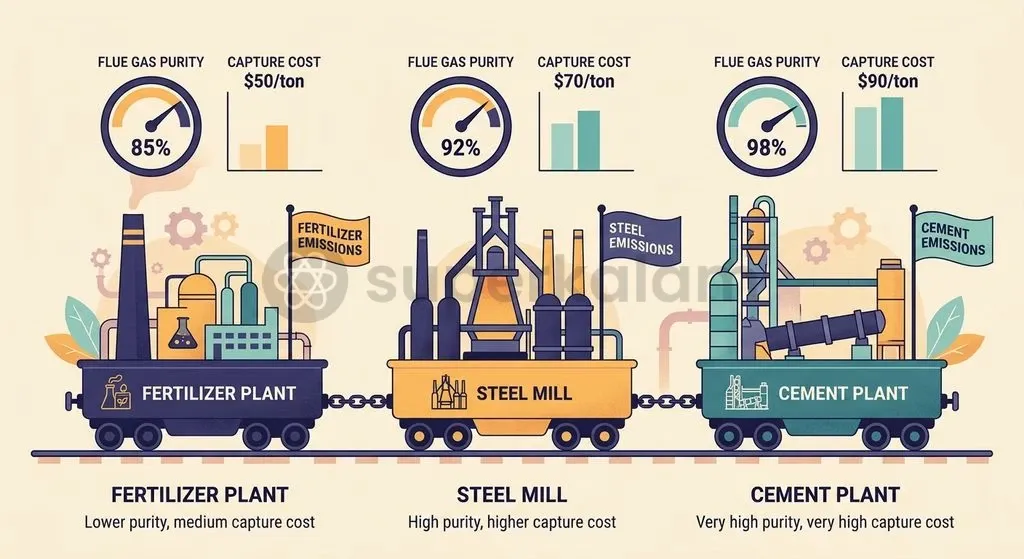
Industrial carbon capture costs vary widely based on partial pressures, gas volumes, and chemical concentrations across different manufacturing plants. Capture costs rise sharply as the concentration of carbon dioxide in the flue stream drops, requiring larger absorption vessels, higher solvent volumes, and substantial reboiler heat.
| Dimension | Urea & Fertilizer | Cement Manufacturing | Primary Steel (BF-BOF) |
|---|---|---|---|
| CO2 Stream Concentration | 95% to 99% (High purity) | 14% to 30% (Dilute flue gas) | 15% to 27% (Moderate off-gas) |
| Levelized Capture Cost | $15 to $25 per tonne | $60 to $120 per tonne | $60 to $110 per tonne |
| Primary Emission Driver | Hydrocarbon reforming | Limestone calcination (60–65%) | Carbon chemical reduction |
| Energy Penalty on Plant | Minimal (<5% auxiliary power) | Moderate (Heat for regeneration) | High (15% to 25% auxiliary power) |
| Alternative Pathway | Green ammonia synthesis | Clinker substitution (partial) | Green hydrogen DRI |
| Commercial Timeline | Immediate deployment | 2030–2035 cluster scale | 2028–2035 retrofit window |
Discuss with Superkalam
Explain why switching industrial kilns and furnaces to renewable electricity fails to eliminate stoichiometric process emissions.
Ask NowHigh Purity, Low Cost: Why Fertilizer and Chemicals Offer the Easiest Starting Point
Ammonia synthesis facilities generate nearly pure streams of carbon dioxide that require minimal chemical separation before compression and transport. Two structural factors explain this cost advantage:
- Minimal Regeneration Penalty: During steam methane reforming or secondary purification, fertiliser plants vent an off-gas stream containing 95% to 99% carbon dioxide. This high purity eliminates the need for complex thermal regeneration stripping. Data from the Asian Development Bank indicates that this concentrated stream limits levelised capture expenditures to between $15 and $25 per tonne of carbon dioxide.
- Direct Co-located Utilisation: Ammonia production facilities also operate adjacent urea synthesis plants that absorb massive quantities of carbon dioxide to convert ammonia into solid nitrogenous fertiliser. This co-location makes the chemical sector the most commercially viable starting point for immediate, low-cost domestic deployment.
Discuss with Superkalam
How would you apply the hub-and-cluster infrastructure model to overcome the geographic dispersion of rural cement kilns?
Ask NowThe Steel Dilemma: Blast Furnaces, Energy Penalties, and the Threat of Green Hydrogen
Primary steel producers face an operational trade-off between retrofitting young blast furnaces with carbon capture systems and waiting for green hydrogen technology to mature. Blast furnace off-gases carry moderate carbon dioxide concentrations of 15% to 27%, requiring levelised capture expenditures of $60 to $110 per tonne of carbon dioxide according to NITI Aayog's CCUS Policy Framework.
A primary technical barrier is the energy penalty of 15% to 25% imposed on plant auxiliary power systems to regenerate chemical absorption solvents. Yet, Indian blast furnaces have an average operational age of 10 to 15 years, compared to a normal economic operating lifespan of 30 to 40 years. Retiring these facilities early to adopt alternative production pathways would trigger massive capital write-offs across public and private steelmakers.
Direct-reduced iron powered by green hydrogen offers an emission-free production alternative, but the process faces steep infrastructure and resource constraints:
- Hydrogen Price Threshold: Production costs for green hydrogen must fall below $1.50 to $2.00 per kilogram to achieve economic parity with conventional coal-based reduction routes.
- Feedstock Volume: Clean ironmaking consumes approximately 50 to 60 kilograms of green hydrogen for every single tonne of crude steel produced.
- Continuous Clean Power: Electrolyser fleets demand dedicated, uninterrupted renewable electricity grids to maintain steady furnace feed rates, per NITI Aayog sectoral insights.
Because these supply chains will take years to build, post-combustion CCUS retrofitting is an essential medium-term mechanism to prevent asset stranding across India's young blast furnace fleet.
The Missing Backbone: CO2 Pipelines, Storage Mapping, and Regulatory Ambiguity
Geological sequestration capacity in India is distributed unevenly across offshore basins, inland saline aquifers, and continental flood basalts. According to NITI Aayog's CCUS Policy Framework, India holds a total theoretical geological storage potential estimated at 400 to 600 gigatonnes of carbon dioxide.
India's storage reservoirs offer distinct geological characteristics and trade-offs:
- Deep Saline Aquifers: Represent India's single largest potential sink, offering a theoretical capacity exceeding 300 gigatonnes, as recorded in a Clean Energy Ministerial and NITI Aayog study.
- Depleted Oil and Gas Fields: Mature onshore and offshore fields account for only 3 to 10 gigatonnes of storage capacity. While they offer well-understood structural trapping and extensive historical geological data, their limited volumetric capacity cannot accommodate decades of continuous emissions from national industrial clusters.
- Deccan Volcanic Province Basalts: Offer permanent containment through in-situ chemical mineralisation. As highlighted by the Ministry of Science and Technology, injecting supercritical carbon dioxide into deep basalt formations triggers chemical reactions with divalent cations, locking greenhouse gases into solid carbonate rock. This permanent mineralisation eliminates the subsurface migration and leakage risks inherent to hydrodynamic trapping within porous sedimentary sandstone.
Making the Math Work: Carbon Pricing, Viability Gap Funding, and Global Lessons
India's compliance carbon architecture operates through the Carbon Credit Trading Scheme under the Energy Conservation (Amendment) Act, 2022. The Bureau of Energy Efficiency established compliance procedures that allow regulated entities to deduct greenhouse gas volumes permanently transferred outside plant boundaries for CCUS from their direct emission accounts.
The Central Electricity Regulatory Commission notified the Carbon Credit Certificates Regulations on 27 February 2026 to govern exchange transactions. Under these rules, regulated facilities that miss their greenhouse gas intensity reduction targets face statutory environmental penalties equal to twice the average market certificate price for that compliance year, according to a PIB release on the Carbon Credit Trading Scheme.
International carbon subsidies contrast sharply with India's market-based framework:
- United States Performance Subsidies: The United States Section 45Q tax credit provides a guaranteed performance subsidy of $85 per metric ton for dedicated geological storage and $60 per ton for utilisation or enhanced oil recovery, per the US Internal Revenue Code.
- India's Capital and Market Model: Conversely, India pairs its market-driven intensity scheme with targeted capital grants, including the ₹20,000 crore Union Budget allocation and Viability Gap Funding recommended by NITI Aayog.
As of late October 2026, Indian power exchanges have not registered an official market-clearing price for compliance Carbon Credit Certificates. Exchange transactions await the gazetting of floor and forbearance price bands alongside registry crediting following the initial compliance review deadline of 31 July 2026, according to Central Electricity Regulatory Commission procedural documents.
Discuss with Superkalam
Analyse the trade-off between the auxiliary energy penalty of post-combustion CCUS and the capital write-off of young blast furnaces in India.
Ask NowWay Forward: A Hub-and-Cluster Roadmap for Industrial Clusters
The Department of Science and Technology recommends adopting a regional hub-and-cluster framework to reduce infrastructure costs for industrial carbon abatement. Establishing shared pipeline trunklines and open-access geological injection hubs allows nearby steel, chemical, and cement plants to aggregate captured volumes, driving down transportation and storage costs through economies of scale.
- Priority Industrial Corridors: State agencies must prioritise shared infrastructure development across the Gujarat coastal industrial corridor and the mineral-dense Odisha-Jharkhand industrial belt.
- Capital Support Mechanisms: The Ministry of Finance should disburse Viability Gap Funding grants to co-finance initial capture facilities and derisk shared pipeline networks.
- Standardised Clearances: Inter-ministerial committees must issue uniform environmental, cross-state pipeline transit, and long-term geological liability frameworks to secure commercial investments.
- Storage Characterisation: The Directorate General of Hydrocarbons must accelerate deep exploratory scientific drilling across offshore saline aquifers and Deccan basalt formations to convert theoretical storage capacity into certified injection reserves.
Key Takeaways
- Divergent Abatement Economics: Levelised capture costs range from $15 to $25 per tonne in concentrated chemical off-gases to over $120 per tonne in dilute cement kilns, ruling out uniform decarbonisation policies.
- Process Emission Realities: Thermal efficiency and clean electrification cannot eliminate the 60% to 65% of cement emissions caused by limestone calcination, making geological carbon capture technically indispensable.
- Blast Furnace Asset Protection: Post-combustion retrofits safeguard India's young blast furnace fleet, which averages an operational age of only 10 to 15 years, while green hydrogen supply chains scale up.
- Enormous Storage Potential: India possesses 400 to 600 gigatonnes of theoretical storage capacity, led by deep saline aquifers exceeding 300 gigatonnes and basalt formations that trap emissions via permanent chemical mineralisation.
- Evolution of Carbon Markets: The Carbon Credit Trading Scheme allows industrial capture deductions, with enforcement supported by statutory non-compliance penalties set at twice the annual average certificate price.
Mains Question
"Because carbon abatement costs range from $15 per tonne in chemical synthesis to over $120 per tonne in cement production, India cannot adopt a blanket, uniform CCUS framework." Elucidate. (10 Marks)
Evaluate NowMains Question
India's primary steel sector faces a complex dilemma between near-term CCUS retrofitting and transitioning to Green Hydrogen Direct Reduced Iron (DRI). In light of blast furnace fleet demographics and techno-economic hurdles, critically examine both pathways. (15 Marks)
Evaluate NowPractice MCQs
QUESTION 1
With reference to industrial emissions and Carbon Capture, Utilisation, and Storage (CCUS) in India, consider the following statements:
- In cement manufacturing, roughly 60% to 65% of direct emissions arise from the calcination of limestone, which cannot be eliminated by switching kilns to clean electricity.
- In conventional blast furnace steelmaking, metallurgical coke acts solely as a thermal fuel to supply high-temperature heat.
- Carbon dioxide capture costs from ammonia synthesis off-gas are substantially lower than from cement kilns due to higher stream purity. Which of the statements given above are correct?
QUESTION 2
Consider the following statements regarding the technical stages and parameters of CCUS:
- Supercritical carbon dioxide is required for bulk transport through high-pressure trunk pipelines.
- Deep geological sequestration requires carbon dioxide to be injected into geological formations at depths below 800 metres.
- The Integrated CCUS Field Laboratory Facility at IIT Bombay is designed to study sequestration in continental flood basalts of the Deccan Traps. Which of the statements given above is/are correct?
QUESTION 3
Regarding the decarbonisation pathways for India's primary steel sector, consider the following statements:
- Regenerating chemical absorption solvents for carbon capture in primary steel plants imposes an auxiliary power energy penalty of 15% to 25%.
- Indian blast furnaces have an average operational age of 30 to 40 years, nearing the end of their economic lifespans.
- To attain economic parity with coal-based iron reduction, green hydrogen production costs must decline below $1.50 to $2.00 per kilogram. Which of the statements given above is/are correct?
QUESTION 4
Which of the following industrial sectors were specifically identified under the ₹20,000 crore CCUS outlay announced in the Union Budget 2026–27?
QUESTION 5
Consider the following statements regarding the economics and readiness of CCUS across industries:
- Fertilizer and ammonia manufacturing plants face an auxiliary power penalty of over 20% during carbon capture.
- Cement manufacturing exhibits low CO2 flue gas concentrations between 14% and 30% due to combustion nitrogen and excess air dilution.
- Green hydrogen-based direct-reduced iron requires 50 to 60 kilograms of hydrogen per tonne of crude steel produced. Which of the statements given above are correct?