Draft Drugs Rules: Mandatory CCTV in Retail Pharmacies Explained
Draft Drugs Rules propose mandatory CCTV at retail chemists to curb antimicrobial resistance and drug diversion, raising patient privacy and compliance concerns.
Sep, 2026
•7 min read

Context
The Union Ministry of Health and Family Welfare has proposed amending the Drugs Rules, 1945 to mandate Closed-Circuit Television surveillance across all retail pharmacies during the dispensing of prescription medicines. This regulatory intervention seeks to enforce physical pharmacist oversight, curb over-the-counter dispensing of critical antibiotics that accelerate Antimicrobial Resistance, and prevent illicit diversion of habit-forming narcotics. While the draft amendment establishes an auditable compliance mechanism, it introduces substantial operational challenges for standalone chemists alongside constitutional questions regarding patient health data privacy.
Why in the News?
As of September 2026, the Union Ministry of Health and Family Welfare notified Draft Gazette Notification G.S.R. 791(E) on 8 September 2026 to introduce mandatory video monitoring at retail drug dispensaries. The proposal inserts sub-rule (2A) into Rule 65 of the Drugs Rules, 1945, requiring all retail supply of prescription drugs to occur under active CCTV coverage.
The statutory revision stems from formal recommendations by the Drugs Technical Advisory Board, which examined compliance vulnerabilities in retail dispensing. The rulemaking power is anchored in Sections 12 and 33 of the parent Drugs and Cosmetics Act, 1940.
Understanding Drug Classifications: Schedule H, H1, and X
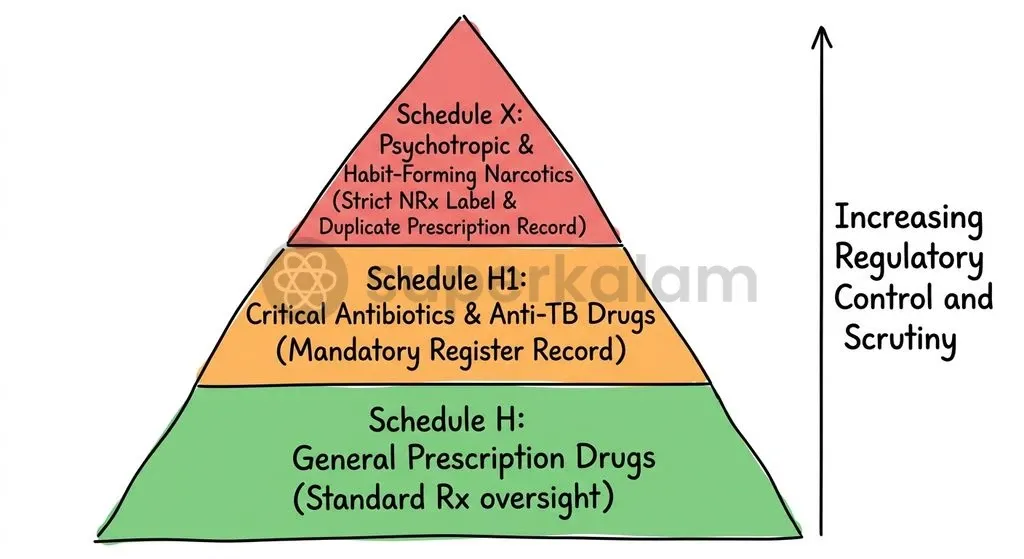
The Drugs Rules, 1945 categorise pharmaceutical preparations into distinct schedules based on their therapeutic potency, risk of abuse, and public health impact. Understanding these regulatory boundaries is essential for analysing statutory enforcement standards across retail supply chains.
| Regulatory Parameter | Schedule H Drugs | Schedule H1 Drugs | Schedule X Drugs |
|---|---|---|---|
| Primary Scope | Over 500 prescription-only medicines, including standard antibiotics and analgesics | 3rd and 4th generation antibiotics, anti-TB medicines, and habit-forming psychotropics | Potent narcotic and psychotropic substances with high abuse potential |
| Labelling Requirement | Distinct 'Rx' symbol with a mandatory statutory cautionary warning on the packaging | 'Rx' symbol in red displayed prominently along with warning against non-prescription sale | 'NRx' symbol in red on the left corner of the label |
| Record-Keeping Mandate | Standard billing record with prescription verification | Dedicated register detailing patient name, prescriber details, and medicine quantity maintained for three years | Maintenance of dedicated accounts and mandatory retention of prescription duplicates for two years |
| Storage Protocol | Standard pharmacy shelving under controlled temperature | Standard retail storage under registered pharmacist supervision | Separate lock-and-key storage to prevent unmonitored access |
Schedule H serves as the baseline tier for standard prescription medications, ensuring that potent medicines are not consumed without clinical guidance. Schedule H1 was notified in August 2013 through Gazette Notification G.S.R. 588(E) to institute stricter oversight against antimicrobial misuse and tranquiliser diversion. Schedule X enforces the most stringent retail barriers under Rule 65(4), requiring duplicate prescription copies to facilitate multi-agency statutory audits.
Discuss with Superkalam
Recall the minimum time period for which retail pharmacies must preserve video footage under draft G.S.R. 791(E).
Ask NowKey Provisions of the Draft Rules: Mandatory CCTV and Digital Auditing
The draft amendment under G.S.R. 791(E) inserts sub-rule (2A) into Rule 65 to introduce mandatory electronic surveillance over retail pharmaceutical dispensing. The rule specifies that no prescription drug may be supplied by a licensed retail chemist unless the transaction takes place under an operational Closed-Circuit Television system.
The statutory provisions outline three structural mandates for retail establishments:
- Mandatory Video Retention: Retail pharmacies must preserve all recorded surveillance footage for a minimum period of three months to allow verification during regulatory inspections.
- Retail-Specific Application: The surveillance requirement applies strictly to retail pharmacies and compounding dispensaries, while wholesale drug distributors are explicitly exempted from the mandate.
- Verification of Pharmacist Presence: The video audit trail creates verifiable visual evidence that a qualified Registered Pharmacist is physically present and actively supervising transactions, as mandated under the Pharmacy Practice Regulations, 2015.
Enforcement duties remain divided under the federal regulatory framework. The Central Drugs Standard Control Organisation, headed by the Drugs Controller General of India, sets uniform national standards, whereas State Drug Control Administrations execute field inspections and retail licence cancellations under Rule 65.
Public Health Imperatives: Tackling AMR and Drug Diversion
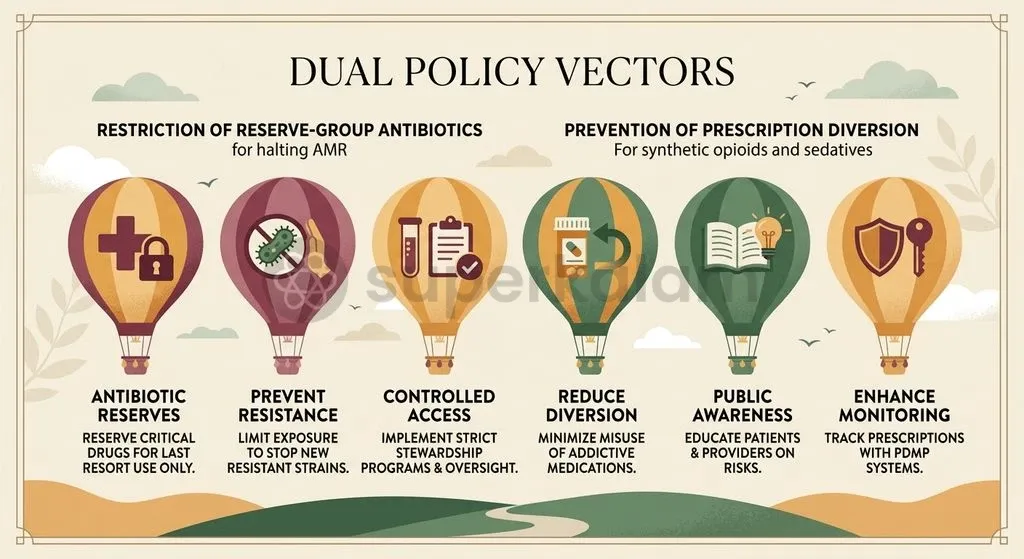
The Central Drugs Standard Control Organisation designed the CCTV mandate to resolve critical structural failures in medicine distribution. Widespread over-the-counter dispensing of Watch and Reserve category antibiotics without legitimate prescriptions has accelerated Antimicrobial Resistance across the country.
Unregulated antibiotic use destroys microbial sensitivity, rendering frontline therapeutic regimens ineffective against common bacterial pathogens. Continuous visual record-keeping deters pharmacies from selling broad-spectrum antimicrobials without valid medical documentation, directly advancing the goals of the National Action Plan on AMR.
The surveillance framework also targets the illegal diversion of habit-forming pharmaceutical preparations. Joint administrative reviews by regulatory authorities highlight how unrecorded retail channels feed substance abuse through the illicit sale of synthetic opioids, high-potency sedatives, and codeine formulations.
A 2019 AIIMS study quantified the misuse behind this provision: 1.8% of children surveyed reported opioid use and 1.9% cannabis use, while about 25 lakh of India's 2.3 crore opioid users were dependent on pharmaceutical opioids rather than illicit drugs.
Discuss with Superkalam
Explain how visual verification of a registered pharmacist's physical presence helps curb Antimicrobial Resistance (AMR).
Ask NowImplementation Challenges: Compliance Burden and Small Chemists
The All India Organisation of Chemists and Druggists has raised substantial concerns regarding the technical and financial feasibility of continuous video recording. Standalone and rural retail chemists face high initial hardware expenditures alongside recurring costs for secure digital data storage.
Maintaining ninety days of uncorrupted video archives requires reliable electricity, multi-terabyte storage servers, and regular hardware servicing. For small rural pharmacies operating on slim retail margins, uninterrupted surveillance presents an acute structural challenge that could disrupt local access to essential medicines.
Chemists have also flagged patient privacy, since cameras record identifiable buyers of sensitive medicines. The proposal itself dates to 2021, when the Drugs Consultative Committee first recommended CCTV to curb drug abuse among children; the DCC and the CDSCO decided to implement it this year.
Ethical and Legal Dimensions: Balancing Patient Confidentiality and Public Safety
The draft CCTV mandate intersects directly with informational privacy guarantees established under the Digital Personal Data Protection Act, 2023. Continuous video capture at retail pharmacy counters records identifiable facial footage alongside sensitive personal health choices.
Retail surveillance creates immediate ethical friction regarding doctor-patient confidentiality and public health stigmatisation. Video recording risks deterring patients from seeking essential treatments for socially stigmatised conditions, including:
- Reproductive health interventions, contraceptive access, and medical termination of pregnancy formulations.
- Psychiatric medications, mood stabilisers, and anti-depressants.
- Anti-retroviral therapies for HIV and treatments for Sexually Transmitted Infections.
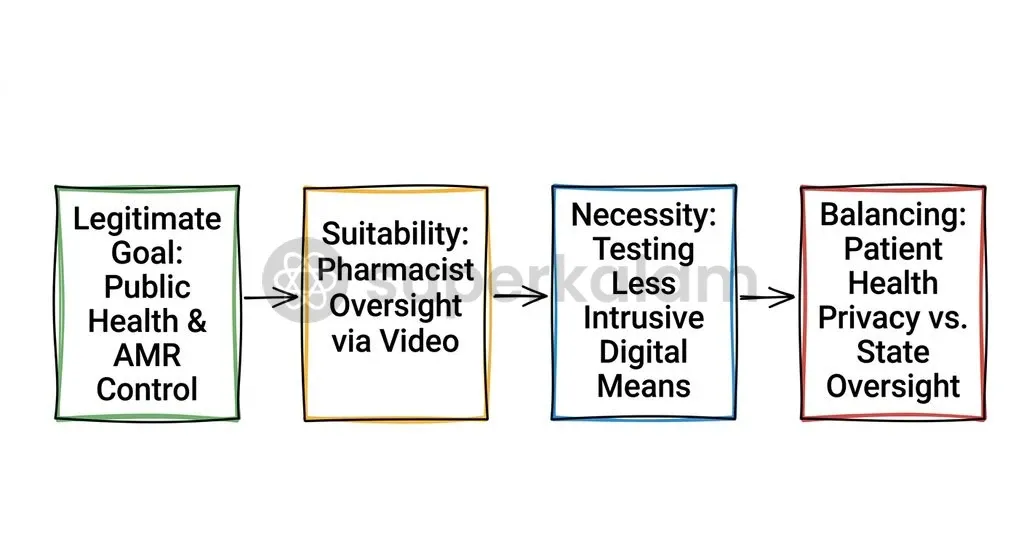
The Supreme Court laid down a binding four-prong proportionality standard in Justice K.S. Puttaswamy (Retd.) v. Union of India (2017), holding that state intrusions into privacy must demonstrate a legitimate aim, suitability, necessity, and strict balancing. While controlling AMR serves a legitimate state interest, deploying blanket video surveillance across every routine prescription purchase faces strict constitutional scrutiny under the least-restrictive-means test.
Discuss with Superkalam
Analyse the structural and financial hurdles that make 90-day video archiving more burdensome for rural standalone chemists than urban chains.
Ask NowWay Forward: Building a Balanced Regulatory Architecture
The Ministry of Health and Family Welfare must refine the draft rules to reconcile regulatory enforcement with constitutional proportionality. Instead of universal, indiscriminate video surveillance, the Central Drugs Standard Control Organisation should consider a tiered risk-based enforcement framework.
A calibrated mechanism should mandate continuous CCTV monitoring solely for establishments stocking high-risk Schedule X narcotics and critical Reserve-group antibiotics, rather than routine Schedule H formulations. Clear data governance rules must restrict video access exclusively to judicial warrants or formal inquiries by designated Drug Inspectors, preventing arbitrary data leaks. Integrating centralised electronic prescription tracking systems can deliver robust regulatory oversight without subjecting ordinary citizens to counter-level surveillance.
Discuss with Superkalam
Weigh the public health benefits of curbing illicit drug diversion against the informational privacy rights of patients under the Puttaswamy doctrine.
Ask NowKey Takeaways
- The Union Health Ministry's Draft Notification G.S.R. 791(E) proposes inserting sub-rule (2A) into Rule 65 of the Drugs Rules, 1945, mandating CCTV coverage for retail prescription drug dispensing.
- Retail pharmacies must retain recorded video footage for a minimum of three months, while wholesale dealers remain exempt from the requirement.
- The policy aims to verify the physical presence of a Registered Pharmacist, halt over-the-counter antibiotic sales driving Antimicrobial Resistance, and curb prescription narcotic diversion.
- The mandate creates significant operational and storage compliance costs for small, rural chemists who operate on narrow margins.
- Unrestricted counter-level surveillance raises severe privacy and ethical concerns under the DPDP Act, 2023 and the Supreme Court's Puttaswamy (2017) proportionality doctrine, especially for stigmatised medical treatments.
Mains Question
"The proposed insertion of sub-rule (2A) into Rule 65 of the Drugs Rules, 1945 seeks to curb Antimicrobial Resistance and drug diversion, but it faces constitutional scrutiny under informational privacy guarantees." Critically analyse this regulatory intervention in light of the proportionality standard laid down in the Puttaswamy judgment. (15 Marks)
Evaluate NowMains Question
Highlighting the distinct regulatory mandates under Schedules H, H1, and X of the Drugs Rules, 1945, evaluate the operational challenges faced by standalone retail chemists in complying with digital and electronic surveillance mandates. (10 Marks)
Evaluate NowPractice MCQs
QUESTION 1
With reference to drug classifications under the Drugs Rules, 1945, consider the following statements:
- Schedule H1 drugs require retail chemists to maintain a dedicated register with patient and prescriber details for three years.
- Schedule X drugs require separate lock-and-key storage and retention of prescription duplicates for two years.
- Packaging for Schedule H1 drugs must display the 'NRx' symbol in red on the left corner of the label. Which of the statements given above are correct?
QUESTION 2
Consider the following statements regarding the draft amendment to the Drugs Rules, 1945 notified under G.S.R. 791(E):
- It inserts sub-rule (2A) into Rule 65, mandating CCTV surveillance during the retail dispensing of prescription medicines.
- Retail pharmacies are required to preserve recorded video footage for a minimum period of three months.
- The CCTV surveillance mandate applies equally to both retail pharmacies and wholesale drug distributors. Which of the statements given above is/are correct?
QUESTION 3
With reference to the statutory and regulatory framework governing pharmaceuticals in India, consider the following statements:
- The rulemaking power to amend the Drugs Rules, 1945 is anchored in Sections 12 and 33 of the Drugs and Cosmetics Act, 1940.
- The Drugs Technical Advisory Board (DTAB) recommended the introduction of CCTV surveillance in retail dispensing.
- Field inspections and retail drug licence cancellations under Rule 65 are directly executed by the Central Drugs Standard Control Organisation (CDSCO). Which of the statements given above is/are correct?
QUESTION 4
Schedule H1 was incorporated into the Drugs Rules, 1945 primarily to regulate which of the following categories of pharmaceutical products?
QUESTION 5
Under the constitutional framework established in Justice K.S. Puttaswamy v. Union of India (2017), state intrusions into personal privacy must satisfy a four-prong proportionality standard. Which of the following is NOT one of these prongs?