CBI General Consent: Bihar's Two-Tier Model and Federalism
Bihar's bifurcated CBI consent regime tests the delicate constitutional balance between central anti-corruption enforcement and state police prerogatives.
Sep, 2026
•11 min read
Overview
The Bihar Home Department notification restructuring Central Bureau of Investigation consent establishes a bifurcated investigative framework under Section 6 of the Delhi Special Police Establishment Act, 1946. It grants standing jurisdiction over Central personnel. At the same time, it mandates case-by-case state sanction for inquiries against state public servants and institutions.
As of September 2026, this institutional shift highlights the constitutional friction between Union investigative powers under Entry 8 of List I and exclusive state police jurisdiction under Entry 2 of List II. While the complete withdrawal of general consent has historically signalled political confrontation, Bihar's selective consent mechanism attempts an operational compromise between central anti-corruption enforcement and state-level administrative autonomy.
Why in the News: The Shift in CBI State Consent
The Bihar Home Department issued a notification under Section 6 of the Delhi Special Police Establishment Act, 1946, establishing a two-tier consent regime for the Central Bureau of Investigation. As of September 2026, this policy shift fundamentally modifies how central investigative agencies operate within the state's territorial boundaries.
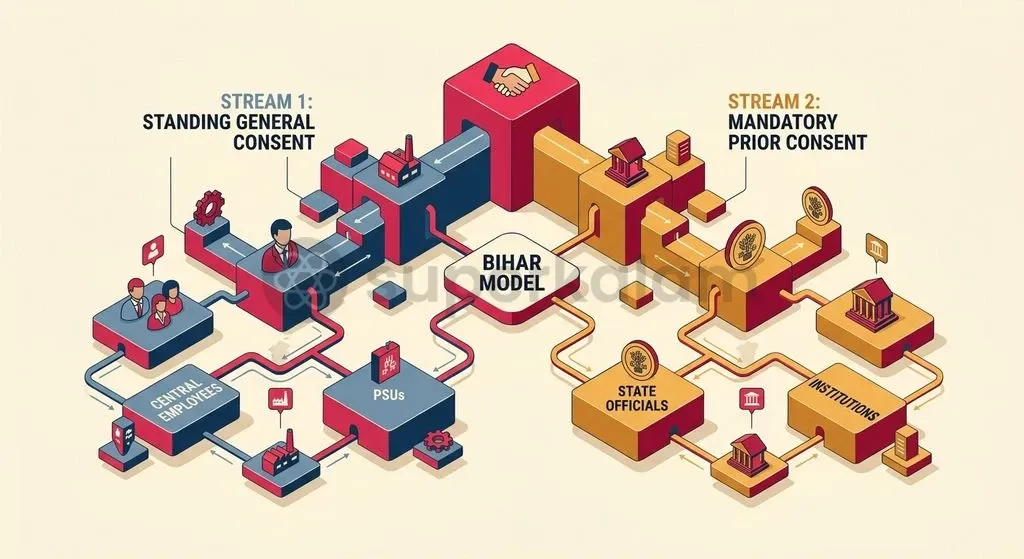
The revised framework separates investigative jurisdiction into two distinct operational streams:
- Standing general consent: The Central Bureau of Investigation (CBI) retains automatic clearance to investigate offences involving Central government employees, Central public sector undertakings (PSUs), and private individuals under Central control. Routine federal anti-corruption probes proceed without state-level clearance.
- Mandatory specific consent: The CBI must secure prior state government consent on a case-by-case basis before undertaking any formal investigation, search, interrogation, or arrest involving Bihar government public servants, state-owned public sector enterprises, or state-funded institutions.
This bifurcated model distinguishes Bihar from other states that implemented complete, across-the-board revocations of general consent.
Discuss with Superkalam
Which specific entries in the Seventh Schedule of the Constitution govern Central intelligence agencies and State police powers respectively?
Ask NowGeneral Consent vs Specific Consent: Key Differences and Mechanics
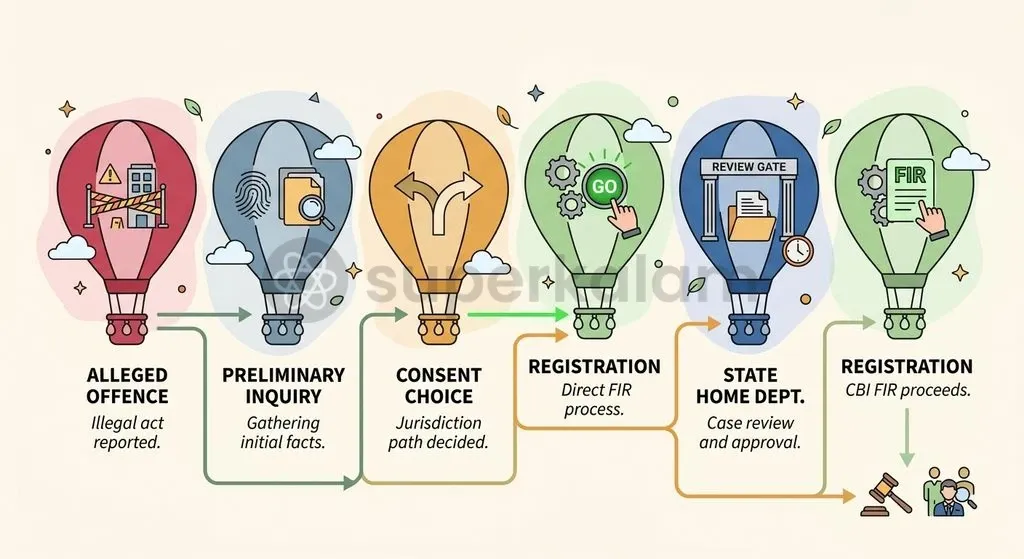
State consent under the Delhi Special Police Establishment Act, 1946 determines whether central investigators can seamlessly register First Information Reports or must seek individual administrative clearances. The operational differences between these two consent frameworks govern the speed, reach, and independence of CBI inquiries within a state.
| Dimension | General Consent | Specific (Case-by-Case) Consent |
|---|---|---|
| Statutory Basis | Section 6, DSPE Act, 1946 | Section 6, DSPE Act, 1946 |
| Operational Mechanism | Standing, blanket clearance for notified offences | Individual application submitted for each specific case or person |
| Administrative Process | Immediate registration of Regular Cases (FIRs) and Preliminary Inquiries | State home department scrutinises and approves or denies each request |
| Jurisdictional Scope | Covers all central and notified state-level economic or corruption offences | Confined strictly to the specific incident or individual sanctioned |
| Investigative Speed | High operational efficiency without procedural bottlenecks | Substantial procedural delays during inter-governmental review |
According to official parliamentary clarifications from the Ministry of Personnel, Public Grievances and Pensions, the withdrawal or restriction of general consent operates strictly prospectively. It does not invalidate ongoing inquiries or cancel cases registered prior to the notification date. Furthermore, central officers retain the legal authority to pursue investigations within the state if the primary offence was registered in a jurisdiction where valid consent exists.
Why States Withdraw Consent: Police Powers, Politics, and Trust
State governments withdraw general consent primarily to protect their exclusive legislative competence over police and public order under the Seventh Schedule from perceived central encroachment. The lack of an independent, modern legislative charter for the CBI often converts routine jurisdictional boundaries into intense federal controversies.
The friction between the Union and the States typically centres on three key governance challenges:
- Federal Autonomy and State Police Prerogatives: Because state governments bear sole constitutional accountability for maintenance of law and order, uninhibited central investigations into local administrative machinery can destabilise state executive authority.
- Perceptions of Selective Enforcement: State administrations frequently argue that central agencies focus disproportionately on opposition-governed states, eroding the perceived political neutrality required for cooperative federalism.
- Institutional Subordination: Unlike autonomous constitutional bodies such as the Election Commission of India, the CBI remains an attached office under the Department of Personnel and Training (DoPT), leading states to question its investigative insulation.
When general consent is withdrawn, central investigators face significant hurdles. The agency cannot conduct surprise raids, seize evidence, or arrest suspects within state borders without prior administrative approval or judicial intervention, significantly weakening anti-corruption deterrence.
Discuss with Superkalam
How does blanket general consent fundamentally differ from specific case-by-case consent in terms of investigative speed and administrative clearance?
Ask NowWhy Bihar’s Position Stands Apart in India’s Federal Landscape
Bihar's September 2026 notification distinguishes itself by avoiding a blanket revocation of general consent, opting instead for a targeted, asymmetric two-tier model. While several other states have previously rescinded all standing permissions for central inquiries, Bihar’s framework preserves central jurisdiction over Union personnel.
This structured distinction directly addresses federal governance realities:
- Central Integrity Protection: By maintaining standing general consent for Central government employees and Central PSUs, the state ensures that central anti-corruption enforcement against Union officers is not obstructed.
- State Administrative Shield: By requiring specific, case-by-case clearance for state public servants and state-funded institutions, the state executive retains oversight over its own administrative apparatus.
This calibrated bifurcation illustrates the concept of asymmetric federalism in executive administration. It provides a legal mechanism that accommodates the Union's interest in regulating federal officers while safeguarding state autonomy against unilateral central investigative actions.
What the Courts Have Ruled: CBI Jurisdiction and State Autonomy
The Supreme Court of India has consistently maintained that while statutory investigation requires state consent, constitutional judicial review under Articles 32 and 226 remains unconstrained. The judiciary has repeatedly clarified the constitutional boundaries governing central investigative powers and state territorial sovereignty.
In the landmark case of State of West Bengal v. Committee for Protection of Democratic Rights (2010), a 5-judge Constitution Bench held that the Supreme Court under Article 32 and High Courts under Article 226 possess the extraordinary constitutional power to direct CBI investigations without state consent. The Court ruled that fundamental rights enforcement overrides statutory limitations contained in Section 6 of the DSPE Act, though such powers must be exercised sparingly.
- Vineet Narain (1998): Mandated statutory CVC oversight and a fixed two-year minimum tenure for the CBI Director.
- CPDR Case (2010): Confirmed the Supreme Court (Art 32) and High Courts (Art 226) can order investigations without state consent.
- Fertico Marketing (2020): Affirmed Section 6 of the DSPE Act upholds the constitutional federal character of India.
- State of WB v. UOI (2024): Ruled Article 131 original suits are maintainable against the Union regarding consent disputes.
The apex court has also guarded the statutory federal balance. In Fertico Marketing and Investment Private Limited v. CBI (2020), the Supreme Court affirmed that Section 6 of the DSPE Act aligns with the federal character of the Constitution, emphasizing that Parliament consciously designed state consent as an indispensable statutory condition.
More recently, in State of West Bengal v. Union of India (2024), the Supreme Court held that an original suit filed by a State under Article 131 challenging CBI investigations post-withdrawal of general consent is maintainable against the Union of India, confirming that jurisdictional disputes over central agencies represent justiciable federal controversies.
Discuss with Superkalam
If a Central government PSU employee and a Bihar state administrative officer are jointly accused of corruption within Bihar, how would the two-tier consent model apply to the initiation of the CBI probe?
Ask NowBalancing Impartial Justice with Federal Rights: The Governance Dilemma
Institutional ethics require reconciling the imperative of impartial central anti-corruption enforcement with the constitutional sanctity of state autonomy in police administration. The tension between central vigilance and state executive powers represents a major structural challenge in Indian administrative governance.
| Governance Dimension | Central Anti-Corruption Imperative | State Federal Autonomy |
|---|---|---|
| Core Objective | Seamless prosecution of corruption across national jurisdictions | Protection of state executive authority and local policing control |
| Institutional Vulnerability | Potential weaponisation against state political leadership | Creation of administrative opacity and local political patronage |
| Constitutional Mandate | Union accountability under Entry 8 of List I | Exclusive provincial jurisdiction under Entry 2 of List II |
From a public administration perspective, unchecked state-level immunity creates risks of administrative opacity and local political patronage. When a state administration denies specific consent to shield influential public officials, it undermines the rule of law and equal application of justice. Conversely, unfettered central investigative powers risk converting central agencies into instruments of political control, overriding the constitutional demarcation established by the Seventh Schedule.
To maintain institutional integrity, the Supreme Court in Vineet Narain v. Union of India (1998) established statutory superintendence over the CBI by the Central Vigilance Commission (CVC) for corruption cases. The judgment also mandated a minimum two-year tenure for the CBI Director to protect the leadership from arbitrary executive interference.

Way Forward: Statutory Reforms to Secure Autonomy and Federal Balance
Reforming the Central Bureau of Investigation demands moving beyond the pre-constitutional DSPE framework toward comprehensive legislation that defines federal crimes and institutes multi-stakeholder oversight. Relying on an executive police establishment act from 1946 fails to address the jurisdictional complexities of modern federal governance.
Expert administrative committees have proposed structural solutions to resolve this federal impasse:
- Comprehensive Federal Legislation: The 2nd Administrative Reforms Commission (ARC), in its 4th Report on 'Ethics in Governance', recommended enacting a dedicated central statute to define federal crimes and govern the CBI with explicit statutory safeguards.
- Consultative Interstate Mechanism: The Commission on Centre-State Relations (Justice Punchhi Commission) recommended enacting an overarching legal framework under Entry 8 of List I that establishes a formal consultative mechanism to respect state police prerogatives while ensuring national-level investigative efficacy.
- Transparent Classification of Offences: Parliament should statutorily classify offences involving inter-state organized crime, national security, and high-value financial fraud as distinct "federal crimes", limiting state vetoes while leaving local policing strictly to state forces.
- Independent Oversight and Depoliticisation: Strengthening bipartisan selection panels and institutional accountability through independent oversight bodies can restore mutual trust between Union and State executives.
Discuss with Superkalam
Why does the institutional subordination of the CBI under the Department of Personnel and Training (DoPT) heighten state-level concerns regarding federal encroachment?
Ask NowKey Takeaways
- Bifurcated Consent Framework: The Bihar Home Department notification under Section 6 of the DSPE Act, 1946 establishes standing general consent for Central personnel while requiring case-by-case specific consent for Bihar state public servants.
- Statutory Authority: The CBI operates under the Delhi Special Police Establishment Act, 1946, where Section 5 allows the extension of jurisdiction to states, strictly subject to state consent mandated by Section 6.
- Constitutional Demarcation: While Parliament exercises competence over the Central Bureau of Intelligence and Investigation under Entry 8 of List I, Police and Public Order remain exclusive state subjects under Entries 1 and 2 of List II.
- Constitutional Court Powers: In State of West Bengal v. CPDR (2010), the Supreme Court affirmed that constitutional courts under Articles 32 and 226 can mandate CBI probes without state consent, superseding statutory consent restrictions.
- Prospective Operation: Withdrawal or restriction of general consent does not invalidate ongoing cases registered prior to the date of notification.
- Reform Imperative: Both the 2nd ARC (4th Report) and the Punchhi Commission recommended replacing the 1946 DSPE Act with modern central legislation governing federal crimes through structured state consultation.
Mains Question
"Section 6 of the Delhi Special Police Establishment Act, 1946 acts as an indispensable statutory check to preserve the constitutional balance between Union investigative powers and State police autonomy." In light of this statement, elucidate how the two-tier consent model adopted by Bihar seeks to balance central anti-corruption enforcement with state administrative autonomy. (10 Marks)
Evaluate NowMains Question
The repeated withdrawal of general consent to the Central Bureau of Investigation by State governments underscores deep-seated frictions in Indian federalism. Critically analyse the constitutional and institutional dilemmas surrounding the operation of the DSPE Act, 1946, and discuss the judicial boundaries established by the Supreme Court to reconcile state consent with fundamental rights enforcement. (15 Marks)
Evaluate NowPractice MCQs
QUESTION 1
With reference to the statutory framework governing the Central Bureau of Investigation (CBI), consider the following statements:
- Section 6 of the Delhi Special Police Establishment (DSPE) Act, 1946 mandates prior state government consent before the CBI can exercise jurisdiction within a state.
- The Central Bureau of Intelligence and Investigation is enumerated under Entry 8 of the Union List (List I).
- Police and Public Order are subjects placed under the concurrent legislative jurisdiction of both Parliament and State Legislatures.
Which of the statements given above are correct?
QUESTION 2
Consider the following statements regarding landmark judicial pronouncements on the CBI's jurisdiction:
- In the CPDR case (2010), a Constitution Bench held that the Supreme Court and High Courts cannot order CBI probes without prior state consent.
- In Fertico Marketing (2020), the Supreme Court affirmed that Section 6 of the DSPE Act reflects and upholds the federal character of the Constitution.
- The Vineet Narain (1998) ruling mandated statutory CVC oversight and a fixed minimum tenure of two years for the CBI Director.
Which of the statements given above is/are correct?
QUESTION 3
With reference to the administrative mechanics of state consent under the DSPE Act, 1946, consider the following statements:
- The withdrawal of general consent applies retrospectively, resulting in the cancellation of previously registered First Information Reports (FIRs).
- Central investigators retain authority to pursue inquiries within a non-consenting state if the primary offence was registered in a jurisdiction where valid consent exists.
- Bihar's two-tier model requires specific, case-by-case state clearance for investigations involving state public servants and state-funded institutions.
Which of the statements given above are correct?
QUESTION 4
Consider the following statements regarding Bihar's two-tier CBI consent framework:
- It completely revokes standing general consent for all central and state-level investigations across the state.
- It retains standing general consent for inquiries concerning Central government employees and Central Public Sector Undertakings (PSUs).
- It represents an asymmetric operational framework designed to balance central anti-corruption probes with state administrative autonomy.
Which of the statements given above are correct?
QUESTION 5
Under the Delhi Special Police Establishment (DSPE) Act, 1946, which specific section empowers the Central Government to extend the jurisdiction of the CBI to any area in a State outside Union Territories?