CBFC New Film Certification Guidelines: UA 7+, 13+ and 16+
CBFC guidelines apply UA 7+, UA 13+ and UA 16+ age ratings under the Cinematograph Rules 2024, with new anti-narcotics warnings.
Sep, 2026
•8 min read

Overview
The Ministry of Information and Broadcasting notified the Cinematograph (Certification) Rules, 2024 on 15 March 2024. The notification replaced the four-decade-old 1983 framework to introduce age-graded parental guidance markers, permanent certificate validity, and mandatory accessibility standards for public film exhibitions across India. According to Gazette Notification G.S.R. 214(E), the rules operationalise structural reforms enacted under the Cinematograph (Amendment) Act, 2023.
The updated mechanism subdivides the broad Parental Guidance category into UA 7+, UA 13+, and UA 16+ tiers. This shift aligns Indian film classification with international age-rating conventions while expanding digital accessibility and anti-piracy deterrence.
Why in the News?
The Ministry of Information and Broadcasting notified the Cinematograph (Certification) Rules, 2024 on 15 March 2024, fully superseding the Cinematograph (Certification) Rules, 1983. According to Gazette Notification G.S.R. 214(E), this regulatory overhaul modernises India's film certification architecture under the parent Cinematograph Act, 1952.
As of March 2024, the updated guidelines integrate the statutory mandates introduced by the Cinematograph (Amendment) Act, 2023. The framework establishes explicit age-based categories, digital workflows, and inclusive screening requirements across cinema halls.
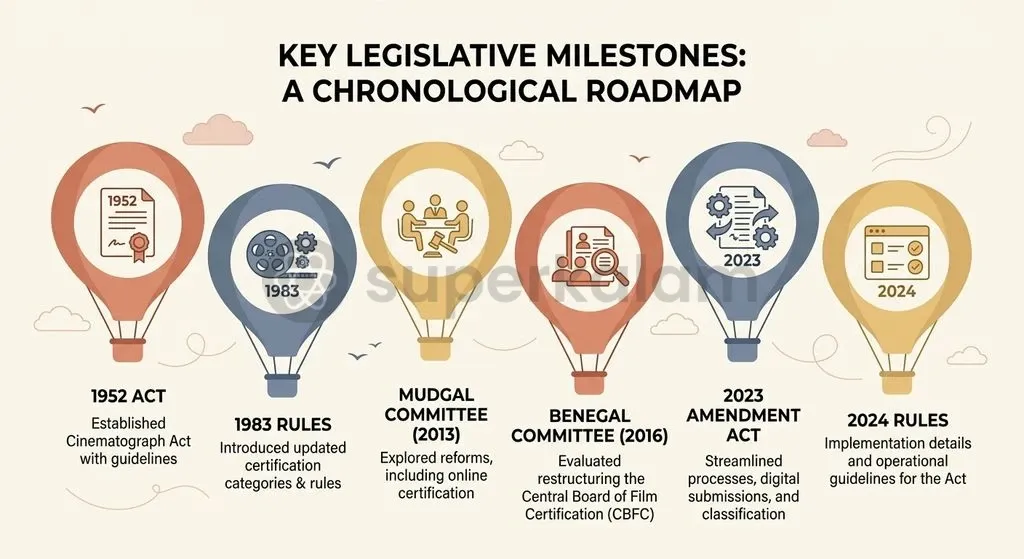
Background: Evolution of Film Censorship from the 1952 Act to the 2023 Amendment
The Central Board of Film Certification is a statutory body established under Section 3 of the Cinematograph Act, 1952, headquartered in Mumbai. According to the Central Board of Film Certification Portal, the organisation oversees public exhibition standards through nine regional offices across the country.
Legislative reform of Indian cinema has progressed across four key phases:
- Enactment of the Cinematograph Act, 1952: Created statutory machinery for film certification and embedded censorship criteria under Section 5B(1) anchored to the reasonable restrictions of Article 19(2).
- Notification of the 1983 Rules: Introduced procedural norms for examining committees, certificate validity limits, and standard application protocols.
- Passage of the Cinematograph (Amendment) Act, 2023: Inserted strict anti-piracy provisions under Sections 6AA and 6AB, eliminated perpetual re-certification friction, and enabled age-based sub-categorisation.
- Notification of the 2024 Rules: Superseded the 1983 framework with comprehensive digital processing, accessibility mandates, and tripartite age indicators.
Discuss with Superkalam
Recall the three distinct age markers introduced within the Parental Guidance (UA) category under the Cinematograph (Certification) Rules, 2024.
Ask NowWhat Are the New Film Certification Categories?
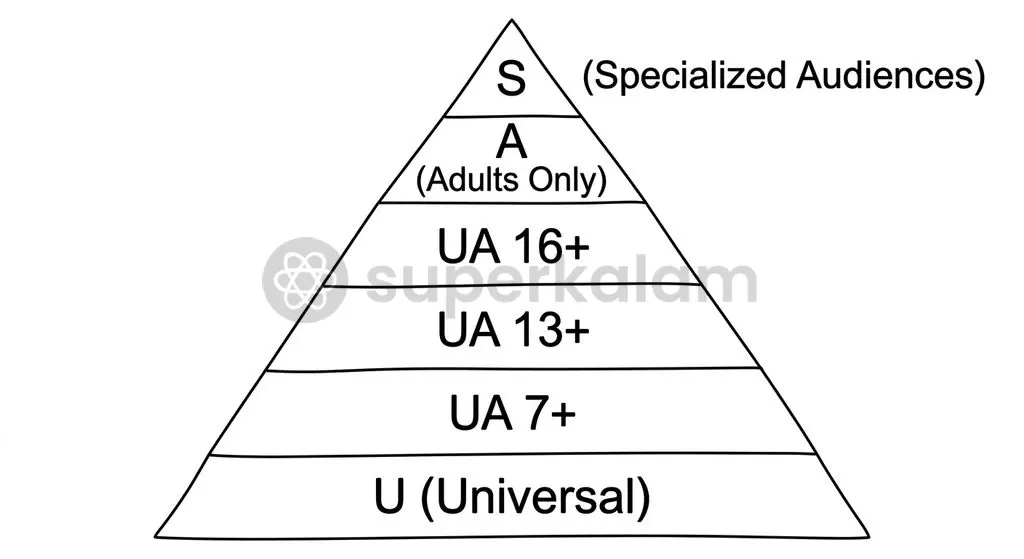
The Cinematograph (Certification) Rules, 2024 introduce three distinct age-graded markers within the Universal Adult category to guide parental discretion. According to the Ministry of Information and Broadcasting, the reform preserves the core statutory classifications while offering granular age recommendations.
The updated certification scheme operates across six distinct classifications:
- Unrestricted Public Exhibition (U): Suitable for viewers of all age groups without restriction.
- Parental Guidance 7+ (UA 7+): Content suitable for general viewing, but parental guidance is recommended for children below seven years of age.
- Parental Guidance 13+ (UA 13+): Content containing themes or language where parental guidance is advised for viewers below thirteen years.
- Parental Guidance 16+ (UA 16+): Content featuring mature themes where parental discretion is recommended for adolescents below sixteen years.
- Adults Only (A): Exhibition restricted exclusively to persons aged eighteen years and above.
- Specialised Audiences (S): Exhibition restricted to specific professional classes, such as doctors, scientists, or engineers.
According to the 2024 Rules, all certification applications, category modifications, and recertification requests must be submitted digitally through the centralised e-cinepramaan online portal.
Old Film Certification Framework vs. New 2024 Rules
The Cinematograph (Certification) Rules, 2024 replace obsolete procedural rules with streamlined digital mechanisms and inclusive screening mandates. A detailed structural comparison highlights the shift:
| Feature Dimension | Old Framework (1983 Rules) | New Framework (2024 Rules) |
|---|---|---|
| UA Classification Structure | Single monolithic 'UA' category without age granularity | Tripartite age markers: UA 7+, UA 13+, and UA 16+ |
| Certificate Validity | Restricted to a 10-year validity period, requiring renewal | Granted perpetual validity across all categories |
| Accessibility Mandates | No mandatory statutory requirement for disabled access | Compulsory closed captioning and audio descriptions |
| Application Processing | Physical documentation alongside fragmented online tools | Fully digitised via the centralised e-cinepramaan portal |
| Board Gender Representation | No fixed statutory quota for women panel members | Mandatory one-third women representation, targeting 50% |
| Television Recertification | Complex administrative process for broadcast conversion | Streamlined voluntary editing for 'A' to 'UA' conversion |
| Expedited Examination | Standard processing timeline without priority fast-track | Priority screening within five days at three times the fee |
Discuss with Superkalam
Explain how the transition from a 10-year validity cap to perpetual certificate validity benefits digital streaming platforms and film distributors.
Ask NowKey Provisions: Anti-Narcotics Warnings, Accessibility Standards, and Perpetual Validity
The Cinematograph (Certification) Rules, 2024 embed public health directives, disability rights, and administrative ease within the statutory certification workflow.
Revised guidelines issued under Section 5B(2) of the Cinematograph Act, 1952 mandate that any film depicting the consumption, use, or trafficking of narcotic drugs or psychotropic substances must display a static on-screen statutory warning stating: "Illicit Narcotics Destroy Health and Guarantees Imprisonment. Say No To Drugs". This operates alongside pre-existing anti-tobacco requirements under the Cigarettes and Other Tobacco Products Act (COTPA), 2003, which require static warnings, audiovisual disclaimers, and health spots during tobacco consumption scenes.
Rule 22(4) of the 2024 Rules mandates accessibility features as an explicit condition for public exhibition certification. Feature films must incorporate same-language closed captioning and subtitling for persons with hearing impairments, alongside secondary audio descriptions for visually impaired audiences.
Rule 29 removes the historic 10-year expiration cap, conferring perpetual validity on all CBFC certificates. This perpetual status removes bureaucratic renewal burdens for catalogue distributors and streaming platforms.
The rules also operationalise anti-piracy deterrence under Sections 6AA and 6AB of the parent Act. Under Section 7(1A), unauthorised audio-visual recording or transmission in exhibition venues carries a minimum imprisonment of three months extending up to three years, alongside fines ranging from ₹3 lakh up to 5% of the audited gross production cost.

Constitutional Balance: Freedom of Expression vs Reasonable Restrictions
Section 5B(1) of the Cinematograph Act, 1952 grounds state censorship powers directly within the eight permissible grounds of Article 19(2) of the Constitution of India. Filmmakers enjoy fundamental artistic freedom under Article 19(1)(a), which guarantees freedom of speech and expression, subject to statutory limits defending national sovereignty, security, public order, decency, or morality.
In the landmark case of K.A. Abbas v. Union of India (1970), the Supreme Court upheld the constitutional validity of pre-censorship for motion pictures. The bench ruled that cinema represents a uniquely persuasive medium with immediate visual and auditory impact. This visual power justifies specialised regulatory scrutiny not applied to print media. However, the Court emphasised that administrative censorship must adhere to definite, objective standards rather than arbitrary moral judgements.
Discuss with Superkalam
Compare the recommendations of the Justice Mudgal Committee (2013) and Shyam Benegal Committee (2016) regarding CBFC's censorship powers with the actual provisions enacted in the 2024 Rules.
Ask NowCommittees and Past Recommendations: Mudgal and Shyam Benegal Panels
The Justice Mukul Mudgal Committee and the Shyam Benegal Committee provided the analytical foundation for modernising Indian film governance.
The Justice Mukul Mudgal Committee Report (2013) recommended expanding age-based classifications, restricting discretionary cuts, and providing transparent statutory criteria for visual modifications. The Shyam Benegal Committee Report (2016) went further, asserting that the CBFC should function strictly as a content categorisation body rather than a censorship board exercising scissor powers.
While the 2024 Rules successfully adopt the age-segmented markers recommended by both panels, they leave Section 5B's underlying power to order cuts and alterations intact. This dual structure creates an ongoing tension. The regulatory framework adopts modern classification labels while maintaining administrative pre-censorship authority.
Key Challenges: Implementation Hurdles and Concerns Over Censorship
The Cinematograph (Certification) Rules, 2024 face practical implementation challenges across technology, exhibition economics, and creative liberty:
- Enforcement of Advisory Age Markers: The UA 7+, UA 13+, and UA 16+ classifications are advisory rather than mandatory gatekeeping restrictions, placing monitoring burdens entirely on cinema operators and parents.
- Theatrical Accessibility Costs: Single-screen cinemas face capital costs when retrofitting projection systems to support simultaneous audio description tracks and closed-caption display hardware.
- Persistence of Content Cuts: Retaining administrative excision powers under Section 5B(2) leaves filmmakers vulnerable to subjective content deletions despite receiving higher age ratings.
- Visual Intrusion of Warnings: Mandatory static banners for narcotics and tobacco across narrative scenes dilute cinematic aesthetics and director intent.
Way Forward: Balancing Creative Freedom with Child Protection
A modern film regulatory regime requires transitioning from executive censorship to transparent age classification supported by co-regulatory industry standards.
- Transition to Pure Classification: Parliament should amend Section 5B of the Cinematograph Act, 1952 to shift CBFC's mandate from ordering modifications to assigning age ratings, fulfilling the Shyam Benegal Committee's recommendations.
- Institutionalising Co-Regulation: Cinema chains, streaming platforms, and creative guilds should establish voluntary compliance boards to standardise age verification and content flagging.
- Fiscal Support for Accessibility Infrastructure: The Ministry of Information and Broadcasting can offer targeted subsidies to regional and single-screen theatres for installing assistive listening devices and accessibility software.
- Digital Metadata Standards: Standardising age-rating tags across ticketing platforms and digital streaming services will ensure parents receive actionable content descriptors before booking.
Discuss with Superkalam
Evaluate whether the advisory nature of UA 7+, UA 13+, and UA 16+ ratings places an unfair monitoring burden on cinema hall operators and parents.
Ask NowKey Takeaways
- The Ministry of Information and Broadcasting notified the Cinematograph (Certification) Rules, 2024, fully superseding the 1983 rules to align film governance with the Cinematograph (Amendment) Act, 2023.
- The 'UA' category is subdivided into three age-specific advisory tiers: UA 7+, UA 13+, and UA 16+, providing granular parental guidance.
- Film certificates now carry perpetual validity, eliminating the previous 10-year renewal requirement.
- The rules mandate accessibility features (closed captioning and audio descriptions) for persons with visual and hearing impairments and introduce compulsory anti-narcotics warnings under Section 5B(2).
- Anti-piracy violations under Sections 6AA and 6AB attract imprisonment up to 3 years and fines up to 5% of the gross production cost.
- While the 2024 Rules implement key classification reforms proposed by the Mudgal and Benegal Committees, CBFC retains statutory excision powers under Section 5B(1), preserving the fundamental debate around pre-censorship.
Mains Question
'While the Cinematograph (Certification) Rules, 2024 introduce granular age-based classifications, retaining excision powers under Section 5B of the parent Act continues the tension between creative expression and administrative censorship.' Critically analyse. (15 Marks)
Evaluate NowMains Question
The Cinematograph (Certification) Rules, 2024 attempt to balance commercial ease, social health mandates, and disability rights. Elucidate the key structural reforms introduced under the new framework. (10 Marks)
Evaluate NowPractice MCQs
QUESTION 1
With reference to the Cinematograph (Certification) Rules, 2024, consider the following statements:
- The rules subdivide the Universal Adult (UA) category into three distinct age-graded markers: UA 7+, UA 13+, and UA 16+.
- Film exhibition certificates issued by the Central Board of Film Certification (CBFC) now carry perpetual validity.
- The rules mandate a minimum of one-third representation of women on the advisory panels.
Which of the statements given above are correct?
QUESTION 2
Regarding the anti-piracy provisions under the Cinematograph (Amendment) Act, 2023 and the 2024 Rules, consider the following statements:
- Unauthorised audio-visual recording or transmission in exhibition venues is penalized under Section 7(1A).
- The minimum term of imprisonment prescribed for piracy offences is six months.
- The financial penalty can range from ₹3 lakh up to 5% of the audited gross production cost of the film.
Which of the statements given above is/are correct?
QUESTION 3
Consider the following statements regarding the constitutional jurisprudence and statutory basis of film certification in India:
- In K.A. Abbas v. Union of India (1970), the Supreme Court held pre-censorship of motion pictures to be unconstitutional as violative of Article 19(1)(a).
- Section 5B(1) of the Cinematograph Act, 1952 grounds certification criteria directly in the permissible restrictions under Article 19(2).
- The Central Board of Film Certification (CBFC) is a statutory body established under Section 3 of the Cinematograph Act, 1952.
Which of the statements given above is/are correct?
QUESTION 4
With reference to the accessibility standards under Rule 22(4) of the Cinematograph (Certification) Rules, 2024, feature films submitted for public exhibition certification must mandatorily incorporate:
QUESTION 5
Which of the following expert committees explicitly recommended that the Central Board of Film Certification (CBFC) should act strictly as a content categorization body rather than exercising powers to order cuts and deletions?