CAZRI Moth Bean Resilience: How Arid Crops Survive Extended Drought
With climate shifts disrupting monsoons, drought-hardy arid pulses like moth bean provide vital ecological resilience and self-reliance in dryland farming.
Sep, 2026
•7 min read
Overview
Improved moth bean varieties developed by the ICAR-Central Arid Zone Research Institute demonstrate how biological mechanisms provide climate resilience. By deploying developmental plasticity, these crops survive extended dry spells without complete failure in rainfed farming systems.
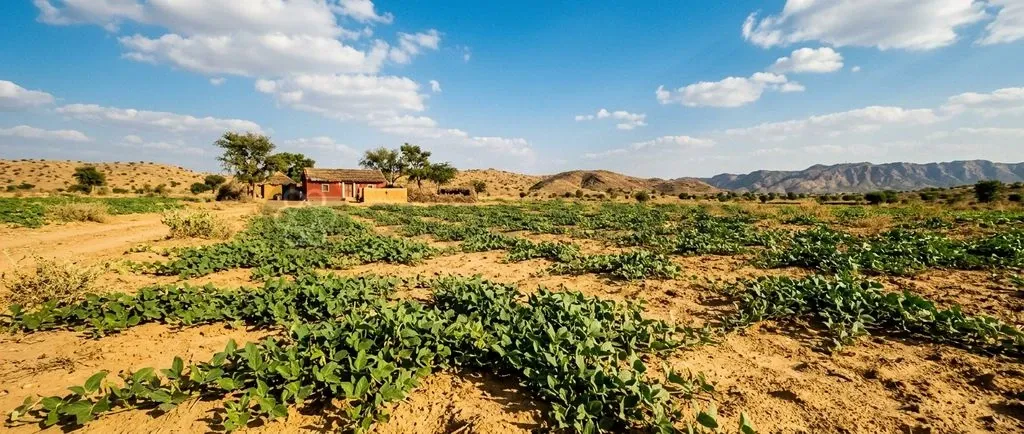
Cultivated primarily in western Rajasthan, Vigna aconitifolia combines a spreading prostrate canopy with symbiotic nitrogen fixation to withstand moisture-deficient environments. Integrating drought-hardy arid pulses into national food security strategies buffers erratic monsoon breaks and reduces dependence on volatile global pulse imports.
Why in the News: Moth Bean Resilience in an El Niño Year
The ICAR-Central Arid Zone Research Institute reported that its improved moth bean varieties survived an acute 35-day rainless dry spell during Kharif 2026. As of September 2026, field assessments conducted by the institute in Jodhpur revealed that these arid legumes maintained physiological survival despite severe monsoon interruptions.
El Niño weather patterns frequently disrupt the Indian monsoon by generating prolonged precipitation breaks across fragile agro-ecological zones. Key observations from the Kharif 2026 dry spell include:
- Intense Moisture Deficit: An intense dry interval stretched from 3 August to 7 September following an initial 86 mm rainfall event on 2–3 August.
- Adaptive Field Endurance: The standing crop sustained climate-smart agricultural adaptation under high thermal load and extreme soil moisture depletion without suffering irreversible wilting.
What Is Moth Bean and Why Is It Vital for Arid Regions?
Moth bean (Vigna aconitifolia) is an extremely drought-hardy, short-duration kharif pulse cultivated extensively across the arid tracts of western Rajasthan. The crop covers approximately 10 lakh hectares in Rajasthan, serving as a primary source of dietary protein and nutritious livestock fodder.
Agricultural productivity in this arid zone remains low at around 350 kg per hectare, largely due to erratic annual precipitation ranging between 150–250 mm. Despite these severe climatic limitations, the botanical structure of moth bean provides essential ecological services:
- Rhizosphere Moisture Retention: The low-lying, spreading canopy creates dense ground cover that suppresses weed growth and limits surface water loss.
- Sand Dune Stabilisation: The prostrate vine habit acts as a natural sand binder, checking wind erosion across loose desert soils.
- Low Input Demand: The crop produces harvestable biomass where conventional legumes such as chickpea or pigeonpea fail entirely.
Understanding Developmental Plasticity: How Arid Crops Adapt to Drought
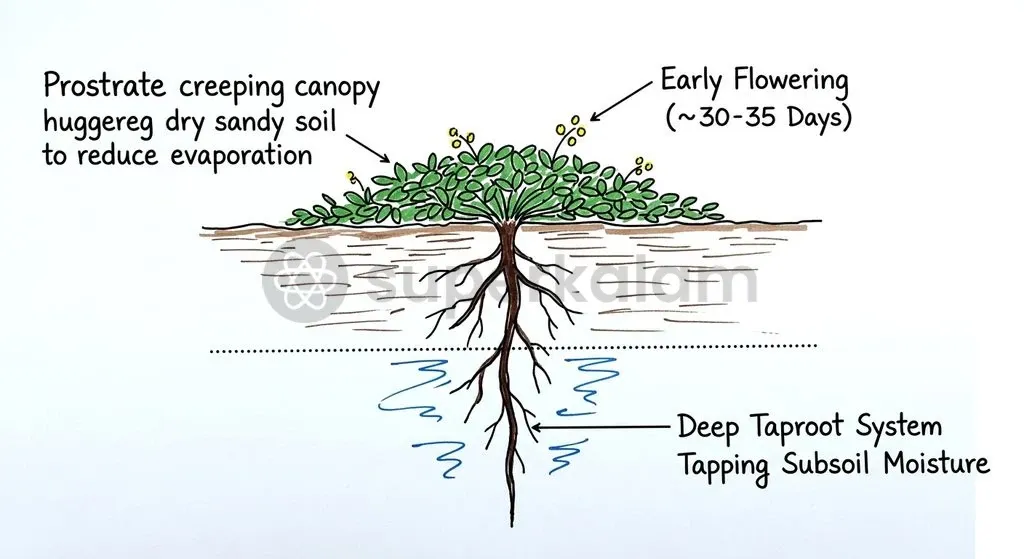
Developmental plasticity is an adaptive botanical mechanism where a plant alters its growth stages and resource allocation in direct response to environmental stress. Stress-tolerant crops adjust their phenology—the timing of flowering and seed set—to align with real-time moisture availability rather than following a rigid developmental timeline.
In moth bean, this biological flexibility operates through distinct physiological responses:
- Early Phenological Switching: The plant initiates flowering approximately 30 days after sowing, ensuring early pod development before root zones exhaust available water.
- Growth Suspension and Resumption: When extreme moisture stress occurs, vegetative expansion halts while reproductive structures stay viable until precipitation returns.
- Dynamic Root Foraging: Root networks prioritise vertical penetration to draw moisture from deeper subsoil strata as upper soil layers dry out.
Discuss with Superkalam
Recall the rainfall range within which moth bean can survive compared to guar and green gram.
Ask NowThe CAZRI Findings: How Specific Varieties Handled a 35-Day Dry Spell
ICAR-CAZRI developed four high-yielding, stress-resilient varieties: CAZRI Moth-4, CAZRI Moth-5, CAZRI Moth-6, and CAZRI Moth-7. During the 35-day rainless interval in Kharif 2026, research teams recorded critical agro-meteorological and edaphic parameters to evaluate crop survival mechanisms.
High temperatures created immense atmospheric moisture demand. Cumulative pan evaporation reached approximately 180 mm during the dry spell, out of a total seasonal pan evaporation of 317 mm recorded between 10 July and 2 September 2026.
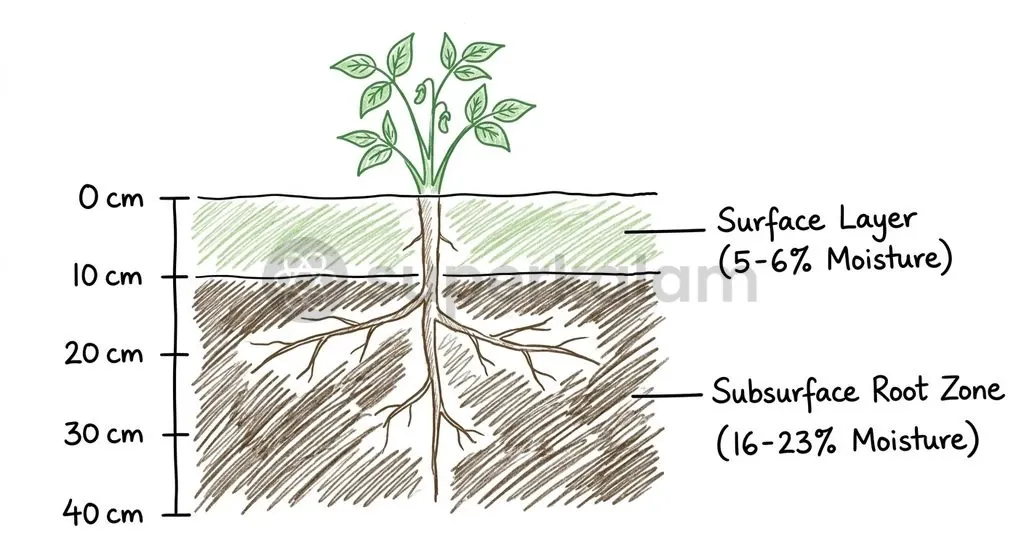
Soil moisture observations confirmed how deep root architecture sustained plant survival through the prolonged drought:
- Surface Stratum (0–10 cm depth): Moisture content dropped sharply from 15–16% (v/v) down to 5–6%, rendering topsoil dry and biologically inhospitable.
- Subsurface Stratum (10–40 cm depth): Moisture declined moderately from 23% down to 16%, providing adequate moisture for deep root absorption.
Comparing Arid Pulses: Drought Tolerance and Yield Stability
Arid legumes exhibit diverse morphological and physiological adaptations to manage severe water scarcity. Examining these distinct agronomic attributes clarifies how specific pulses fit into rainfed farming systems.
| Agronomic Feature | Moth Bean (Vigna aconitifolia) | Cluster Bean / Guar (Cyamopsis tetragonoloba) | Green Gram / Moong (Vigna radiata) |
|---|---|---|---|
| Drought Tolerance Level | Exceptionally High (survives 150–250 mm rainfall) | High (requires 250–350 mm rainfall) | Moderate (requires 350–500 mm rainfall) |
| Canopy Architecture | Prostrate and spreading; acts as sand binder | Erect, bushy, and single/branched stem | Erect or semi-erect bush |
| Phenological Plasticity | Modulates flowering from 30 days onward | Rigid indeterminate flowering cycle | Fixed early-maturity windows (60–70 days) |
| Soil Conservation Role | High ground cover, controls wind erosion | Moderate ground cover | Low ground cover during early stages |
| Primary Economic Output | Protein-rich pulse, nutritious fodder | Industrial gum, vegetable, fodder | High-value commercial food pulse |
Discuss with Superkalam
Explain how the subsurface soil moisture dynamic (0–10 cm vs 10–40 cm) enables deep-rooted arid crops to survive high pan evaporation.
Ask NowStrategic Importance for Food, Nutrition, and Soil Security
Expanding arid pulse production aligns with national agricultural priorities focused on climate resilience, soil health, and nutritional security. Pulses supply an affordable source of protein and micro-nutrients in rural diets while functioning as low-carbon, restorative crops.
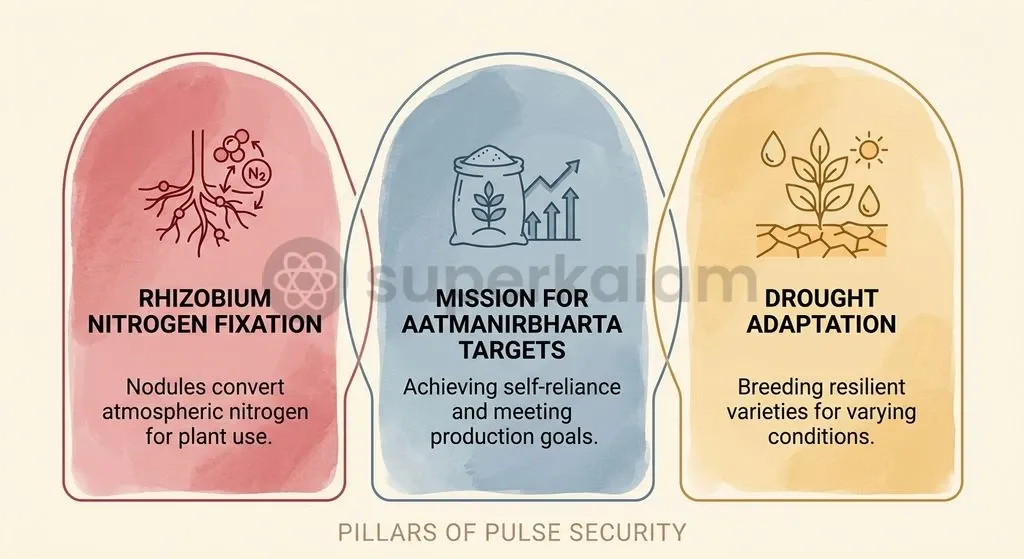
Biological nitrogen fixation provides a substantial agro-ecological benefit. Through symbiotic associations with root-nodule Rhizobium bacteria, moth bean converts atmospheric nitrogen into bioavailable soil nutrients. This process improves soil fertility, curbs dependence on synthetic urea, and enhances the yields of subsequent crop rotations.
National food security targets require strengthening domestic pulse supply chains:
- Reducing Import Vulnerability: India imported 47.38 lakh tonnes of pulses in 2023–24 despite a total domestic harvest of 242.42 lakh tonnes, leaving markets vulnerable to international price spikes.
- Decarbonising Cropping Systems: Legumes require minimal irrigation and chemical fertiliser, lowering overall greenhouse gas emissions compared to water-intensive cereal monocultures.
Key Bottlenecks in Scaling Up Dryland Pulse Cultivation
Dryland pulse cultivation faces structural, technological, and market barriers that impede widespread adoption among smallholder farmers. Despite high ecological suitability, farmers frequently treat arid legumes as secondary risk-management crops rather than high-yielding commercial enterprises.
Key institutional and operational bottlenecks include:
- Subdued Yield Baselines: Productivity in arid zones hovers near 350 kg per hectare, limited by traditional seed mixtures and low adoption of improved varieties.
- Seed Replacement Deficits: Certified seed production for arid-specific varieties like CAZRI Moth-5 or CAZRI Moth-7 remains inadequate across remote desert villages.
- Fragmented Market Linkages: Processing industries and organised procurement networks concentrate mainly on mainstream pulses, leaving minor arid legumes exposed to local price fluctuations.
- Climate Vulnerability Risks: Intense monsoon breaks exceeding 40 days or extreme terminal heat can still cause significant yield penalties if subsoil moisture reserves fully exhaust.
Discuss with Superkalam
How would you apply the concept of developmental plasticity to design crop contingent plans for drought-prone districts facing an El Niño year?
Ask NowThe Way Forward: Strengthening Climate-Smart Arid Agriculture
Promoting climate-resilient dryland farming requires combining crop breeding innovations with institutional policy support. Policy frameworks must scale up climate-smart varieties to insulate rainfed farming systems from erratic monsoons.
The Union Cabinet approved the Mission for Aatmanirbharta in Pulses (2025–26 to 2030–31) with an outlay of ₹11,440 crore to achieve self-sufficiency by 2030–31. The mission targets expanding national pulse acreage from 275 lakh hectares to 310 lakh hectares, seeking to elevate domestic production from 242 lakh tonnes to 350 lakh tonnes.
Policy implementation should focus on several priority measures:
- Procurement Guarantees: Expanding the 100% Minimum Support Price procurement framework established for Tur, Urad, and Masoor under PM-AASHA to include climate-resilient arid pulses.
- Contingency Planning: Utilising District Agricultural Contingent Plans (DACPs) formulated under ICAR's NICRA project across 651 vulnerable districts to distribute stress-tolerant seeds during monsoon delays.
- Integrated Farming Systems: Deploying the Rainfed Area Development (RAD) scheme under the National Mission on Sustainable Agriculture (NMSA) to integrate livestock with pulse-based fodder systems.
Discuss with Superkalam
Analyse the trade-offs between cultivating commercial water-intensive crops versus drought-hardy legumes in fragile arid ecosystems.
Ask NowKey Takeaways
- Improved moth bean cultivars (CAZRI Moth-4, 5, 6, and 7) survived a severe 35-day rainless dry spell during Kharif 2026 through developmental plasticity and deep subsoil moisture absorption.
- Moth bean (Vigna aconitifolia) covers roughly 10 lakh hectares in western Rajasthan under low annual rainfall of 150–250 mm, serving as both a food pulse and a soil-conserving sand binder.
- Subsurface soil moisture (10–40 cm depth) stayed above 16% during the dry spell despite surface layers drying down to 5–6%, sustaining root water uptake amid 180 mm of pan evaporation.
- India imported 47.38 lakh tonnes of pulses in 2023–24, demonstrating the necessity of expanding climate-hardy kharif pulses to attain domestic production targets.
- The Mission for Aatmanirbharta in Pulses (₹11,440 crore outlay) aims to increase national pulse production to 350 lakh tonnes by 2030–31 through expanded area and improved yields.
Mains Question
"Promoting developmental plasticity and biological resilience in arid legumes is crucial for climate-smart agriculture in drought-prone agro-ecological zones." In light of the recent performance of ICAR-CAZRI moth bean cultivars during prolonged dry spells, elucidate. (10 Marks)
Evaluate NowMains Question
Despite their exceptional ecological resilience and soil restorative properties, dryland pulses face persistent productivity and adoption constraints. Critically analyse the structural bottlenecks in dryland pulse cultivation and evaluate the potential of the 'Mission for Aatmanirbharta in Pulses' in addressing these challenges. (15 Marks)
Evaluate NowPractice MCQs
QUESTION 1
With reference to Moth bean (Vigna aconitifolia) cultivation in arid zones, consider the following statements:
- It is a short-duration rabi pulse that requires high synthetic nitrogen inputs.
- Its prostrate vine habit assists in soil moisture conservation and acts as a sand binder against wind erosion.
- It exhibits developmental plasticity by initiating early flowering around 30 days after sowing under moisture stress.
Which of the statements given above are correct?
QUESTION 2
Consider the following statements regarding the physiological responses of arid pulse crops during extended dry spells:
- Moth bean possesses greater drought tolerance than cluster bean and green gram, surviving on 150–250 mm of precipitation.
- Subsurface soil strata (10–40 cm) retain higher relative moisture compared to topsoil (0–10 cm), sustaining plants with deep root architecture.
- Unlike moth bean, green gram has a rigid, indeterminate flowering cycle that easily adapts to sudden rainfall interruptions.
Which of the statements given above is/are correct?
QUESTION 3
Consider the following statements regarding India's pulse sector and the 'Mission for Aatmanirbharta in Pulses':
- India achieved complete self-sufficiency without any imports of pulses during the 2023–24 period.
- The Mission for Aatmanirbharta in Pulses (2025–26 to 2030–31) aims to scale domestic pulse production to 350 lakh tonnes.
- Low seed replacement rates and inadequate certified seed availability in arid regions remain key bottlenecks in scaling dryland pulses.
Which of the statements given above is/are correct?
QUESTION 4
The varieties 'CAZRI Moth-4', 'CAZRI Moth-5', 'CAZRI Moth-6', and 'CAZRI Moth-7' recently evaluated for drought resilience are improved cultivars of which crop?
QUESTION 5
In the context of arid zone agriculture, how does the phenomenon of 'developmental plasticity' primarily help crops survive drought?