C-Section Rates in India: Private Hospitals and Regulatory Gaps
Surging private caesarean births expose deep regulatory voids, turning life-saving interventions into commercial incentives that test India's health governance.
Nov, 2026
•10 min read

Overview
India’s private healthcare sector delivers nearly half of its babies through caesarean section. This shift turns a life-saving surgical intervention into an unregulated commercial default, skewing medical priorities and driving up household healthcare costs nationwide.
According to the National Family Health Survey (NFHS-5), private hospital caesarean section rates reached 47.4% nationwide between 2019 and 2021, compared to 14.3% in public facilities. This stark divergence shows that surgical childbirth is expanding due to commercial fee-for-service incentives, practitioner convenience, and absent clinical audits rather than clinical risk. While the World Health Organization recommends a benchmark of 10% to 15% for medically indicated surgeries, several Indian states report rates exceeding 60%.
Why in the News: The Widening Rift Between WHO Benchmarks and India's Maternity Wards
India's expanding surgical birth numbers highlight a growing disconnect between global public health guidelines and ground reality in domestic maternity wards. According to the World Health Organization Statement on Caesarean Section Rates (WHO/RHR/15.02), population-level caesarean section rates exceeding 10% to 15% do not correlate with any reduction in maternal or neonatal mortality.
As of November 2021, the Ministry of Health and Family Welfare documented in the National Family Health Survey (NFHS-5) 2019-21: India Fact Sheet that the national caesarean birth rate rose to 21.5%, up from 17.2% recorded during NFHS-4 in 2015-16. This upward trajectory accompanied a substantial expansion in institutional childbirth:
- Institutional deliveries nationwide: Rose from 78.9% in NFHS-4 to 88.6% in NFHS-5.
- Policy intention: Curbs maternal deaths under the National Health Mission via skilled birth attendance.
- Clinical reality: Institutionalisation without oversight spurred provider-driven surgical procedures across maternity wards.

This rapid surgical expansion indicates structural distortions rather than clinical progress. Surpassing recommended thresholds without curbing maternal morbidity transforms physiological birth into an unnecessary surgical risk for pregnant women.
The Sub-National Paradox: How Southern States Became Global Outliers in Caesarean Births
Southern Indian states present an epidemiological paradox. Superior health infrastructure and higher literacy coexist with some of the highest caesarean delivery rates in the world.
The State Fact Sheet Telangana from NFHS-5 reveals that Telangana recorded an overall caesarean section rate of 60.7% between 2019 and 2021, the highest in the country. Total institutional births in the state reached 97.0%, showing near-universal clinical delivery coverage.
Private hospitals in Telangana delivered 81.5% of births via surgery, whereas public facilities recorded a surgical rate of 44.5%. This gap illustrates how commercial incentives inflate surgical rates. The table below outlines the divide between public and private maternity wards across key southern states:
| State | Total Institutional Births (%) | Overall C-Section Rate (%) | Public Facility C-Section (%) | Private Facility C-Section (%) |
|---|---|---|---|---|
| Telangana | 97.0% | 60.7% | 44.5% | 81.5% |
| Tamil Nadu | 99.6% | 44.9% | 36.0% | 63.8% |
| Andhra Pradesh | 96.5% | 42.4% | 26.6% | 63.0% |
| All-India Average | 88.6% | 21.5% | 14.3% | 47.4% |
According to the State Fact Sheet Andhra Pradesh, the state's overall caesarean rate climbed from 40.1% in NFHS-4 to 42.4% in NFHS-5, with private hospitals reaching 63.0%. Similarly, data from the State Fact Sheet Tamil Nadu shows that Tamil Nadu’s overall rate rose from 34.1% to 44.9%, while public sector caesarean births expanded from 26.3% to 36.0%. Higher regional wealth and universal institutional coverage have not restrained routine surgical childbirth.
Discuss with Superkalam
Recall the WHO benchmark threshold for caesarean section rates and state India's national average as per NFHS-5.
Ask NowMarket Incentives vs Clinical Need: The Economics Driving Private Hospital C-Sections
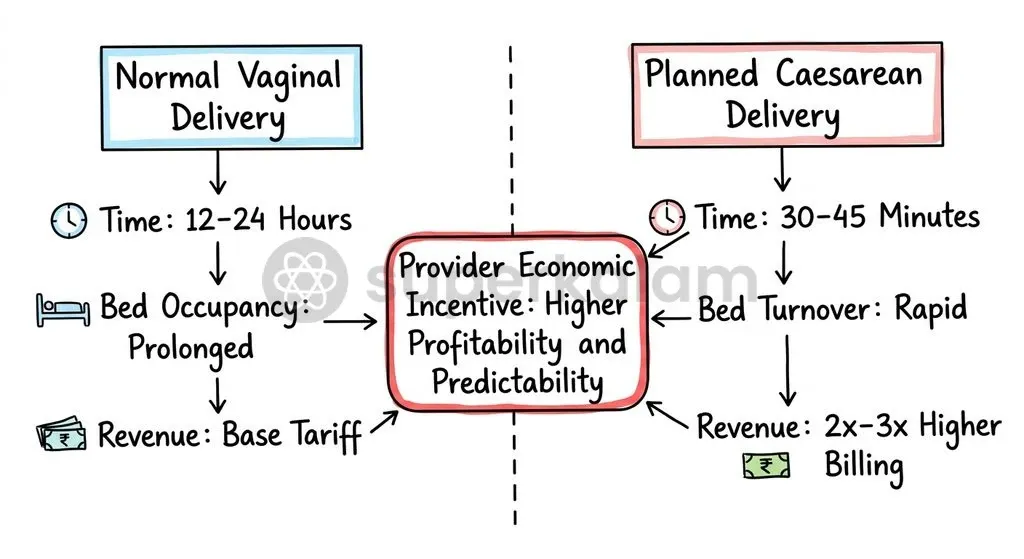
Private maternity care facilities operate on financial models that reward operative intervention over normal labour. According to a research analysis by Surana and Dongre published by Ideas for India, private hospitals rely on fee-for-service pricing where caesarean deliveries cost two to three times more than normal vaginal deliveries. This tariff structure generates direct financial incentives for facilities and operating obstetricians to opt for surgery.
Beyond baseline surgical markups, scheduling efficiency reinforces private commercial priorities:
- Operating theatre turnaround: A planned surgical delivery concludes in 30 to 45 minutes.
- Vaginal delivery workload: Physiological labour demands 12 to 24 hours of continuous monitoring by clinical staff.
- Facility resource management: Scheduled surgery maximises bed-occupancy turnover, stabilizes staffing rosters, and lowers staffing costs per delivery.
These financial patterns dominate commercial maternity claims. According to the Plum Data Labs Maternity Study reported in The Hindu, an assessment of over 160,000 corporate delivery claims found that caesarean deliveries reached an all-time high of 69%.
Rates varied sharply by geography and hospital type, with the four cities recording the lowest C-section rates at private hospitals all in Tamil Nadu: Chennai, Coimbatore, Salem and Vellore. The study also noted that 82% of insured families incurred out-of-pocket expenses during childbirth due to policy sub-limits, showing how surgical deliveries deplete household savings.
Defensive Medicine and Maternal Autonomy: Examining Non-Commercial Pressures
Clinical decisions during labour respond to legal liabilities as well as commercial motives. Legal reviews published in the Journal of South Asian Federation of Obstetrics and Gynaecology suggest that fear of consumer litigation under the Consumer Protection Act, 2019 encourages defensive medicine among private obstetricians. In contested intrapartum situations, practitioners often turn to operative delivery at the earliest sign of foetal distress to guard against allegations of medical negligence.
Non-clinical factors outside the hospital theatre compound this operative bias:
- Calendar scheduling: Families frequently request deliveries at pre-selected auspicious times, turning clinical care into a calendar-driven event.
- Inadequate antenatal preparation: Gaps in counselling and intense fears of labour pain leave women with limited guidance on natural options.
- Erosion of informed choice: Expectant mothers receive insufficient information to exercise meaningful maternal autonomy during active labour.
Primary surgical deliveries create lasting clinical consequences for subsequent pregnancies. According to microdata analysis presented at the International Population Conference (IPC 2025), over 91% of Indian women with a prior caesarean section had a repeat surgical delivery, reinforcing the practice of repeat surgical deliveries.
Systematic reviews published in PLoS Medicine by Keag and colleagues show that primary caesareans substantially elevate risks of postpartum haemorrhage, uterine rupture, and abnormal placental attachments like placenta praevia spectrum in subsequent pregnancies.
Discuss with Superkalam
Explain how fee-for-service payment structures and operating theatre turnaround times incentivise private hospitals to favour surgical deliveries over physiological labour.
Ask NowPublic Infrastructure vs Private Monopolies: What NFHS-5 Reveals Across Healthcare Sectors
Multivariate analysis confirms that institutional delivery setting is the primary driver of caesarean birth rates across India. A study published in PLOS ONE (PMID: 42406715) using NFHS-5 data revealed that delivering in a private health facility is the single strongest predictor of receiving a caesarean section, showing 4.11 times higher odds compared to public facilities.
The sectoral divide highlights contrasting clinical environments across India's health systems:
- Public facilities (14.3% surgical rate): Resource bottlenecks like shortages of operating theatres, anaesthetists, and obstetricians delay emergency interventions, yet the aggregate rate remains within the WHO recommended 10% to 15% range.
- Private facilities (47.4% surgical rate): Well-equipped units face fewer resource constraints, but unmonitored commercial incentives turn minor labour delays into revenue-generating surgical emergencies.
Private providers operate with minimal external auditing. Without strict clinical oversight, commercial convenience routinely supersedes expectant physiological management.
Discuss with Superkalam
If you were the District Collector tasked with inspecting private maternity wards under your jurisdiction, how would you operationalise the Robson Classification parameters to identify non-indicated surgeries?
Ask NowThe Regulatory Vacuum: Why Clinical Audits and Robson Classification Enforcement Stalled
State and central health authorities have struggled to establish binding oversight over private maternity wards. Although the Clinical Establishments (Registration and Regulation) Act, 2010 provides a framework to register and monitor healthcare centres, its adoption remains uneven because public health is a State subject under Entry 6 of List II in the Seventh Schedule of the Constitution. Consequently, several states have not enacted or enforced the central statute, leaving private maternity facilities largely free from independent clinical audits.
| Robson Group Parameter | Clinical Variables Assessed |
|---|---|
| Gestational Age | Preterm (< 37 weeks) vs Term (≥ 37 weeks) |
| Foetal Presentation | Cephalic vs Breech vs Transverse |
| Number of Foetuses | Single vs Multiple |
| Onset of Labour | Spontaneous vs Induced vs Pre-labour Caesarean |
| Obstetric History | Nulliparous vs Multiparous without scar vs With uterine scar |
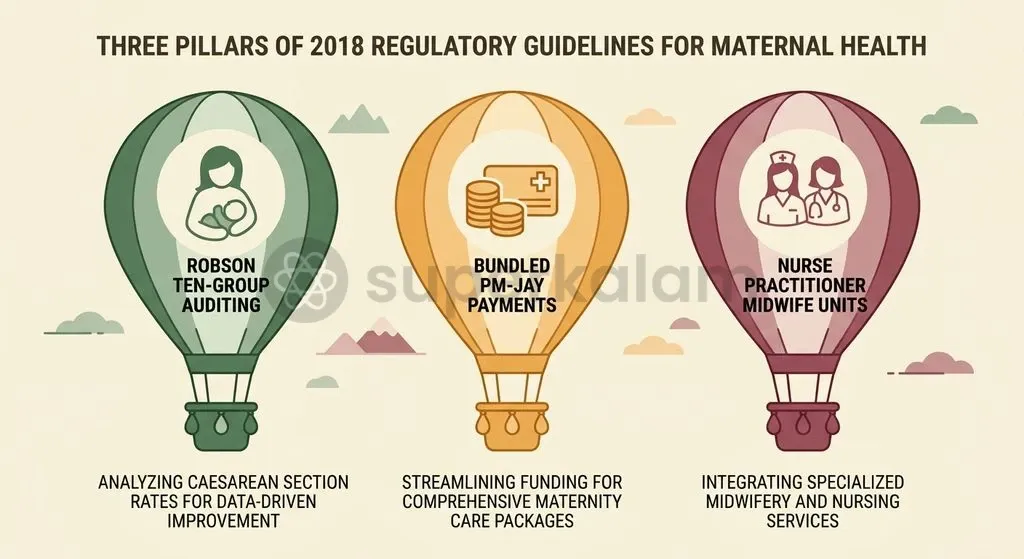
The Robson Ten-Group Classification System categorises pregnant women based on obstetric characteristics to identify whether surgical intervention was clinically warranted. As highlighted by the World Health Organization and releases from the Ministry of Health and Family Welfare, India still lacks a statutory mandate requiring private hospitals to conduct and publish Robson audits. While the Ministry's LaQshya Quality Improvement Initiative mandates regular caesarean section audits in public maternity wards, private facilities remain exempt from comparable scrutiny.
Decentralised enforcement actions demonstrate the scale of unmonitored private practices. In Telangana's Nizamabad district, the district administration issued show-cause notices to 54 private hospitals in 2022 after finding unusually high numbers of caesarean deliveries. Sporadic administrative notices cannot substitute for systematic, legally mandated clinical oversight.
Ethical Fault Lines: Informed Consent, Doctor-Patient Trust, and Medical Commodification
The commodification of maternal care poses severe ethical challenges to medical practice and patient trust. Information asymmetry between obstetricians and patients often turns informed consent into an administrative formality. In private maternity units, women in active labour rarely receive objective assessments of non-surgical alternatives, compromising their right to bodily autonomy.
This commercialisation fractures several fundamental pillars of bioethics:
- Violation of non-maleficence: Exposing mothers to major abdominal surgery without medical necessity breaches the duty to do no harm.
- Compromised autonomy: Asymmetric information prevents families from weighing surgical risks against natural childbirth.
- Erosion of social trust: Commercialising birth drains savings through high out-of-pocket costs and leaves patients sceptical of objective medical advice.
Performing unnecessary major abdominal surgery exposes mothers and newborns to avoidable surgical risks for institutional financial gain. Over time, treating childbirth as a revenue generator dismantles the moral foundation of maternal healthcare.
Discuss with Superkalam
Analyse the epidemiological paradox observed in southern states like Telangana, where high literacy and near-universal institutional births coincide with world-leading caesarean section rates.
Ask NowWay Forward: Reforming Reimbursements, Strengthening Midwifery, and Mandating Public Disclosure
Addressing excessive surgical births requires structural changes in hospital reimbursement models and professional clinical practice. Public and commercial health insurers must move away from itemised fee-for-service models toward standard reimbursement packages. Under the Ayushman Bharat PM-JAY scheme, the National Health Authority uses bundled health benefit packages that pay a flat rate for deliveries regardless of method, removing financial incentives for unnecessary surgery.
Reforming maternity care demands three concurrent policy interventions:
- Expand independent midwifery: Operationalise the Guidelines on Midwifery Services in India (2018) by training Nurse Practitioner Midwives and setting up Midwife-Led Care Units in hospitals.
- Shift low-risk maternity triage: Grant trained midwives primary responsibility over uncomplicated births, preserving obstetrician capacity for complex, high-risk interventions.
- Enforce institutional transparency: Require all private facilities to publicly display caesarean rates—extending the mandate currently applied to hospitals empanelled under the Central Government Health Scheme.
State governments must mandate the Robson Ten-Group Classification for all surgical births and introduce independent clinical audits to protect maternal health.
Discuss with Superkalam
Design a regulatory and financial policy framework that balances the clinical autonomy of private obstetricians with transparent accountability mechanisms to curb unindicated caesarean births.
Ask NowKey Takeaways
- The World Health Organization recommends a population-level caesarean section benchmark of 10% to 15%, noting that higher rates do not lower maternal or neonatal mortality.
- National Family Health Survey data shows India’s national caesarean rate reached 21.5% in NFHS-5, driven by private health facilities where 47.4% of deliveries were surgical.
- Southern states report very high rates, led by Telangana with an overall caesarean rate of 60.7% and a private facility surgical rate of 81.5%.
- Private hospitals record markedly higher surgical rates than public facilities, supported by fee-for-service tariffs that bill surgeries at two to three times the cost of vaginal deliveries.
- Tamil Nadu records the lowest private-facility caesarean rate among these states at 63.8% (NFHS-5, 2019-21), still far above public-facility rates.
- Regulatory solutions require bundled insurance payments under PM-JAY, implementation of Midwife-Led Care Units, and statutory Robson classification audits across all private facilities.
Mains Question
"Institutionalisation of childbirth without robust clinical oversight has transformed physiological birth into a commercial default." In light of NFHS-5 findings, critically examine the systemic and economic factors driving high caesarean delivery rates in India's private healthcare sector. (15 Marks)
Evaluate NowMains Question
The application of the Robson Ten-Group Classification System remains confined largely to public facilities under initiatives like LaQshya. Evaluate the necessity of mandating clinical audits across private maternity establishments in India. (10 Marks)
Evaluate NowPractice MCQs
QUESTION 1
With reference to caesarean section rates and healthcare delivery in India as documented in NFHS-5, consider the following statements:
- The national caesarean delivery rate in India stands below the World Health Organization recommended threshold of 10% to 15%.
- In private health facilities nationwide, the proportion of caesarean deliveries exceeded 45%.
- Institutional births in public facilities registered a caesarean delivery rate within the WHO recommended benchmark range. Which of the statements given above is/are correct?
QUESTION 2
Consider the following statements regarding the regulatory and clinical oversight of maternity care in India:
- The Robson Ten-Group Classification System categorises pregnant women based on obstetric characteristics to assess whether surgical intervention was clinically warranted.
- The Union Ministry's LaQshya Quality Improvement Initiative mandates regular caesarean section audits across both public and private maternity wards.
- Under Entry 6 of List II (State List) in the Seventh Schedule of the Constitution, public health is a State subject, contributing to uneven enforcement of central statutes like the Clinical Establishments Act, 2010. Which of the statements given above is/are correct?
QUESTION 3
According to findings and clinical literature highlighted in the context of caesarean births in India, which of the following are recognized maternal risks associated with primary caesarean sections in subsequent pregnancies?
- Postpartum haemorrhage
- Abnormal placental attachments such as placenta praevia spectrum
- Uterine rupture Select the correct answer using the code given below:
QUESTION 4
Which of the following southern Indian states recorded an overall caesarean section rate exceeding 60% in the National Family Health Survey (NFHS-5), representing the highest rate in the country?
QUESTION 5
Consider the following statements regarding the economic and systemic drivers of caesarean deliveries in India:
- Multivariate analysis of NFHS-5 data indicates that delivering in a private health facility is associated with more than four times higher odds of receiving a caesarean section compared to public facilities.
- NFHS 2023-24 trend data showed that 54% of deliveries in the private sector were C-sections.
- Fear of consumer litigation under the Consumer Protection Act, 2019 has been identified as a factor encouraging defensive medicine and prompt surgical interventions. Which of the statements given above are correct?