Buxa Tiger Reintroduction: Tigress T138 and Habitat Recovery in the Dooars
Why the translocation of Tigress T138 from Valmiki marks a pivotal shift from habitat restoration to active apex predator recovery across northern Bengal.
Oct, 2026
•7 min read
Context
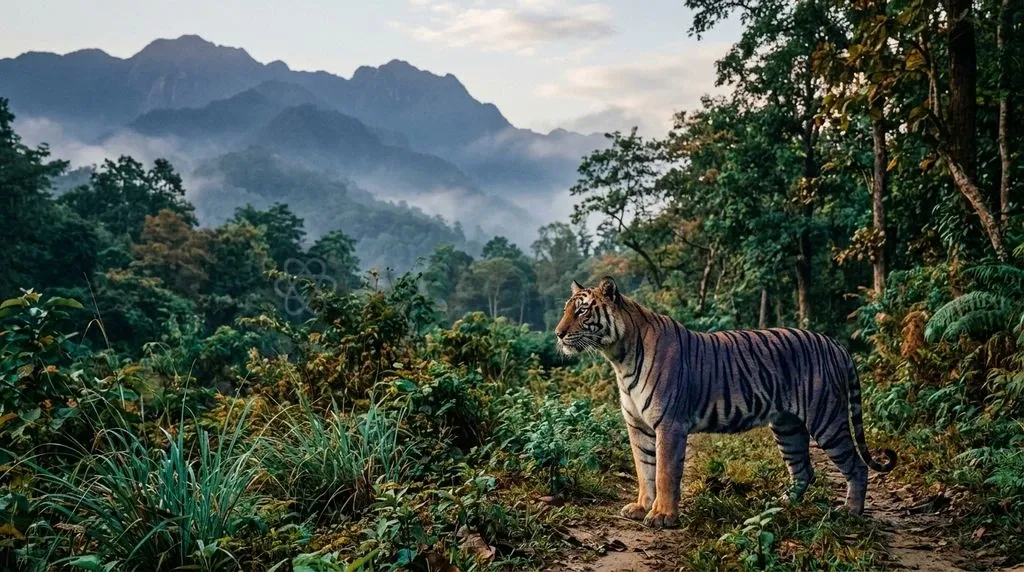
On 2 October 2026, forest authorities initiated the Buxa Tiger Reintroduction Programme. The operation released a three-year-old Bengal tigress (T138), translocated from Bihar's Valmiki Tiger Reserve, into an acclimatisation enclosure in West Bengal's Buxa Tiger Reserve.
As of October 2026, this inter-state translocation marks the culmination of an intensive eight-year habitat restoration and prey-augmentation initiative. The joint project is executed by the West Bengal Forest Department, the National Tiger Conservation Authority (NTCA), and the Wildlife Institute of India (WII). Its goal is to re-establish a self-sustaining breeding tiger population across the sub-Himalayan Dooars landscape.
The relocation highlights a core ecological reality. Reviving apex predators in depleted habitats requires fixing basic ecological bottlenecks, particularly ungulate prey density and habitat fragmentation, before bringing in founding animals.
Why in the News? The Relocation of Tigress T138
According to a press release by the Press Information Bureau, the Union Environment Minister and the Chief Minister of West Bengal oversaw the release of a three-year-old Bengal tigress (T138) into Buxa Tiger Reserve on 2 October 2026. This operation formally operationalised the phased Buxa Tiger Reintroduction Programme.
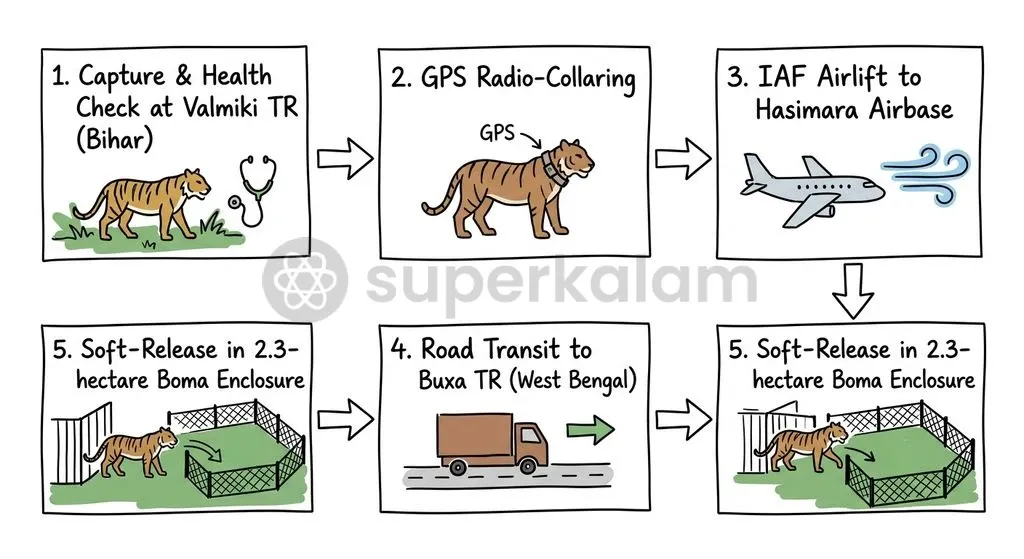
Tigress T138 was translocated from Valmiki Tiger Reserve in Bihar, chosen by wildlife biologists for its matching ecological and bio-climatic conditions. As reported by The Indian Express on 2 October 2026, an Indian Air Force aircraft airlifted the tigress directly to Hasimara airbase.
Authorities then moved her by road to Buxa. Field teams fitted her with a satellite GPS radio-collar and released her into a 2.3-hectare soft-release enclosure for observation.
Case Study: How Valmiki's Source Rescues Buxa's Tiger Deficit
Valmiki Tiger Reserve in Bihar serves as a donor site because its Terai-foothill ecosystem mirrors the climatic and floral conditions of northern West Bengal. According to a PIB press release, choosing an ecologically matching donor population minimises post-release dispersal stress and improves adaptation rates.
Reports in The Economic Times on 2 October 2026 indicate that the Buxa recovery framework forms part of a phased multi-year initiative. The plan introduces a total of 6 to 7 tigers across 2026 to 2028–29, structured around two distinct breeding units.
| Feature | Parameter Detail |
|---|---|
| Translocated Animal | Bengal Tigress T138 (Age: 3 years) |
| Donor Landscape | Valmiki Tiger Reserve, Bihar |
| Recipient Landscape | Buxa Tiger Reserve, West Bengal |
| Initial Containment | 2.3-hectare soft-release enclosure |
| Monitoring Protocol | 24x7 satellite GPS radio-telemetry |
| Long-term Target | 6 to 7 tigers by 2028–29 (as reported in October 2026) |
The relocation process follows statutory mandates under the Wildlife (Protection) Act, 1972. This ensures that genetic compatibility and landscape connectivity remain central to national tiger recovery planning.
Discuss with Superkalam
Which donor tiger reserve provided the founding tigress T138 for the Buxa reintroduction programme?
Ask NowGeography and Habitat: What Makes Buxa Tiger Reserve Unique
Buxa Tiger Reserve was established in 1983 as India's 15th tiger reserve, spanning an area of approximately 760 square kilometres in the Dooars region of West Bengal's Alipurduar district, according to the Press Information Bureau.
According to landscape reports from the National Tiger Conservation Authority, Buxa represents a strategic transboundary wildlife hub:
- Steep altitudinal gradient: Elevations rise from 200 feet up to nearly 5,740 feet along the Sinchula range, spanning moist sal forests to evergreen tracts.
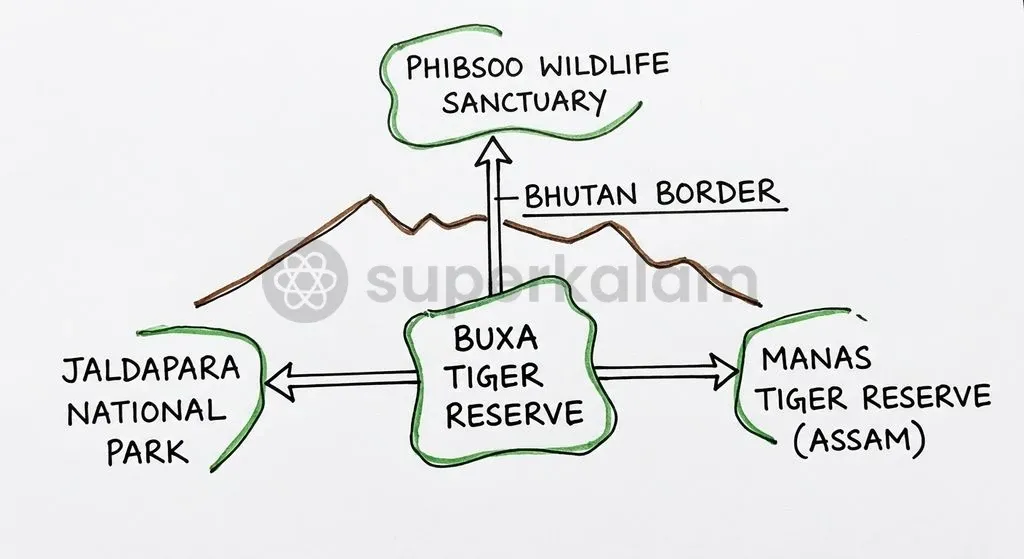
- Transboundary connectivity: The reserve shares an international border with Bhutan's Phibsoo Wildlife Sanctuary to the north.
- Regional corridors: Buxa links directly with Manas Tiger Reserve in Assam to the east and Jaldapara National Park to the west.
This geography enables transboundary genetic exchange across northern South Asia.
Why Tigers Disappeared from Buxa: Prey Depletion and Disturbance
The NTCA and WII 'Status of Tigers in India 2018' census confirmed zero resident tigers in Buxa Tiger Reserve, categorising it alongside Mizoram's Dampa and Jharkhand's Palamau as reserves suffering local tiger extirpation.
According to the Press Information Bureau, several historical factors drove this local extinction:
- Prey-base collapse: Severe depletion of wild ungulate populations deprived large carnivores of an adequate food source.
- Canopy closure: Dense tree canopies suppressed the growth of nutritious fodder grasses required by herbivores.
- Anthropogenic pressures: Heavy livestock grazing, linear infrastructure corridors, and encroachment from fringe tea estates fragmented core wilderness tracts.
Without an abundant wild prey base, resident breeding tigers could not sustain their energetic requirements, leading to gradual extirpation across the reserve.
Discuss with Superkalam
Why is habitat and prey-base restoration essential before translocating apex predators into a depleted reserve?
Ask NowProtocol and Preparations: How the Prey Base Was Built
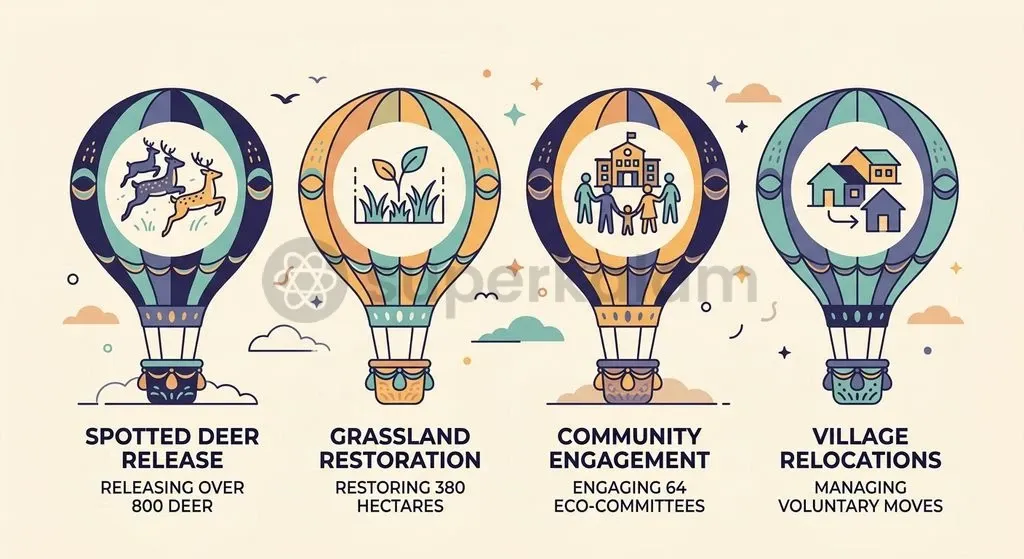
Active preparation for tiger reintroduction began under the Tiger Augmentation and Recovery Project, launched collaboratively in 2018 by the West Bengal Forest Department, NTCA, and WII. According to official data released by the Press Information Bureau, field managers introduced more than 800 spotted deer (chital) to repopulate the herbivore community.
Between 2018 and 2026, park managers restored or converted roughly 380 hectares of degraded land into productive grassland habitats, providing nutritious foraging grounds for expanding ungulate herds.
Community coordination formed another central pillar of the preparatory work:
- Community engagement: The reserve administration engaged fringe settlements through 64 Eco-Development Committees and Joint Forest Management Committees, as reported by the Press Information Bureau.
- Voluntary relocation: As reported by ANI News on 2 October 2026, authorities facilitated the voluntary relocation of two forest villages from the core zone to curb human-wildlife conflict risks.
These systematic management improvements were reflected in the 5th cycle of the Management Effectiveness Evaluation (MEE) of Tiger Reserves in India, where Buxa earned an official rating of 'Good'.
Comparing Tiger Reintroduction Models: Buxa, Panna, and Sariska
India has built a scientific framework for carnivore reintroductions, guided by the NTCA Standard Operating Procedure for Active Management towards Rehabilitation of Tigers. This protocol mandates comprehensive disease screening, genetic profiling, continuous satellite radio-collaring, and phased soft-release monitoring.
The table below contrasts the Buxa project with previous national reintroduction models:
| Reserve Landscape | Primary Cause of Extirpation | Reintroduction Mechanism | Outcome & Key Lessons Learned |
|---|---|---|---|
| Sariska Tiger Reserve (Rajasthan, 2008) | Systematic poaching collapse | Translocation from Ranthambore via IAF helicopters | Slow initial breeding; highlighted need for rapid village relocation |
| Panna Tiger Reserve (Madhya Pradesh, 2009) | Total poaching-driven local extinction | Translocations from Kanha and Bandhavgarh | Remarkable recovery; established the standard for round-the-clock ground monitoring |
| Satkosia Tiger Reserve (Odisha, 2018) | Low prey base & local hostility | Inter-state translocations from Kanha and Bandhavgarh | Project suspended; proved that translocations fail without community consensus (as reported in October 2026) |
| Buxa Tiger Reserve (West Bengal, 2026) | Severe prey depletion & habitat degradation | Translocation from Valmiki into soft-release enclosure | Rigorous multi-year prey augmentation preceding predator release |
Discuss with Superkalam
How do the community-level lessons learned from Satkosia's suspension compare with Buxa's Eco-Development strategy?
Ask NowChallenges Ahead: Human-Wildlife Conflict and International Corridors
Securing the long-term survival of reintroduced tigers in Buxa involves navigating distinct operational risks:
- Human-carnivore interfaces: Managing human-wildlife encounters along reserve boundaries bordered by extensive tea plantations and dense rural habitations remains a primary concern.
- Transboundary integrity: Maintaining contiguous pathways into Bhutan's Phibsoo Wildlife Sanctuary and Assam's Manas Tiger Reserve is vital for long-term gene flow, as noted in NTCA corridor reports.
Dispersing tigers require unhindered movement across forest patches to establish independent territories without straying into populated agricultural belts.
Discuss with Superkalam
Design a framework for real-time transboundary cooperation between India and Bhutan to secure wildlife migration corridors.
Ask NowWay Forward: Securing the Terai-Dooars Landscape
The sustainable recovery of tigers in Buxa requires sustained ecological management and institutional collaboration across administrative boundaries:
- Continuous Prey-Base Monitoring: Forest managers must sustain ungulate breeding programmes and maintain rotational grassland burning to keep fodder grass palatable.
- Community Stewardship: Expanding alternative livelihood programmes through the 64 Eco-Development Committees will reduce local dependency on minor forest produce and livestock grazing inside core zones.
- Transboundary Protection: Establishing real-time intelligence sharing and joint patrolling mechanisms between West Bengal, Assam, and Bhutan forest administrations will secure contiguous migration corridors.
- Active Radio-Telemetry Tracking: Strict adherence to NTCA soft-release monitoring protocols will provide early warning if translocated individuals approach human settlements, allowing timely mitigation.
Key Takeaways
- On 2 October 2026, Tigress T138 from Valmiki Tiger Reserve was released into a soft-release enclosure in Buxa Tiger Reserve, initiating the park's formal tiger recovery plan.
- Buxa had zero resident tigers in the NTCA 2018 assessment due to severe prey depletion, canopy closure, and disturbance.
- Between 2018 and 2026, authorities released over 800 spotted deer and restored 380 hectares of grassland to rebuild the herbivore base.
- Buxa forms a critical transboundary wildlife corridor linking Bhutan's Phibsoo Wildlife Sanctuary, Manas Tiger Reserve in Assam, and Jaldapara National Park.
- The reintroduction follows statutory NTCA protocols developed after successful recoveries in Panna and Sariska, avoiding the community conflicts observed in Satkosia.
Mains Question
"Re-establishing apex carnivores in historically depleted landscapes is contingent upon resolving primary ecological bottlenecks rather than mere translocation." In light of the Buxa Tiger Reintroduction Programme and previous national experiences, evaluate the prerequisites for successful carnivore reintroduction. (15 Marks)
Evaluate NowMains Question
Examine the significance of transboundary ecological corridors and community stewardship mechanisms in ensuring the long-term viability of tiger reintroduction in the sub-Himalayan Dooars landscape. (10 Marks)
Evaluate NowPractice MCQs
QUESTION 1
With reference to the Buxa Tiger Reserve, consider the following statements:
- It shares an international boundary with Bhutan's Phibsoo Wildlife Sanctuary to its north.
- It forms an ecological corridor connecting Manas Tiger Reserve in Assam to the east and Jaldapara National Park to the west.
- It is located along the Sinchula range in West Bengal's Alipurduar district.
Which of the statements given above are correct?
QUESTION 2
Consider the following statements regarding the Buxa Tiger Reintroduction Programme:
- The founding animal, Tigress T138, was translocated from the donor landscape of Valmiki Tiger Reserve in Bihar.
- The programme was preceded by prey augmentation, involving the release of more than 800 spotted deer (chital).
- In the 2018 national tiger census, Buxa Tiger Reserve was confirmed to have zero resident tigers due to prey depletion and canopy closure.
Which of the statements given above is/are correct?
QUESTION 3
Consider the following tiger reserves and their primary causes of historical tiger extirpation:
- Sariska Tiger Reserve : Poaching collapse
- Buxa Tiger Reserve : Severe prey depletion and habitat degradation
- Satkosia Tiger Reserve : Low prey base and local hostility
Which of the pairs given above are correctly matched based on national reintroduction experiences?
QUESTION 4
In the context of the Buxa Tiger Reintroduction Programme, which of the following measures were implemented during the habitat restoration and preparatory phase?
- Conversion of degraded land into productive grassland habitats.
- Engagement of local communities through Eco-Development Committees.
- Voluntary relocation of forest villages from the core zone.
Select the correct answer using the code given below:
QUESTION 5
In the context of wildlife reintroduction protocols established by the National Tiger Conservation Authority (NTCA), what was the primary ecological rationale for choosing Valmiki Tiger Reserve as the donor site for Buxa Tiger Reserve?