Bihar Liquor Ban and Drug Crisis: Prohibition Explained
A decade after prohibition, Bihar faces an unintended narcotics surge, revealing the severe administrative and public health costs of criminalizing addiction.
Oct, 2026
•11 min read
Overview
Bihar's statutory prohibition regime shows how banning alcohol without treatment infrastructure triggers substance substitution. It drives vulnerable consumers toward potent illicit narcotics while straining the state's judicial and police apparatus.
When the state banned liquor under the Bihar Prohibition and Excise Act, 2016, policymakers aimed to improve public health under the directive principles of state policy. A decade of enforcement reveals that punitive supply suppression cannot eliminate chemical dependency without treatment facilities.
Instead, consumers shifted to other substances and created severe secondary crises:
- Transition to illicit narcotics: Consumers moved toward cannabis, brown sugar, and diverted prescription drugs.
- Border smuggling networks: Trafficking expanded along the porous Indo-Nepal frontier.
- Institutional strain: The shift generated policy substitution, court backlogs, and socio-economic distress for marginalised communities.
Why Bihar's Prohibition Policy Is Back Under the Spotlight
The Bihar Prohibition and Excise Act, 2016 faces renewed scrutiny as enforcement enters its tenth year. State interventions intended to curb alcohol abuse have collided with complex ground realities.
Illicit narcotics have established a firm foothold across rural and urban Bihar alike. As of October 2026, investigative reports and law enforcement reviews recorded several converging pressures:
- Surging synthetic drug trafficking: Illicit narcotics expanded into areas previously dominated by liquor retail.
- Escalating narcotic dependency: Untreated chemical dependency found outlets in unregulated substances.
- Heightened legal scrutiny: Public health experts and legal scholars began questioning statutory enforcement outcomes.
Article 47 of the Constitution of India explicitly directs the State to endeavour to bring about the prohibition of intoxicating drinks and drugs injurious to health. This constitutional directive sits within Part IV as a non-justiciable Directive Principle of State Policy. It guides legislative intent rather than creating directly enforceable fundamental rights.
The Supreme Court of India reinforced this statutory boundary in October 2016 in State of Bihar v. Confederation of Indian Alcoholic Beverage Companies. Staying a Patna High Court ruling, the bench observed that liquor and fundamental rights do not go together, affirming that citizens possess no fundamental right to trade or consume liquor.
Yet legislative bans alone cannot eliminate chemical dependency. When a state suppresses an entrenched consumer market without treating psychological addiction, it risks generating secondary illicit economies.
Discuss with Superkalam
Which constitutional article contains the Directive Principle directing the State to pursue the prohibition of intoxicating drinks and injurious drugs?
Ask NowA Decade of Prohibition: Intent vs Ground Reality of the 2016 Ban
The Bihar Prohibition and Excise Act, 2016 enforced a total prohibition on the manufacture, bottling, distribution, transportation, sale, and consumption of alcohol across the state on 2 October 2016. The policy sought to curb domestic violence and eliminate chronic indebtedness among low-income households. Initial civic reception was enthusiastic, particularly among rural women who had long organised against local liquor vends.
Ten years of implementation exposed severe operational friction. Rather than ending consumption, the blanket ban created a sprawling black market for bootlegged liquor. As reported by The Indian Express in October 2026, records from the Bihar Police Headquarters revealed that authorities made approximately 7.15 lakh prohibition-related arrests and seized roughly 3.16 crore litres of illicit alcohol over the decade following the ban's notification.
| Policy Dimension | Legislative Intent (2016 Act) | Documented Ground Reality (Post-2016) |
|---|---|---|
| Public Health Goal | Eliminate intoxication and related chronic liver and metabolic diseases | Sparked substance substitution toward opioids, cannabis, and synthetic sedatives |
| Law Enforcement | Free police personnel to tackle violent crime and maintain public order | Shifted investigative bandwidth toward bootlegging surveillance and breath-analyser checks |
| Judicial Workload | Rapid summary deterrence through stringent statutory penal provisions | Choked High Court and subordinate court rosters with hundreds of thousands of bail filings |
| Penal Framework | Stringent mandatory jail terms for all violators to deter repeat consumption | Diluted in 2022 to introduce compounding fines and Executive Magistrate hearings |
| Socio-Economic Equity | Protect low-income families from alcohol-induced financial ruin | Led to disproportionate criminalisation of landless and Dalit communities |
Repeated statutory revisions reflected these structural strains. The Bihar Prohibition and Excise (Amendment) Act, 2022 amended Section 37 to allow first-time drinking offenders to secure release by paying a fine instead of facing mandatory judicial custody.
The same amendment empowered Executive Magistrates rather than judicial courts to adjudicate first-time consumption violations, attempting to relieve subordinate courts from crippling backlogs. To counter syndicates, lawmakers also inserted Section 2(50A), formally classifying illicit liquor operations as an organised crime attracting aggravated statutory penalties.
The Substitution Trap: How Banning Alcohol Fueled Narcotic and Synthetic Drug Use
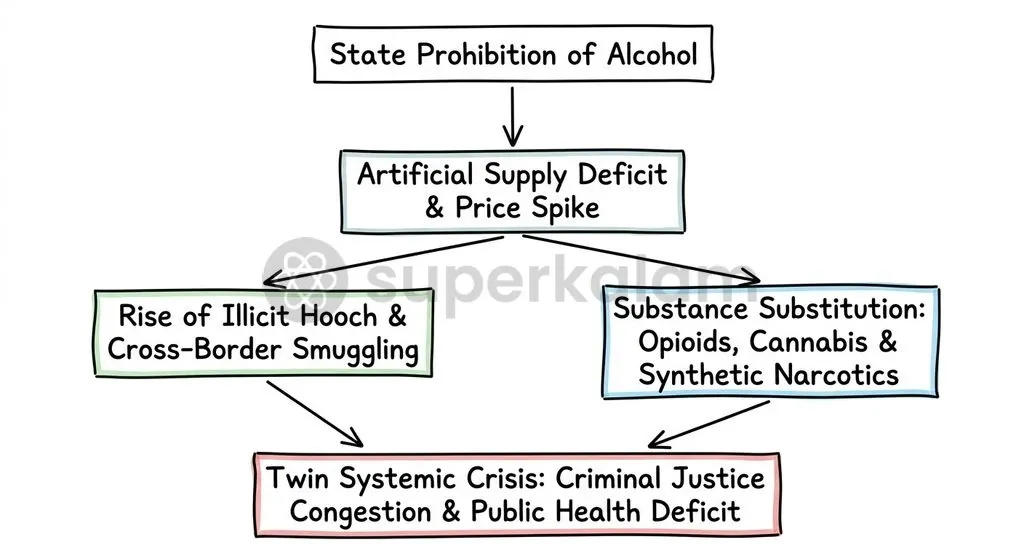
The substitution effect occurs when consumers switch to alternative psychoactive substances after the state makes their primary choice inaccessible. Demand for chemical intoxication did not vanish when liquor vends shut down; it migrated to compact narcotics. Illicit drugs generate little odour and are simpler to conceal, allowing them to penetrate the market rapidly.
Clinical research corroborates this shift. A tertiary care study published in the Cureus Journal of Medical Science by Dr. Sambhu Prasad and colleagues at AIIMS Patna documented statistically significant increases in opioid consumption (p = 0.008) and cannabis consumption (p = 0.021) among substance use disorder patients in Bihar following the liquor ban.
The study also recorded marked changes in consumption patterns:
- Statistically significant increases occurred in daily drug usage frequencies (p = 0.008).
- Parallel increases appeared in weekly drug usage frequencies (p = 0.021), proving that prohibition accelerated dependency on dangerous alternatives.
State policing data matches this clinical pattern. As reported in The Indian Express in August 2025, data compiled by the Economic Offences Unit of the Bihar Police showed that registered cases under the Narcotic Drugs and Psychotropic Substances Act, 1985 surged from 518 in 2016 to 2,411 in 2024.
Arrests under the NDPS Act escalated from 496 in 2016 to 1,813 in 2024, alongside rising seizures of charas, smack, brown sugar, and doda. An investigation reported by The Indian Express revealed that Bihar registered 1,905 NDPS Act cases during the first five months of 2026 alone, exceeding the total narcotics cases registered during the entire year of 2022. The transition from low-potency alcohol to adulterated brown sugar represents a profound public health setback.
Discuss with Superkalam
How does the economic and pharmacological concept of the 'substitution effect' explain the post-2016 rise in NDPS Act registrations across Bihar?
Ask NowPorous Borders and Trafficking Corridors: The Supply Chain via Nepal and Neighbouring States
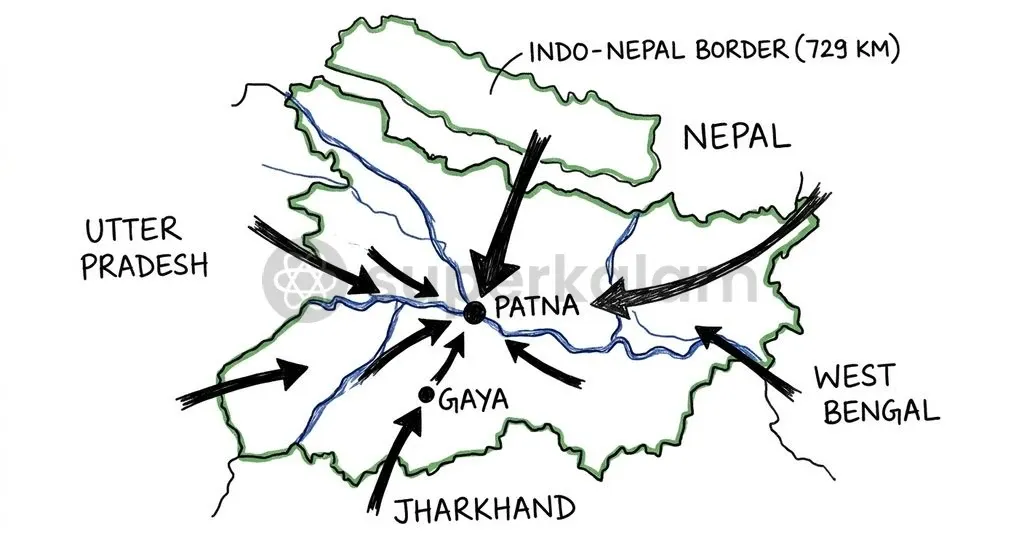
Northern Bihar's geography presents distinct enforcement hurdles. The state borders Nepal to the north and shares domestic boundaries with states maintaining different excise policies. Organised trafficking syndicates quickly exploited these entry points after the ban.
Key transit routes feed illicit contraband across multiple vectors:
- The northern international frontier: The 729-kilometre porous Indo-Nepal border serves as a primary conduit for cannabis and charas trafficking, according to operational releases from the Sashastra Seema Bal and the Narcotics Control Bureau.
- Unmonitored rural passages: Open frontier paths allow couriers to bypass established highway checkpoints on foot or via rural tracks, funnelling narcotics directly into northern districts.
- Interstate road networks: Transport networks linking Bihar with West Bengal, Jharkhand, and Uttar Pradesh channel steady streams of country-made liquor alongside synthetic narcotics.
The Narcotics Control Bureau coordinates cross-border interdiction efforts across northern Bihar to stem this influx. In response to the integrated contraband trade, the Bihar government established the Prohibition and State Narcotics Control Bureau in September 2025 by merging its excise enforcement wing with the police Anti-Narcotics Task Force.
Enforcement Burden: Court Congestion, Bail Backlogs, and Police Distraction
Bihar's excise enforcement placed unprecedented strain on the state's legal framework. In January 2022, a bench headed by Chief Justice N.V. Ramana noted in State of Bihar v. Raju Das that the prohibition law had choked the state's justice delivery machinery. The Supreme Court observed that 16 High Court judges were spending their working hours hearing liquor-related bail applications.
This influx of excise litigation overwhelmed prison infrastructure as well:
- Exploding undertrial rolls: A comparative cross-sectional study on Bihar undertrial prisoners between 2010 and 2021 documented a 1,190.39 percent increase in undertrials incarcerated for liquor and narcotics offences following absolute prohibition.
- Prison overcrowding: As reported by Gulf News in December 2021, a Bihar Home Department report showed the state's 59 correctional facilities housing over 68,000 inmates against an authorised capacity of 46,669 inmates, driven substantially by prohibition detentions.
- Distorted policing focus: According to figures from the Directorate of Prohibition cited in July 2025, over 6.40 lakh people were convicted under the Prohibition Act between April 2016 and July 2025, with 6.38 lakh convicted under Section 37 simply for drinking or public intoxication.
Diverting police resources toward chasing petty drinkers depleted investigative bandwidth for serious criminal offences.
Discuss with Superkalam
If you were the District Magistrate of a district bordering Nepal, how would you coordinate between central border guarding forces and local police to dismantle dual contraband networks?
Ask NowPublic Health Deficit: The Severe Shortage of De-Addiction and Rehabilitation Centers
The National Drug Dependence Treatment Centre at AIIMS has long maintained that chemical dependency requires clinical therapy rather than carceral detention. When Bihar enacted total prohibition in 2016, public health experts anticipated that thousands of dependent individuals would require supervised detoxification. The state announced 39 de-addiction facilities across 38 administrative districts to manage the caseload.
Physical infrastructure failed to match clinical need. Structural shortcomings appeared across several fronts:
- Staffing and medicine deficits: As reported by The Hindu and India Today, district hospital facilities set up under the 2016 notification suffered from persistent shortages of qualified psychiatrists, psychiatric social workers, and essential withdrawal medications.
- Limited operational reach: By 2026, an investigation published by The Indian Express revealed that centrally supported addiction treatment facilities were functional in less than one-third of Bihar's 38 administrative districts.
- Shift in patient intake: Within the first year of the alcohol ban, clinicians at Nalanda Medical College Hospital observed that a majority of admissions to designated de-addiction wards sought treatment for cannabis, prescription sedatives, and solvent abuse rather than alcohol withdrawal.
The Ministry of Social Justice and Empowerment's National Substance Use Survey stressed that opioid and sedative dependence requires long-term opioid substitution therapy. Primary health centres in Bihar remain largely unequipped to deliver this specialised clinical care.
Discuss with Superkalam
Examine the institutional trade-offs between deploying Executive Magistrates for summary fines under the 2022 amendment versus preserving conventional judicial oversight.
Ask NowWay Forward: Shifting from Criminalization to Harm Reduction and Public Health
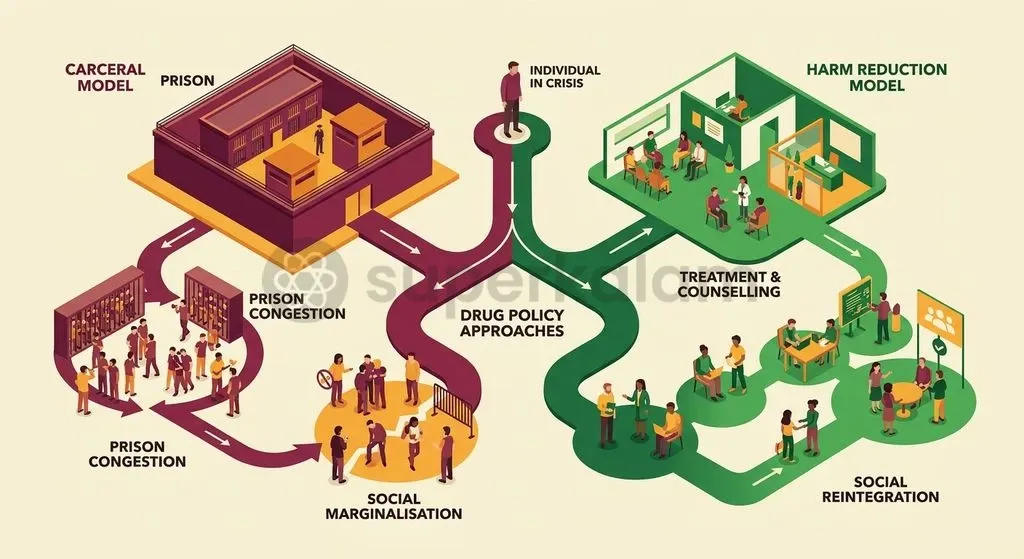
The United Nations Office on Drugs and Crime and the World Health Organization advocate for harm reduction strategies that treat chemical dependency as an urgent public health priority. Complete supply bans routinely produce illicit market substitution, criminal syndicates, and public corruption unless accompanied by evidence-based demand reduction. Rebalancing Bihar's policy requires moving away from heavy carceral enforcement toward clinical and economic rehabilitation.
Key policy priorities include:
- Expanding Opioid Agonist Treatment and needle-syringe programmes under UNODC and WHO guidelines to curb transmission of blood-borne infections among injecting drug users.
- Upgrading district hospitals with dedicated psychiatric wards, trained de-addiction counsellors, and continuous supplies of essential substitution medicines such as buprenorphine.
- Strengthening the Ministry of Social Justice and Empowerment's Nasha Mukt Bharat Abhiyan, using community mobilisation and youth-led awareness drives to suppress substance demand before it takes root.
- Decoupling minor substance possession from criminal prosecution, redirecting individuals detected with personal quantities into compulsory outpatient healthcare rather than crowded prisons.
- Expanding Jeevika's micro-credit and vocational training schemes to secure sustainable alternative livelihoods for families formerly engaged in traditional toddy tapping and brewing.
Discuss with Superkalam
Weigh the efficacy of a purely punitive supply-suppression regime against a public-health harm reduction approach in managing chemical dependency.
Ask NowKey Takeaways
- Article 47 of the Constitution directs the State to pursue the prohibition of intoxicating drinks and injurious drugs as a non-justiciable Directive Principle of State Policy.
- The Supreme Court held in 2016 that there is no fundamental right to trade or consume liquor, validating the state's legislative competence to enact absolute prohibition.
- Suppressing alcohol without providing adequate treatment infrastructure created a policy substitution trap, causing statistically significant increases in opioid and cannabis dependency across Bihar.
- Cross-border smuggling across the 729-kilometre open Indo-Nepal border and contiguous states created thriving supply chains for charas, smack, and synthetic sedatives.
- Prohibition litigation placed an enormous burden on the judicial system, with over 6.38 lakh individuals convicted under Section 37 for consumption and thousands of undertrials crowding prisons.
- Marginalised communities, particularly the Musahar Dalit community, bore the brunt of criminal enforcement, highlighting the need to shift from penal deterrence to public health harm reduction.
Mains Question
'Blanket legislative prohibitions aimed at intoxicating substances often fail when divorced from public health mechanisms, triggering an unintended policy substitution trap.' In light of the implementation of the Bihar Prohibition and Excise Act, 2016, critically examine this statement. (15 Marks)
Evaluate NowMains Question
Evaluate the institutional and administrative challenges posed by cross-border trafficking and illicit syndicates following the statutory prohibition of alcohol in Bihar. (10 Marks)
Evaluate NowPractice MCQs
QUESTION 1
With reference to the constitutional and judicial jurisprudence on liquor prohibition in India, consider the following statements:
- Article 47 of the Constitution of India provides an enforceable fundamental right to citizens demanding the prohibition of intoxicating drinks.
- The Supreme Court in 'State of Bihar v. Confederation of Indian Alcoholic Beverage Companies' held that citizens do not possess a fundamental right to trade or consume liquor.
- The Directive Principles of State Policy under Part IV guide legislative intent regarding the prohibition of intoxicating drinks and injurious drugs. Which of the statements given above are correct?
QUESTION 2
Regarding the statutory amendments introduced under the Bihar Prohibition and Excise (Amendment) Act, 2022, consider the following statements:
- The amendment diluted Section 37 to allow first-time drinking offenders to secure release by paying a fine instead of undergoing mandatory judicial custody.
- It vested the adjudication of first-time consumption violations in Executive Magistrates rather than judicial courts.
- It inserted Section 2(50A) to classify illicit liquor operations as organised crime. Which of the statements given above are correct?
QUESTION 3
Consider the following statements regarding substance consumption trends and enforcement data following Bihar's prohibition policy:
- A clinical study by AIIMS Patna researchers published in the 'Cureus Journal of Medical Science' recorded statistically significant increases in opioid and cannabis consumption among substance use disorder patients.
- Registered cases under the Narcotic Drugs and Psychotropic Substances (NDPS) Act, 1985 in Bihar showed a declining trend between 2016 and 2024 due to stringent border surveillance.
- The Bihar government established the Prohibition and State Narcotics Control Bureau in September 2025 by merging its excise enforcement wing with the police Anti-Narcotics Task Force. Which of the statements given above is/are correct?
QUESTION 4
In the context of interstate and international contraband corridors affecting Bihar's excise enforcement, the primary conduit identified for cross-border cannabis and charas trafficking is the:
QUESTION 5
In 'State of Bihar v. Raju Das' (2022), the Supreme Court of India highlighted judicial congestion resulting from the Bihar Prohibition and Excise Act, 2016 by observing that: