BHAVYA Rasayan Scheme: Rs 3,030 Crore for Three Chemical Parks, Explained
While capital subsidies fund shared industrial parks, solving India's chemical trade deficit demands unravelling deep feedstock and tax bottlenecks.
Oct, 2026
•9 min read
Overview
The Union Cabinet approved the Bharat Audyogik Vikas Yojana Rasayan scheme to bridge India's severe chemical trade deficit through three dedicated industrial parks. Yet capital subsidies alone cannot overcome import reliance without tackling upstream feedstock bottlenecks and tax cascading on industrial inputs.
Operating with a ₹3,030 crore financial outlay from FY 2026–27 to FY 2030–31, the initiative funds shared common infrastructure. This support covers common effluent treatment plants and interconnected utility pipelines.
India's chemical manufacturing ecosystem faces deep structural deficits. Domestic petrochemical intensity remains low despite massive oil refining capacity, leaving specialty chemical producers reliant on imported building blocks. Real self-reliance requires aligning feedstock supplies, rationalising utility tariffs, and integrating hydrocarbon inputs into unified indirect tax structures.
Why in the News: India's Push to Cut Dependence on Chemical Imports
The Union Cabinet approved the BHAVYA Rasayan Scheme on July 24, 2026, committing central funds to build three dedicated chemical parks. As of October 2026, the Department of Chemicals and Petrochemicals is rolling out scheme guidelines to address India's persistent trade vulnerabilities.
At the 14th edition of India Chem 2026 in Mumbai, themed 'Advantage Bharat: An Emerging Global Chemicals Hub', Union Minister J.P. Nadda projected the domestic market to expand from its current baseline to $300 billion by 2030 and reach $1 trillion by 2040.
Export ambitions clash directly with severe upstream vulnerabilities across critical value chains. According to the Department of Chemicals and Petrochemicals, India incurs an annual chemical trade deficit exceeding $25 billion, driven by large-scale inflows of basic organic building blocks like methanol, acetic acid, and phenol.
Trade asymmetry is acute with Beijing. Data from NITI Aayog shows China accounts for 30% to 35% of chemical imports into India, whereas Indian exporters direct merely 5% of chemical exports back to Chinese markets. Strategic downstream sectors bear the brunt of this exposure:
- Active pharmaceutical ingredients: Indian bulk drug formulators depend on Chinese suppliers for 65% to 80% of active ingredients and key starting materials.
- Agrochemical intermediates: Crop protection synthesis relies on imported organophosphates and basic intermediates subject to global pricing shocks.
- Specialty performance chemicals: Domestic manufacturers must import primary building blocks due to missing basic chemical synthesis capacity.
Discuss with Superkalam
Recall the exact petrochemical intensity percentage of Indian refineries compared to advanced crude-to-chemicals facilities in China and the Gulf.
Ask NowWhat is the BHAVYA Rasayan Scheme?
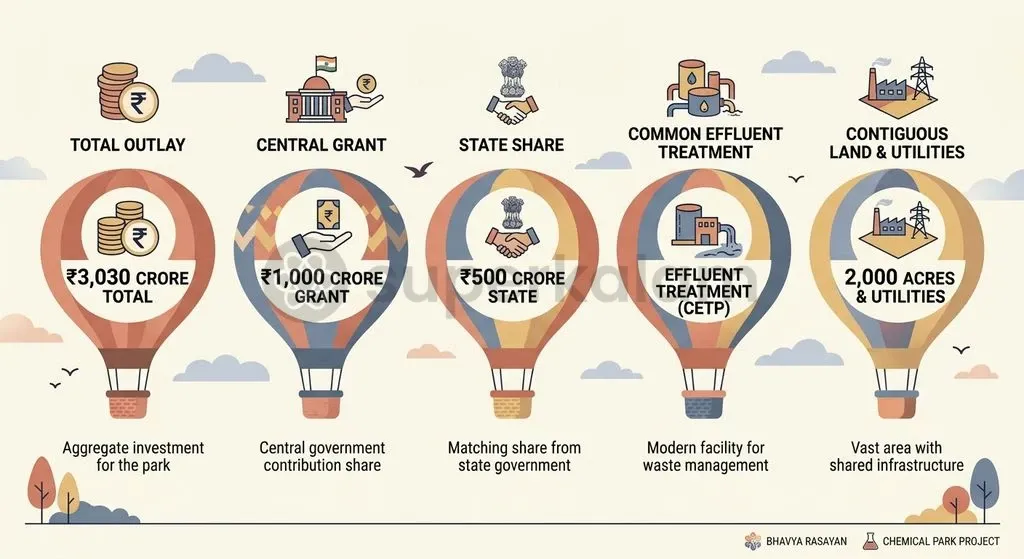
The Department of Chemicals and Petrochemicals designed the BHAVYA Rasayan Scheme as a dedicated infrastructure initiative to support domestic manufacturing of specialty chemicals and intermediates. Operating over a five-year window spanning FY 2026–27 through FY 2030–31, the scheme deploys a total financial outlay of ₹3,030 crore, which earmarks ₹3,000 crore for common infrastructure and reserves ₹30 crore for administrative expenditure.
Fiscal assistance follows a targeted co-financing arrangement between the Union and regional administrations. The Central Government provides a capital grant capped at ₹1,000 crore per park, made contingent upon a minimum ₹500 crore matching contribution from the host State Government.
Participating states undergo competitive selection based on objective project readiness criteria. Per guidelines from the Department of Chemicals and Petrochemicals, states must allocate at least 2,000 acres of contiguous land free from legal encumbrances.
Policy documents distinguish BHAVYA Rasayan from broader multi-sector industrial initiatives. In March 2026, the Department for Promotion of Industry and Internal Trade launched the umbrella Bharat Audyogik Vikas Yojana with an outlay of ₹33,660 crore across six years to finance 100 general multi-sector industrial parks. BHAVYA Rasayan operates independently as a focused intervention addressing the specific effluent, safety, and utility demands of chemical synthesis.
| Parameter | BHAVYA Rasayan (Chemical Sector) | Umbrella BHAVYA (DPIIT) |
|---|---|---|
| Nodal Department | Department of Chemicals and Petrochemicals | DPIIT |
| Financial Outlay | ₹3,030 crore across five years | ₹33,660 crore across six years |
| Target Infrastructure | 3 specialized chemical parks | 100 multi-sector industrial parks |
| Land Requirement | Minimum 2,000 contiguous acres | Variable based on industrial profile |
| Core Provision | Common effluent and hazardous waste treatment | General multi-sector logistics and utilities |
The Feedstock Paradox: Why an Oil Refining Hub Imports Basic Chemicals
India has vast refining capacity but produces remarkably few basic chemical building blocks. The country operates more than 250 MMTPA of crude refining capacity across its energy complexes. Yet downstream chemical synthesizers face severe shortages of domestic building blocks.
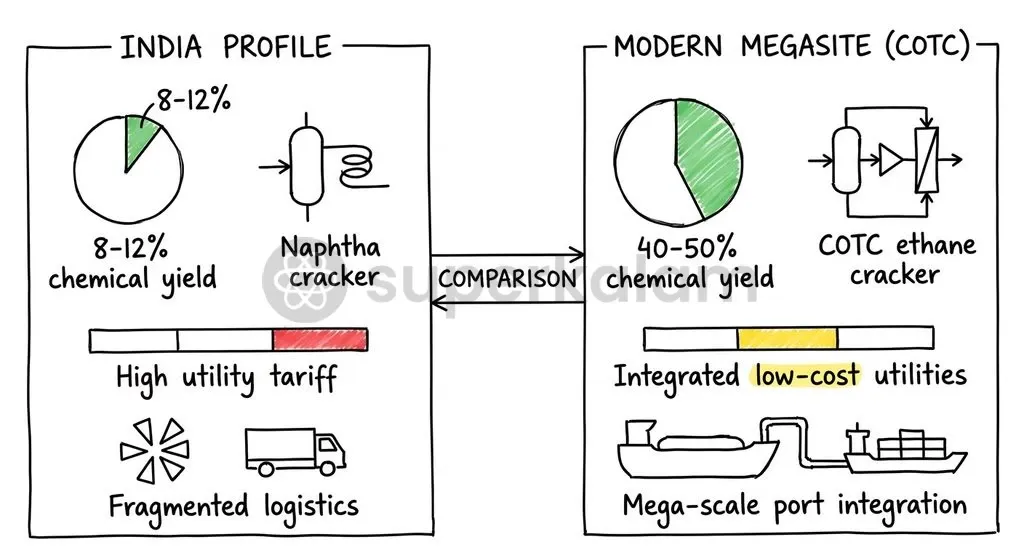
The structural bottleneck is low refinery integration. The Ministry of Petroleum and Natural Gas notes that national petrochemical intensity in refining remains low, hovering between 8% and 12% across domestic complexes. Indian refineries are configured to maximise transportation fuels like petrol and diesel rather than chemical intermediates.
Global competitors operate on a fundamentally different manufacturing footprint:
- Crude-to-chemicals conversion: Advanced complexes in China and the Gulf convert 40% to 50% of crude oil directly into olefins, aromatics, and downstream chemicals.
- Feedstock cost differentials: Middle Eastern producers run low-cost ethane-based gas crackers yielding abundant, inexpensive ethylene.
- Domestic cracker disadvantages: Indian crackers rely on expensive liquid naphtha or imported liquefied natural gas, creating an unbridgeable base-cost differential.
Without inexpensive domestic primary olefins and aromatics, Indian specialty chemical producers stay locked into importing high-cost basic derivatives.
Discuss with Superkalam
Explain how the exclusion of crude oil and natural gas from the GST framework results in tax cascading for chemical synthesis.
Ask NowSubsidies vs Scale: Can Fiscal Grants Overcome China's Cost Edge?
Industrial subsidies like BHAVYA Rasayan lower upfront capital outlays. They do not, however, solve ongoing operational input costs. Chinese manufacturers deploy massive centralised plants that drive down global marginal costs across essential solvents and intermediates.
Three structural handicaps neutralise early capital subsidies:
- Industrial power differentials: State electricity boards in India charge chemical processing units average tariffs of ₹7 to ₹10 per kilowatt-hour. In contrast, state-supported industrial zones in competing manufacturing hubs across China and the Gulf deliver electricity at rates under ₹4 to ₹5 per kilowatt-hour.
- Tax cascading on primary inputs: The Goods and Services Tax Council continues to leave crude oil and natural gas outside the uniform indirect tax system. The Parliamentary Standing Committee on Chemicals and Fertilizers highlighted that exclusion from the GST network traps manufacturers under uncreditable value-added taxes and central excise duties, creating an unrelieved tax burden of 10% to 15% on production costs.
- Capital expenditure vs input parity: A state subsidy covering park infrastructure reduces capital costs for on-site utilities. However, basic feedstock and power constitute the overwhelming majority of variable production expenditure for continuous chemical synthesis.
A central grant cushions initial plant setup. Over the life of a chemical facility, recurring disparities in power tariffs and uncreditable taxes consistently eclipse that upfront relief.
PCPIR Lessons: Why India's Previous Chemical Clusters Stalled
The Petroleum, Chemicals and Petrochemical Investment Regions policy of 2007 attempted to create massive integrated chemical enclaves but struggled against implementation friction. The Central Government notified four mega-regions across Dahej in Gujarat, Paradip in Odisha, Visakhapatnam in Andhra Pradesh, and Cuddalore in Tamil Nadu.
Overambitious land planning quickly undermined regional execution:
- Excessive scale requirements: The framework demanded contiguous land parcels spanning 250 square kilometres per region, triggering extensive land acquisition litigation and social displacement resistance.
- Anchor tenant delays: The model depended on state-owned oil marketing companies building massive mother crackers to supply downstream tenants, but prolonged capital allocation delays left clusters without baseline olefins.
- Trunk infrastructure lags: State governments struggled to finance external rail, express highway, and specialised chemical port linkages, leaving downstream secondary plots isolated.
BHAVYA Rasayan incorporates these institutional lessons by modifying cluster scale and development requirements. Guidelines issued by the Department of Chemicals and Petrochemicals abandon the sprawling 250-square-kilometre layout in favour of compact 2,000-acre industrial enclaves. Requiring host states to demonstrate clear title and encumbrance-free contiguous possession before disbursing central grants prevents the land acquisition bottlenecks that crippled earlier initiatives.
Discuss with Superkalam
How might a pharmaceutical formulator adjust supply chain strategies if global prices of basic petrochemical intermediates like phenol or methanol surge?
Ask Now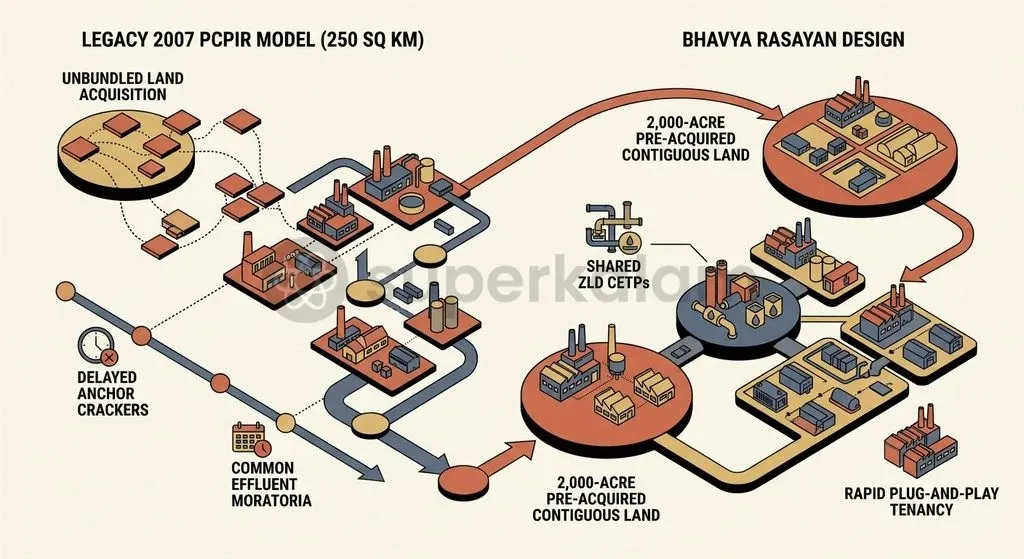
Way Forward: Building Feedstock Security Beyond Subsidies
The Department of Chemicals and Petrochemicals and NITI Aayog have proposed that bridging India's structural olefin deficit requires establishing consortium cracker units funded jointly by public oil marketing companies and private specialty chemical manufacturers (as reported by DCPC in November 2025). Shared ownership aligns refining output directly with downstream consumption, securing guaranteed domestic absorption of ethylene and propylene.
A coherent strategy must link infrastructure grants with broader structural reforms:
- Indirect tax rationalisation: The Goods and Services Tax Council should bring natural gas and petroleum feedstocks under the unified GST framework to eliminate the current 10% to 15% tax cascading burden affecting basic synthesis.
- Crude-to-chemicals transitions: Refining policies must mandate higher petrochemical yields for upcoming refinery expansions, moving from the current national average of 8% to 12% toward global benchmarks above 40%.
- Shared green utilities: State governments should provide dedicated renewable energy corridors to chemical parks, lowering industrial power tariffs closer to competing international benchmarks.
- Process technology R&D: NITI Aayog recommends boosting dedicated public-private research funding for indigenous catalysts, flow chemistry, and green hydrogen integration to replace outdated, polluting synthetic pathways.
Combining compact, plug-and-play park infrastructure with feedstock price parity will allow domestic producers to build competitive scale, turning ambitious market projections into sustainable industrial capacity.
Discuss with Superkalam
Compare the institutional design of the 2007 PCPIR policy with the BHAVYA Rasayan Scheme in terms of land acquisition and infrastructure targets.
Ask NowKey Takeaways
- The Union Cabinet approved the BHAVYA Rasayan Scheme on July 24, 2026, with an outlay of ₹3,030 crore to establish three dedicated chemical parks across FY 2026–27 to FY 2030–31.
- Under the scheme guidelines, the Centre offers grants up to ₹1,000 crore per park, requiring participating states to provide a minimum ₹500 crore matching contribution and 2,000 contiguous acres.
- India faces an annual chemical trade deficit exceeding $25 billion, relying on China for 30% to 35% of total chemical imports and 65% to 80% of active pharmaceutical ingredients.
- Domestic refining capacity exceeds 250 MMTPA, but petrochemical intensity remains low at 8% to 12%, compared to 40% to 50% conversion rates achieved by modern Crude-to-Chemicals facilities abroad.
- High industrial power tariffs (₹7 to ₹10 per kWh) and the exclusion of natural gas from the GST regime create structural cost handicaps that capital subsidies alone cannot resolve.
Mains Question
"Capital subsidies for common industrial infrastructure reduce entry barriers, but they cannot compensate for uncompetitive operational input costs." In light of the BHAVYA Rasayan Scheme, critically examine the structural challenges hindering self-reliance in India's chemical sector. (15 Marks)
Evaluate NowMains Question
Analyzing the implementation shortcomings of the 2007 Petroleum, Chemicals and Petrochemical Investment Regions (PCPIR) framework, evaluate how the BHAVYA Rasayan Scheme modifies cluster-based industrial planning. (10 Marks)
Evaluate NowPractice MCQs
QUESTION 1
With reference to the Bharat Audyogik Vikas Yojana Rasayan (BHAVYA Rasayan) scheme, consider the following statements: 1. It is implemented by the Department for Promotion of Industry and Internal Trade (DPIIT) with an outlay of ₹33,660 crore. 2. The scheme provides a capital grant capped at ₹1,000 crore per park, subject to a minimum ₹500 crore matching contribution from the host state. 3. Host states are required to allocate at least 2,000 acres of contiguous encumbrance-free land for each chemical park. Which of the statements given above is/are correct?
QUESTION 2
Regarding the structural characteristics of India's chemical and refining industry, consider the following statements: 1. India possesses over 250 MMTPA of crude refining capacity, but its domestic petrochemical intensity remains limited to 8% to 12%. 2. Competing refining complexes in China and the Gulf convert 40% to 50% of crude oil directly into chemicals and petrochemical building blocks. 3. Indian gas crackers predominantly rely on low-cost domestic ethane, giving them a structural price advantage over Middle Eastern producers. Which of the statements given above is/are correct?
QUESTION 3
Consider the following statements regarding the bottlenecks faced by the Petroleum, Chemicals and Petrochemical Investment Regions (PCPIR) policy of 2007: 1. The policy mandated a contiguous land requirement of 250 square kilometres per region, leading to significant land acquisition litigation. 2. Implementation was delayed by capital allocation lags in establishing mother crackers by state-owned oil marketing companies. Which of the statements given above is/are correct?
QUESTION 4
According to the Parliamentary Standing Committee on Chemicals and Fertilizers, what is the primary cause of the 10% to 15% unrelieved tax burden on domestic chemical manufacturing costs?
QUESTION 5
With reference to India's chemical trade dependencies, consider the following statements: 1. India incurs an annual chemical trade deficit exceeding $25 billion. 2. China accounts for 30% to 35% of India's chemical imports, while receiving only 5% of India's chemical exports. 3. Indian bulk drug formulators depend on Chinese suppliers for 65% to 80% of active ingredients and key starting materials. Which of the statements given above is/are correct?