Badr MoU: Turkiye, Pakistan, Qatar and Indonesia Defence Pact
While the four-nation pact deepens the Pakistan-Turkiye defence axis, New Delhi's Gulf ties and Southeast Asian diplomacy preserve regional strategic balance.
Oct, 2026
•12 min read

Overview
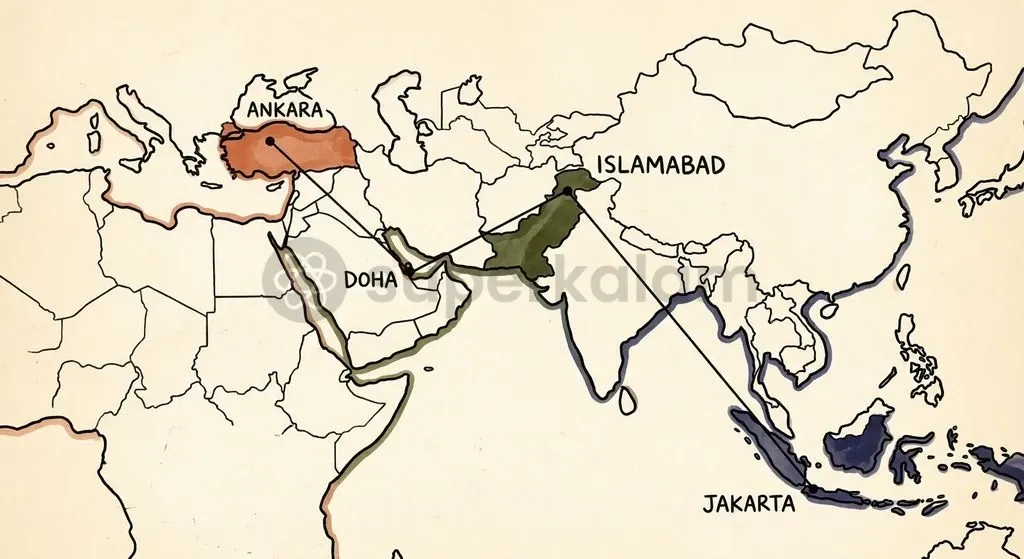
On 21 October 2026, the defence ministries of Qatar, Indonesia, Pakistan, and Turkiye signed the Badr Memorandum of Understanding in Doha. The pact establishes a multilateral defence-industrial framework focused on joint military manufacturing, shared research, and technology transfer. It pools regional manufacturing capabilities and co-development initiatives without establishing a collective security treaty or mutual military defence commitment.
For New Delhi, this development does not represent a unified hostile military alliance. However, it institutionalises defence-industrial collaboration between Islamabad and Ankara. This makes it vital for India to leverage its comprehensive strategic partnerships with Gulf powers like Saudi Arabia and the United Arab Emirates, while expanding defence exports across Southeast Asia.
Why Is the Badr MoU in the News?
The Badr Memorandum of Understanding entered into force on 21 October 2026 following a formal signing ceremony hosted by the Qatari Ministry of Defence in Doha. As of October 2026, the agreement establishes an operational defence-industrial partnership among Turkiye, Pakistan, Qatar, and Indonesia designed to integrate their respective military production capabilities.
Strategic analysts have monitored the pact due to its cross-regional reach across West Asia, South Asia, and Southeast Asia. The inclusion of Indonesia alongside Pakistan and Turkiye has drawn particular scrutiny across Indian strategic circles. Jakarta simultaneously maintains growing bilateral security and procurement ties with New Delhi.
What Is the Badr MoU and Who Are the Signatories?
The Badr Memorandum of Understanding coordinates military manufacturing and technical research among four partner nations. According to an official dispatch from the Saudi Press Agency, the agreement derives its name from 'Badr', the Arabic word for 'full moon'. The name symbolises how the four signatory states intend to complement one another's domestic industrial capacities.
Senior defence and procurement leadership representing each signatory administration formally concluded the pact:
- Turkiye: Represented by Turkish Defence Minister Yaşar Güler and Haluk Görgün, Head of Turkiye's Presidency of Defence Industries (SSB).
- Qatar: Represented by Sheikh Saud bin Abdulrahman bin Hasan Al Thani, Deputy Prime Minister and Minister of State for Defence.
- Pakistan: Represented by Federal Minister for Defence Khawaja Muhammad Asif.
- Indonesia: Represented by Deputy Defence Minister Yusuf Jauhari.
The arrangement does not construct an expeditionary military command. Instead, the framework establishes a predefined procedural mechanism that enables national procurement agencies and public defence enterprises to coordinate development programmes under common operational guidelines.
Key Provisions: What Does the Agreement Cover?
The Badr Memorandum of Understanding establishes specific technical and industrial mechanisms to facilitate cross-border military co-production. According to the Qatar Ministry of Defence, the functional mandate centres on joint military manufacturing, direct technology transfer, technical military training exchanges, and collaborative research and development tailored for modern defence systems.
The agreement focuses on several core functional areas:
- Joint military production: Participating nations seek to co-develop conventional platforms, ammunition, and subsystem components, combining low-cost manufacturing infrastructure with specialised design capabilities.
- Technology sharing and transfer: Signatories agreed to lower administrative barriers to transfer technical data, defence software, and engineering expertise across participating domestic entities.
- Collaborative R&D programmes: The pact initiates shared research efforts targeting emerging domains, including electronic warfare, unmanned aerial platforms, and secure tactical communications.
- Supply chain integration for friendly export markets: A core objective stated by the Turkish Ministry of National Defence is integrating the four nations' production capacities to supply defence materiel to allied and partner third-party countries.
Discuss with Superkalam
Recall the four signatory nations that formally concluded the Badr Memorandum of Understanding in Doha.
Ask NowWhat the Badr Pact Does Not Include: Limits and Strategic Red Lines
The Badr Memorandum of Understanding is strictly a defence-industrial framework and explicitly omits collective security guarantees or operational mutual defence obligations. The legal provisions contain no clause compelling signatories to deploy military personnel, share real-time operational combat intelligence, or provide armed assistance if another member faces an external armed attack.
This structural distinction matters when evaluating the pact's strategic footprint. The absence of mutual security commitments preserves national strategic autonomy:
- No mutual combat commitment: Signatories have no legal duty to supply troops or direct military assistance during armed conflict.
- No operational intelligence integration: The text omits real-time battlefield intelligence networks.
- Independent bilateral diplomacy: No member can automatically drag partner states into bilateral territorial disputes.
The agreement differs fundamentally from binding defence pacts concluded elsewhere in the region. Most notably, the Makkah Joint Defence Agreement signed on 7 August 2026 by Pakistan, Saudi Arabia, and Turkiye established an explicit collective defence commitment stipulating that an armed attack on one member shall be treated as an attack on all. The Badr MoU deliberately avoids collective defence obligations, restricting its mandate entirely to commercial, technical, and industrial spheres.
Comparison: How It Differs from Traditional Military Alliances
Multilateral defence alignments vary significantly in their legal structures, obligations, and operational scopes. The Badr MoU is an industrial consortium rather than a collective defence apparatus.
| Dimension | Badr Memorandum of Understanding | Traditional Military Alliance (e.g. Makkah Joint Defence Agreement) | Non-Aligned Strategic Partnership (e.g. India-Indonesia Strategic Ties) |
|---|---|---|---|
| Primary Mandate | Defence manufacturing, technology sharing, and cooperative R&D | Collective security and mutual armed assistance against external aggression | Bilateral security dialogue, maritime domain awareness, and arms trade |
| Collective Security Clause | None; contains no operational combat commitment or binding assistance clause | Explicit Article 5-style clause; an attack on one signatory is treated as an attack on all | None; upholds complete sovereign non-alignment and independent action |
| Operational Integration | Limited to technical training exchanges and procedural industrial mechanisms | Joint command structures, interoperable combat doctrines, and deployment rights | Joint maritime patrols, staff talks, and bilateral training exercises |
| Third-Party Arms Exports | Explicit goal to integrate industrial capacity for supply to friendly nations | Focused primarily on alliance deterrence and mutual territorial defence | Regulated through bilateral end-user monitoring and non-re-export agreements |
| Strategic Flexibility | High; members retain independent foreign policies and external partnerships | Low; binding treaty commitments constrain unilateral security realignments | High; partners pursue multi-alignment based on mutual national interests |
Discuss with Superkalam
Explain the functional distinction between a collective defence agreement and a defence-industrial framework like the Badr MoU.
Ask NowGeopolitical Drivers: Why Turkiye, Pakistan, Qatar, and Indonesia Formed This Grouping
The formation of the Badr grouping reflects the converging economic and strategic imperatives of four distinct middle powers seeking to hedge against global supply chain volatility.
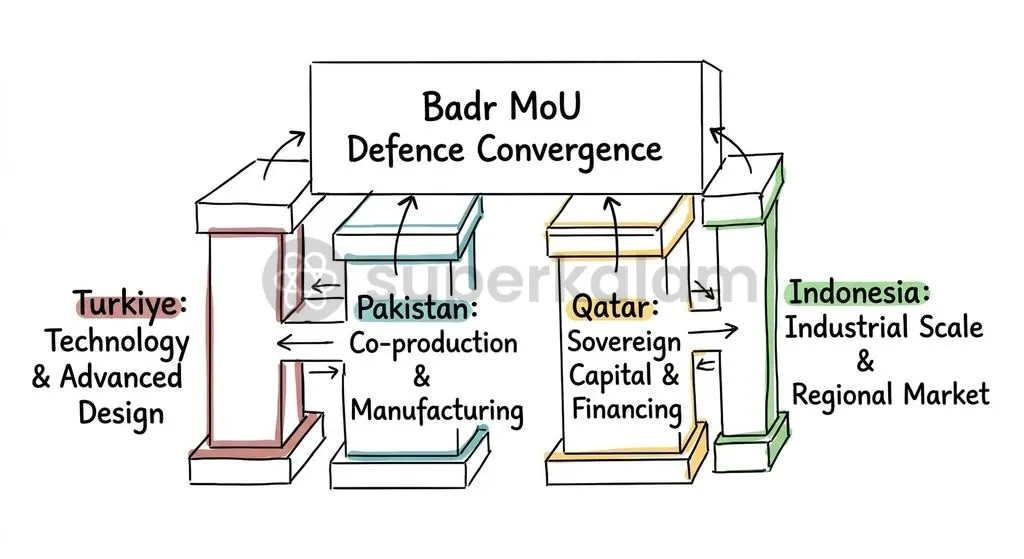
Each signatory pursues distinct national objectives within the pact:
- Turkiye: Aims to commercialise indigenous defence technologies and scale up global exports.
- Pakistan: Seeks external technical collaboration and financial relief for platform upgrades.
- Qatar: Endeavours to diversify military acquisitions away from Western dependence.
- Indonesia: Aims to modernise archipelagic defence systems without joining binding blocs.
Turkiye's Defence Export Ambition
For Ankara, the Badr MoU represents an institutional vehicle to expand export markets and monetise indigenous systems developed under the Presidency of Defence Industries. Turkish defence firms have achieved significant breakthroughs in tactical unmanned aerial vehicles, naval corvettes, and precision-guided munitions. Engaging Qatar, Pakistan, and Indonesia provides Turkiye with external capital, distributed production lines, and direct access to markets across South and Southeast Asia.
Pakistan's Search for Technological and Financial Lifelines
For Islamabad, the agreement provides critical access to foreign manufacturing technology and external co-production agreements amidst severe domestic fiscal constraints. Faced with dwindling foreign reserves, Pakistan's military-industrial complex seeks external partnerships to modernise its conventional arsenals. The pact helps sustain aviation maintenance programmes and reduces excessive reliance on singular external suppliers.
Qatar's Security Diversification Strategy
As reported by the Aviation Week Intelligence Network on 21 October 2026, Doha's participation reflects a long-term strategy to diversify security procurement beyond Western defence contractors. It also aims to develop sovereign technical capacities amidst Middle Eastern instability. Qatar provides substantial financial resources, which can fund capital-intensive research and development projects carried out across partner production facilities.
Indonesia's Non-Aligned Modernisation Strategy
Indonesia's accession aligns with its traditional bebas-aktif foreign policy, which prioritises an independent and active stance that avoids binding military alliances, as evaluated by The Times of India on 21 October 2026. Jakarta faces pressing requirements to recapitalise its naval and air assets to secure its vast archipelagic waters. Participating in the Badr framework provides Indonesian state-owned enterprises access to aerospace and maritime technology without requiring Jakarta to join an adversarial bloc.
Discuss with Superkalam
How might India apply its strategic partnerships with Gulf powers like Saudi Arabia and the UAE to counterbalance the Badr grouping's regional footprint?
Ask NowStrategic Concerns for New Delhi: Impact on South Asia and the Indian Ocean
The Ministry of Defence and the Ministry of External Affairs in New Delhi evaluate the Badr MoU through the prism of its secondary strategic consequences rather than as an immediate collective military threat.
Institutionalisation of the Pakistan-Turkiye Nexus
A major security implication for New Delhi is the formal institutionalisation of the Pakistan-Turkiye defence relationship, as highlighted in a strategic analysis by The Hindu on 21 October 2026. Turkish aerospace, electronic warfare, and sensor systems have increasingly integrated into Pakistani platforms. Subsidised access to Turkish military innovation through the Badr framework could accelerate Pakistan's acquisition of advanced unmanned systems, stand-off precision munitions, and electronic countermeasures, shifting tactical balances along India's western frontier.
Maritime Domain Implications in the Northern Arabian Sea
Enhanced naval industrial collaboration among the signatories introduces long-term operational considerations for the Indian Navy. Expert commentary from the Centre for Aerospace Power Studies on 21 October 2026 noted that expanded industrial cooperation could facilitate increased technical coordination across northern Arabian Sea sea-lanes. Regular deployments, joint servicing facilities, and shared maintenance protocols between Turkish and Pakistani naval units could complicate Indian maritime surveillance operations along vital energy corridors.
Discuss with Superkalam
Analyse the domestic economic and technological drivers that led Pakistan and Turkiye to institutionalise this defence partnership.
Ask NowThe Indonesian Factor and Safeguarding Indian Technology
Indonesia's inclusion in a grouping that includes Pakistan initially raised questions regarding regional alignments. However, Jakarta's bilateral security portfolio with New Delhi remains strong and legally insulated.
On 7 July 2026, India and Indonesia concluded landmark bilateral defence agreements in Jakarta. Under the pact, Indonesia contracted to acquire India's PJ-10 BrahMos supersonic cruise missiles and Astra beyond-visual-range air-to-air missiles in a transaction reported at approximately $630 million. Addressing potential third-party risks, former BrahMos Aerospace leadership confirmed that Indian export contracts incorporate strict data protection clauses, strong intellectual property rights, and stringent end-user monitoring mechanisms that legally prohibit technology transfer or operational access to third parties such as Pakistan.
Key pillars of the India-Indonesia strategic shield include:
- Major missile procurement: Indonesia contracted India's BrahMos and Astra missile systems in a reported ~$630 million deal.
- Strict end-user monitoring: Contractual firewalls legally prohibit third-party technology access or transfer to Pakistan.
- Operational maritime fusion: Indonesia deployed a Naval Liaison Officer directly to India's Information Fusion Centre - Indian Ocean Region.
India's Diplomatic Counterweights and Strategic Levers
India retains substantial diplomatic and military levers that prevent the Badr MoU from undermining New Delhi's regional security posture.
Gulf Diplomatic Counterweights
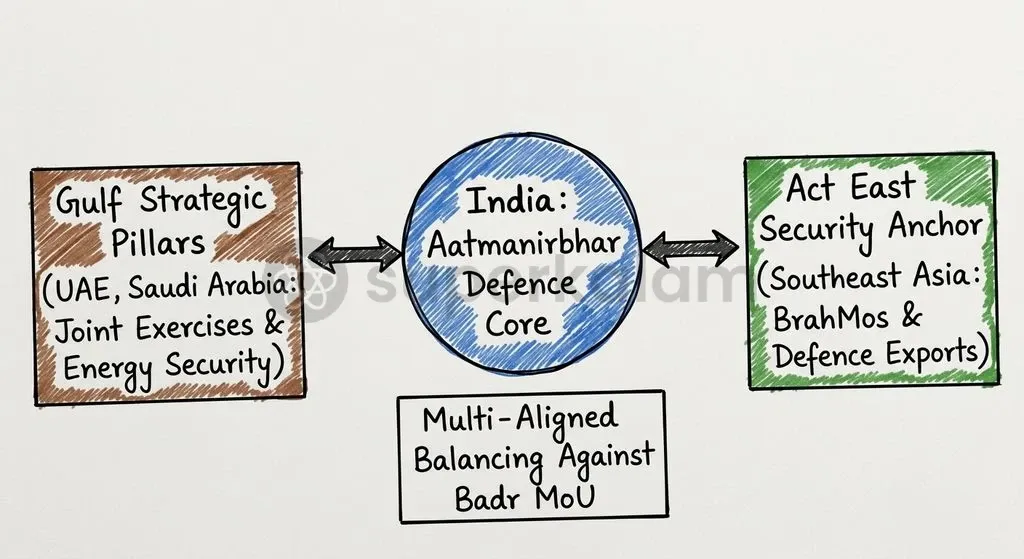
While Qatar has engaged in the Badr framework, India maintains deep comprehensive strategic partnerships with the primary regional powers of the Gulf Cooperation Council. India's diplomatic, energy, and counter-terrorism cooperation with Saudi Arabia and the United Arab Emirates provides a structural counterweight against adverse geopolitical initiatives in West Asia. These partnerships insulate Indian interests from sub-regional alignments that involve Pakistan.
Anchoring Southeast Asian Security via Act East
India continues to expand its defence diplomacy across Southeast Asia under the Act East policy. New Delhi has concluded major missile export contracts with key regional states, including the Philippines, Vietnam, and Indonesia.
Furthermore, institutional security collaboration between New Delhi and Jakarta remains operationalised on the ground. Under the July 2026 bilateral agreements, Indonesia confirmed the deployment of an Indonesian Naval Liaison Officer to India's Information Fusion Centre - Indian Ocean Region located in Gurugram. This bilateral deployment provides direct, day-to-day maritime domain awareness coordination between the two navies, establishing a degree of operational trust that an industrial MoU cannot replicate.
India deploys four main counterweights to balance these developments:
- West Asian diplomatic anchors: Comprehensive strategic partnerships with Saudi Arabia and the UAE counter sub-regional alignments.
- Act East defence architecture: Active missile exports and military diplomacy with regional partners including the Philippines, Vietnam, and Indonesia.
- Plurilateral engagement: Regular strategic and maritime coordination through groupings like the Quad and I2U2.
- Accelerated self-reliance: Expansion of domestic manufacturing capabilities and supply chain security under Aatmanirbhar Bharat.
Discuss with Superkalam
Propose diplomatic and security initiatives New Delhi could adopt under the Act East policy to insulate its defence ties with Indonesia.
Ask NowKey Takeaways
- The Badr Memorandum of Understanding was signed on 21 October 2026 in Doha by Turkiye, Pakistan, Qatar, and Indonesia to coordinate defence manufacturing, technical training, and collaborative R&D.
- The agreement is strictly an industrial and technical framework; it contains no collective defence commitment, mutual assistance clause, or binding security guarantee.
- The Badr framework contrasts with the Makkah Joint Defence Agreement of 7 August 2026, wherein Pakistan, Saudi Arabia, and Turkiye established a binding collective defence clause.
- India's primary concern remains the institutionalisation of the Pakistan-Turkiye defence axis, which may accelerate Islamabad's acquisition of advanced sensors, avionics, and unmanned aerial platforms.
- India's strategic position remains resilient due to comprehensive partnerships with the UAE and Saudi Arabia, coupled with strong bilateral ties with Indonesia, reinforced by a $630 million missile agreement containing strict third-party data protections and an Indonesian liaison officer stationed at the IFC-IOR in Gurugram.
Mains Question
'The Badr Memorandum of Understanding represents a functional shift from traditional collective security treaties toward pragmatic, plurilateral defence-industrial consortia.' Examine this statement in light of its institutional architecture and strategic implications for India. (15 Marks)
Evaluate NowMains Question
Highlighting the cross-regional footprint of the Badr MoU across West, South, and Southeast Asia, evaluate India's diplomatic levers to mitigate its strategic fallout. (10 Marks)
Evaluate NowPractice MCQs
QUESTION 1
Consider the following statements regarding the Badr Memorandum of Understanding (MoU):
- It includes a mutual defence commitment stipulating that an armed attack on one member shall be treated as an attack on all.
- It establishes a procedural mechanism enabling national procurement agencies and public defence enterprises to coordinate development programmes.
- Indonesia, Pakistan, Qatar, and Turkiye are the four signatory nations. Which of the statements given above is/are correct?
QUESTION 2
With reference to the Badr Memorandum of Understanding, consider the following statements:
- It mandates real-time operational battlefield intelligence sharing across participating air and naval forces.
- One of its explicit objectives is integrating the four nations' production capacities to supply defence materiel to friendly third-party countries.
- The agreement involves collaborative research and development in emerging domains such as electronic warfare and unmanned aerial platforms. Which of the statements given above is/are correct?
QUESTION 3
Consider the following statements comparing regional defence pacts:
- The Badr MoU functions as an industrial consortium rather than a collective defence apparatus.
- The Makkah Joint Defence Agreement, signed by Pakistan, Saudi Arabia, and Turkiye, contains an explicit collective defence commitment.
- Unlike traditional military alliances, signatories to the Badr MoU retain independent foreign policies and external strategic flexibility. Which of the statements given above are correct?
QUESTION 4
Which of the following best describes the primary functional mandate of the Badr Memorandum of Understanding?
QUESTION 5
Consider the following statements regarding the strategic implications of the Badr MoU:
- It formalises defence-industrial collaboration between Islamabad and Ankara.
- Indonesia's inclusion presents a multi-alignment dynamic as it also maintains bilateral security ties with India. Which of the statements given above is/are correct?