Ayush Patents in India: Filing Trends, Legal Hurdles, and Commercialization
Why India's defensive intellectual property fortress shields traditional remedies from biopiracy but fails to build globally competitive commercial leaders.
Oct, 2026
•10 min read
Context
India's traditional medicine sector faces an intellectual property paradox. An expansive defensive architecture successfully shields classical remedies against foreign biopiracy. Yet commercialisation stalls.
Strict patentability thresholds, compliance bottlenecks, and institutional funding gaps sideline domestic enterprise from global value creation. According to the CGPDTM Status Report on Ayush Related Inventions in India (2014–2026), domestic patent filings rose significantly, but commercial entities contributed only a fraction of applications.
Most activity remains concentrated in universities and individual research portfolios. These creators struggle to bridge the translation gap into clinical commercialisation. Systemic statutory friction and enterprise-level underinvestment continue to prevent traditional formulations from converting into globally competitive commercial patents.
Why in the News: What the Latest CGPDTM Report Discloses
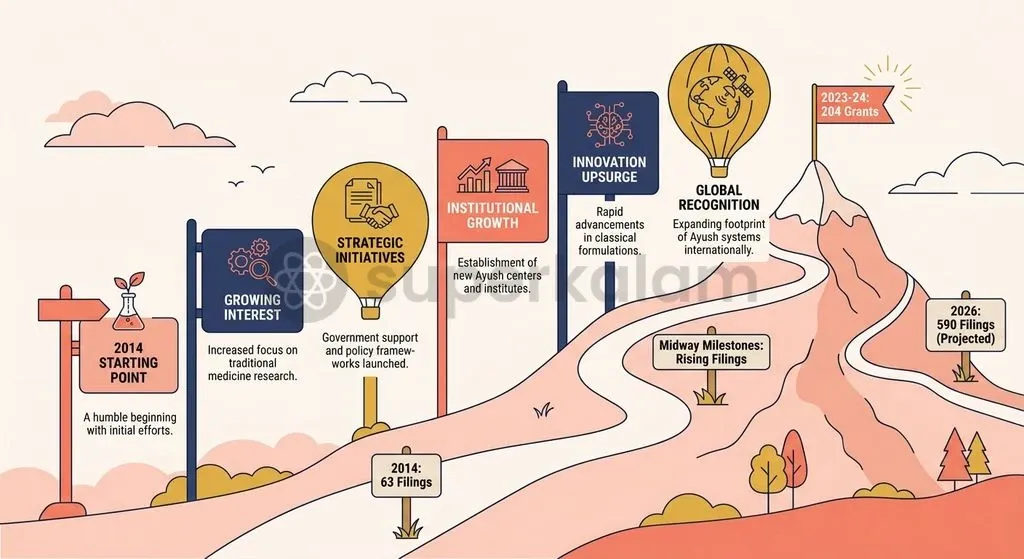
The Office of the Controller General of Patents, Designs and Trade Marks released its comprehensive status report on Ayush-related inventions, tracing twelve years of domestic patenting trends. As of October 2026, the report documents that 4,077 Ayush-related patent applications were filed and 711 patents were granted between FY 2014–15 and FY 2025–26.
Key growth milestones recorded in the review period include:
- Filing surge: Annual filings surged by 836.5% over this 12-year review period, climbing from 63 applications in FY 2014–15 to 590 applications in FY 2025–26.
- Grant expansion: Grants rose from 3 in FY 2015–16 to a peak of 204 grants in FY 2023–24, before recording 114 grants in FY 2024–25 and 101 in FY 2025–26.
- Post-pandemic acceleration: The data reveals that recent momentum gathered rapidly following global healthcare reorientations.
The Ministry of Ayush also instituted 23 September as the permanent annual date for National Ayurveda Day. It observed the 11th edition in Nagpur, Maharashtra under the theme 'Ayurveda for a Healthier Tomorrow'. This institutional focus signals state commitment to integrate codified systems into mainstream commercial healthcare.
Discuss with Superkalam
Recall the exact percentage of Ayush patent applications filed by educational institutions and natural persons according to the CGPDTM status report.
Ask NowIndia's Traditional Knowledge Trap: Shielding Heritage vs Creating Value
The Council of Scientific and Industrial Research established the Traditional Knowledge Digital Library to protect indigenous formulations from predatory patent claims overseas. Jointly created by CSIR and the Ministry of Ayush, the database digitises over 4.4 lakh formulations across Ayurveda, Unani, Siddha, Sowa-Rigpa, and Yoga into five international languages as defensive prior art. Prior art refers to any pre-existing public technical evidence that disproves an invention's novelty.
The repository is strictly a defensive shield rather than an offensive commercial asset. According to the CSIR-TKDL Access Agreements Portal, the library provides access to 18 international patent offices under non-disclosure agreements without conferring patent monopolies or revenue streams. This mechanism prevents foreign actors from obtaining illegitimate patents on documented Indian herbal knowledge.
Defensive protection alone does not build domestic market leaders. Keeping formulations in the public domain creates structural trade-offs:
- Precludes exclusivity: By keeping formulations public, the architecture denies domestic innovators the exclusive market protections needed to justify heavy clinical trial expenditures.
- Constrains domestic innovators: Indian enterprises find themselves legally prevented from monopolising traditional knowledge.
- Synthetic circumvention: Multinational pharmaceutical firms direct research into derivative synthetic formulations that circumvent traditional knowledge citations entirely.
Inside the CGPDTM Data: Filing Trends, Grant Rates, and the Domestic Gap
Academic institutions and individual inventors dominate Ayush patent filings, while private industry participation remains remarkably thin. Between FY 2014–15 and FY 2025–26, individual natural persons and educational institutions accounted for 76.3% of total applications. Commercial entities represented a minor segment of total activity.
| Applicant Category | Total Applications Filed (FY 2014–15 to FY 2025–26) | Percentage Share of Total Filings |
|---|---|---|
| Natural Persons & Educational Institutions | 3,108 | 76.3% |
| Corporate Entities | 700 | 17.2% |
| Small Entities | 144 | 3.5% |
| Startups | 125 | 3.1% |
| Foreign Applicants | 81 | 2.0% |
The sector experienced an acute concentration of activity in recent years. The post-COVID period between FY 2020–21 and FY 2025–26 accounted for 70% of all filings (2,854 applications) and 92.4% of all patent grants (657 grants). Commercial enterprise filings remained low, with startups submitting just 125 applications and small entities filing 144 over the full twelve years.
Geographic concentration mirrors the presence of established manufacturing and academic hubs. The top five states—Maharashtra (744), Tamil Nadu (670), Uttar Pradesh (354), Punjab (295), and Karnataka (273)—accounted for 57.3% of all applications. Foreign interest was similarly muted: foreign applicants filed only 81 applications, led by the United States with 37 filings.
Discuss with Superkalam
Explain in your own words the difference between defensive protection of traditional knowledge and offensive commercialization.
Ask NowThe Legal Obstacle Course: Section 3(p), Section 3(e), and NBA Clearance
The Patents Act, 1970 imposes strict statutory thresholds to prevent the trivial monopolisation of traditional Indian medicine. Section 3(p) expressly bars the grant of patents for inventions that are in effect traditional knowledge or an aggregation or duplication of known properties of traditionally known components. Patent examiners apply this barrier to reject applications that repackage classical scriptural remedies as novel medical discoveries.
Downstream formulations must clear the hurdle of Section 3(e). According to the CGPDTM examination standards, Section 3(e) prohibits the patenting of any substance obtained by a mere admixture resulting only in the aggregation of component properties, requiring applicants to furnish empirical proof of synergistic interaction. Synergy requires demonstration that the combined formulation produces a therapeutic effect greater than the sum of its individual herbs.
The Indian Patent Office issued the 'Guidelines for Examination of Ayush Related Inventions, 2025' to provide clearer regulatory signposts. The guidelines delineate patentable downstream innovations—such as novel extraction processes, isolated bioactives, and specialised medical devices—from unpatentable classical herbal recipes.
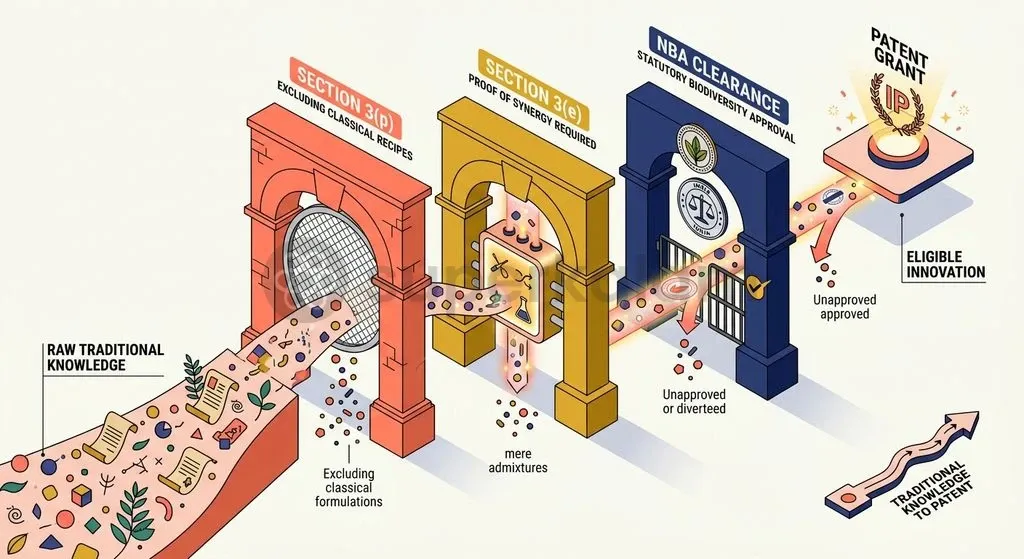
- Statutory Filter 1 (Section 3(p), Patents Act, 1970): Direct classical herbal remedies and aggregations of known properties face automatic rejection.
- Statutory Filter 2 (Section 3(e), Patents Act, 1970): Novel downstream extractions and admixtures must supply empirical proof of synergistic therapeutic efficacy.
- Regulatory Filter 3 (National Biodiversity Authority): Indian applicants require pre-grant registration, whereas foreign applicants must secure mandatory prior approval before commercial patent grants issue.
Regulatory friction also stems from biodiversity legislation. Under Section 6(1) of the parent Biological Diversity Act, 2002, applicants were prohibited from applying for any intellectual property right for biological resource inventions without the previous approval of the NBA.
The Biological Diversity (Amendment) Act, 2023 relaxed this mechanism. Indian applicants must now register with the NBA before the patent grant rather than prior to filing, while foreign applicants retain mandatory prior approval. The 2023 amendment also exempted registered Ayush practitioners and codified knowledge users from prior intimation to State Biodiversity Boards and Access and Benefit Sharing fees.
Discuss with Superkalam
If an Indian startup creates a new herbal blend by combining two classical herbs, what evidentiary test under Section 3(e) of the Patents Act must it satisfy to obtain a patent?
Ask NowDefensive Protection vs Offensive Commercialisation: How India Compares to China's TCM
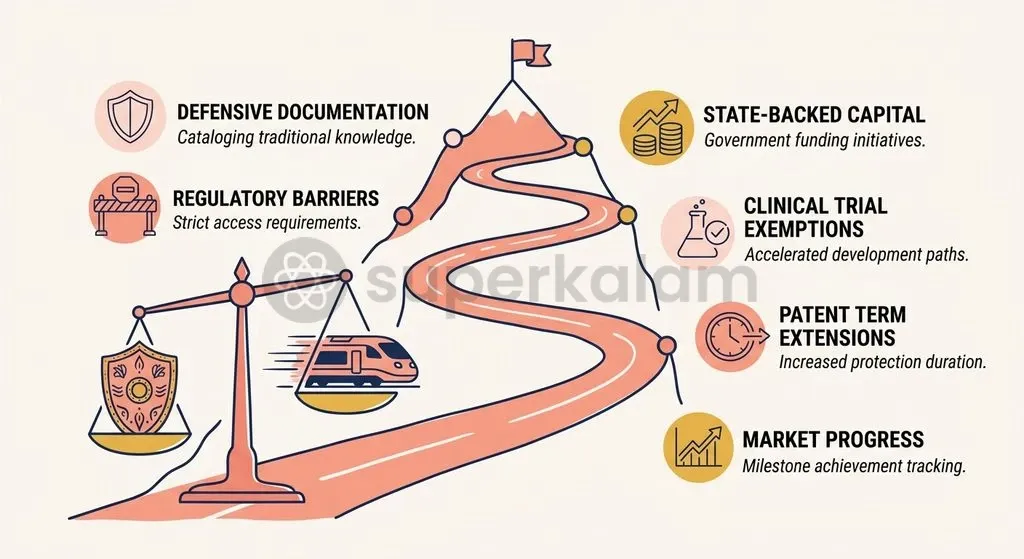
China built a commercialised pipeline for Traditional Chinese Medicine by coupling massive state capital with targeted patent extensions and regulatory dispensations. China invested $1.76 billion into TCM R&D in 2021 alone, driving an aggressive offensive patent pipeline through the China National Intellectual Property Administration. This sustained capital injection enabled Chinese institutions to systematically run modern pharmacological assays on historical remedies.
Regulatory mechanisms in China actively de-risk commercial product development. Under Article 42 of the 2020 Patent Law and National Medical Products Administration regulations, China offers patent term extensions of up to five years and exempts documented classical formulas from repetitive phase I–III clinical trials. This policy framework drastically lowers the time and capital required to launch standardised traditional products into domestic and international retail markets.
| Dimension | India (Ayush Framework) | China (Traditional Chinese Medicine) |
|---|---|---|
| Primary IP Strategy | Primarily defensive (TKDL prior-art cataloguing to prevent biopiracy) | Aggressive offensive patenting via CNIPA and overseas filings |
| Annual State R&D Allocation | CCRAS allocation of ₹457 crore in FY 2024–25 | State investment of $1.76 billion in 2021 |
| Clinical Trial Requirements | High regulatory burden; global trials require upwards of $20 million | Documented classical formulas exempted from phase I–III trials by NMPA |
| Patent Term Adjustments | Standard 20-year term from filing without extensions | Patent term extensions of up to 5 years under the 2020 Patent Law |
| Enterprise Participation | Dominated by universities and natural persons (76.3% of filings) | Heavily commercialised through integrated state-backed enterprise consortia |
India operates under severe clinical financing constraints. A NITI Aayog study revealed that the Central Council for Research in Ayurvedic Sciences received an annual budget allocation of ₹457 crore in FY 2024–25, whereas conducting high-end clinical trials for single-drug global regulatory approval requires over $20 million.
CCRAS has secured patents for formulations including AYUSH-64 (anti-malarial repurposed for COVID-19), AYUSH-56 (anti-epileptic), and Ksharsutra, transferring technologies to commercial manufacturers. Even so, scaling these successes globally remains limited by constrained state R&D funding.
Ethical and Public Health Stakes: Benefit Sharing Without Monopolies
The National Biodiversity Authority balances indigenous rights and research incentives through Access and Benefit Sharing mechanisms grounded in distributive justice. Access and Benefit Sharing refers to the fair division of commercial gains between users of genetic resources and the local communities that conserved them. Ethically, unconstrained patent monopolies risk biopiracy by privatising communal knowledge, while excessive regulatory compliance can freeze the bio-economy altogether.
The TBGRI–Kani model illustrates the real-world operational challenges of indigenous benefit sharing:
- Agreement terms: Established in 1995 between the Tropical Botanic Garden and Research Institute and the Kani tribe, the agreement transferred 50% of licence fees (₹10 lakh) and 50% of commercial royalties (2%) from the anti-fatigue drug 'Jeevani' to the Kerala Kani Samudaya Kshema Trust.
- Commercial breakdown: Commercial partner Arya Vaidya Pharmacy terminated production of Jeevani in 2008 due to raw material cultivation bottlenecks, forest access curbs on Trichopus zeylanicus (Arogyapacha) leaves, and the expiry of the underlying process patent.
- Structural lesson: Benefit-sharing trusts remain vulnerable if conservation laws restrict the sustainable harvesting of wild medicinal flora.
International intellectual property diplomacy is gradually institutionalising source disclosure. The World Intellectual Property Organization adopted the Treaty on Intellectual Property, Genetic Resources and Associated Traditional Knowledge by consensus in Geneva in May 2024, mandating patent applicants to disclose the country of origin or indigenous source of biological material and associated traditional knowledge. This multilateral instrument equips megadiverse nations to enforce traceability across foreign patent jurisdictions.
Discuss with Superkalam
Compare the state support mechanisms and clinical trial requirements between China's Traditional Chinese Medicine (TCM) and India's Ayush framework.
Ask NowWay Forward: Reforming Ayush Patents for Global Competitiveness
The Ministry of Ayush must bridge the translation gap by aligning patent examination clarity with institutional clinical funding. Protecting classical heritage through defensive archives cannot substitute for commercialisation policies that incentivise the domestic pharmaceutical industry to validate downstream discoveries.
Policy reforms must address four specific operational bottlenecks:
- Clarify Synergistic Evidence Standards: The Indian Patent Office should establish standardised, affordable pharmacological assay protocols under Section 3(e) to help domestic applicants demonstrate synergy without incurring prohibitive preclinical costs.
- Expand Translational Clinical Consortia: Public research bodies like CCRAS should co-fund phase II and phase III clinical trials through public-private partnerships, closing the gap between its ₹457 crore budget and international regulatory requirements.
- Operationalise Biodiversity Compliance Portals: The National Biodiversity Authority must digitise the post-2023 pre-grant registration pipeline for Indian applicants under Section 6(1A) to ensure zero pendency accumulation at the Patent Office.
- Leverage the WIPO GRATK Framework: India should actively utilise the 2024 WIPO treaty's mandatory disclosure requirements to monitor foreign filings while assisting domestic startups in converting proprietary extraction processes into global intellectual property assets.
Key Takeaways
- According to the CGPDTM Status Report (2014–2026), 4,077 Ayush patent applications were filed and 711 granted, with post-COVID filings accounting for 70% of all applications and 92.4% of total grants.
- Natural persons and educational institutions generated 76.3% of total Ayush patent applications, while corporate entities, small businesses, and startups combined accounted for under 24%.
- Section 3(p) of the Patents Act, 1970 strictly bars traditional knowledge patents, while Section 3(e) requires empirical proof of therapeutic synergy for polyherbal admixtures.
- The Biological Diversity (Amendment) Act, 2023 eased compliance by permitting Indian inventors to register with the NBA before patent grant, rather than seeking mandatory pre-filing approval.
- China invested $1.76 billion into Traditional Chinese Medicine R&D in 2021, deploying patent extensions and trial exemptions that contrast sharply with India's defensive, underfunded commercial pipeline.
- The 2024 WIPO GRATK Treaty mandates international patent applicants to disclose the indigenous source and country of origin of biological resources.
Mains Question
"India's reliance on defensive IP mechanisms like the Traditional Knowledge Digital Library (TKDL) successfully deters biopiracy, but inadvertently perpetuates a commercialisation deficit in indigenous medicine." Critically analyse. (15 Marks)
Evaluate NowMains Question
Examine how Sections 3(p) and 3(e) of the Patents Act, 1970, alongside the Biological Diversity (Amendment) Act, 2023, balance the prevention of trivial monopolies with the promotion of Ayush-related innovations. (10 Marks)
Evaluate NowPractice MCQs
QUESTION 1
With reference to the patentability of Ayush-related inventions under the Patents Act, 1970, consider the following statements:
- Section 3(p) bars the patenting of an invention which in effect is traditional knowledge or an aggregation of known properties of traditionally known components.
- Under Section 3(e), an applicant seeking to patent an admixture of known components must demonstrate synergistic interaction yielding therapeutic efficacy greater than the sum of its individual components.
- The Guidelines for Examination of Ayush Related Inventions categorically bar the patenting of novel extraction processes and isolated bioactives derived from traditional medicinal plants. Which of the statements given above are correct?
QUESTION 2
Regarding the Traditional Knowledge Digital Library (TKDL) established in India, consider the following statements:
- It was jointly established by the Council of Scientific and Industrial Research (CSIR) and the Ministry of Ayush.
- It operates as an offensive patenting asset, licensing classical herbal formulations to commercial enterprises to secure global royalty streams.
- It provides access to international patent offices under non-disclosure agreements as defensive prior art against illegitimate patent claims. Which of the statements given above is/are correct?
QUESTION 3
With reference to the regulatory framework under the Biological Diversity Act, 2002 and its 2023 amendment, consider the following statements:
- Under the parent Biological Diversity Act, 2002, obtaining prior approval from the National Biodiversity Authority (NBA) was mandatory before applying for any intellectual property right based on biological resources.
- The Biological Diversity (Amendment) Act, 2023 requires Indian applicants to register with the NBA before the patent grant rather than prior to filing the application.
- The 2023 amendment maintains identical prior approval requirements for both foreign applicants and domestic registered Ayush practitioners. Which of the statements given above is/are correct?
QUESTION 4
According to the Controller General of Patents, Designs and Trade Marks (CGPDTM) Status Report on Ayush Related Inventions in India (2014–2026), which applicant category accounted for the largest share (over 75%) of Ayush patent applications filed?
QUESTION 5
Consider the following statements regarding the comparative intellectual property frameworks of India's Ayush and China's Traditional Chinese Medicine (TCM):
- While India relies primarily on defensive prior-art documentation through TKDL, China utilizes an aggressive offensive patenting strategy supported by targeted patent term extensions.
- Under its regulatory provisions, China allows exemptions from repetitive phase I–III clinical trials for documented classical TCM formulas.
- In FY 2024–25, India's state budgetary allocation for the Central Council for Research in Ayurvedic Sciences (CCRAS) surpassed China's annual public R&D investment in TCM. Which of the statements given above is/are correct?