Ashoke Sen Wins Oskar Klein Medal 2026: First Indian to Get the Honour
Ashoke Sen is the first Indian to receive the Oskar Klein Medal for his contributions to string theory. What S-duality and black hole entropy mean.
Oct, 2026
•8 min read
Overview
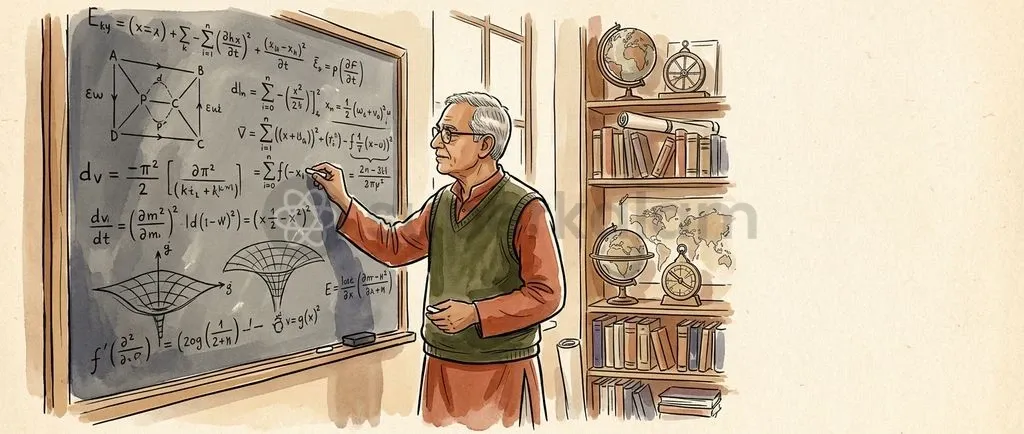
Theoretical physicist Professor Ashoke Sen has won the 2026 Oskar Klein Medal from Stockholm University and the Nobel Committee for Physics. He is the first Indian scientist to secure this theoretical physics honour since its inception in 1988. Conferred annually, the prize recognises Sen's pioneering breakthroughs in string theory, including his formulations of S-duality and black hole entropy.
Sen's international acclaim highlights India's deep pedigree in theoretical physics. Yet it also exposes a domestic paradox. India produces world-class theoretical work inside isolated, well-funded enclaves like the Harish-Chandra Research Institute, even as gross domestic expenditure on research stagnates. Resolving this divide requires expanding academic excellence into a systemic research culture across state universities.
Why Ashoke Sen's Oskar Klein Medal Matters Today
Professor Ashoke Sen received the 2026 Oskar Klein Medal from Stockholm University and the Nobel Committee for Physics of the Royal Swedish Academy of Sciences. The award recognises distinguished, foundational contributions to theoretical physics per the Stockholm University / Oskar Klein Centre Statute & Award Records.
On 22 October 2026, Professor Sen delivered the Oskar Klein Memorial Lecture, titled 'Gravity from Strings and Strings from Gravity', at Stockholm University's AlbaNova Centre. As of October 2026, Professor Sen is the first Indian physicist to receive the medal since the honour was instituted in 1988.
The honour marks a milestone for Indian fundamental science, proving that breakthrough theoretical work can emerge directly from domestic academic institutions:
- Institutional base: Professor Sen currently holds the ICTS-Infosys Madhava Chair Professorship at the International Centre for Theoretical Sciences in Bengaluru.
- Domestic pedigree: His career has spanned premier domestic research bodies, including the Tata Institute of Fundamental Research in Mumbai and the Harish-Chandra Research Institute in Prayagraj.
- Global recognition: In 2012, Sen was selected among the nine inaugural recipients of the $3 million Fundamental Physics Breakthrough Prize for proving that diverse string theories represent limits of a single underlying physical framework.
Discuss with Superkalam
Which Swedish institutions confer the Oskar Klein Medal, and in what year was the award established?
Ask NowThe Physics: How Sen Transformed String Theory and Black Holes
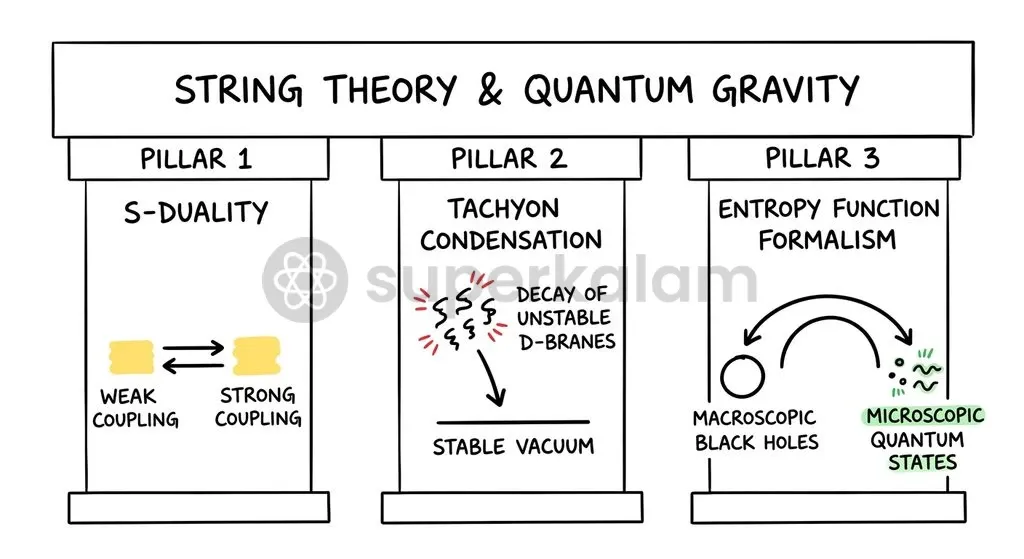
Professor Ashoke Sen altered modern mathematical physics by demonstrating that seemingly contradictory formulations of string theory describe the exact same physical reality. In 1994, Sen formulated a foundational proof of S-duality. His proof established that four-dimensional string theory at strong coupling is mathematically equivalent to another string theory at weak coupling.
This breakthrough gave physicists a practical calculational tool. They could now compute complex, strongly interacting physical states by translating them into simple, weakly interacting systems.
Discuss with Superkalam
How does theoretical physics allow developing nations to achieve frontline scientific breakthroughs despite facing capital constraints?
Ask NowSen's work quickly broadened into unstable quantum structures and gravitational thermodynamics. In 1998, he introduced the Sen conjecture on tachyon condensation. The conjecture demonstrated that unstable configurations of D-branes decay towards an open-string vacuum where unstable excitations disappear.
A decade later, Sen formulated the Entropy Function Formalism for extremal black holes. This mathematical framework enabled physicists to compute quantum logarithmic corrections to macroscopic black hole entropy. It created a rigorous bridge between microscopic quantum states and macroscopic gravitational thermodynamics.
| Theoretical Milestone | Year of Formulation | Core Physical Mechanism | Primary Impact on Fundamental Physics |
|---|---|---|---|
| S-Duality Proof | 1994 | Equivalence between strong coupling and weak coupling limits | Proved distinct string theories are dual descriptions of one framework |
| Tachyon Condensation | 1998 | Decay of unstable D-branes into a stable non-perturbative vacuum | Resolved fundamental instabilities in open string field theory |
| Entropy Function Formalism | 2008 | Direct computation of quantum corrections in extremal black holes | Reconciled macroscopic Bekenstein-Hawking entropy with quantum mechanics |
Theoretical physics thrives under distinct economic conditions. Its primary research capital consists of blackboards, paper, and distributed compute clusters. Experimental high-energy physics requires multi-billion-dollar particle colliders and massive international detector arrays. Pure theory, by contrast, relies on human cognitive capital. This dynamic allows developing economies to produce frontline physics discoveries despite strict national fiscal limitations.
The Enclave Model: How Isolated Elite Institutes Nurture Pure Science
The Department of Atomic Energy established an institutional enclave model that insulates theoretical researchers from bureaucratic friction and heavy teaching duties. Autonomous institutions such as the Harish-Chandra Research Institute and the Tata Institute of Fundamental Research operate under this administrative architecture.
Faculty members at these centres concentrate primarily on curiosity-driven fundamental research. They avoid the administrative burdens typical of broad-spectrum public universities.
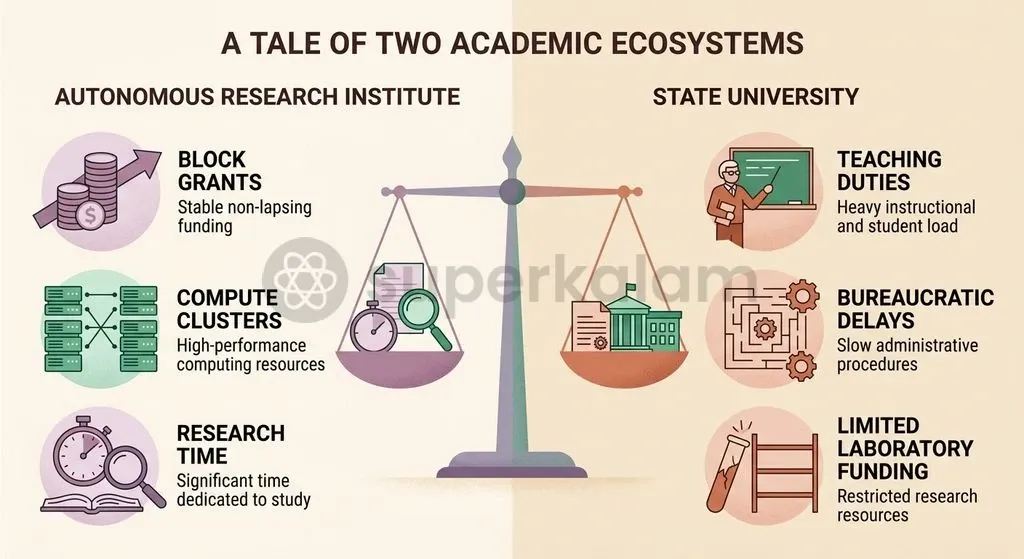
Financial predictability anchors this enclave model. According to the Union Expenditure Budget, Vol. II (Demand for Grants: Department of Atomic Energy), these autonomous bodies receive regular non-lapsing institutional block grants.
This fiscal arrangement shields basic science from the volatility of short-term project grants and commercial deliverable demands. Researchers can pursue long-term, high-risk theoretical inquiries that offer no immediate industrial application.
Discuss with Superkalam
How can the mentor-institution model envisioned under the ANRF be applied to upgrade laboratory infrastructure in regional state universities?
Ask NowProtected enclaves, however, produce real institutional trade-offs across the wider scientific landscape:
- Dedicated research institutes provide researchers with minimal administrative interference, protected research time, and reliable access to high-performance computing clusters.
- The separation of elite research centres isolates top-tier scientists from undergraduate classrooms, preventing university students from accessing active researchers.
- Enclave funding models concentrate national capital in a few centres of excellence, leaving regional institutions to manage severe resource scarcity.
India's Research Bottleneck: Low GERD and Decaying State Universities
India's national spending on science exposes an enduring domestic bottleneck. Stagnant public allocations and low commercial participation hold back experimental laboratories across the higher education sector.
Key structural constraints defining India's research funding include:
- Stagnant national outlay: India's Gross Expenditure on Research and Development remains trapped at approximately 0.64% of GDP, according to the Economic Survey 2025-26. This budgetary plateau trails behind China's 2.4% and the United States' 3.4% of GDP, limiting capital-heavy experimental science.
- Unbalanced public burden: The public sector finances nearly 60% of gross research expenditure, with central and state governments carrying the load. Private industry contributes roughly 36% to 41% of national R&D, compared to over 70% in advanced industrial economies.
- Disproportionate state university neglect: Post-independence policy decoupled higher education from research by establishing standalone national networks under the Council of Scientific and Industrial Research and the Department of Atomic Energy, per the National Education Policy 2020. Consequently, state universities educate over 90% of higher education students but receive less than 10% of competitive government research grants, while premier institutions like the Indian Institutes of Technology absorb the majority of state support.
Discuss with Superkalam
Compare the fiscal and institutional features of autonomous research enclaves with those of state-funded public universities.
Ask NowCan the Anusandhan National Research Foundation Fix the Divide?
The Parliament of India passed the Anusandhan National Research Foundation Act, 2023 to dismantle the structural division between elite research centres and state universities. Operating as an apex national body, the foundation aims to seed, grow, and democratise scientific inquiry across higher education institutions.
Statutorily, Section 4 of the Act stipulates that the foundation's Governing Board includes the Prime Minister as ex-officio President, along with the Union Ministers of Science & Technology and Education as ex-officio Vice-Presidents.
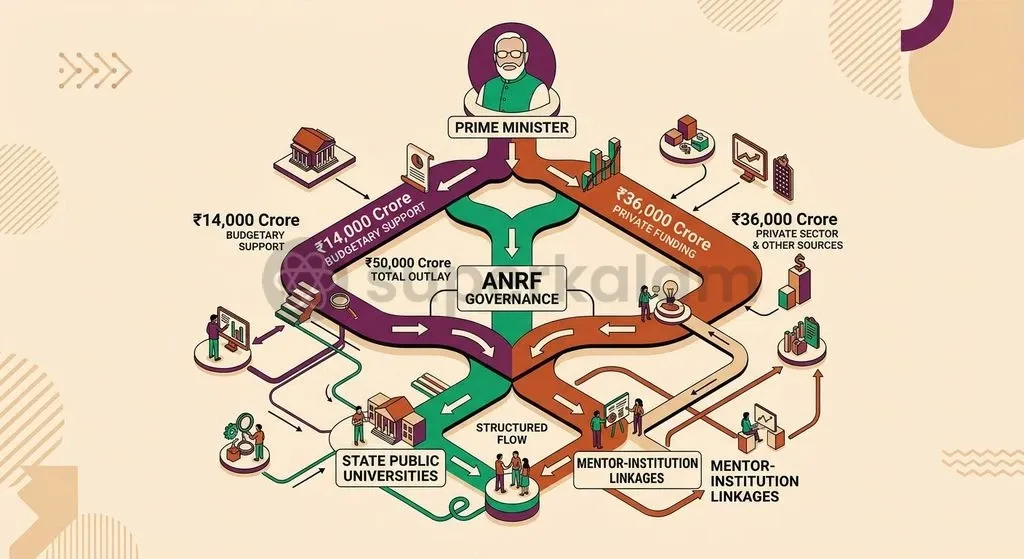
The financial design of the foundation pairs substantial public allocations with ambitious private capital targets:
- Total outlay: Official disclosures outline a projected five-year financial outlay of ₹50,000 crore between 2023 and 2028.
- Public allocation: The Central Government provides a direct budgetary commitment of ₹14,000 crore.
- Private dependency: The remaining ₹36,000 crore, or 72%, must be raised from non-government and private sources.
Securing private capital on this scale presents a clear policy challenge. Private industry in India has historically directed capital towards applied product development rather than fundamental, curiosity-driven science. If non-governmental contributions fall short of the targeted ₹36,000 crore, the foundation could face shortfalls that curtail planned funding programmes for state university laboratories.
The Way Forward: Sustaining Deep Science Beyond Islands of Excellence
The Anusandhan National Research Foundation must operationalise targeted equity mechanisms to build research capacity outside traditional urban centres. Under its statutory framework, the foundation is tasked with establishing ring-fenced grant allocations for state universities and creating formal mentor-institution linkages with premier Indian Institutes of Technology.
To bridge the structural divide, policy implementation should focus on three immediate interventions:
- Structured institutional linkages: Facilitate shared laboratory access, joint doctoral supervision, and structured researcher exchanges so state universities do not fall further behind.
- Corporate research incentives: Evaluate enhanced tax offsets and targeted corporate social responsibility frameworks for private contributions made directly to basic research endowments.
- Mobility and fellowships: Broaden university exchange fellowships to connect autonomous enclaves like the Harish-Chandra Research Institute and the International Centre for Theoretical Sciences with regional classrooms.
India must preserve the institutional integrity of its theoretical physics enclaves while systematically ending their academic isolation. Institutes like HRI and ICTS demonstrate that freedom from administrative friction produces frontier scientific breakthroughs. Broadening this supportive environment will ensure that frontline basic research inspires the next generation of Indian scientists.
Key Takeaways
- Professor Ashoke Sen received the 2026 Oskar Klein Medal from Stockholm University, becoming the first Indian theoretical physicist honoured since the award began in 1988.
- Sen's theoretical milestones include the 1994 proof of S-duality, the 1998 Sen conjecture on tachyon condensation, and the 2008 Entropy Function Formalism for extremal black holes.
- Theoretical physics succeeds under domestic capital constraints because its infrastructure footprint relies on pencil, paper, and compute clusters rather than multi-billion-dollar particle colliders.
- The Department of Atomic Energy enclave model nurtures foundational inquiry by providing non-lapsing institutional block grants and shielding researchers from administrative duties.
- India's Gross Expenditure on R&D stagnates at approximately 0.64% of GDP, with the public sector financing nearly 60% of outlays while state universities receive under 10% of competitive federal grants.
- The Anusandhan National Research Foundation targets a five-year outlay of ₹50,000 crore, requiring ₹36,000 crore (72%) from non-governmental sources to democratise research funding across state public institutions.
Mains Question
"India's post-independence institutional architecture created productive 'islands of excellence' in pure science, but simultaneously deepened the research deficit in the broader higher education system." Elucidate. (10 Marks)
Evaluate NowMains Question
The Anusandhan National Research Foundation (ANRF) Act, 2023 seeks to democratise research funding across India's higher education sector. Critically analyse the structural challenges in realising its mandate, particularly regarding its targeted financial architecture. (15 Marks)
Evaluate NowPractice MCQs
QUESTION 1
With reference to the Anusandhan National Research Foundation (ANRF) Act, 2023, consider the following statements:
- The Prime Minister of India serves as the ex-officio President of the Governing Board of the Foundation.
- The statutory framework mandates that non-governmental and private sources contribute less than thirty percent of its projected five-year outlay.
- The Foundation is tasked with creating formal mentor-institution linkages between premier Indian Institutes of Technology and state universities. Which of the statements given above are correct?
QUESTION 2
Consider the following statements regarding theoretical physicist Professor Ashoke Sen's contributions to fundamental physics:
- His 1994 proof of S-duality demonstrated that four-dimensional string theory at strong coupling is mathematically equivalent to another string theory at weak coupling.
- The Sen conjecture on tachyon condensation proved that unstable D-brane configurations decay toward an open-string vacuum.
- His Entropy Function Formalism established a method to compute quantum logarithmic corrections to macroscopic black hole entropy. Which of the statements given above are correct?
QUESTION 3
Regarding the structural landscape of research and development (R&D) expenditure in India, consider the following statements:
- India's Gross Expenditure on Research and Development (GERD) stands at approximately 0.64% of GDP.
- In India, private industry accounts for over seventy percent of national R&D expenditure, mirroring advanced industrial economies.
- State universities educate more than ninety percent of higher education students but receive less than ten percent of competitive government research grants. Which of the statements given above is/are correct?
QUESTION 4
In the context of scientific governance in India, autonomous research institutions under the Department of Atomic Energy (DAE), such as TIFR and HRI, are functionally characterized by which of the following mechanisms?
- Regular non-lapsing institutional block grants.
- Heavy undergraduate teaching requirements.
- Administrative insulation from routine public university procedures. Select the correct answer using the code given below:
QUESTION 5
Who was the first Indian physicist to be awarded the Oskar Klein Medal since the honour was instituted in 1988?