Article 317: Why Removing State PSC Members Requires a Supreme Court Trial
As recruitment fraud hits Kerala PSC, constitutional shields meant to secure commission independence expose deep frictions in federal removal powers.
Oct, 2026
•9 min read
Overview
Under Article 317 of the Constitution of India, state executives cannot discipline or dismiss members of a Public Service Commission. Any removal demands a formal presidential reference alongside a full judicial inquiry by the Supreme Court.
The escalating controversy surrounding the Kerala Public Service Commission demonstrates how protections intended to guarantee independence can produce institutional paralysis during corruption probes. While the Governor appoints members under Article 316, the power of removal is exclusively federal.
This constitutional architecture prevents arbitrary dismissals. However, it leaves state governments unable to sanction their own appointees without enduring an exhaustive trial at the apex court.
Why in the News: The Cash-for-Job Allegation Rocking Kerala PSC
Allegations of recruitment fraud within the Kerala Public Service Commission (KPSC) reached a constitutional crisis in October 2026. The Kerala Police Crime Branch Special Investigation Team, supervised by Inspector General S. Ajeetha Begum, initiated criminal proceedings involving digital evaluation fraud in the recruitment examination for Chief (Industry and Infrastructure) in the State Planning Board.
The investigation and subsequent judicial hearings revealed major systemic irregularities:
- Unevaluated Answer Scripts: Under the On-Screen Marking system, examiners left 10 descriptive questions carrying between 54 and 58 marks entirely unevaluated.
- Judicial Reprimand: While hearing WP(Crl.) 1497/2026, Justice A. Badharudeen of the Kerala High Court admonished the commission for failing to cooperate with the Crime Branch probe, observing that leaving 58 marks unevaluated constitutes prima facie corruption.
- No Statutory Immunity: The High Court ruled that statutory shields, such as prior approval under Section 17A of the Prevention of Corruption Act, 1988, cannot bar criminal investigations into digital mark manipulation.
This digital evaluation scandal followed earlier political allegations in Kozhikode, where local news outlets reported that a political functionary accepted a ₹22 lakh bribe toward a ₹60 lakh demand to secure a KPSC member post for a doctor couple.
In response to growing irregularities, as reported in late October 2026, outgoing Governor Rajendra Vishwanath Arlekar formally recommended that President Droupadi Murmu initiate proceedings under Article 317 to remove KPSC Chairman M.R. Baiju and members.
Discuss with Superkalam
Recall the constitutional grounds under Article 317(3) that allow the President to remove a Public Service Commission member without a Supreme Court inquiry.
Ask NowHow Article 317 Works: Why Sacking a PSC Member Requires a Supreme Court Trial
The removal of a Public Service Commission Chairman or member follows a stringent constitutional mechanism under Article 317. The Constitution deliberately insulates commission members from political pressure, ensuring recruitment bodies remain protected from changing executive administrations.
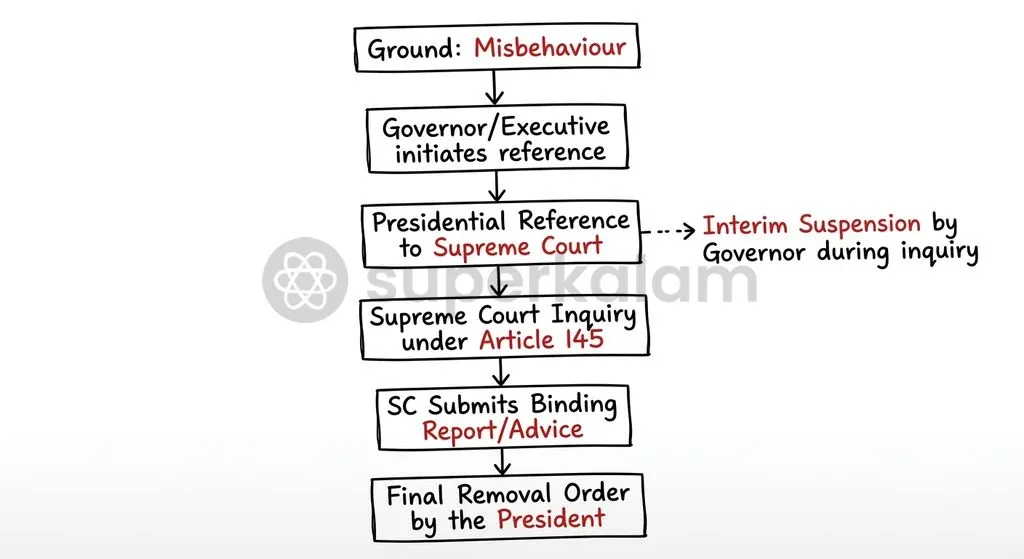
Under Article 317(1), a member can only be removed by an order of the President on the ground of proven "misbehaviour". Even for a State PSC, the Governor has no constitutional authority to order a dismissal. The process requires a formal reference from the President to the Supreme Court of India, which conducts a judicial inquiry pursuant to Article 145(1)(j), regulated under Order XLIII of the Supreme Court Rules, 2013.
| Constitutional Provision | Grounds for Action | Competent Authority | Judicial Inquiry Required? |
|---|---|---|---|
| Article 317(1) | Proven misbehaviour (e.g., bribery, fraud, recruitment bias) | President of India | Yes (Mandatory Supreme Court trial under Article 145) |
| Article 317(2) | Interim suspension pending judicial inquiry | Governor (State PSC) / President (UPSC) | No (Purely executive measure, but requires pending 317(1) reference) |
| Article 317(3) | Insolvency, outside paid employment, infirmity of mind or body | President of India | No (Summary administrative removal on objective facts) |
| Article 317(4) | Profit-sharing or interest in government contracts | Deemed misbehaviour under Clause (1) | Yes (Treated under Article 317(1) formal inquiry framework) |
The Supreme Court confirmed in Special Reference No. 1 of 1983 that an Article 317(1) trial is an original fact-finding inquiry into the merits of the allegations, not merely an appellate review. The President does not require a prior administrative probe to make a reference; a prima facie satisfaction suffices. Once the Supreme Court concludes its inquiry and issues a report, its findings are legally binding on the President.
The Supreme Court also ruled in In re Dr. H.B. Mirdha, Chairman, Orissa PSC, that charges of bribery, corruption, and exam tampering cannot be bypassed via summary dismissal under Article 317(3). Because criminal misconduct falls strictly under "misbehaviour," it mandates the full procedural trial guaranteed by Article 317(1).
The Kerala Impasse: Why the State Cabinet Cannot Fire Its Own Appointee
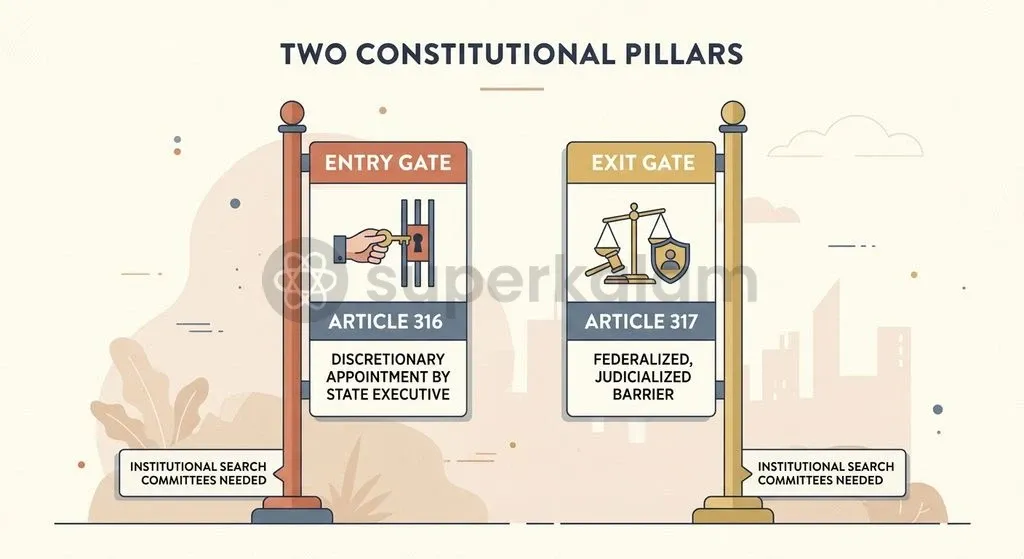
The Kerala controversy illustrates a stark constitutional imbalance: while the state executive selects commission members, it cannot discipline them. Under Article 316, the Governor appoints the Chairman and members of a State PSC on the mandatory aid and advice of the State Council of Ministers. However, once appointed, the state executive's control ceases entirely.
This structural divide creates operational paralysis during scandals:
- No Direct Dismissal Power: The Chief Minister and State Cabinet cannot remove or dismiss a PSC member, regardless of the severity of police or Crime Branch findings.
- Conditional Suspension Powers: Under Article 317(2), the Governor can suspend a State PSC member, but only after the President makes a formal reference to the Supreme Court.
- No Unilateral Executive Freezing: The Karnataka High Court in Sri Shiva Shankarappa S. Sahukar v. Special Secretary affirmed that a Governor cannot unilaterally suspend a member before a presidential reference is submitted.
- Individual Liability Requirement: In 2025 INSC 1047, the Supreme Court ruled that removal under Article 317 operates strictly in personam (against the individual). The executive cannot invoke collective responsibility to unseat an entire commission without establishing individual guilt for each appointee.
This jurisdictional split means the Kerala government must rely on the Union executive and the Supreme Court to address corruption within an agency conducting state recruitments.
Discuss with Superkalam
Explain why the constitutional architecture creates an operational impasse when a State Cabinet wishes to discipline its own State PSC appointee.
Ask NowPast Scandals as Precedents: What the Supreme Court Did in the Punjab and Haryana PSC Cases
Historical precedents show how Article 317's rigorous procedural standards often collide with swift administrative accountability.
Key past interventions highlight these procedural barriers:
- The Punjab PSC Case (Sidhu Precedent): State vigilance teams caught Ravinderpal Singh Sidhu, then Chairman of the Punjab Public Service Commission, with crores in unaccounted cash from selling public service posts. Following a presidential reference under Article 317(1), proceedings dragged on for years. In Re: Reference by the President under Article 317(1) (Ravinder Pal Singh Sidhu, Re), the Supreme Court returned the reference unanswered in 2003. Sidhu's six-year constitutional tenure had expired during the inquiry, rendering the proceedings moot after he surrendered his retiral benefits.
- The Haryana PSC Case (Kashyap Precedent): In Re Ram Kumar Kashyap (2009), Haryana PSC members faced long delays while attempting to challenge suspension orders issued under Article 317(2).
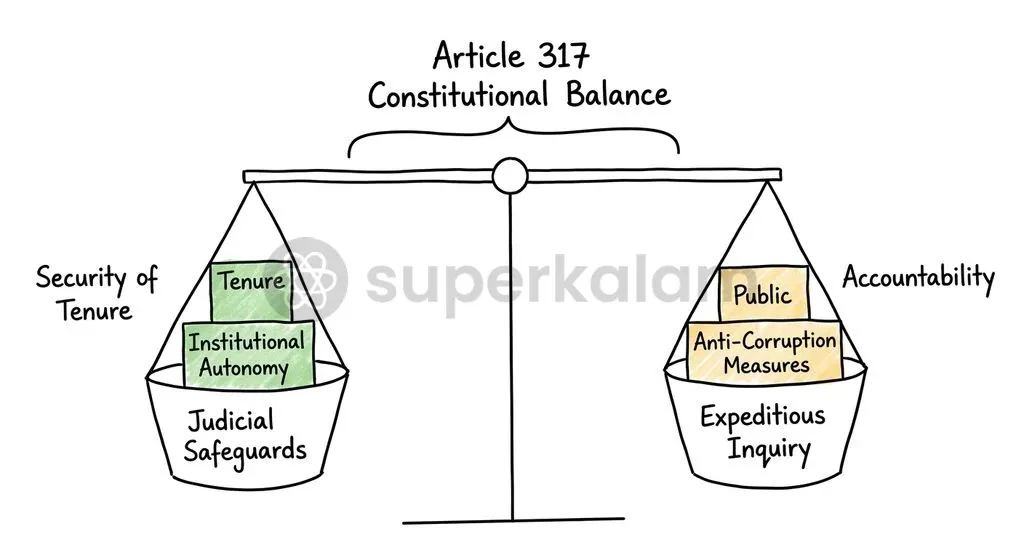
These precedents illustrate a persistent vulnerability. While Article 317 guards against executive victimisation, lengthy judicial timelines can allow implicated officials to exhaust their tenures, evading formal constitutional removal.
Constitutional Shield vs. Political Patronage: How Partisan Appointments Weaponize Article 317
The constitutional framers paired ironclad security of tenure with post-retirement employment prohibitions under Article 319 to protect institutional independence. However, when state executives fill vacancies through political patronage rather than objective merit, this protective machinery turns into an unintended shield for improper conduct.
Constitutional selection mechanisms contain distinct structural gaps:
- Minimal Qualification Threshold: Article 316 specifies only that roughly half the commission's members must have held civil office for at least 10 years.
- Unguided Discretion: The remaining posts are left entirely to executive choice, leading ruling parties across states to treat memberships as political rewards for party loyalists.
- Judicial Limits on Executive Choice: In State of Punjab v. Salil Sabhlok, the Supreme Court ruled that Article 316 does not grant the executive unfettered discretion in appointments. The bench directed state governments to institute transparent, objective selection procedures to appoint individuals of unquestionable integrity and recognised competence.
Despite these judicial directions, few states have codified binding selection mechanisms, leaving commissions vulnerable to partisan capture.
Discuss with Superkalam
If a State vigilance agency uncovers digital tampering in an ongoing PSC exam, how does the ruling in the Kerala High Court WP(Crl.) 1497/2026 apply to Section 17A statutory immunity?
Ask NowEthics in Public Service: The Moral Cost of Merit Destruction for Millions of Job Aspirants
When corruption infiltrates a Public Service Commission, the damage extends far beyond administrative irregularities. Public employment in India is a direct pathway for upward socio-economic mobility, particularly for first-generation learners and economically disadvantaged families.
According to the Second Administrative Reforms Commission (2nd ARC) Fourth Report, Ethics in Governance, institutional corruption in constitutional recruitment bodies destroys the constitutional promise of equality of opportunity under Articles 14 and 16.
The socio-ethical consequences are profound:
- Erosion of Public Trust: When candidates perceive that interviews, descriptive marks, or appointments are bought, public belief in bureaucratic meritocracy collapses.
- Widespread Moral Demoralisation: Lakhs of aspirants dedicate years to competitive examinations. Undetected mark tampering induces profound cynicism and psychological despair among youth.
- Administrative Degradation: Civil servants selected through compromised channels enter public service ethically compromised, embedding corruption throughout the administrative machinery.
Recruitment fraud within a constitutional commission does not merely deny deserving candidates employment; it subverts the foundational legitimacy of the democratic state.
Way Forward: Reforming State PSC Appointments and Streamlining Article 317
Resolving the structural tension between institutional autonomy and swift accountability requires parallel reforms in recruitment integrity, appointment screening, and judicial review.
Key administrative and procedural reforms include:
- Search-cum-Selection Committees: State governments should adopt the P.C. Hota Committee on Civil Services Reforms (2004) recommendation to establish independent Search-cum-Selection Committees composed of eminent figures to vet candidates prior to appointment under Article 316.
- Institutional Consultation: States should implement the Second Administrative Reforms Commission's 15th Report recommendation, requiring the Governor to consult the Chairman of the UPSC and the sitting State PSC Chairman before clearing appointments.
- Dedicated Fast-Track Judicial Benches: The Supreme Court should consider establishing a dedicated bench under Order XLIII of the Supreme Court Rules to adjudicate Article 317 references within a strict timeline (e.g., six months), preventing cases from lapsing into mootness due to tenure expiry.
- Strengthened Digital Auditing: Recruitment evaluation systems require tamper-evident digital architecture, third-party code verification, and real-time oversight to protect on-screen marking mechanisms from administrative sabotage.
Discuss with Superkalam
Analyse the structural tension between the requirement for in personam liability under 2025 INSC 1047 and systemic corruption involving an entire recruitment board.
Ask NowKey Takeaways
- Exclusive Removal Authority: Under Article 317(1), only the President can remove a State PSC member on grounds of proven misbehaviour, following a mandatory Supreme Court trial.
- Limited Scope for Summary Removal: Article 317(3) allows summary presidential removal without judicial inquiry only for insolvency, outside paid employment, or physical/mental infirmity; bribery and mark tampering require a full Article 317(1) inquiry.
- Condition Precedent for Suspension: Under Article 317(2), a Governor can suspend a State PSC member only after the President has formally referred the matter to the Supreme Court.
- Judicial Precedents: The Supreme Court affirmed in Salil Sabhlok (2013) that appointments under Article 316 require objective vetting of integrity, while the Sidhu (2003) case revealed how judicial delays can render Article 317 inquiries moot.
- Institutional Reform Proposals: Both the P.C. Hota Committee (2004) and the Second Administrative Reforms Commission (15th Report) recommended institutionalising independent selection committees and mandatory consultations to prevent political patronage in PSC appointments.
Mains Question
"The constitutional insulation provided to State Public Service Commission members under Article 317, while intended to safeguard institutional autonomy, has created an operational paradox during instances of institutional corruption." Elucidate in light of recent controversies. (10 Marks)
Evaluate NowMains Question
In State of Punjab v. Salil Sabhlok, the Supreme Court observed that the executive does not enjoy unfettered discretion under Article 316 in appointing Public Service Commission members. Critically analyse how deficiencies in the appointment framework undermine the integrity of Article 317 disciplinary mechanisms. (15 Marks)
Evaluate NowPractice MCQs
QUESTION 1
With reference to the constitutional provisions governing the removal and suspension of members of a Public Service Commission under Article 317 of the Constitution of India, consider the following statements:
- The Governor of a State has the constitutional power to dismiss a State Public Service Commission member on grounds of proven misbehaviour.
- The Governor can place a State Public Service Commission member under interim suspension only after a formal reference has been made by the President to the Supreme Court.
- The findings and report submitted by the Supreme Court pursuant to an inquiry under Article 317(1) are legally binding on the President. Which of the statements given above are correct?
QUESTION 2
Consider the following statements regarding the grounds and procedures under Article 317 of the Constitution:
- Summary administrative removal without a Supreme Court judicial inquiry is permissible under Article 317(3) on grounds such as insolvency or infirmity of mind or body.
- Charges involving exam paper tampering and corruption can be dealt with summarily under Article 317(3) to avoid procedural delays.
- A member obtaining an interest in a government contract is deemed to be guilty of misbehaviour under Article 317(4). Which of the statements given above is/are correct?
QUESTION 3
With reference to judicial precedents concerning Article 317 of the Constitution of India, consider the following statements:
- In Special Reference No. 1 of 1983, the Supreme Court held that an inquiry under Article 317(1) is an original fact-finding proceeding rather than an appellate review.
- In the 2025 INSC 1047 ruling, the Supreme Court established that the doctrine of collective cabinet responsibility allows the wholesale removal of an entire Public Service Commission without individual guilt.
- In the Ravinderpal Singh Sidhu case (2003), the Supreme Court returned the presidential reference unanswered because the Chairman's constitutional tenure expired during the proceedings. Which of the statements given above is/are correct?
QUESTION 4
Regarding the recruitment and governance framework of State Public Service Commissions, which of the following statements is correct according to the Supreme Court's ruling in State of Punjab v. Salil Sabhlok (2013)?
QUESTION 5
Consider the following statements regarding the constitutional architecture of Public Service Commissions:
- Under Article 316, the Governor appoints the Chairman and members of a State PSC on the aid and advice of the State Council of Ministers.
- Article 316 mandates that all appointed members of a State Public Service Commission must have held civil office for at least 10 years.
- In WP(Crl.) 1497/2026, the Kerala High Court ruled that statutory protection under Section 17A of the Prevention of Corruption Act cannot shield criminal investigations into digital mark manipulation. Which of the statements given above is/are correct?