Airfare Regulation in India: Surge Pricing, Supreme Court PIL, and BVA 2024
As unchecked dynamic pricing faces Supreme Court scrutiny, India confronts the challenge of balancing carrier solvency against fair consumer protection.
Oct, 2026
•11 min read
Overview
India's civil aviation sector operates on an open-market dynamic pricing framework introduced after deregulation in 1994. Sharp ticket price surges during peak festival seasons and humanitarian emergencies have prompted strict legal scrutiny over consumer protection.
On 16 October 2026, the Central Government informed the Supreme Court in S. Laxminarayanan v. Union of India that comprehensive new tariff rules under the Bharatiya Vayuyan Adhiniyam, 2024 have received administrative approval to address arbitrary pricing.
The Ministry of Civil Aviation maintains that over 98% of domestic fares remain within standard brackets. Even so, high market concentration—where two airline groups control over 85% of domestic passenger traffic—has intensified calls for statutory oversight. Resolving this tension requires balancing airline solvency against citizen welfare under India's updated civil aviation statutes.
Why in the News? The Supreme Court PIL on Airline Fare Surges
The Supreme Court of India is currently hearing a Public Interest Litigation concerning unchecked domestic airfare inflation during peak travel windows. As of October 2026, the Central Government confirmed before a Supreme Court bench that new regulatory rules framed under the Bharatiya Vayuyan Adhiniyam, 2024 will be published in the Official Gazette to address airfare pricing mechanisms.
The petition, filed by activist S. Laxminarayanan, challenged arbitrary surge pricing, algorithm-driven seat price escalations during national festivals and climatic disasters, and the gradual curtailment of free check-in baggage allowances. The Central Government submitted that administrative approvals for the new statutory rules are complete, marking an impending overhaul of legacy aviation regulations.
The litigation brings judicial focus to executive discretion in monitoring private pricing algorithms. Crucially, it tests whether dynamic pricing violates basic consumer fairness when unexpected transport disruptions leave passengers without travel alternatives.
Discuss with Superkalam
Which specific provision of the Bharatiya Vayuyan Adhiniyam, 2024 grants the Central Government explicit powers over air transport economic regulation?
Ask NowHow Airfares Are Determined in India: Dynamic Pricing vs Regulation
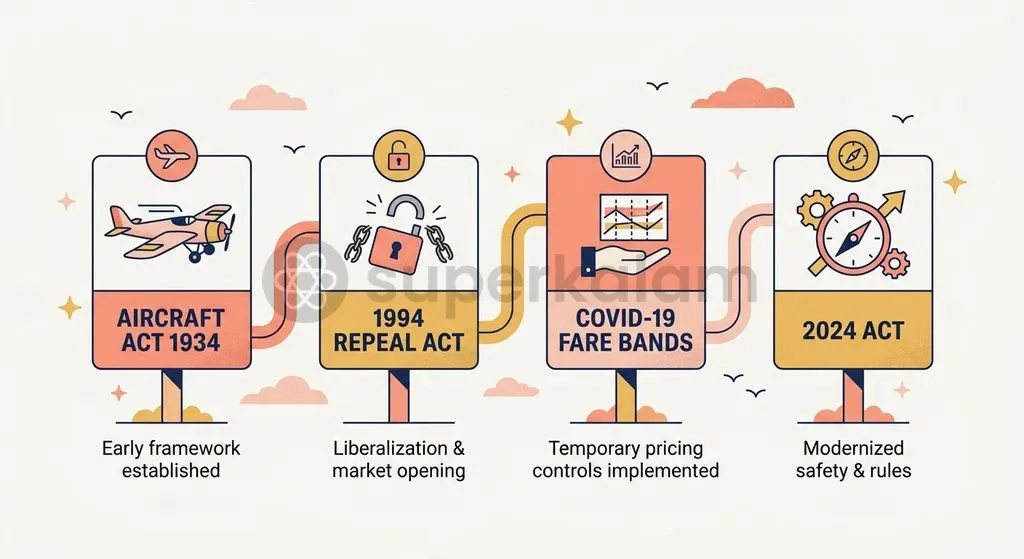
Air transport undertakings in India determine passenger ticket prices through automated yield management systems governed by free-market principles. The framework traces back to the repeal of the Air Corporations Act, 1953 by the Air Corporations (Transfer of Undertakings and Repeal) Act, 1994, which dismantled public airline monopolies and ended state-mandated tariff setting.
Commercial dynamic pricing moves through three structured phases:
- Inventory Allocation: Dividing available cabin capacity into distinct fare buckets.
- Algorithmic Monitoring: Tracking real-time velocity, historical demand, and competitor pricing.
- Sequential Fare Escalation: Shifting remaining seats into progressively higher price tiers as departures approach.
To understand how commercial carriers manage their inventories, the International Civil Aviation Organization outlines the standard industry mechanism:
- Inventory Segmentation: Commercial carriers divide total cabin seating into sequential fare buckets known as Reservation Booking Designators (RBDs).
- Algorithmic Tracking: Automated revenue management software continuously assesses real-time booking velocity, remaining seat availability, and historical route demand.
- Tier Advancement: Lower-priced RBD buckets close automatically as seat inventory depletes or departure schedules draw near, advancing subsequent bookings into higher price tiers.
The Ministry of Civil Aviation reports that dynamic pricing does not penalise the vast majority of travellers during ordinary operations. According to official parliamentary submissions by the Ministry, more than 98% of airline tickets are purchased across lower and middle fare buckets, with extreme surge fares occurring in fewer than 2% of total booking instances.
| Dimension | Market-Determined Dynamic Pricing | Statutory Regulated Price Capping |
|---|---|---|
| Primary Objective | Revenue maximisation and capacity allocation | Consumer protection and transit accessibility |
| Statutory Authority | Commercial carrier autonomy under Rule 135(1) | Executive powers under statutory provisions |
| Inventory Impact | Incentivises early booking through lower tiers | Risks premature seat exhaustion on high-demand routes |
| Operational Flexibility | Allows rapid absorption of volatile input shocks | Restricts carrier ability to offset sudden fuel spikes |
| Consumer Impact | Rewards advance planners but penalises emergency travel | Protects last-minute travellers from extreme surges |
What Powers Does DGCA Currently Have Over Ticket Prices?
The Directorate General of Civil Aviation operates primarily as a technical and safety regulator rather than a day-to-day economic price controller. Under Sub-rule (1) of Rule 135 of the Aircraft Rules, 1937, every air transport undertaking maintains the legal freedom to establish reasonable tariffs, taking into account operating costs, service characteristics, reasonable profit margins, and prevailing market rates.
The regulatory framework nevertheless establishes specific transparency obligations and conditional enforcement powers:
- Mandatory Tariff Disclosure: Under Sub-rule (2) of Rule 135, every domestic airline must publish its full fare structure and route-wise tariff sheets transparently on its website.
- Intervention Against Market Abuse: Sub-rule (4) of Rule 135 authorises the Director General of Civil Aviation to issue binding directions if an airline charges excessive, predatory, or oligopolistic tariffs.
- Routine Fare Surveillance: The regulator maintains a dedicated Tariff Monitoring Unit, which inspects domestic airfares across randomly selected routes each month to verify that charged prices remain within the carriers' self-declared tariff brackets.
Despite these oversight provisions, the regulator rarely intervenes in daily market pricing. Proving that an algorithmically generated fare is legally predatory presents complex evidentiary hurdles under existing standards.
Discuss with Superkalam
How does dynamic pricing via Reservation Booking Designators (RBDs) balance seat inventory allocation against consumer price expectations?
Ask NowCan the Government Legally Cap Airfares? Lessons from the Aircraft Rules, 1937
The Central Government possesses the legal authority to intervene in aviation tariffs during extraordinary conditions through statutory delegated legislation. Under Section 5(2) and Section 10(2) of the now-repealed Aircraft Act, 1934, the Union Government held broad rule-making powers to regulate the economic operation of air transport services during national crises.
A definitive operational test of this power occurred in May 2020 following the outbreak of the COVID-19 pandemic. The Ministry of Civil Aviation implemented formal minimum and maximum fare bands based on flight duration:
- Lower Floor Caps: Instituted to prevent financially vulnerable airlines from collapse caused by predatory undercutting during severe travel contractions.
- Upper Ceiling Caps: Enforced to safeguard stranded citizens from extortionate last-minute fares during restricted capacity operations.
The Ministry dismantled these domestic fare bands on 31 August 2022, restoring unrestricted open-market dynamic pricing as regular domestic schedules normalised. This episode confirmed an enduring principle: while executive price intervention remains legally enforceable during emergencies, sustained peacetime price caps conflict with the state's broader deregulation policy.
What Changes Under the Bharatiya Vayuyan Adhiniyam, 2024?
The Bharatiya Vayuyan Adhiniyam, 2024 modernises India's civil aviation framework by replacing century-old colonial legislation with contemporary statutory mechanisms. The statute received Presidential assent on 11 December 2024 and formally came into force on 1 January 2025, completely repealing the Aircraft Act, 1934.
The new enactment modernises sovereign legislative oversight over commercial airline operations in several ways:
- Express Statutory Mandate for Tariffs: Unlike the scattered provisions of the 1934 Act, Section 10(2)(c) of the Bharatiya Vayuyan Adhiniyam, 2024 explicitly empowers the Central Government to make rules governing the economic regulation of air transport, including the approval, disapproval, or formal revision of passenger tariffs.
- Formalisation of Subordinate Legislation: The statute provides clear legislative backing for the comprehensive airfare pricing rules submitted before the Supreme Court in October 2026.
- Administrative Adaptability: The Act enhances the central executive's legal agility to issue binding policy directions to operators without relying on ambiguous emergency clauses.
By embedding economic regulation directly into the parent Act, Parliament has removed historical doubts. Regulatory directives on airfares can now withstand legal challenges founded on procedural overreach.
Discuss with Superkalam
If a severe natural disaster disrupts highway and rail networks in a state, how should the DGCA apply its powers under Rule 135 to prevent predatory ticket surges?
Ask NowFree Market Pricing vs Passenger Welfare: Arguments For and Against Fare Caps
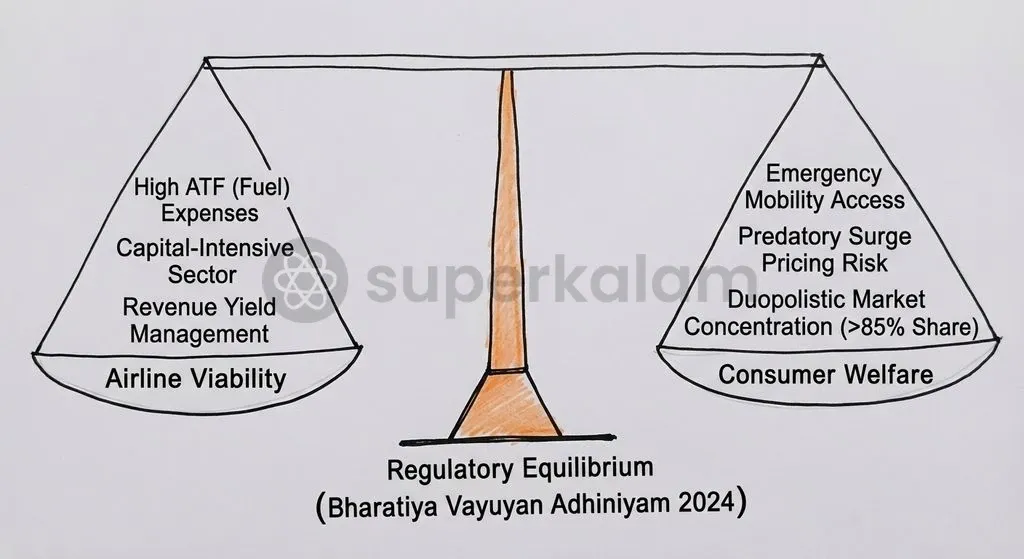
The debate surrounding airfare capping highlights an enduring economic dilemma between protecting travelling consumers and ensuring the commercial viability of private airlines. The Department-related Parliamentary Standing Committee on Transport, Tourism and Culture, in its 375th Report, strongly urged the Ministry to establish route-specific upper fare ceilings to deter opportunistic ticket pricing during regional disruptions.
| Perspective | Core Arguments | Key Considerations |
|---|---|---|
| Arguments For Fare Caps | Protects consumers during regional distress; checks anti-competitive risks | High duopoly risks with an 85%+ domestic share; safeguards essential connectivity |
| Arguments Against Fare Caps | Distorts market signals for capacity; risks route abandonment | Severe cost pressures, with ATF comprising 40% to 45% of carrier operating expenses |
The consumer welfare argument gains urgency from India's steep domestic market concentration. Industry data shows that two airline conglomerates—IndiGo and the Air India group—command over 85% market share of total domestic passenger traffic. Consumer advocates argue that high concentration weakens regular competitive disciplines, creating natural oligopolies that can exploit dynamic algorithms.
The Competition Commission of India examines passenger airline pricing under Section 3 and Section 4 of the Competition Act, 2002. However, the Commission has repeatedly observed that algorithmic price following without documented collusion does not meet the legal threshold of unlawful cartelisation.
Conversely, airlines point to severe operational cost structures. Official aviation data shows that Aviation Turbine Fuel accounts for approximately 40% to 45% of an Indian carrier's total operating expenditure. Imposing rigid fare ceilings limits an airline's commercial capacity to cross-subsidise discounted advance seats with high-yield last-minute bookings, threatening long-term balance-sheet stability.
Global Practices: How Other Aviation Markets Handle Surge Pricing
Major international aviation markets maintain a firm preference for unconstrained fare deregulation while enforcing strict transparency requirements. In the United States, the Airline Deregulation Act of 1978 dismantled federal economic controls over routes and tariffs, expressly barring individual states from regulating airline rates, routes, or services.
United States regulators concentrate their enforcement on full cost disclosure rather than price suppression:
- Full Fare Transparency: The U.S. Department of Transportation strictly enforces the Full Fare Advertising Rule (14 CFR § 399.84), requiring advertised airfares to state the total payable sum upfront, inclusive of mandatory government taxes and carrier surcharges.
- Anti-Deceptive Oversight: Regulatory enforcement penalises hidden drip-pricing tactics rather than dynamic seat escalations.
Similarly, the European Union institutionalises pricing autonomy under Article 22 of Regulation (EC) No 1008/2008, affirming that licensed Community air carriers are free to set passenger fares for intra-Community flights.
To protect travellers, Article 23 of the same regulation mandates that published airfares must display the complete final price at all times. The rule requires mandatory items like airport fees and fuel surcharges to be integrated directly into base quotes, while optional ancillary services can only be offered on a strictly transparent opt-in basis.
Discuss with Superkalam
Compare the 2020–2022 pandemic emergency price bands with normal peacetime dynamic pricing in terms of carrier solvency and consumer protection.
Ask NowWay Forward: Balancing Market Efficiency with Fair Consumer Protection
A sustainable civil aviation framework must protect stranded citizens from predatory price shocks without compromising the financial independence of private airlines. Rather than returning to broad, bureaucratic price controls, policymakers can adopt targeted regulatory mechanisms under the Bharatiya Vayuyan Adhiniyam, 2024:
- Targeted Emergency Ceilings: The Central Government can define clear statutory triggers—such as floods, rail derailments, or designated natural disasters—to impose temporary upper fare ceilings on affected regional corridors.
- Independent Algorithmic Audits: As recommended in analytical studies on market competition, civil aviation authorities should consider periodic regulatory reviews of airline Revenue Management Systems to ensure that automated algorithms do not artificially withhold lower-tier RBD buckets.
- Expansion of Subsidised Seat Models: The government's Regional Connectivity Scheme offers a tested model of state intervention. Under the UDAN framework, airfares remain capped for 50% of aircraft seats on qualifying routes, with airlines receiving Viability Gap Funding financed through a small levy on standard commercial flights.
- Enhanced Quasi-Judicial Powers for DGCA: Implementing the recommendations of the Parliamentary Standing Committee by conferring explicit tariff investigation powers upon the regulator will ensure swift accountability against predatory market distortions.
Calibrating these measures will safeguard passenger rights while preserving the commercial dynamics necessary for India's aviation market to expand responsibly.
Key Takeaways
- Regulatory Paradigm: India completely deregulated passenger airfares under the Air Corporations (Transfer of Undertakings and Repeal) Act, 1994, transitioning commercial operations to algorithmic dynamic pricing.
- Judicial Scrutiny: In S. Laxminarayanan v. Union of India, the Supreme Court is examining algorithmic surge pricing, with the Centre confirming that new tariff rules under the Bharatiya Vayuyan Adhiniyam, 2024 will be published shortly.
- Statutory Authority: Section 10(2)(c) of the Bharatiya Vayuyan Adhiniyam, 2024 explicitly authorises the Central Government to formulate rules for the economic regulation and tariff revision of air transport services.
- Enforcement Mechanisms: Rule 135(4) of the Aircraft Rules, 1937 empowers the DGCA to issue directions against predatory or excessive pricing, supported by routine monitoring through its Tariff Monitoring Unit.
- Structural Market Pressures: Two dominant airline groups control over 85% of domestic passenger traffic, while Aviation Turbine Fuel constitutes 40% to 45% of airline operational expenses, complicating simple administrative price-fixing.
Mains Question
"High market concentration—where two airline groups control over 85% of domestic passenger traffic—has intensified calls for statutory price regulation." In this context, examine whether statutory airfare caps balance consumer welfare against market efficiency. (10 Marks)
Evaluate NowMains Question
The Bharatiya Vayuyan Adhiniyam, 2024 modernises legislative oversight over civil aviation by repealing century-old colonial statutes. Critically analyse the scope and limitations of executive intervention in airline tariff regulation under this new framework. (15 Marks)
Evaluate NowPractice MCQs
QUESTION 1
Regarding civil aviation regulation in India, consider the following statements:
- Under Rule 135 of the Aircraft Rules, 1937, airlines are legally empowered to establish reasonable tariffs based on operational costs, service characteristics, and market rates.
- The Directorate General of Civil Aviation (DGCA) lacks legal power to intervene even if an airline charges predatory or oligopolistic tariffs.
- The dedicated Tariff Monitoring Unit randomly inspects domestic routes monthly to verify whether charged prices stay within airlines' self-declared tariff brackets. Which of the statements given above is/are correct?
QUESTION 2
With reference to the statutory framework governing Indian civil aviation, consider the following statements:
- The Bharatiya Vayuyan Adhiniyam, 2024 completely repealed the colonial-era Aircraft Act, 1934.
- Section 10(2)(c) of the Bharatiya Vayuyan Adhiniyam, 2024 explicitly empowers the Central Government to make rules regarding the economic regulation of air transport, including passenger tariffs.
- State-mandated tariff setting and public airline monopolies were abolished by the Bharatiya Vayuyan Adhiniyam, 2024. Which of the statements given above is/are correct?
QUESTION 3
Consider the following statements regarding airfare pricing and regulation in India:
- Commercial dynamic pricing operates through Reservation Booking Designators (RBDs), shifting remaining seats into higher tiers as booking velocity increases.
- In May 2020, the Central Government instituted both lower floor caps and upper ceiling caps on domestic airfares, which remained in force until August 2022.
- The Ministry of Civil Aviation reported to Parliament that over 98% of domestic tickets are purchased across lower and middle fare buckets. Which of the statements given above are correct?
QUESTION 4
The 375th Report of the Department-related Parliamentary Standing Committee on Transport, Tourism and Culture specifically recommended which of the following measures?
QUESTION 5
In the context of airline tariff regulation in India, the Public Interest Litigation in S. Laxminarayanan v. Union of India before the Supreme Court primarily challenged: