Agrivoltaics in India: How PM-KUSUM Can Balance Solar Power and Food Security
Balancing solar expansion with food security requires restructuring PM-KUSUM to mandate active crop cultivation beneath elevated photovoltaic arrays.
Oct, 2026
•6 min read
Overview
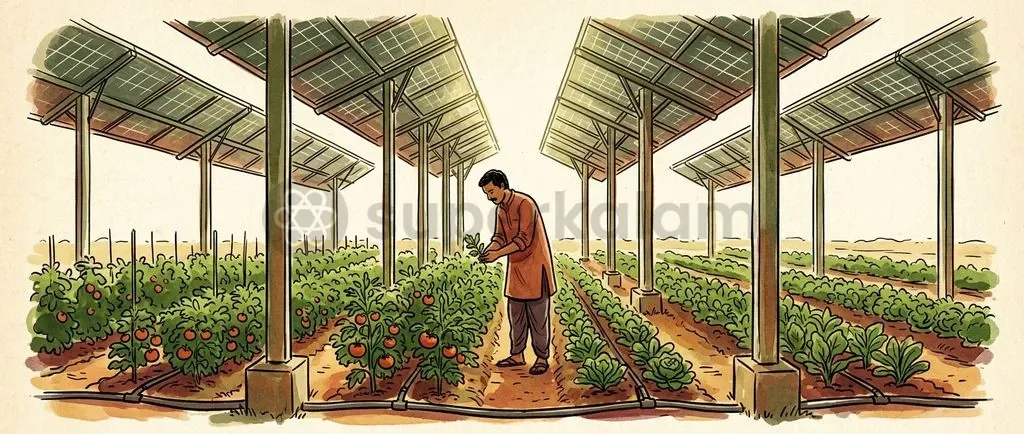
Agrivoltaic systems integrate solar photovoltaic generation directly above active farmland. This dual approach addresses direct land competition between India's 500-gigawatt non-fossil energy ambitions and national food security priorities.
India holds an estimated theoretical potential between one and two terawatts for dual-use solar. Elevating arrays over arable fields allows smallholders to generate clean power while farming shade-tolerant crops. Yet unlocking genuine rural resilience requires overhauling the PM-KUSUM scheme.
Current capital subsidies lack differentiated tariffs and statutory farming safeguards. As a result, landowners often abandon active cultivation for guaranteed solar revenues. Turning agrivoltaics into durable farm security requires strict canopy standards, mandatory crop audits, and targeted smallholder credit.
Why in the News? The Global Agrivoltaics Push and India's Land Constraint
India is preparing to host a major global summit on dual-use clean energy while managing acute spatial tensions on the ground:
- Global summit: India will host the 7th Agrivoltaics World Conference at Bharat Mandapam in New Delhi from 21 to 23 October 2026 under the theme "Powering the Global South".
- Installed base: As of March 2026, the Ministry of New and Renewable Energy reports that the nation possesses approximately 171 gigawatts of installed solar capacity.
- Land pressure: Ground-mounted solar installations demand extensive acreage, often displacing farming activity and rural employment. To ease this friction, the Ministry of New and Renewable Energy and the Ministry of Finance are negotiating dedicated central incentives.
- Research hub: The Central Government established a 100-kilowatt Centre of Excellence on Agri-Photovoltaics in 2025 at the ICAR-Indian Agricultural Research Institute in New Delhi. Jointly run by the Indian Council of Agricultural Research and the National Institute of Solar Energy, it formulates national microclimate baselines.
How Agrivoltaics Operates: Balancing Solar Radiation and Crop Agronomy
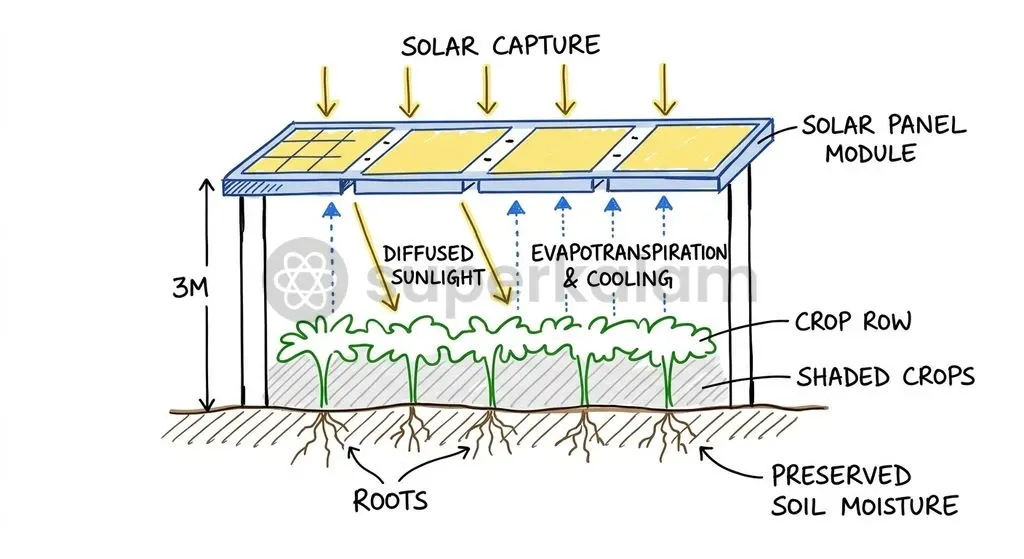
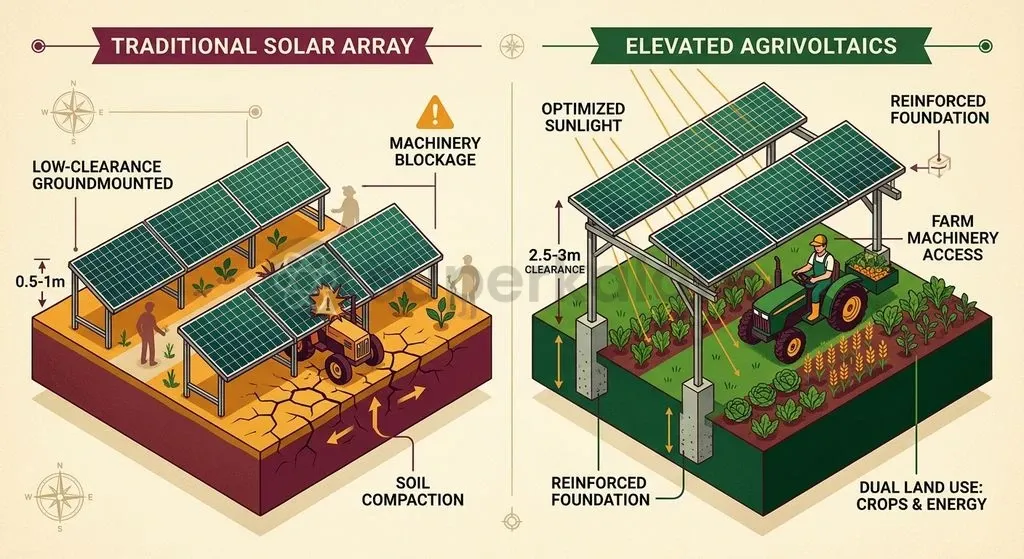
Agrivoltaics co-locates photovoltaic modules and crops on the same parcel. Standard engineering uses stilted mounting systems that elevate modules between 2.5 and 3.0 metres overhead, leaving ample clearance for manual labour and light machinery.
Arrays are spaced to transmit at least 70 percent of incident photosynthetically active radiation to the crop canopy below. Wider row pitch prevents shading from dipping beneath biological light saturation thresholds.
This canopy microclimate lowers daytime soil temperatures and suppresses evaporation. Meanwhile, transpiration from crops cools the overhead panels, boosting their thermodynamic efficiency compared to heat-stressed ground arrays. Field trials by the Central Arid Zone Research Institute show marked gains in overall Land Equivalent Ratios.
| Parameter | Conventional Ground-Mounted Solar | Elevated Agrivoltaic System (Agri-PV) |
|---|---|---|
| Primary Land Use | Dedicated single-use power generation | Dual-use: electricity and agricultural cultivation |
| Mounting Clearance | 0.5 to 1.0 metre above ground level | 2.5 to 3.0 metres elevated stilts |
| Row Pitch Spacing | Narrow pitch optimised for panel packing density | Expanded pitch permitting ~70% canopy radiation |
| Balance of System Capex | Baseline installation and civil costs | 20% to 30% higher capital expenditure |
| Water Utilisation | Consumptive periodic panel cleaning | Panel wash runoff harvested for under-canopy crops |
| Target Agronomy | Ground cleared; vegetation suppressed | Shade-tolerant C3 crops, legumes, and horticulture |
Agronomic performance hinges on plant biology. Species using C3 photosynthetic pathways—including tomatoes, onions, leafy vegetables, and pulses—thrive under partial shade due to low light saturation points. In contrast, light-intensive C4 cereals like maize, pearl millet, and sugarcane suffer biomass losses when canopy shade exceeds physiological limits.
Discuss with Superkalam
What mounting clearance height and radiation transmission percentage define standard agrivoltaic systems in the article?
Ask NowThe PM-KUSUM Incentive Trap: Food Security Risks Under Component A
Component A of the Pradhan Mantri Kisan Urja Suraksha evam Utthaan Mahabhiyan allows farmers, cooperatives, and panchayats to install grid-connected plants from 500 kilowatts to 2 megawatts on barren, fallow, or cultivable lands.
However, the scheme's operating structure creates an unintended moral hazard:
- Assured revenue: Power Purchase Agreements lock in feed-in tariffs across a 25-year lifecycle through state distribution companies.
- Farm abandonment: Guaranteed cash flows lead landowners to abandon labour-intensive farming, turning fertile topsoil over to ground-mounted developer arrays.
- Topsoil sterilisation: Commercial developers routinely strip vegetation and compact the subsoil to suppress weeds around cabling, degrading arable land into monocultural power stations.
Without statutory mandates requiring concurrent agricultural output, subsidies designed to uplift rural livelihoods instead accelerate farmland diversion.
Discuss with Superkalam
Why do C3 horticultural crops adapt better to agrivoltaic under-canopy microclimates than C4 cereal crops?
Ask NowThe Smallholder Equation: Capital Costs, Structural Engineering, and Tenancy
The Agriculture Census notes that small and marginal farmers owning under two hectares make up approximately 86 percent of India's agrarian base. For this majority, adopting dual-use solar involves severe hurdles:
- Steep capex: Raising panels to 2.5 to 3.0 metres requires sturdier purlins, deeper foundations, and wind bracing. This increases Balance of System capex by 20 to 30 percent.
- Credit bottlenecks: Commercial lenders frequently label elevated frames as developmental risks, imposing harsh collateral demands on smallholders.
- Tenancy barriers: Fragmented plots restrict mechanical manoeuvrability, while informal oral leases bar tenant farmers from accessing capital subsidies.
Discuss with Superkalam
How might a tenant farmer operating under an informal oral lease be impacted by a landowner's decision to adopt PM-KUSUM Component A?
Ask NowRegulatory Safeguards: Lessons From Japan and France
International jurisdictions enforce strict statutory safeguards to prevent renewable energy from displacing agricultural production:
- Japan's 80 percent yield rule: Farmland conversions under the Ministry of Agriculture, Forestry and Fisheries must preserve at least 80 percent of baseline crop yields. State agricultural committees run annual physical inspections; uncultivated sites or yield defaults trigger immediate permit revocation and mandatory decommissioning.
- France's 40 percent canopy ceiling: French legal decrees restrict solar canopy cover to a maximum of 40 percent of the parcel area to prevent light deprivation. Projects must provide documented microclimatic benefits—such as frost shielding—and cap allowable crop yield declines at a maximum penalty cap of 10 percent.
Discuss with Superkalam
Compare the trade-offs between conventional ground-mounted solar and elevated agri-PV regarding capital expenditure, soil health, and land productivity.
Ask NowWay Forward: Reforming PM-KUSUM for Verified Dual Land Productivity
The Ministry of New and Renewable Energy can prevent farmland loss by instituting binding technical and agronomic standards:
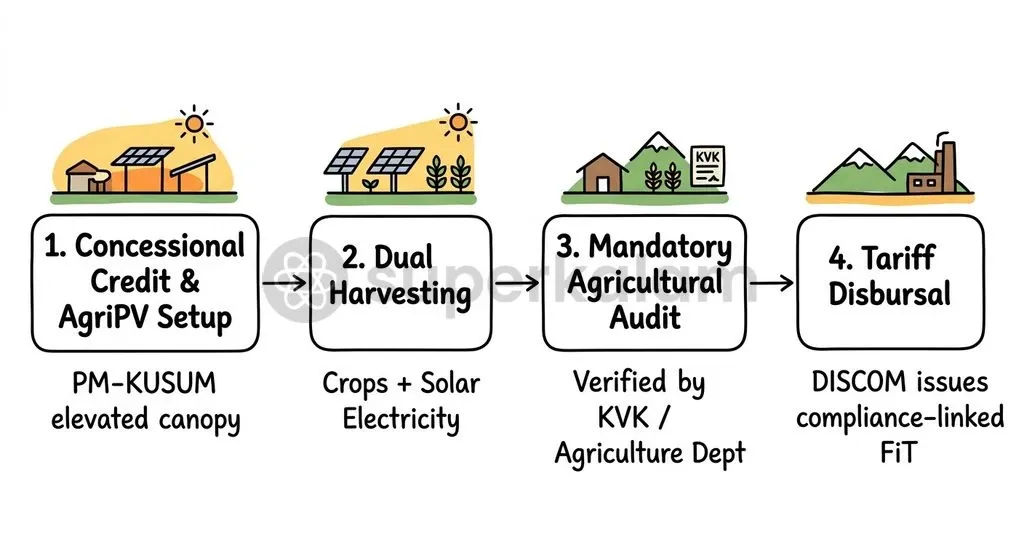
- Differentiated feed-in tariffs: Regulators should establish specialised tariffs that compensate for the 20 to 30 percent higher structural costs of 2.5-metre stilted frames.
- Output-linked contracts: Discoms must tie long-term tariff payouts to verified crop production, backed by annual audits from Krishi Vigyan Kendras or State Agricultural Universities.
- Standardised crop packages: ICAR and the Centre of Excellence at ICAR-IARI should release agro-climatic packages combining shade-tolerant C3 seeds, drip irrigation, and panel cleaning runoff capture.
- Priority lending channels: The Reserve Bank and the National Bank for Agriculture and Rural Development should classify elevated agri-PV as priority infrastructure, unlocking low-cost credit for farmer producer organisations.
Discuss with Superkalam
How can the Ministry of New and Renewable Energy redesign PM-KUSUM tariffs and contracts to prevent arable land abandonment?
Ask NowKey Takeaways
- India will host the 7th Agrivoltaics World Conference in New Delhi between 21 and 23 October 2026 under the theme "Powering the Global South", spotlighting dual land-use solutions.
- The nation's technical agri-photovoltaic potential stands between 1 and 2 terawatts, complementing the existing installed solar capacity of approximately 171 gigawatts.
- Elevating solar modules between 2.5 and 3.0 metres preserves roughly 70 percent of natural canopy radiation, though it increases capital expenditure by 20 to 30 percent.
- Small and marginal farmers represent 86 percent of Indian agriculturalists, requiring targeted priority-sector credit to overcome high structural balance-of-system costs.
- International models like Japan's mandatory 80 percent crop yield retention rule and France's 40 percent canopy ceiling offer actionable templates for reforming PM-KUSUM Component A.
Mains Question
"Without statutory mandates requiring concurrent agricultural output, renewable energy incentives under PM-KUSUM Component A risk transforming fertile agricultural land into monocultural power stations." Critically analyse. (15 Marks)
Evaluate NowMains Question
Highlighting regulatory frameworks adopted by countries like Japan and France, evaluate the measures needed to institutionalise agrivoltaics as a dual land-use model in India. (10 Marks)
Evaluate NowPractice MCQs
QUESTION 1
With reference to agrivoltaic systems (Agri-PV), consider the following statements:
- Modules elevated at 2.5 to 3.0 metres allow light machinery and manual farm labour beneath the canopy.
- In elevated agrivoltaic arrays, wider row pitch is maintained to transmit at least 70 percent of incident photosynthetically active radiation to crops.
- Elevated Agri-PV systems typically reduce the Balance of System capital expenditure by 20 to 30 percent compared to conventional ground-mounted installations. Which of the statements given above are correct?
QUESTION 2
Consider the following statements regarding crop agronomy under agrivoltaic arrays:
- Crops utilising the C3 photosynthetic pathway, such as tomatoes and pulses, adapt well under partial shade due to low light saturation points.
- Light-intensive C4 cereals such as maize and pearl millet exhibit biomass increases when canopy shading exceeds conventional thresholds.
- Evapotranspiration from under-canopy crops cools overhead solar modules, enhancing their thermodynamic efficiency. Which of the statements given above is/are correct?
QUESTION 3
Regarding the regulatory mechanisms governing agrivoltaics in international jurisdictions, consider the following statements:
- In Japan, agricultural land conversions for solar installations mandate maintaining at least 80 percent of baseline crop yields under penalty of permit revocation.
- In France, solar canopy coverage on agricultural parcels is legally capped at a maximum of 40 percent. Which of the statements given above is/are correct?
QUESTION 4
Under Component A of the PM-KUSUM scheme, what primary operational factor creates a moral hazard leading to the diversion of cultivable land from farming?
QUESTION 5
Consider the following statements regarding the institutional and technical landscape of agrivoltaics in India:
- India will host the 7th Agrivoltaics World Conference in New Delhi in October 2026 under the theme 'Powering the Global South'.
- A 100-kilowatt Centre of Excellence on Agri-Photovoltaics was set up in 2025 at ICAR-IARI, jointly operated by ICAR and the National Institute of Solar Energy.
- Small and marginal farmers holding less than two hectares constitute less than half of India's total agrarian base according to the Agriculture Census. Which of the statements given above is/are correct?