AgriStack and Farmer ID: Why Digital Infrastructure Cannot Bypass Land Reform
Digitising presumptive land titles under AgriStack risks entrenching historical inequities and locking out millions of tenant tillers from farm welfare.
Oct, 2026
•11 min read
Overview
AgriStack establishes a unified digital identity framework for Indian agriculture by linking eleven crore planned Farmer IDs to land records. Yet its reliance on presumptive property titles risks entrenching historical inequities. It also threatens to exclude millions of tenant cultivators.
The Union Cabinet approved the Digital Agriculture Mission in September 2024 with a total financial outlay of Rs 2,817 crore. The initiative seeks to streamline welfare delivery, farm credit, and crop monitoring across states.
However, Indian land records carry only presumptive legal validity rather than guaranteed ownership. Digitising these registries without prior land reform threatens to formalise historical exclusions. For this architecture to succeed, legal recognition of actual tillers and tenant cultivators must anchor the system before technical rollout.
Why in the News: The Union Cabinet's Push for Digital Public Infrastructure in Agriculture
The Union Cabinet approved the Digital Agriculture Mission on 2 September 2024 to build foundational digital public infrastructure for Indian farming.
The initiative sets out clear operational targets and fiscal allocations:
- Financial allocation: A total financial outlay of Rs 2,817 crore, with Rs 1,940 crore provided by the Central Government and the remaining balance contributed by State Governments.
- Digital registry targets: Generating 11 crore unique Farmer IDs linked dynamically to state land revenue databases.
- Scheme integration: Integrating service delivery across key central programmes such as PM-KISAN, crop insurance, and institutional credit as of September 2024.
The central pillar of this mission is AgriStack, a federated digital architecture designed to create an interoperable agricultural database across the country.
Discuss with Superkalam
What is the total financial outlay approved for the Digital Agriculture Mission, and how many Farmer IDs does it target?
Ask NowWhat Is AgriStack: Breaking Down the Farmer ID, Registry, and Geo-Referencing
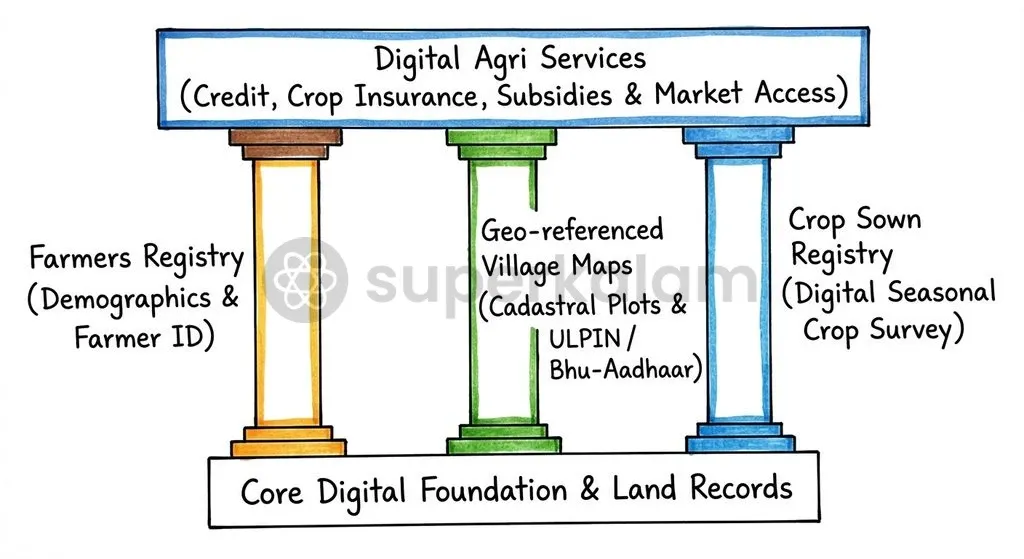
AgriStack is an interoperable digital public infrastructure built upon three foundational registries developed and maintained by States and Union Territories. These layers operate together to verify the farmer, locate the farm plot, and track actual seasonal cultivation.
The foundational registries under the AgriStack architecture comprise:
- The Farmers' Registry: A central repository containing demographic profiles and unique Farmer IDs linked dynamically to land ownership records.
- Geo-referenced Village Maps: Spatial cadastral layers created under the Digital India Land Records Modernization Programme (DILRMP), connecting plot boundaries to Unique Land Parcel Identification Numbers (ULPIN or Bhu-Aadhaar).
- The Crop Sown Registry: A dynamic seasonal record populated through the Digital Crop Survey (DCS), which deploys mobile ground surveys to register seasonal crops plot by plot.
| Core Component | Primary Administrative Custodian | Structural Function | Critical Limitation |
|---|---|---|---|
| Farmer ID & Registry | State Revenue & Agriculture Departments | Generates a unique, verifiable digital identity linked to land titles | Excludes non-titled tillers, oral lessees, and women cultivators |
| Geo-Referenced Village Maps | Department of Land Resources (DILRMP) | Demarcates spatial cadastral boundaries using ULPIN / Bhu-Aadhaar | Preserves existing spatial boundary disputes in digital form |
| Crop Sown Registry | State Agriculture Departments via DCS | Captures plot-level seasonal crop data through ground surveys | Fails to identify non-owner cultivators sowing the registered crop |
By linking these layers, the platform aims to provide paperless sanction of crop loans. It also intends to power targeted delivery of Direct Benefit Transfers and automated assessment of crop damage under the Pradhan Mantri Fasal Bima Yojana (PMFBY).
The Core Paradox: Building High-Tech Identity on Incomplete Land Records
India's property registration regime operates on presumptive title under the Registration Act of 1908. This means the state registers transaction deeds rather than certifying ownership. When an individual registers a land sale, the government merely records the deed between two private parties. It does not investigate whether the seller holds genuine legal title.
State Land Revenue Codes maintain Records-of-Rights (RoR) that carry a rebuttable presumption of truth under Indian evidence law. A revenue entry serves administrative fiscal purposes and does not confer an indisputable legal title. Because property ownership remains presumptive, land records across the country face civil court challenges, partition disputes, and unrecorded intestate successions.
This legal reality creates a profound technical contradiction for AgriStack:
- Presumptive vs Conclusive Rights: A digital registry assumes verified ground facts, but Indian land administration lacks state-guaranteed conclusive titles.
- Freezing Flawed Records: Digitising disputed revenue records into immutable digital Farmer IDs locks in historical inaccuracies before civil courts resolve competing claims.
- Vulnerability to Administrative Errors: Mutation delays, typographical land record errors, and unpartitioned ancestral holdings become permanent digital barriers when welfare entitlements require an authenticated Farmer ID.
Discuss with Superkalam
Explain the difference between a presumptive land title and a state-guaranteed conclusive title in the context of AgriStack.
Ask Now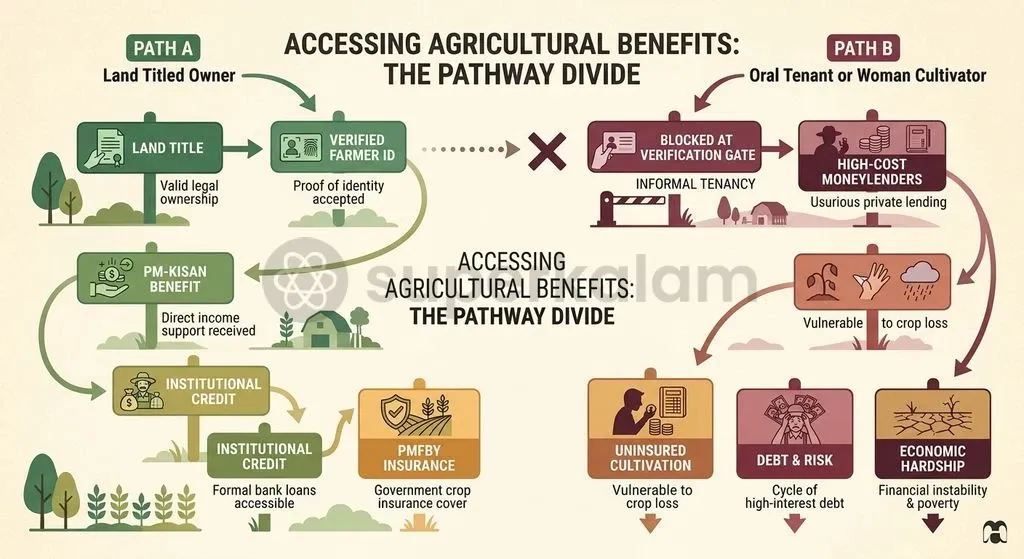
Discuss with Superkalam
How might a local bank's crop loan disbursement change for an oral sharecropper once AgriStack is fully operational?
Ask NowDigital Commons or Corporate Capture: Data Privacy and Agri-Monopolies
The Ministry of Agriculture and Farmers Welfare initiated partnerships with private technology companies between 2021 and 2022 to pilot digital agricultural architectures. Under the India Digital Ecosystem of Agriculture (IDEA) framework, the government executed pilot Memorandums of Understanding with technology and agribusiness corporations including Microsoft, Cisco, Amazon Web Services (AWS), and ITC.
These collaborations raise severe ethical and market-structure concerns regarding the governance of farm-level data. The Task Force Report on IDEA noted that commercial integration of granular agronomic and yield data creates risks of private market profiling, price manipulation, and asymmetric bargaining against smallholders. When private corporations access hyper-local data on crop yields, soil conditions, and harvest timelines, input suppliers and commodity trading cartels can manipulate regional pricing structures before harvest.
Agrarian data protection remains weak under current law:
- Statutory Exemptions: Section 7(b) of the Digital Personal Data Protection Act, 2023 allows the processing of personal data without explicit consent for delivering state subsidies, benefits, services, or certificates.
- Lack of Community Data Rights: Current data protection regimes frame privacy as an individual entitlement, failing to protect collective farmer rights against predatory market profiling.
- Algorithmic Asymmetry: The collection of proprietary farm-level intelligence by private technology partners shifts negotiating power away from smallholder farmers, who lack legal tools to challenge algorithmic credit scoring or dynamic pricing models.
Discuss with Superkalam
Why does the dynamic linking of Farmer IDs with land titles create a systemic bias against women agricultural workers?
Ask NowFederalism at the Farm Gate: State Land Records Under Central Digital Standards
The Constitution of India places agriculture, land tenures, and the maintenance of land records under the exclusive legislative domain of the States. Under Entry 18 and Entry 14 of the State List in the Seventh Schedule, State Legislatures hold plenary constitutional authority to legislate on land rights, tenancy reforms, land revenue, and agricultural administration.
AgriStack relies on centrally standardised data schemas, application programming interfaces (APIs), and verification rules managed by the Union Government. Members of Parliament have argued that imposing uniform central technical standards on state-maintained revenue registers undermines the federal allocation of administrative powers.
This centralisation triggers three distinct federal friction points:
- Divergent Tenancy Definitions: Land administration practices and cadastral terminology differ widely across Indian states, and uniform central schemas risk flattening regional land tenure nuances.
- Asymmetric Administrative Burdens: The Union Government funds the digital architecture, yet State revenue administrations bear the administrative load and political friction of resolving record discrepancies.
- Erosion of Revenue Autonomy: Centralised digitisation risks turning autonomous State revenue departments into clerical data collection channels for a Union-managed digital registry.
Lessons from the Ground: What Early State Pilots Reveal
State-level pilot implementations demonstrate that digital verification tools cannot substitute for physical verification of land relations. Field research by agrarian economists indicates that digital verification without physical ground-truthing replicates offline power asymmetries and exacerbates the exclusion of marginal and oral cultivators.
Andhra Pradesh established a notable legislative attempt to bridge this divide through the Andhra Pradesh Crop Cultivator Rights Act (CCRA), 2019. The CCRA created Crop Cultivator Rights Cards (CCRC), designed to provide registered tenant cultivators access to institutional bank credit, crop insurance, and input subsidies for a single agricultural season without altering the underlying landowner's title.
However, practical implementation exposed administrative friction:
- Landowner Veto: The CCRA required explicit written consent from the landowner before an oral tenant could receive a CCRC, causing landowners to reject agreements out of fear of future property disputes.
- Institutional Reluctance: Commercial banks remained hesitant to disburse agricultural loans against temporary cultivator cards lacking physical land collateral.
- Digital Mismatches: When state digital platforms cross-checked tenancy cards against title databases, conflicting claims between title-holders and actual tillers regularly stalled welfare disbursements.
Discuss with Superkalam
Evaluate whether technical digitisation of land records should precede or follow legal tenancy reforms in India.
Ask NowWay Forward: Securing Tenancy Rights Before Locking in Digital IDs
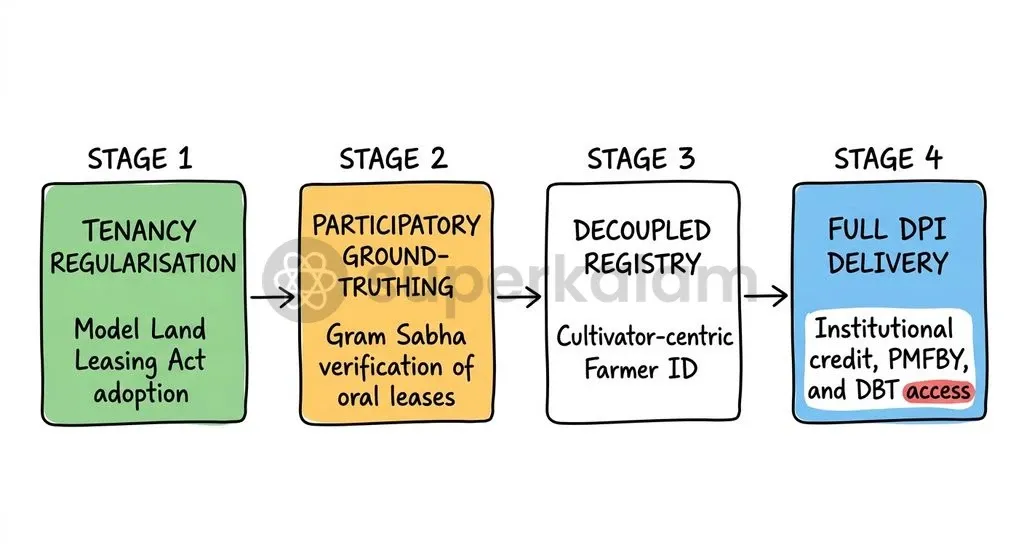
A sustainable digital agricultural infrastructure requires foundational tenancy reform and legal recognition of non-titled tillers before records are locked into digital identities. The NITI Aayog Expert Committee on Land Leasing presented a clear institutional blueprint through the Model Agricultural Land Leasing Act, 2016.
The Model Land Leasing Act, 2016 provides that registered tenant cultivators be recognised as formal beneficiaries for institutional agricultural credit, PMFBY crop insurance, and disaster compensation. Enacting this model legislation across States legalises leasing agreements without compromising the landowner's ownership rights. It directly resolves the fear of adverse possession that currently drives tenancy underground.
To prevent digital exclusion, agricultural governance should implement three institutional reforms:
- Legalise Agricultural Tenancy: States should enact legislation modelled on the NITI Aayog framework, allowing mutual tenancy agreements that guarantee land retrieval for owners while granting formal cultivator status to tenants.
- Decouple Cultivator Identity from Title Deeds: The Ministry of Agriculture and Farmers Welfare should separate the operational Farmer ID from the property ownership register, establishing verifiable cultivator registries based on real-time cultivation rather than land revenue ownership. Per Press Information Bureau reports (as reported, 1 April 2025), the Ministry proposed a multi-tiered validation architecture incorporating Gram Sabha certifications and self-declaration pathways for oral cultivators to access local input benefits.
- Mandate Participatory Ground-Truthing: Prior to freezing land parcels into the central registry, local revenue authorities must conduct open Gram Sabha verifications to validate actual possession, resolve inherited boundaries, and include marginalised women cultivators.
Digital public infrastructure is an administrative delivery vehicle, not a substitute for institutional agrarian reform. If AgriStack digitises land records without legalising tenancy and resolving presumptive titles, it will entrench agrarian vulnerability behind a modern digital interface.
Key Takeaways
- The Union Cabinet approved the Digital Agriculture Mission on 2 September 2024 with a total financial outlay of Rs 2,817 crore, aiming to generate 11 crore unique Farmer IDs linked to state land records.
- Under the Registration Act, 1908 and State Land Revenue Codes, Indian land records carry only presumptive legal validity rather than guaranteed title, meaning digital registries risk formalising disputed or flawed ownership records.
- NSSO 77th Round data indicates that over 10 percent of agricultural land is leased in, leaving informal tenants, oral lessees, and women farmers (who operate only 13.9 percent of holdings) structurally excluded from title-linked Farmer IDs.
- Land and agriculture remain exclusive State subjects under Entry 18 and Entry 14 of the State List in the Seventh Schedule, generating constitutional friction against centralised digital schemas and API mandates.
- Adopting the NITI Aayog Model Agricultural Land Leasing Act, 2016 and decoupling cultivator identity from title deeds are essential prerequisites to prevent digital public infrastructure from entrenching agrarian inequalities.
Mains Question
"Building a high-tech agricultural digital identity on presumptive land titles risks entrenching historical inequities rather than resolving them." In light of the Digital Agriculture Mission and AgriStack, critically analyse this statement. (15 Marks)
Evaluate NowMains Question
Examine the implications of deploying digital public infrastructure like AgriStack for tenant farmers and women cultivators in Indian agriculture. (10 Marks)
Evaluate NowPractice MCQs
QUESTION 1
Regarding the Digital Agriculture Mission approved in September 2024, consider the following statements:
- The initiative entails a total financial outlay shared between the Central Government and State Governments.
- It establishes a target of generating 11 crore unique Farmer IDs dynamically linked to state land revenue databases.
- The AgriStack architecture relies on three foundational registries maintained primarily by the Union Ministry of Electronics and Information Technology.
Which of the statements given above is/are correct?
QUESTION 2
With reference to the foundational registries under the AgriStack framework, consider the following statements:
- The Farmers' Registry holds demographic profiles linked dynamically to land ownership records.
- The Crop Sown Registry is populated through mobile ground surveys conducted under the Digital Crop Survey (DCS).
- Geo-referenced Village Maps link cadastral plot boundaries to Unique Land Parcel Identification Numbers (ULPIN / Bhu-Aadhaar).
Which of the statements given above are correct?
QUESTION 3
Consider the following statements regarding the legal status of property titles and land registration in India:
- The Registration Act, 1908 confers guaranteed, conclusive title to land upon registration of a sale deed.
- Records-of-Rights (RoR) maintained under State Land Revenue Codes carry a rebuttable presumption of truth under Indian evidence law.
- Revenue entries alone serve administrative fiscal purposes and do not confer indisputable legal ownership.
Which of the statements given above is/are correct?
QUESTION 4
According to the NSSO Report No. 587 (77th Round, 2019) and the Agriculture Census 2015-16 cited in the context of agricultural tenancy in India, which of the following is correct?
QUESTION 5
Under the Digital Personal Data Protection Act, 2023, personal data of individuals can be processed without explicit consent under Section 7(b) specifically for which of the following purposes?