Agricultural Carbon Credits in India: Soil Payouts and CCTS Framework
As Punjab and Haryana smallholders earn India's first soil carbon payouts, voluntary climate finance meets domestic regulatory challenges under CCTS.
Sep, 2026
•9 min read
Overview
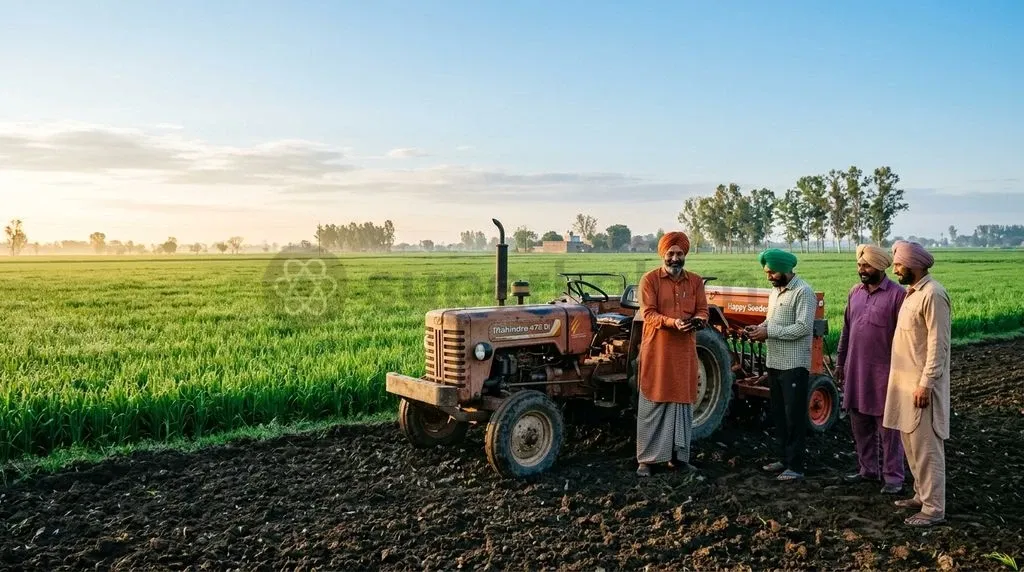
Agricultural carbon credits have emerged as a market-driven instrument in India to monetise sustainable farming practices, transforming soil organic carbon sequestration into tradable financial assets for smallholders transitioning away from ecologically damaging monocultures. In September 2026, the direct disbursement of ₹2.5 to ₹2.9 crore to 2,550 farmers in Punjab and Haryana demonstrated that voluntary carbon finance can incentivise groundwater conservation and the elimination of crop stubble burning. While this milestone validates private-sector aggregation and digital verification models, scaling agricultural carbon markets across India requires robust statutory floor pricing, low-cost remote measurement, and cooperative-led aggregation to prevent corporate intermediary capture.
Why in the News: India's First Agricultural Soil Carbon Payouts
In September 2026, the Indian agricultural sector achieved a significant milestone when 2,550 smallholder farmers across Punjab and Haryana received India's first farm-level soil carbon payments via Direct Benefit Transfer. The disbursement event, hosted at Punjab Agricultural University in Ludhiana, distributed approximately ₹2.5 to ₹2.9 crore in direct cash payouts to participating growers.
These payments represent verified carbon offsets generated between 2019 and 2022 under an initiative known as the 'Aadi' project (registered as VCS Project 2590). Developed by agricultural carbon developer Grow Indigo in scientific collaboration with the Indian Council of Agricultural Research (ICAR), the project translates farm-level climate mitigation into measurable, monetisable assets. As of September 2026, this rollout marks the first large-scale empirical test of voluntary soil carbon markets in India's agrarian heartland.
How Soil Carbon Credits Work: The Mechanism from Farm to Market
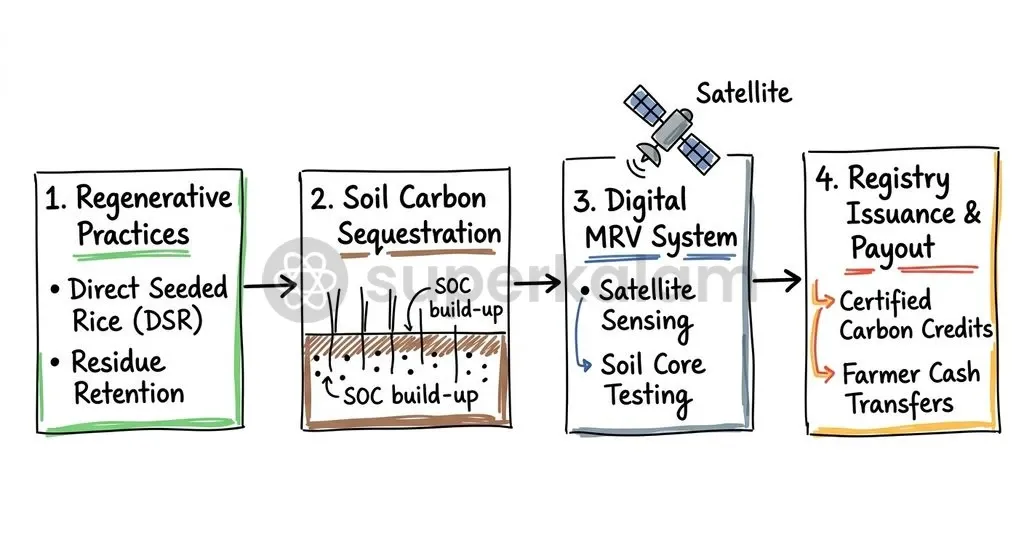
Soil carbon credits represent certified units of greenhouse gas mitigation, where one credit equals one metric tonne of carbon dioxide equivalent sequestered in soil or avoided in emissions. Agricultural soils act as natural carbon sinks through the biological accumulation of Soil Organic Carbon (SOC), which increases when farmers minimise mechanical soil disturbance and retain plant biomass.
Under international voluntary carbon standards, such as Verra's VM0042 methodology for Improved Agricultural Land Management, generating tradeable credits follows a rigorous, multi-stage compliance cycle:
- Baseline Setting and Stratification: Project developers establish historical greenhouse gas emission baselines across target farmlands using regional agronomic data and historical cropping patterns.
- Adoption of Regenerative Interventions: Farmers implement approved conservation practices, including zero-tillage, residue mulching, and non-continuous flooded irrigation.
- Measurement, Reporting, and Verification (MRV): Soil sampling protocols mandate physical soil core extraction to a minimum depth of 30 cm to quantify ex-post changes in mineral soil organic carbon stocks per Intergovernmental Panel on Climate Change (IPCC) standards.
- Third-Party Validation and Issuance: Independent designated operational entities audit the agronomic logs, model estimates, and laboratory tests before registries issue tradable Voluntary Carbon Units (VCUs).
Discuss with Superkalam
Recall the minimum soil core depth required by international standards like Verra's VM0042 to quantify soil organic carbon stocks.
Ask NowCase Study: How Punjab and Haryana Farmers Earned Carbon Payouts
The 'Aadi' project in Punjab and Haryana provides an operational blueprint for deploying voluntary carbon finance within intensive, input-heavy agricultural ecosystems. Covering approximately 30,000 acres of smallholder farmland, the project generated over 50,000 verified carbon credits during its 2019–2022 monitoring cycle.
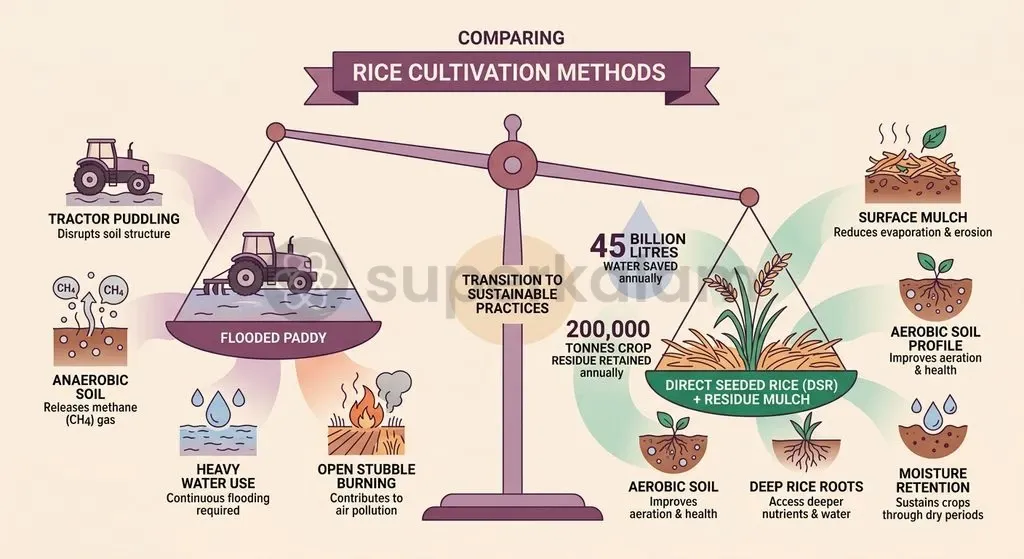
Participating farmers adopted integrated conservation practices that addressed the structural ecological crises plaguing northwest India. The primary agronomic interventions focused on replacing conventional puddled transplanting with Direct Seeded Rice (DSR), adopting low-tillage seeders for wheat sowing, and eliminating paddy stubble burning.
The environmental dividends of this transition extended beyond carbon sequestration. The Indian Council of Agricultural Research documented that participating farms conserved 45 billion litres of groundwater and prevented over 200,000 tonnes of crop residue from open-field burning, preventing approximately 1,000 tonnes of particulate matter (PM2.5) air pollution.
Grow Indigo structured the commercial transactions by contracting a 75% net carbon revenue share directly to participating farmers, providing upfront fixed payments to insulate smallholders against volatile voluntary market settlement cycles.
Discuss with Superkalam
Explain how Alternate Wetting and Drying (AWD) suppresses methane emissions while maintaining crop productivity.
Ask NowRegenerative Practices Behind the Credits: DSR, AWD, and Residue Management
Agronomic practices eligible for carbon credits alter the biological and chemical dynamics of the soil-rhizosphere interface to prevent methane and nitrous oxide emissions. Conventional paddy cultivation relies on prolonged submergence, which creates anaerobic soil conditions where methanogenic bacteria generate severe methane emissions.
The core regenerative techniques driving agricultural carbon generation include:
- Direct Seeded Rice (DSR): Rice seeds are sown directly into non-puddled fields using specialized seed drills, bypassing wet nursery preparation and field puddling. This eliminates anaerobic decomposition, reducing field methane generation while conserving soil structure.
- Alternate Wetting and Drying (AWD): Intermittent field flooding allows the soil to aerate periodically between irrigation cycles. This aerobic phase disrupts methanogenic pathways, cutting irrigation water demand without suppressing grain yields.
- In-Situ Residue Management: Retaining crop stubble as surface mulch via machines like the Happy Seeder incorporates organic plant biomass into the topsoil, raising soil organic carbon stocks while suppressing weed growth.
Comparing Traditional Farming vs Carbon Farming Models
The transition from input-intensive cultivation to carbon farming requires structural changes across field operations, resource consumption, and financial remuneration mechanisms.
| Feature / Dimension | Conventional Cultivation (Paddy-Wheat) | Carbon Farming Model (Regenerative) |
|---|---|---|
| Tillage & Land Preparation | Deep intensive tillage and wet field puddling | Zero to minimal tillage; direct drilling into residue |
| Water Management | Continuous flooded inundation (5–7 cm) | Direct Seeded Rice and Alternate Wetting and Drying |
| Crop Residue Handling | Open-field burning of paddy stubble | Surface retention, in-situ mulching, and zero burning |
| Soil Organic Carbon (SOC) | Gradual depletion due to oxidation and erosion | Progressive sequestration in the top 30 cm soil profile |
| Primary Revenue Driver | Minimum Support Price (MSP) and physical yield | Physical crop yield plus carbon offset revenue streams |
| Environmental Footprint | High methane emissions; severe groundwater drawdown | Lowered greenhouse gas emissions; significant water savings |
Discuss with Superkalam
How can Farmer Producer Organisations (FPOs) apply aggregation models to overcome the high fixed costs of carbon MRV for marginal farmers?
Ask NowMajor Challenges: Verification, High Costs, and Governance Risks
Measurement, Reporting, and Verification (MRV) expenditures constitute the largest technical barrier to smallholder carbon market participation. Traditional physical soil coring to a depth of 30 cm requires intensive field sampling, cold-chain transport, and laboratory chemical analysis, creating prohibitively high transaction overheads for plots under two hectares.
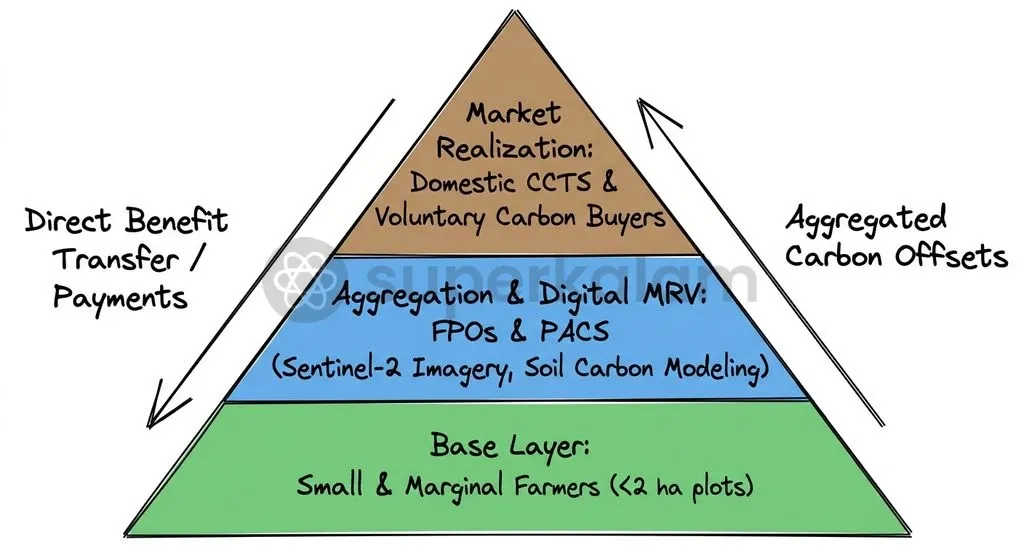
To overcome this constraint, research by ICAR-IARI confirms that digital MRV (dMRV) systems—which integrate Sentinel-2 multispectral satellite imagery with process-based biogeochemical models such as DNDC—can lower verification costs by up to 90% compared to dense soil coring.
Beyond technological hurdles, agricultural carbon projects face critical regulatory and integrity challenges:
- Additionality Verification: International registries such as Verra require developers to demonstrate that carbon-sequestering practices exceed statutory baselines and have a regional adoption rate below 20%.
- Permanence and Reversal Risks: Sequestered soil carbon faces reversal risks if smallholders return to conventional tillage, burning, or prolonged flooding during subsequent seasons due to tenancy changes or market shocks.
- Governance and Corporate Capture: While Grow Indigo’s 75% payout mirrors global smallholder benchmarks of 60% to 80% (such as Indigo Ag in the US at 75% and Rabobank/Acorn at up to 80%), unequal bargaining power remains an issue. Without statutory floor price protections, private aggregators retain unilateral price-setting power over voluntary credit sales, leaving smallholders vulnerable to contractual opacity.
India's Regulatory Framework: Carbon Credit Trading Scheme (CCTS) and Green Credit Programme
The Parliament of India established the statutory foundation for domestic carbon markets by amending the Energy Conservation Act, 2001. Specifically, Section 14(w)—introduced via the Energy Conservation (Amendment) Act, 2022—empowers the Central Government to specify a Carbon Credit Trading Scheme (CCTS) and authorize the issuance of Carbon Credit Certificates.
In June 2023, the Ministry of Power formally notified the Carbon Credit Trading Scheme (CCTS), managed by the Bureau of Energy Efficiency (BEE) as the administrative agency. To broaden market participation beyond obligated industrial entities, the Ministry introduced an Offset Mechanism in December 2023. This framework permits non-obligated sectors, including agriculture, forestry, and waste management, to register decarbonisation projects and generate registered offset credits.
Parallel to the CCTS, the Ministry of Environment, Forest and Climate Change (MoEFCC) notified the Green Credit Programme (GCP) under the Environment (Protection) Act, 1986. While the GCP incentivises voluntary, non-carbon environmental actions (such as water harvesting and afforestation) using activity-based green credits, the CCTS operates as India's primary domestic carbon market accounting for greenhouse gas mitigation.
Discuss with Superkalam
Analyse the trade-offs between physical laboratory soil testing and satellite-based digital MRV (dMRV) regarding accuracy, cost, and smallholder inclusivity.
Ask NowWay Forward: Scaling Carbon Markets for Small and Marginal Farmers
Farmer Producer Organisations (FPOs) and Primary Agricultural Credit Societies (PACS) serve as the primary institutional vehicles to aggregate fragmented landholdings, negotiate fair contracts, and eliminate intermediary rent-seeking in carbon finance.
A forward-looking policy roadmap requires targeted interventions across technical and governance domains:
- Statutory Floor Pricing: Policymakers should establish a regulatory minimum revenue floor for farm-level carbon sales within the domestic CCTS offset market, ensuring smallholders receive transparent compensation tied to prevailing global indices.
- Open-Access Digital MRV Infrastructure: The Indian Council of Agricultural Research and the Ministry of Agriculture should deploy standardized, calibrated digital MRV tools, providing open-source biogeochemical baselines to lower validation expenses for FPOs.
- Contractual Transparency Standards: The Ministry of Agriculture and Farmers Welfare must institute model carbon-farming contract guidelines to prevent predatory lock-in clauses, clarify data ownership, and establish clear dispute-resolution mechanisms.
- Stacking Environmental Rewards: State agricultural departments should align state subsidies (such as DSR promotional assistance) with carbon finance, allowing smallholders to stack ecosystem payments for water conservation, stubble avoidance, and soil health improvement.
Key Takeaways
- Historic Milestone: In September 2026, 2,550 farmers across Punjab and Haryana received India's first soil carbon payments of ₹2.5 to ₹2.9 crore via Direct Benefit Transfer.
- Agronomic Driver: The payouts stem from 50,000 verified credits under Verra VM0042, achieved through Direct Seeded Rice, no-till wheat, and the complete elimination of stubble burning across 30,000 acres.
- Resource Conservation: The project saved 45 billion litres of groundwater and prevented the burning of 200,000 tonnes of crop residue, abating roughly 1,000 tonnes of PM2.5 air pollution.
- Enabling Legislation: Section 14(w) of the Energy Conservation Act, 2001 (inserted via the 2022 Amendment) provides the statutory basis for India's Carbon Credit Trading Scheme (CCTS) and its voluntary offset mechanism.
- Technology Dividend: Digital MRV frameworks using Sentinel-2 multispectral satellite data and biogeochemical models reduce verification costs by up to 90% relative to physical soil coring.
- Policy Imperative: leaves smallholders exposed to aggregator price-setting power, underscoring the need for institutional aggregation via FPOs and PACS.
Mains Question
The integration of voluntary carbon markets into Indian agriculture offers twin dividends of ecological restoration and supplementary farm income. In the light of the 'Aadi' project experience in northwest India, examine the viability of scaling agricultural carbon credits for smallholder farmers. (10 Marks)
Evaluate NowMains Question
"Without robust regulatory oversight and cost-effective digital verification, market-driven agricultural carbon finance risks intermediary capture and high transaction failure." Critically analyse this statement in the context of the Carbon Credit Trading Scheme (CCTS) and voluntary carbon markets. (15 Marks)
Evaluate NowPractice MCQs
QUESTION 1
With reference to agricultural soil carbon credits and international voluntary carbon standards (such as Verra's VM0042 methodology), consider the following statements:
- One agricultural carbon credit corresponds to one metric tonne of carbon dioxide equivalent sequestered or avoided.
- Soil sampling protocols under VM0042 require physical soil core extraction to a minimum depth of 30 cm to quantify changes in mineral soil organic carbon stocks.
- To establish additionality under international registry standards, the regional adoption rate of the carbon-sequestering practice must be below 20%.
Which of the statements given above are correct?
QUESTION 2
Consider the following statements regarding regenerative agronomic practices used in carbon farming:
- Direct Seeded Rice (DSR) reduces field methane emissions by avoiding prolonged anaerobic decomposition associated with wet field puddling.
- Alternate Wetting and Drying (AWD) aerates the soil periodically to disrupt methanogenic pathways without reducing grain yields.
- In-situ residue retention using zero-tillage machinery suppresses weed growth while increasing soil organic carbon stocks.
Which of the statements given above is/are correct?
QUESTION 3
Regarding the institutional and statutory architecture of carbon markets in India, consider the following statements:
- The statutory basis for the domestic Carbon Credit Trading Scheme (CCTS) was established by amending the Energy Conservation Act, 2001.
- Section 14(w) of the Energy Conservation (Amendment) Act, 2022 empowers the Central Government to specify the Carbon Credit Trading Scheme.
- The Bureau of Energy Efficiency (BEE) functions as the administrative agency managing the Carbon Credit Trading Scheme.
Which of the statements given above are correct?
QUESTION 4
Consider the following statements regarding digital Measurement, Reporting, and Verification (dMRV) in agricultural carbon farming:
- dMRV integrates multispectral satellite imagery with process-based biogeochemical models such as DNDC.
- Research by ICAR-IARI indicates that dMRV can reduce verification expenditures by up to 90% compared to dense physical soil core sampling.
Which of the statements given above is/are correct?
QUESTION 5
Under the 'Aadi' project in Punjab and Haryana, which commercial revenue-sharing model was adopted to protect smallholders from voluntary carbon market volatility?