Agnikul Reusable Rocket: Inside the ₹200 Cr TDB Catalytic Deal
By backing Agnikul Cosmos with ₹200 crore in patient capital, India bridges the commercialisation gap to build sovereign, reusable orbital launch capability.
Sep, 2026
•8 min read

Overview
The Technology Development Board under the Department of Science and Technology has committed ₹200 crore to Agnikul Cosmos. This capital backs India's first fully reusable commercial launch vehicle. The move marks a strategic transition in Indian spacetech, moving state support from purely regulatory enablement to patient, non-dilutive catalytic financing.
Structured as Optionally Convertible Debentures, the assistance bridges the commercialisation gap between prototype demonstration and full orbital deployment. It directly accelerates deep-tech manufacturing, drives down per-kilogram launch costs to Low Earth Orbit, and supports India's push for a larger footprint in the global space economy.
Why in the News? The ₹200 Crore TDB-Agnikul Agreement
The Technology Development Board (TDB), operating under the Department of Science and Technology, has signed an agreement with private spacetech startup Agnikul Cosmos. Under the Research Development and Innovation (RDI) Fund, the board will provide ₹200 crore in financial assistance, according to a Press Information Bureau (PIB) Press Release.
As of September 2026, this commitment stands among the largest state-backed funding packages for an Indian private launch vehicle developer. Key parameters of the assistance include:
- Financing Structure: Capital is deployed via Optionally Convertible Debentures (OCDs), providing long-term debt that can convert into equity at a future valuation trigger without diluting early equity.
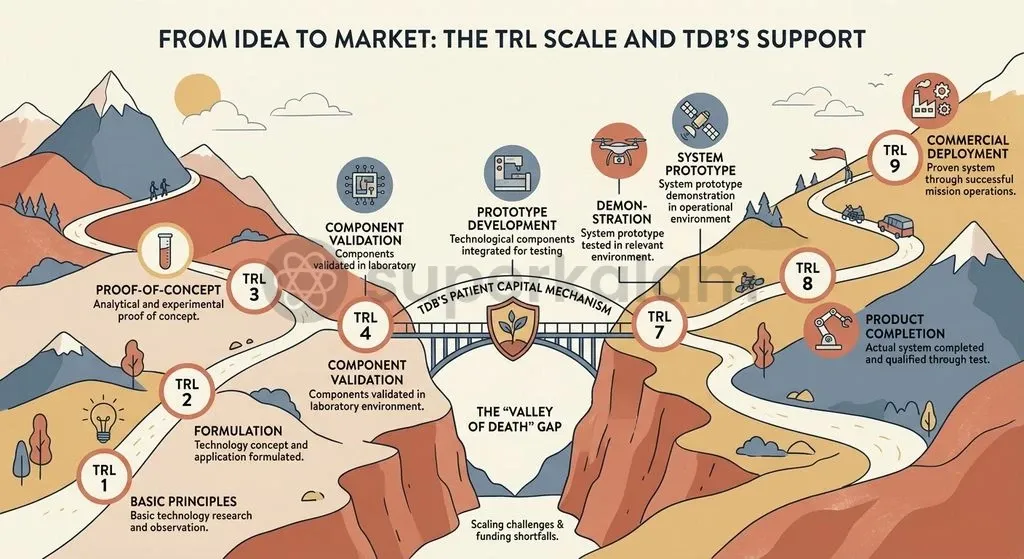
- Target Readiness: The initiative specifically funds the progression of Agnikul's fully reusable launch vehicle platform (Agnibaan RLV) from Technology Readiness Level (TRL) 4+ to TRL 8.
- Flight Maturation: Funding takes the technology from laboratory component validation (TRL 4) to operational flight qualification (TRL 8).
Discuss with Superkalam
Recall the propellant combination used by Agnikul's 3D-printed Agnilet engine.
Ask NowWhat is Agnikul Cosmos and the Agnibaan Launch Vehicle?
Agnikul Cosmos is an Indian private launch vehicle developer incubated at the Indian Institute of Technology (IIT) Madras. The startup recorded a major milestone on 30 May 2024 by conducting the suborbital maiden test flight of Agnibaan SOrTeD (Sub-Orbital Technology Demonstrator). The mission launched from its private launchpad, Dhanush (ALP-01), at SDSC-SHAR in Sriharikota, as detailed in a Press Information Bureau (PIB) Press Release.
The operational Agnibaan orbital launch vehicle is configured as a modular, two-stage rocket with distinct mission capabilities:
- Payload Capacity: Delivers 30 kg to 300 kg into a 700 km Low Earth Orbit (LEO) to support small-satellite constellations.
- Mobile Launch Infrastructure: Supports rapid deployment across multiple launch sites, avoiding ground-pad queuing bottlenecks for commercial operators.
- Customisable Architecture: Configurable stages match varied small-satellite orbital profiles.
Key Innovations: The Single-Piece 3D-Printed Engine and Reusability
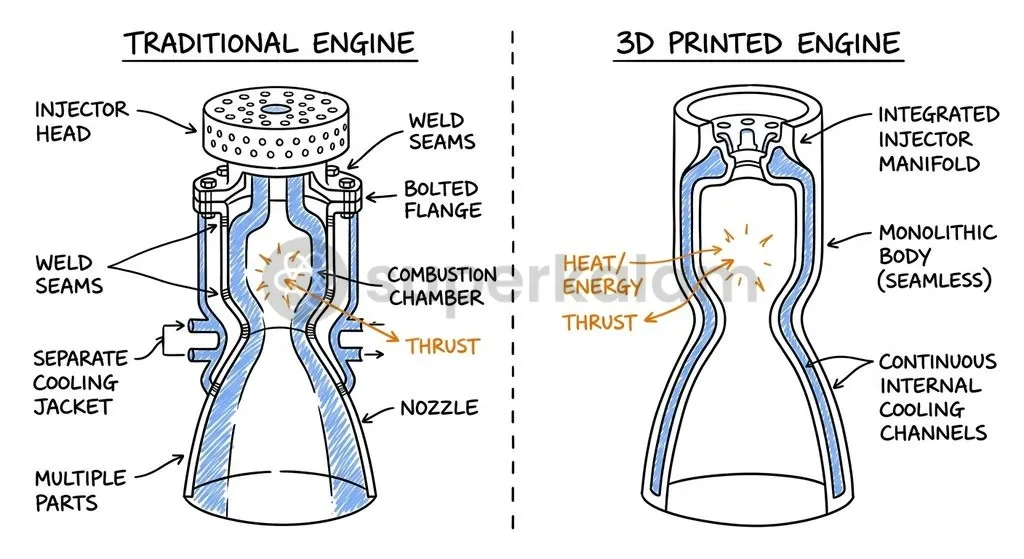
The propulsion backbone of the platform is the Agnilet engine. It is the world's first single-piece, patented 3D-printed semi-cryogenic engine flown in an active flight vehicle, according to a Press Information Bureau (PIB) Press Release. The power plant burns a propellant blend of liquid oxygen (LOX) and aviation turbine fuel (ATF).
Discuss with Superkalam
Explain how monolithic 3D printing of rocket engines reduces points of mechanical failure compared to traditional manufacturing.
Ask NowConventional rocket engines combine thousands of precision components joined by brazing and welding. In contrast, Agnikul produces Agnilet as an integrated monolithic structure using metal additive manufacturing, unlocking key engineering benefits:
- Monolithic Additive Manufacturing: Eliminates mechanical joints, prevents assembly failure points, and cuts manufacturing lead times from months to days.
- Full-System Reusability: Recovers both the booster and upper stages rather than only the first stage.
- Debris Mitigation: Embeds active space debris limitation mechanisms during stage separation and re-entry.
The Role of the Technology Development Board in High-Risk Tech R&D
The Technology Development Board is a statutory body established under the Technology Development Board Act, 1995 to promote the commercialisation of indigenous research and adapt imported technology. Constituted under the Department of Science and Technology, TDB acts as an institutional bridge between scientific laboratories and commercial markets.
Under Section 6 of the Technology Development Board Act, 1995, the Board holds the mandate to offer equity capital, soft loans, or other financial assistance to commercial entities scaling indigenous innovations. Deep-tech space ventures require extensive upfront capital and prolonged testing cycles:
- Overcoming the Valley of Death: Domestic venture capital often avoids long gestation periods, leaving verified prototypes unfunded before commercialisation.
- State-Backed Patient Capital: Absorbs early technical risks while keeping founder equity intact.
- International Precedent: Follows milestone-based public financing models like NASA's Commercial Orbital Transportation Services (COTS) programme.
Institutional Reforms: How IN-SPACe and the Space Policy 2023 Power Private Space
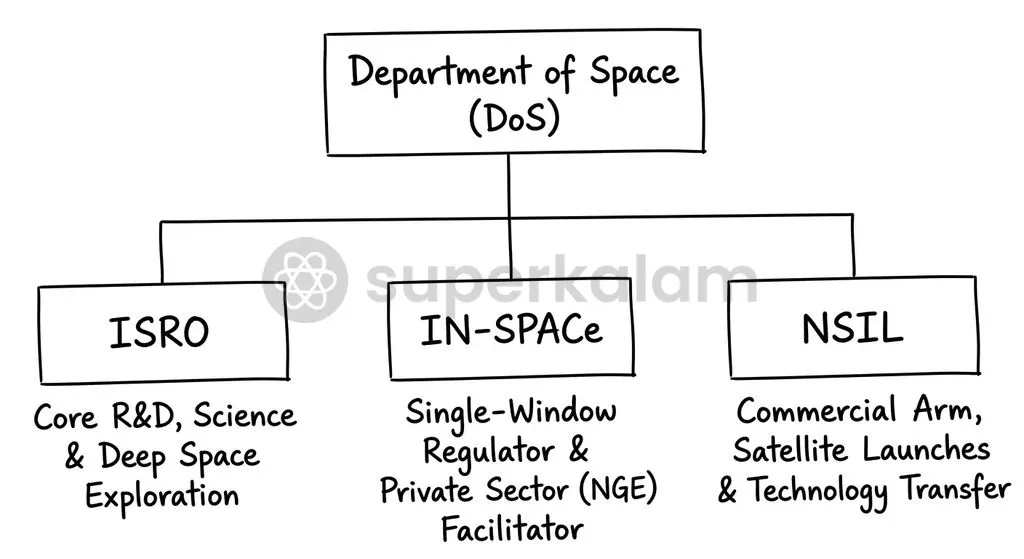
The opening of India's space ecosystem stems from structural directives in the Indian Space Policy 2023, notified by the Department of Space. The policy introduced a clear tripartite division of responsibilities across the national space sector:
- Indian Space Research Organisation (ISRO): Focuses primarily on advanced scientific research, deep-space exploration, and frontier technology development.
- Indian National Space Promotion and Authorization Center (IN-SPACe): Serves as the single-window, autonomous regulatory and promotional agency for Non-Government Entities (NGEs).
- NewSpace India Limited (NSIL): Functions as the commercial arm of the Department of Space, managing commercial launch operations and industrial production of mature systems.
To complement this framework, the Union Cabinet revised the FDI Policy for the space sector in 2024 to facilitate foreign investment. The updated rules allow up to 74% foreign direct investment under the automatic route for satellite manufacturing, satellite data products, and ground segments. For launch vehicles and spaceports, foreign investment is permitted up to 49% under the automatic route, requiring government clearance beyond that threshold.
These policy changes remove entry barriers for private launch companies. Agnikul constructed its Dhanush launchpad inside ISRO's Sriharikota spaceport under an IN-SPACe infrastructure-sharing agreement, illustrating effective public-private technological cooperation.
Discuss with Superkalam
How can private launch developers utilize the revised 2024 FDI limits to scale capital-intensive manufacturing facilities in India?
Ask NowComparing Traditional Expendable Launchers with Reusable Systems
Reusable launch systems transform launch economics by distributing vehicle production costs across multiple missions. Partially reusable launch systems like SpaceX's Falcon 9 have reduced heavy-lift launch costs to approximately $2,500–$3,000 per kilogram to Low Earth Orbit, benchmarked against historical expendable costs exceeding $10,000–$50,000/kg.
| Dimension | Traditional Expendable Launchers | Partially Reusable Launchers | Fully Reusable Launchers (Target Architecture) |
|---|---|---|---|
| Stage Recovery | No recovery; stages burn up in atmosphere or crash | First stage recovered; upper stage expended | Both first and upper stages recovered and refurbished |
| Manufacturing Turnaround | New vehicle fabricated for every launch | Booster refurbished; new upper stage built per flight | Minimal fabrication between launches; rapid turnaround |
| Propellant Cost vs Vehicle Cost | Vehicle hardware constitutes >90% of launch cost | Hardware write-off reduced; upper stage cost remains | Propellant and refurbishment dominate operating costs |
| Payload Fraction to LEO | Maximum (~3–4% of gross lift-off mass) | Reduced (~1.5–2.5% due to recovery hardware) | Lowest payload fraction due to dual recovery systems |
| Orbital Debris Impact | Upper stages remain as orbital space debris | Upper stage remains unless de-orbited actively | Active stage de-orbiting limits orbital debris accumulation |
| Operational Benchmark | Polar Satellite Launch Vehicle (PSLV) | Falcon 9; ISRO RLV-LEX series | Agnikul Agnibaan RLV (target development) |
Alongside private sector efforts, ISRO has tested autonomous high-speed approach and runway landing capabilities for winged reusable vehicles. These milestones were achieved through the completion of the RLV-LEX-01, LEX-02, and LEX-03 landing experiments at the Aeronautical Test Range in Chitradurga, Karnataka, as reported in an ISRO Official Press Release.
Core Challenges: Capital Intensity, Testing Infrastructure, and Market Access
Despite policy reforms, Indian spacetech startups encounter persistent operational bottlenecks, according to NITI Aayog & IN-SPACe Sectoral Consultation Reports on NewSpace Ecosystem:
- High Capital Expenditure and Gestation: Launch vehicle development requires multi-year testing regimes prior to securing flight heritage and space qualification.
- Testing Infrastructure Bottlenecks: Startups remain reliant on specialised ISRO test facilities for hot-fire propulsion tests and high-altitude simulations.
- Dual-Use Export Regulations: International commercial expansion requires compliance with strict dual-use trade regimes, including Missile Technology Control Regime (MTCR) guidelines.
- Unit Economic Trade-offs: Dedicated small launchers carry higher baseline launch costs (averaging $20,000 to $25,000/kg as reported in aerospace launch studies) than bulk rideshare missions, requiring high launch frequency to stay competitive.
Way Forward: Building a Global Space Tech Hub in India
India's strategic roadmap, set out in the Indian Space Policy and the IN-SPACe decadal vision, seeks to expand the country's share of the global commercial space economy from approximately 2% to 8–10% by 2033. Realising this vision requires targeted institutional actions:
- Expanding Blended Finance Mechanisms: Institutionalising venture debt, soft loans, and milestone-linked TDB debenture models to support deep-tech startups across the TRL 5 to TRL 8 transition.
- Anchor Government Procurement: Transitioning state agencies toward procurement contracts for private small-satellite launch services, guaranteeing baseline domestic demand.
- Dedicated Private Test Ranges: Establishing independent static-test stands and offshore mobile recovery infrastructure to reduce testing queues at ISRO facilities.
- Standardised Space Insurance: Creating domestic space-insurance frameworks and underwriting pools to lower the cost of orbital risk coverage for private missions.
Discuss with Superkalam
Analyse the trade-offs between dedicated small launch vehicles and bulk rideshare missions in terms of unit economics and orbital customization.
Ask NowKey Takeaways
- The Technology Development Board (TDB) under the Department of Science and Technology has committed ₹200 crore to Agnikul Cosmos via Optionally Convertible Debentures (OCDs) under the RDI Fund.
- The project targets advancing the Agnibaan RLV from Technology Readiness Level (TRL) 4+ to TRL 8, focusing on full-system reusability and debris limitation.
- Agnikul's Agnilet propulsion system is the world's first single-piece, patented 3D-printed semi-cryogenic engine flown in a flight vehicle.
- TDB operates under Section 6 of the Technology Development Board Act, 1995, providing patient risk capital to overcome the deep-tech "valley of death".
- The Indian Space Policy 2023 and 2024 FDI amendments (allowing 49% automatic FDI in launch vehicles and 74% in satellite systems) underpin private space expansion toward capturing an 8–10% global market share by 2033.
Mains Question
"Bridging the 'Valley of Death' in deep-tech sectors requires a shift from mere regulatory enablement to patient, risk-absorbing state financing." In light of the Technology Development Board's support for commercial reusable launch vehicles, evaluate the role of public catalytic funding in advancing India's private space industry. (10 Marks)
Evaluate NowMains Question
The Indian Space Policy 2023 and recent FDI reforms aim to expand India's share of the global commercial space economy from 2% to 8–10% by 2033. Critically analyse the institutional architecture and operational challenges facing private launch vehicle developers in achieving this target. (15 Marks)
Evaluate NowPractice MCQs
QUESTION 1
With reference to the Indian Space Policy 2023 and private sector participation in the space economy, consider the following statements:
- The Indian Space Research Organisation (ISRO) focuses primarily on advanced scientific research, deep-space exploration, and frontier technology development.
- IN-SPACe serves as the autonomous regulatory and promotional agency for Non-Government Entities (NGEs).
- NewSpace India Limited (NSIL) is mandated to provide non-dilutive catalytic financing directly through Optionally Convertible Debentures (OCDs). Which of the statements given above are correct?
QUESTION 2
Regarding the Agnilet rocket engine developed by Agnikul Cosmos, consider the following statements:
- It is a single-piece, 3D-printed semi-cryogenic engine produced using monolithic additive manufacturing.
- It burns a propellant combination of liquid oxygen (LOX) and aviation turbine fuel (ATF).
- The monolithic design introduces multiple brazed joints to enhance stage structural rigidity. Which of the statements given above is/are correct?
QUESTION 3
With reference to India's 2024 Foreign Direct Investment (FDI) regulations in the space sector, consider the following statements:
- Up to 74% FDI is allowed under the automatic route for satellite manufacturing, satellite data products, and ground segments.
- For launch vehicles and spaceports, FDI is permitted up to 49% under the automatic route, requiring government approval beyond that threshold. Which of the statements given above is/are correct?
QUESTION 4
Consider the following statements comparing traditional expendable launch vehicles with reusable launch systems:
- Traditional expendable launch vehicles exhibit a higher payload fraction to Low Earth Orbit (LEO) compared to fully reusable systems.
- Fully reusable launch systems eliminate all operating and propellant costs during post-flight turnaround.
- Active de-orbiting and stage recovery mechanisms help mitigate the accumulation of orbital space debris. Which of the statements given above are correct?
QUESTION 5
The Technology Development Board (TDB), which provides financial assistance to commercial entities scaling indigenous innovations, is a statutory body established under which of the following?