Election Commissioners Act 2023 vs Anoop Baranwal Ruling Explained
How replacing the Chief Justice of India with a Cabinet Minister in election commissioner appointments tests institutional autonomy and separation of powers.
Sep, 2026
•10 min read

Overview
The Chief Election Commissioner and Other Election Commissioners Act, 2023 altered India's electoral governance. It established a statutory Selection Committee comprising the Prime Minister, a Union Cabinet Minister, and the Leader of the Opposition. Enacted under Article 324(2) of the Constitution of India, this statutory mechanism replaced the interim judicial formula laid down by the Supreme Court of India in Anoop Baranwal v. Union of India (2023), which had included the Chief Justice of India to insulate the watchdog from executive pre-eminence.
By substituting the Chief Justice of India with a government-nominated Cabinet Minister, the legislation creates an executive majority in selecting election commissioners. This shift has triggered constitutional challenges around institutional independence, the separation of powers, and the guarantee of free and fair elections.
Why in the News? The Supreme Court's Reference to a Constitution Bench
The Supreme Court of India placed constitutional challenges against the Chief Election Commissioner and Other Election Commissioners Act, 2023 before the Chief Justice of India under Article 145(3). This development followed a split opinion delivered by a two-judge bench in Dr. Jaya Thakur & Ors. v. Union of India, as reported on 23 September 2026.
Petitions filed by the Association for Democratic Reforms (ADR) and Dr. Jaya Thakur contend that excluding the Chief Justice of India creates a structural conflict of interest that violates the basic structure doctrine. As of September 2026, the reference brings the constitutional friction between parliamentary legislative competence and institutional autonomy back before the judiciary.
Discuss with Superkalam
What are the eligibility criteria and tenure terms specified for Election Commissioners under Sections 5 and 9 of the 2023 Act?
Ask NowHow Election Commissioners Were Appointed Before 2023
Article 324(2) of the Constitution of India originally vested the appointment of the Chief Election Commissioner (CEC) and other Election Commissioners (ECs) in the President, subject to any law enacted by Parliament. Despite constitutional framers envisaging a dedicated legislative framework, Parliament did not enact an appointment statute for over seven decades.
Executive discretion governed all appointments to the Election Commission of India (ECI) between 1950 and 2023. The Union Council of Ministers, headed by the Prime Minister, tendered binding advice to the President under Article 74. This practice gave the incumbent political executive sole authority over appointments.
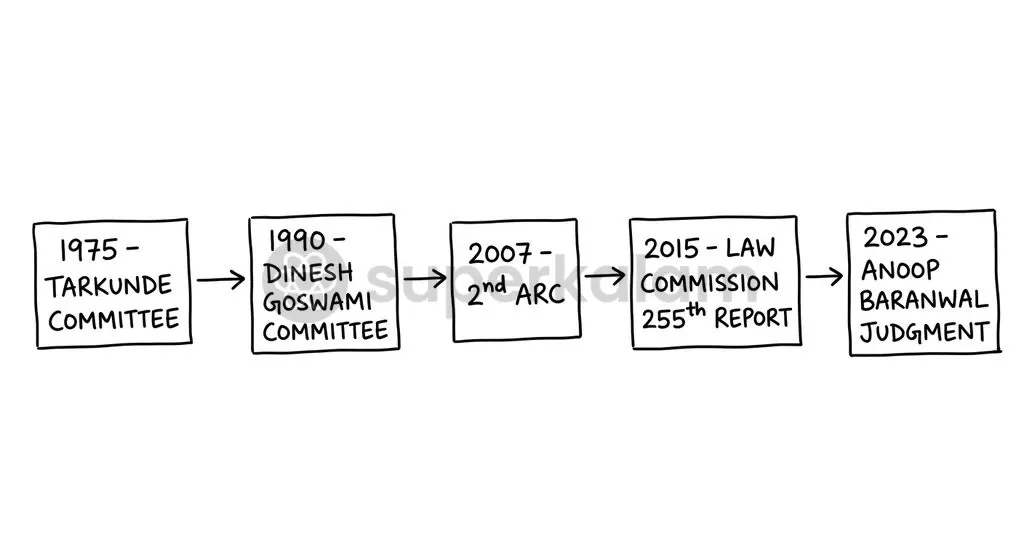
Successive reform committees cautioned against unchecked executive appointments across five decades:
- The Tarkunde Committee (1975): Recommended that ECI members be appointed on the advice of a committee comprising the Prime Minister, the Leader of the Opposition in the Lok Sabha, and the Chief Justice of India.
- The Dinesh Goswami Committee (1990): Proposed statutory consultation with the Chief Justice of India and the Leader of the Opposition for CEC appointments.
- The Second Administrative Reforms Commission (2007): Recommended in its 4th Report a broad collegium including the Prime Minister, Lok Sabha Speaker, Leader of the Opposition in Lok Sabha, Law Minister, and the Deputy Chairman of the Rajya Sabha.
- The Law Commission of India (2015): Advocated in its 255th Report a tripartite collegium comprising the Prime Minister, the Leader of the Opposition, and the Chief Justice of India.
The Landmark Anoop Baranwal Judgment (2023): What the Supreme Court Mandated
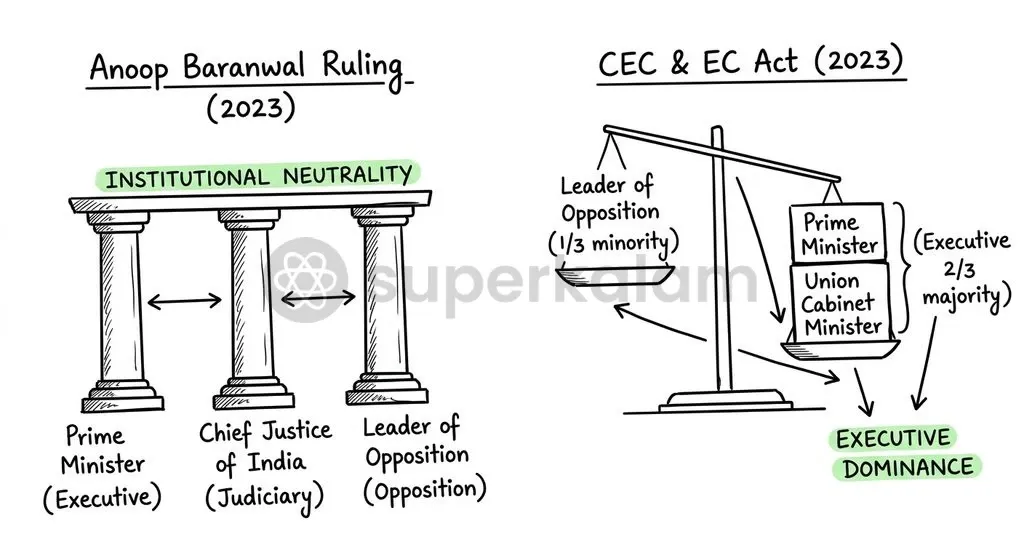
A five-judge Constitution Bench in Anoop Baranwal v. Union of India established an interim tripartite collegium to select the Chief Election Commissioner and Election Commissioners 9 S.C.R. 1 / 2023 INSC 190]. The bench ruled on 2 March 2023 that appointments must be made on the advice of a committee consisting of the Prime Minister, the Leader of the Opposition in the Lok Sabha (or leader of the single largest opposition party), and the Chief Justice of India.
Constitutional bench judges observed that the Election Commission must remain insulated from executive control to preserve free and fair elections, which form an integral part of the basic structure of the Constitution 9 S.C.R. 1 (Para 239)]. The Supreme Court clarified that this collegium mechanism was an interim measure designed to fill a legislative vacuum until Parliament exercised its constitutional power under Article 324(2) to enact a dedicated law.
Discuss with Superkalam
Explain how replacing the Chief Justice of India with a Union Cabinet Minister changes the voting balance within the Selection Committee.
Ask NowThe 2023 Act: Key Provisions and Selection Committee Composition
The Chief Election Commissioner and Other Election Commissioners (Appointment, Conditions of Service and Term of Office) Act, 2023 received Presidential assent on 28 December 2023 and entered into force on 2 January 2024. The statute enacted a formal process governing qualifications, selection, tenure, and operational conditions for members of the commission.
Institutional machinery under the 2023 Act operates through two distinct committees:
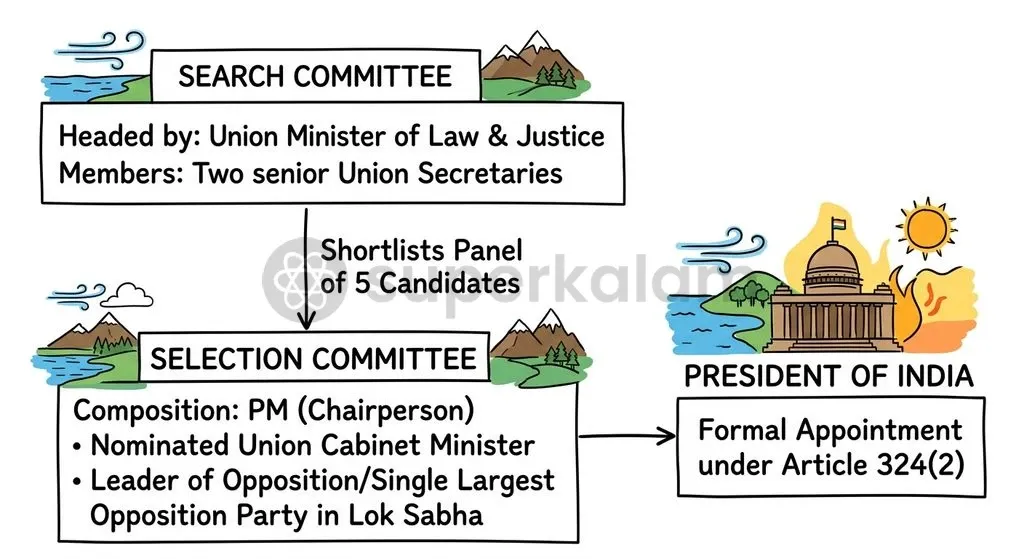
- The Search Committee (Section 6): Chaired by the Minister of Law and Justice and comprising two other members not below the rank of Secretary to the Government of India, this body prepares a shortlisted panel of five candidates.
- The Selection Committee (Section 7(1)): Chaired by the Prime Minister, with the Leader of the Opposition (or leader of the single largest opposition party in the Lok Sabha) and a Union Cabinet Minister nominated by the Prime Minister serving as members.
Procedural flexibility is granted under Section 8(2), which permits the Selection Committee to regulate its own procedure and consider candidates outside the Search Committee's shortlisted panel. Section 5 restricts eligibility to individuals holding or having held a post equivalent to Secretary to the Government of India with relevant administrative experience.
Tenure and service conditions are codified under Sections 9 and 10 of the Act. Section 9 provides a term of six years or until attaining the age of sixty-five years, whichever is earlier, with an explicit bar on reappointment. Section 10 aligns the salary, allowances, and conditions of service of the CEC and ECs with those of a Supreme Court Judge.
Comparison: Pre-2023 vs Anoop Baranwal vs 2023 Act
Electoral watchdog appointments in India have evolved across three distinct institutional frameworks spanning executive discretion, judicial collegium mandates, and statutory selection committees. Understanding these structural shifts is vital for analysing constitutional autonomy and institutional balance.
| Dimension | Pre-2023 Mechanism (Executive Convention) | Anoop Baranwal Ruling (2023 Interim Collegium) | The 2023 Act (Statutory Scheme) |
|---|---|---|---|
| Legal Basis | Article 324(2) read with Article 74 (Executive Discretion) | Supreme Court Judgment under Article 142 / Article 324(2) 9 S.C.R. 1 / 2023 INSC 190] | Statutory Enactment (Act No. 49 of 2023) |
| Selection Body | Union Council of Ministers (Aided and advised the President) | Tripartite Collegium: PM, Leader of Opposition, and Chief Justice of India | Tripartite Committee: PM, Cabinet Minister, and Leader of Opposition |
| Executive Voting Balance | Exclusively executive-driven | Balanced (1 Executive, 1 Opposition, 1 Neutral Judiciary) | Executive Majority (2 Government votes vs 1 Opposition vote) |
| Search Mechanism | Internal civil-service consultations (No statutory rules) | Not formally codified in the judicial ruling | Statutory Search Committee headed by Law Minister |
| Candidate Sourcing | Informal bureaucratic selection | Informal panel considered by Collegium | Five-member panel; committee may also consider persons outside the panel |
| Tenure Safeguards | Article 324(5) provisos | Article 324(5) provisos affirmed | 6 years or 65 years of age; no reappointment permitted |
Removal protections remain asymmetrical under constitutional provisions. Under the first proviso to Article 324(5), the Chief Election Commissioner cannot be removed except through impeachment in like manner and on like grounds as a Supreme Court Judge.
In contrast, the second proviso to Article 324(5) provides that other Election Commissioners can be removed on the recommendation of the CEC. In T.N. Seshan v. Union of India (1995), the Supreme Court clarified that despite this procedural removal difference, the CEC possesses equal voting power with other commissioners in institutional decision-making 4 SCC 611 / 1995 INSC 321].
Discuss with Superkalam
How does Section 8(2) of the 2023 Act, which permits considering candidates outside the Search Committee panel, impact administrative transparency?
Ask NowThe Core Legal Dilemma: Executive Dominance vs Institutional Independence
Petitions before the Supreme Court of India argue that a government-dominated selection panel compromises the institutional independence required for conducting free and fair elections. The central challenge raised by ADR and Dr. Jaya Thakur turns on whether legislative competence under Article 324(2) is subject to the basic structure doctrine.
Institutional autonomy sits at the centre of this dispute. Petitioners argue that replacing the Chief Justice of India with a Union Cabinet Minister creates a 2:1 government majority, reducing the Leader of the Opposition's role to a procedural formality.
Parliamentary competence forms the counter-position grounded in constitutional text. Article 324(2) specifically empowers Parliament to frame appointment laws. Proponents maintain that judicial substitution of executive panels undermines the separation of powers.
Key Arguments: For and Against Excluding the Chief Justice of India
The constitutional debate over excluding the Chief Justice of India balances parliamentary legislative competence against the imperative of independent electoral oversight. Both sides anchor their positions in established constitutional jurisprudence.
Arguments in Favour of the 2023 Statutory Composition
- Constitutional Textualism: Article 324(2) expressly delegates the appointment process to parliamentary legislation, affirming parliamentary legislative prerogative.
- Separation of Powers: Selecting administrative and regulatory watchdogs is fundamentally an executive function, making direct judicial membership in selection panels a potential conflict with judicial review duties.
- Compliance with Judicial Limits: The five-judge bench in Anoop Baranwal explicitly designated its collegium as an interim measure operating only until Parliament enacted a law 9 S.C.R. 1 / 2023 INSC 190].
Arguments Against Excluding the Chief Justice of India
- Structural Imbalance: A three-member panel featuring two sitting government representatives entrenches built-in executive predominance during the selection process.
- Departure from Reform Consensus: Decades of expert committee recommendations—including the Tarkunde (1975), Goswami (1990), and Law Commission 255th Reports—recommended including the Chief Justice of India to guarantee multi-partisan trust.
- Erosion of Checks and Balances: Electoral commissions oversee ruling parties during polls, making independent selection mechanisms essential to prevent institutional capture.
Discuss with Superkalam
Evaluate whether an executive majority in the appointment committee undermines the constitutional guarantee of free and fair elections.
Ask NowEthical Dimensions: Impartiality, Public Trust, and Democratic Legitimacy
Ethical governance principles dictate that democratic institutions rely fundamentally on the perception of institutional neutrality and the integrity of electoral processes. An election watchdog must not only act impartially but must also be seen by the electorate as free from partisan influence.
The ethical doctrine of nemo judex in causa sua (no one should be a judge in their own cause) applies directly to electoral regulation. When a political executive contesting elections retains decisive control over appointing its own umpire, it undermines the perception of neutrality. Public confidence in democratic outcomes requires election watchdogs to operate with demonstrable autonomy from all political contestants.
Discuss with Superkalam
Suggest institutional safeguards that could balance parliamentary legislative power with independent checks in selecting election watchdogs.
Ask NowWay Forward: Balancing Legislative Prerogative with Constitutional Checks
Strengthening the Election Commission of India requires reconciling parliamentary legislative competence under Article 324(2) with institutional safeguards ensuring multi-partisan consensus. Institutional reforms must address both selection mechanisms and ongoing operational independence.
Policy measures to enhance institutional resilience include:
- Consensus-Based Selection: Mandating unanimous approval or requiring a special majority within the Selection Committee, preventing unilateral executive appointments.
- Constitutional Removal Parity: Amending Article 324(5) to extend the same impeachment protections enjoyed by the CEC to all Election Commissioners, shielding individual commissioners from executive leverage.
- Broadening the Talent Pool: Expanding Section 5 eligibility criteria beyond senior civil servants to include distinguished jurists and constitutional experts.
- Strengthening Search Transparency: Restricting the Selection Committee under Section 8(2) to candidates evaluated through transparent, criteria-based screening by the Search Committee.
Key Takeaways
- Constitutional Mandate: Article 324(2) empowers Parliament to enact laws governing the appointment of the Chief Election Commissioner and Election Commissioners.
- Judicial Benchmark: The Supreme Court in Anoop Baranwal (2023) instituted an interim collegium (Prime Minister, Leader of the Opposition, Chief Justice of India) to safeguard free and fair elections.
- Statutory Shift: The 2023 Act established a statutory committee comprising the Prime Minister, a Cabinet Minister, and the Leader of the Opposition, substituting the Chief Justice of India with a government minister.
- Pending Judicial Scrutiny: Petitions challenging Sections 6, 7, and 8 of the 2023 Act stand referred to the Chief Justice of India for a Constitution Bench determination under Article 145(3).
- Removal Asymmetry: Under Article 324(5), the Chief Election Commissioner receives Supreme Court Judge impeachment protections, whereas other Election Commissioners may be removed on the recommendation of the CEC.
Mains Question
'The exclusion of the judiciary from the statutory Selection Committee under the Chief Election Commissioner and Other Election Commissioners Act, 2023 alters the institutional balance envisaged in the Anoop Baranwal ruling.' Critically examine. (15 Marks)
Evaluate NowMains Question
Discuss the evolution of the appointment mechanism of the Election Commission of India from executive convention to the statutory scheme under the 2023 Act, highlighting the recommendations of key reform committees. (10 Marks)
Evaluate NowPractice MCQs
QUESTION 1
With reference to the appointment of the Chief Election Commissioner and other Election Commissioners under the Chief Election Commissioner and Other Election Commissioners Act, 2023, consider the following statements:
- The Selection Committee is headed by the Chief Justice of India and includes the Prime Minister and the Leader of the Opposition in Lok Sabha.
- The Search Committee headed by the Minister of Law and Justice prepares a panel of five persons for consideration by the Selection Committee.
- The Selection Committee is strictly restricted to considering only the persons shortlisted by the Search Committee.
Which of the statements given above is/are correct?
QUESTION 2
Consider the following statements regarding the Supreme Court's ruling in Anoop Baranwal v. Union of India (2023):
- The Constitution Bench established an interim collegium consisting of the Prime Minister, the Leader of the Opposition, and the Chief Justice of India.
- The Court observed that free and fair elections form an integral component of the basic structure of the Constitution.
- The collegium mechanism was declared to be a permanent arrangement that could not be modified by parliamentary legislation.
Which of the statements given above is/are correct?
QUESTION 3
Regarding the tenure, conditions of service, and constitutional protections of the Election Commission of India, consider the following statements:
- The 2023 Act provides a tenure of six years or up to the age of sixty-five years, with an explicit bar on reappointment.
- Both the Chief Election Commissioner and other Election Commissioners are removed from office only through impeachment in like manner as a Supreme Court Judge under Article 324(5).
- In T.N. Seshan v. Union of India (1995), the Supreme Court held that the Chief Election Commissioner possesses equal voting power with other Election Commissioners in institutional decision-making.
Which of the statements given above are correct?
QUESTION 4
Several reform committees historically recommended institutional mechanisms for appointments to the Election Commission of India. Which among the following committees suggested a broad collegium comprising the Prime Minister, Lok Sabha Speaker, Leader of the Opposition in Lok Sabha, Law Minister, and the Deputy Chairman of the Rajya Sabha?
QUESTION 5
Consider the following statements regarding the eligibility and service conditions under the Chief Election Commissioner and Other Election Commissioners Act, 2023:
- Eligibility under Section 5 is restricted to persons holding or having held a post equivalent to Secretary to the Government of India.
- Section 10 aligns the salary and allowances of the CEC and ECs with those of a Supreme Court Judge.
Which of the statements given above is/are correct?